TagThird Runway(157)
-
 1997-03-09 00:00
Why The Port Of Seattle’s Third Runway EIS Fails To Adequately Examine Impacts To Wetlands And Prescribes Inadequate Mitigation
Please place these ln Arlene's mailbox. Thanks. Al 3-1-97 5:21pm p. 1 of 7 Date: 3-1-97 Page 1 of 7 " .. / ~ .. ...,. -·--· ~tHrt THE POF:T OF SEA1TI.E'S 3F.D F.IJlH•]AY EIS FAILS ADEC!fJATEL':.( TO EXAl·fWE B·fPACTS TO ~·)ETLANDS AUD PP.ESCF:IBES m ADEC!fJATE l·HTICJATIOU The FAA Must Comply With Federal Requirements for the Protection of Wetlands Every federal agency is obligated "to minimize the destruction loss or degradation of Vetlands, and to preserve and enhance the natural and beneficial valu~s of wetlands in carrying out the agency's responsibilities for ... providing Federally undertaken, financed, or assisted construction and improvements." 1 Federal agencies, including the FAA, are prohibited from providing funding or other assistance for the construction of projects in wetlands unless they find ·· ( 1) that there is no practicable altemative to such construction, and (2) that the proposed action includes all practicable measures to minimize harm to wetlands which may result from such use." 2 Each of the Master Plan l:"pdate ''Vith Project" proposed alternatives would affect existing wetlands. 3 "Impacts on these wetlands would include: placement of fill material, dredging. removal of existing vegetation, and changes in hydrologic regimes as a result of increase impervious surf ace area and storm water management system restructuring." 4 Section 404 of the Clean Vater Act requires that anyone proposing to discharge dredged or fill material into navigable waters must first obtain a permit from the U.S. Army Corps of Engineers ('Corps'). 5 "Navigable waters" are defined as… -
 1997-02-06 19:09
Sea-Tac International Airport Impact Mitigation Study (HOK)
The Helmuth, Obata Kassabaum study, referred to as ‘HOK’, began as an individual community grant application by the City of Burien. Understandably it became associated with the ACC (plaintiffs in lawsuits attempting to stop the Third Runway) and a response to the defects of the Third Runway EIS. However, this was an independent effort, put -
 1997-02-05 01:50
Highline School District 401 Agreement to Join ACC Lawsuit
8u33atn u3do UB tv passed £}nln8gJ uo!+oai nHsla lampS onlp{BIll ioJ £awoW [Ja80f/la £661 'AJ8ruqod. JO 4ep £66t '£nruqaJ JO ABP,F ; 0/ 8 TO aaLva 109 slq) WEoa 01 SV anLAOXddv131&lSIa IOOHOS aNFIH91H zooFa XUVd xaHVRXOb{ +'' SaiiOR saa JO XL13 Ot99 OIg 902 XVI IT:OT gIIL 26/ga/80L -
1997-01-10 17:53
Runway project to get more scrutiny – updated forecasts show sea-tac might be busier than initially predicted
Runway project to get more scrutiny – updated forecasts show sea-tac might be busier than initially predicted January 10, 1997 | News Tribune, The (Tacoma, WA) Author/Byline: Al Gibbs; The News Tribune | Page: A1 | The Port of Seattle will conduct a rare supplemental environmental assessment of its third runway project at Seattle-Tacoma International Airport. The investigation, expected to last about a month, comes in the wake of updated Federal -
 1996-12-04 00:00
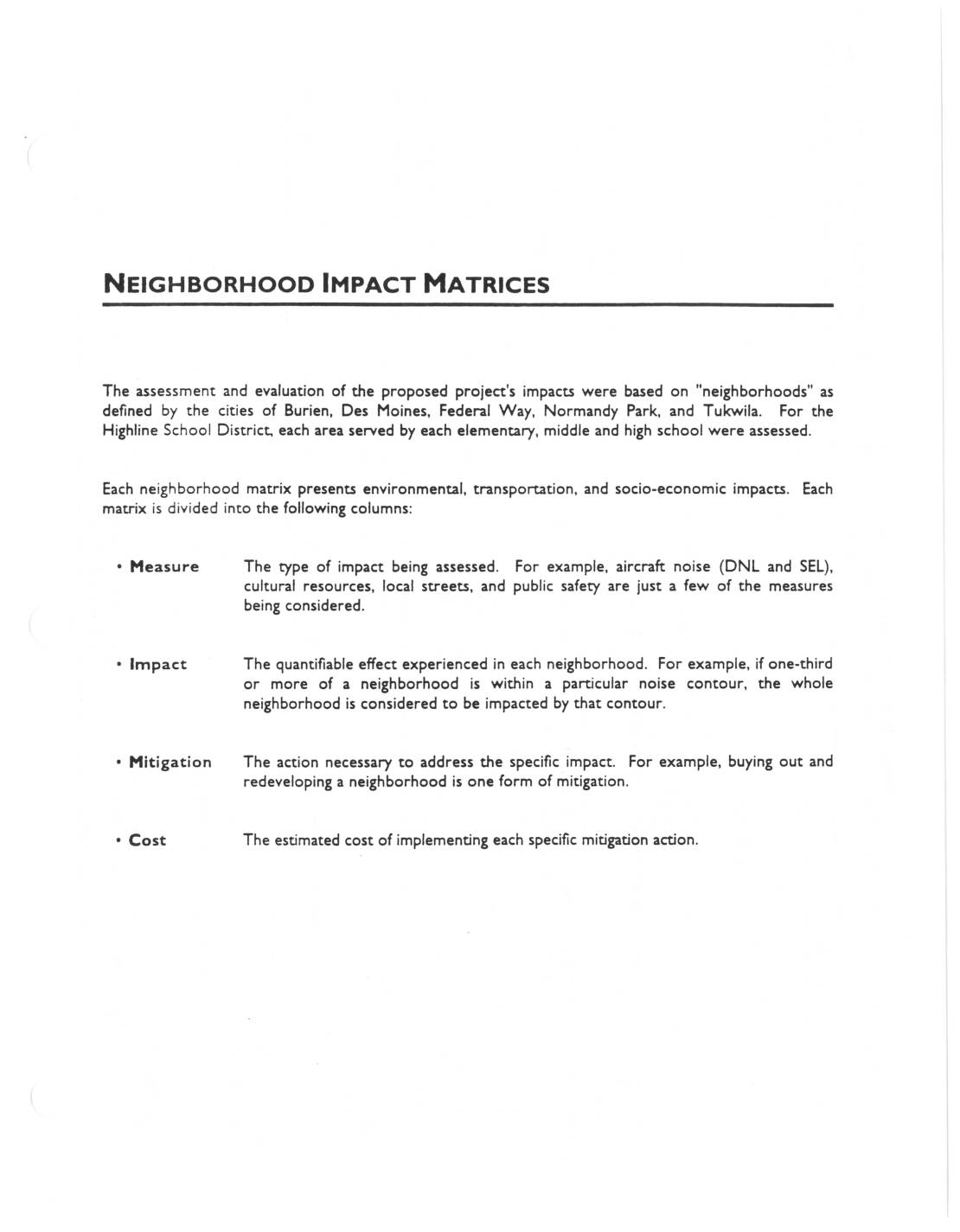
Neighborhood Impact Matrices of proposed Third Runway Raytheon-Thomas/Lane (1996)
The assessment and evaluation of the proposed project's impacts were based on "neighborhoods" as defined by the cities of Burien, Des Moines, Federal Way, Normandy Park, and Tukwila. For the Highline School District, each area served by each elementary, middle and high school were assessed. Each neighborhood matrix presents environmental, transportation, and socio-economic impacts. Each matrix is divided into the following columns: • Measure • Impact • Mitigation • Cost The type of impact being assessed. For example, aircraft noise (DNL and SEL). cultural resources, local streets, and public safety are just a few of the measures being considered. The quantifiable effect experienced in each neighborhood. For example, if one-third or more of a neighborhood is within a particular noise contour, the whole neighborhood is considered to be impacted by that contour. The action necessary to address the specific impact. For example, buying out and redeveloping a neighborhood is one form of mitigation. The estimated cost of implementing each specific mitigation action. NEIGHBORHOOD Et~~ v IRONMENTAL IMPACTS MEASURE ! IMPACT MITIGATION NOISE AND VIBRATION DNL SEL , · ,. ·, 1) 1/3 or more of a neighborhood is in the 65 DNL 11) Buyout and redevelop contour (and higher) 2) 113 or more of a neighborhood is in the 60 to 65 I 2) Easement and insulation DNL contour Neighborhoods within the 400' topographic line that are also within 5 miles of the airport. Easement and insulation 1) $760,000/acre 2) $37,500/acre $37,500/acre ; !::;;!::,~{~'~ ~.;:::'ber of minutes per average annual… -
 1996-10-01 00:00
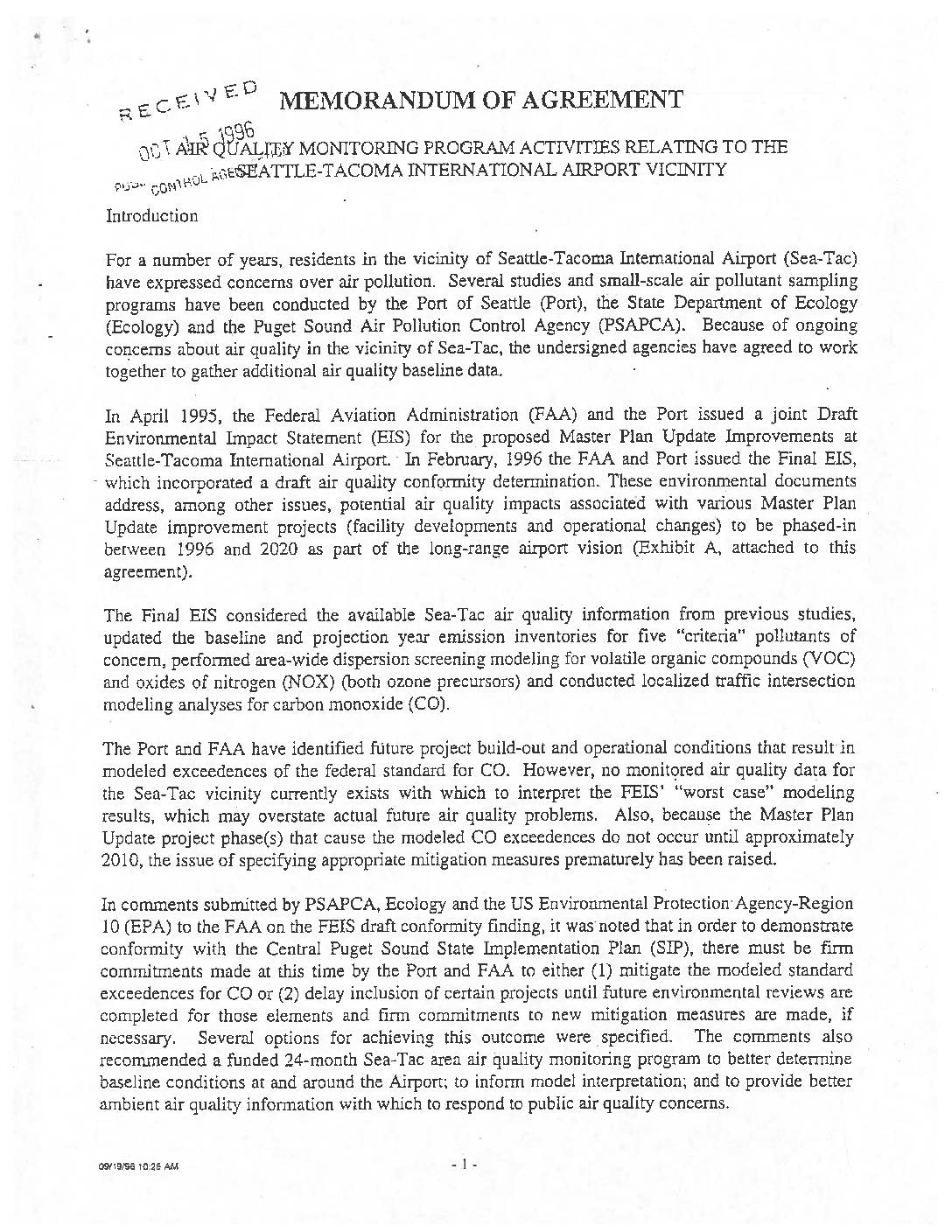
Memorandum Of Agreement Air Quality Monitoring 1996
-
 1996-08-23 10:23
CASE Appeal of Port’s Resolution No. 3212 (Third Runway)
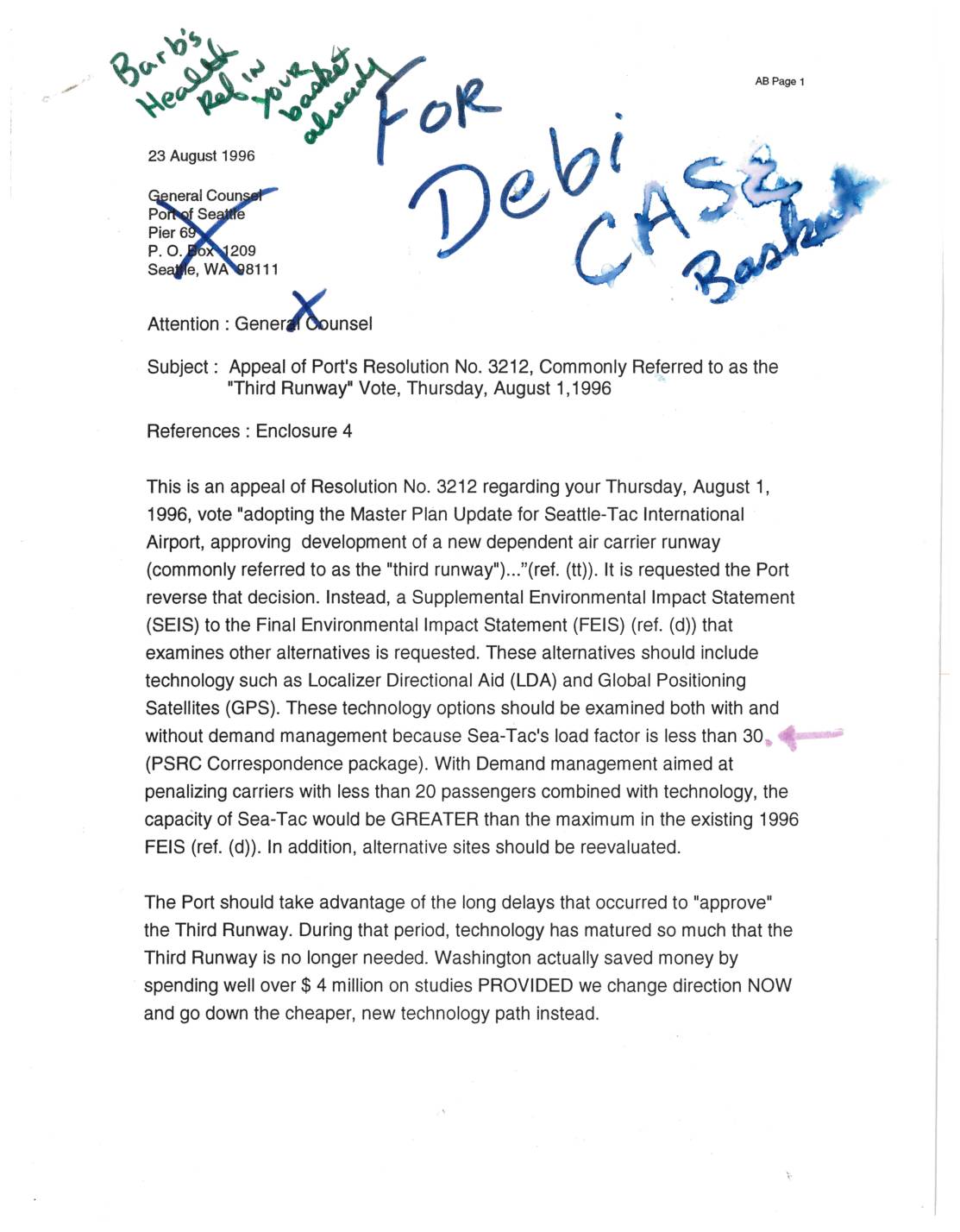
Subject: Appeal of Port's Resolution No. 3212, Commonly Referred to as the "Third Runway" Vote, Thursday, August 1,1996 References: Enclosure 4 This is an appeal of Resolution No. 3212 regarding your Thursday, August 1, 1996, vote "adopting the Master Plan Update for Seattle-Tac International Airport, approving development of a new dependent air carrier runway (commonly referred to as the "third runway") ... "(ref. (tt)) . It is requested the Port reverse that decision. Instead, a Supplemental Environmental Impact Statement (SEIS) to the Final Environmental Impact Statement (FEIS) (ref. (d)) that examines other alternatives is requested. These alternatives should include technology such as Localizer Directional Aid (LOA) and Global Positioning Satellites (GPS). These technology options should be examined both with and without demand management because Sea-Tac's load factor is less than 30• (PSRC Correspondence package). With Demand management aimed at penalizing carriers with less than 20 passengers combined with technology, the capaCity of Sea-Tac would be GREATER than the maximum in the existing 1996 FEIS (ref. (d)). In addition, alternative sites should be reevaluated. The Port should take advantage of the long delays that occurred to "approve" the Third Runway. During that period, technology has matured so much that the Third Runway is no longer needed. Washington actually saved money by spending well over$ 4 million on studies PROVIDED we change direction NOW and go down the cheaper, new technology path instead. .. r · .. '· The Port needs to consider the Air Transport Authority's March 20,1996 statement (ref. (rr)):… -
1996-08-15 00:58
Down-To-Earth Job — Sea-Tac’s Third Runway To Get Its Fill Of Dirt
Jack Broom Seattle Times Staff Reporter Let’s say you’ve been looking for a better view, but you don’t want to leave the neighborhood. Instead, you bring in fill dirt to raise your property so you can see over all your neighbors. Somehow you get the dirt to form a nice column straight up from your -
 1996-06-20 14:58
PSRC Third Runway Decision Process
The purpose of this document is to summarize: (1) the planning that has been undertaken to provide for the long-term commercial air transportation capacity needs of the central Puget Sound Region; (2) air travel demand forecasts and need; and (3) the environmental process for the Council's regional planning decision. 1. Commercial Air Transportation Planning The RASP The first regional aviation plan was completed in the late 1960s and has been updated periodically. The 1988 Regional Airport System Plan (RASP, adopted by the Puget Sound Council of Governments, forerunner to the Regional Council), looked at the components of the regional airport system, and offered a detailed series of recommendations regarding commercial aviation and general aviation. The 1988 RASP recommended that planning be conducted to address commercial aviation needs and then, if needed, adjustments could be made to general aviation capacity at airports that might potentially be impacted by the conclusions and recommendations from the commercial aviation studies. The 1988 RASP recommended that Puget Sound Council of Governments, in cooperation with the Port of Seattle as the operator of Seattle-Tacoma International Airport, should complete a detailed evaluation of the region's long-term commercial air transportation needs. This effort resulted in the Flight Plan Project (1989-92) and subsequent decision processes and studies. The Regional Growth and Transportation Strategy (VISION 2020) adopted in 1990 recognized the 1988 RASP as the interim air transportation element of the Regional Transportation Plan (now called the Metropolitan Transportation Plan) "until a new plan is adopted." (PSCOG Resolution A-90-01). This… -
 1996-03-27 10:21
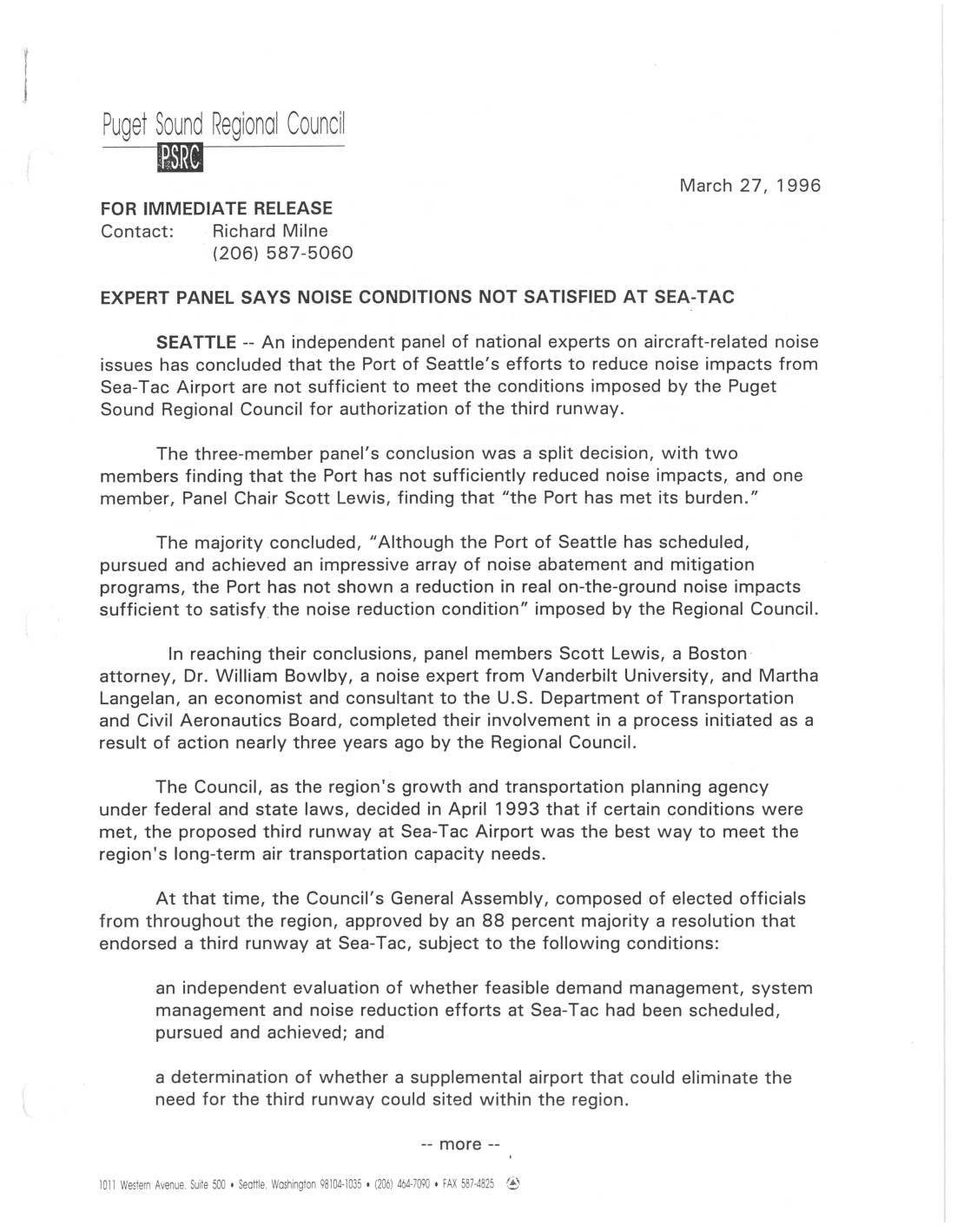
PRSC Press Release Expert Arbitration Panel Noise Mitigation Insufficient 03/27/1996
SEATTLE-- An independent panel of national experts on aircraft-related noise issues has concluded that the Port of Seattle's efforts to reduce noise impacts from Sea-Tac Airport are not sufficient to meet the conditions imposed by the Puget Sound Regional Council for authorization of the third runway. The three-member panel's conclusion was a split decision, with two members finding that the Port has not sufficiently reduced noise impacts, and one member, Panel Chair Scott Lewis, finding that "the Port has met its burden." The majority concluded, "Although the Port of Seattle has scheduled, pursued and achieved an impressive array of noise abatement ·and mitigation programs, the Port has not shown a reduction in real on-the-ground noise impacts sufficient to satisfy the noise reduction condition" imposed by the Regional Council. In reaching their conclusions, panel members Scott Lewis, a Boston · attorney, Dr. William Bowlby, a noise expert from Vanderbilt University, and Martha Langelan, an economist and consultant to the U.S. Department of Transportation and Civil Aeronautics Board, completed their involvement in a process initiated as a result of action nearly three years ago by the Regional Council. The Council, as the region's growth and transportation planning agency under federal and state laws, decided in April 1 993 that if certain conditions were met, the proposed third runway at Sea-Tac Airport was the best way to meet the region's long-term air transportation capacity needs. At that time, the Council's General Assembly, composed of elected officials from throughout the region, approved by an…