TagThird Runway(1084)
-
 2004-03-25
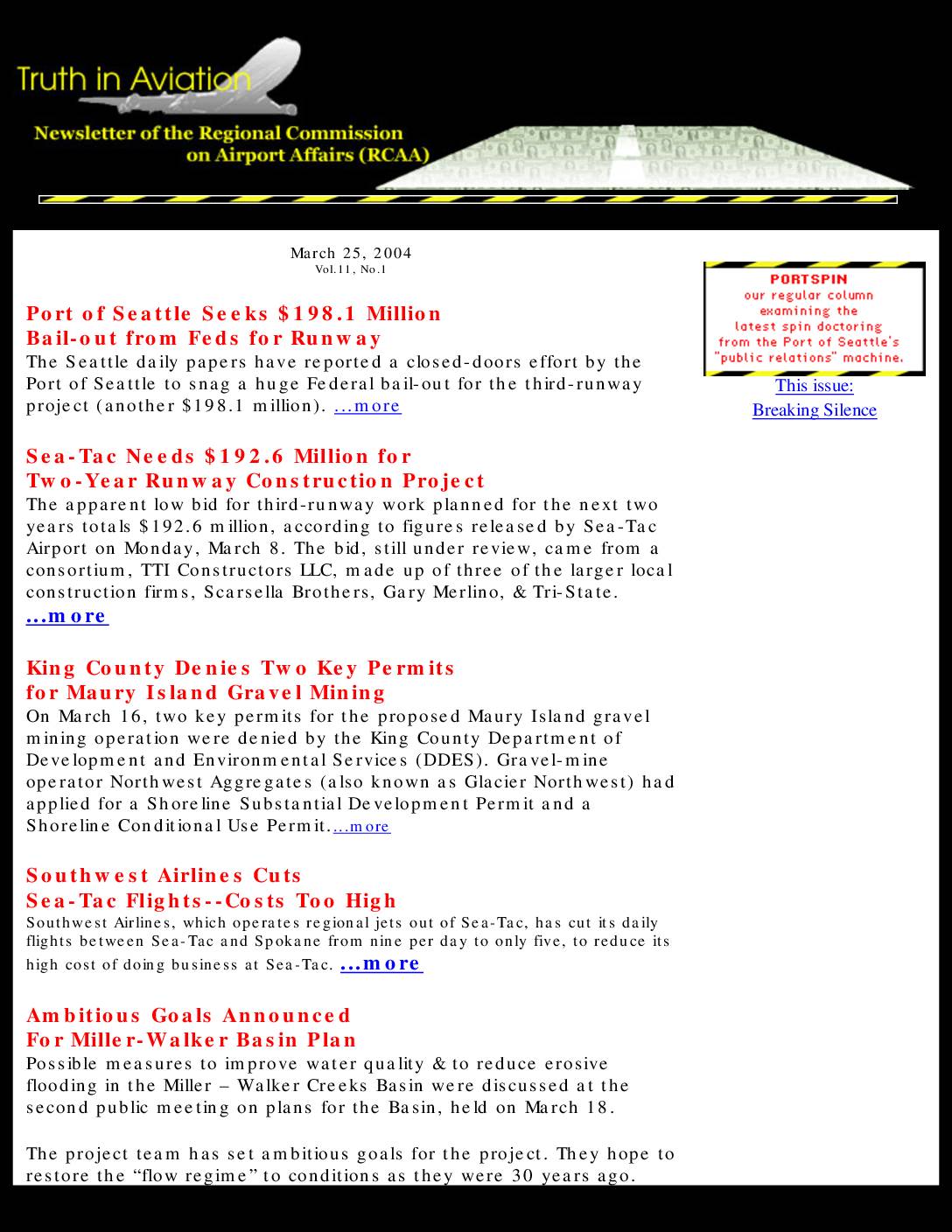
Truth in Aviation newsletter, Vol. 11, No. 1
This March 2004 newsletter from the Regional Commission on Airport Affairs (RCAA) covers several key developments around Sea-Tac Airport, including the Port of Seattle's closed-door attempt to secure a $198.1 million federal bailout for its third-runway project and a $192.6 million construction bid from a local contractor consortium. The newsletter also reports on Southwest Airlines cutting Sea-Tac to Spokane flights due to high operating costs, King County denying two permits for a Maury Island gravel mining operation, and an upcoming public hearing on Boeing Field's Master Plan environmental impact statement. -
 2004-03-19
Declaration of Peter J. Eglick in support of respondent/cross-petitioner Airport Communities Coalition’s emergency motion for injunctive relief pursuant to RAP 8.3
This 2004 legal declaration, filed before the Washington Supreme Court, supports the Airport Communities Coalition's emergency request to halt construction at Seattle-Tacoma International Airport's Third Runway. Attorney Peter J. Eglick argues that the Port of Seattle's approved Work Plan for embankment construction and wetlands filling would cause irreparable environmental harm and violate a Pollution Control Hearings Board order. The filing includes exhibits documenting concerns about contaminated fill materials and requests that the Department of Ecology intervene to stop construction while the case remained under court review. -
2003-11-18
Washington State Supreme Court Oral Arguments Port of Seattle v PCHB
Transcript Origination Notice: Transcriptions are machine-generated and may not have been proofread or corrected. Transcriptions are reference, search and assistive in nature only and are NOT an official transcript of this video 00:00:00.530 — Next on t.v. debut the Washington State Supreme Court listens to oral arguments in the case of Port of Seattle -
 2003-09-01
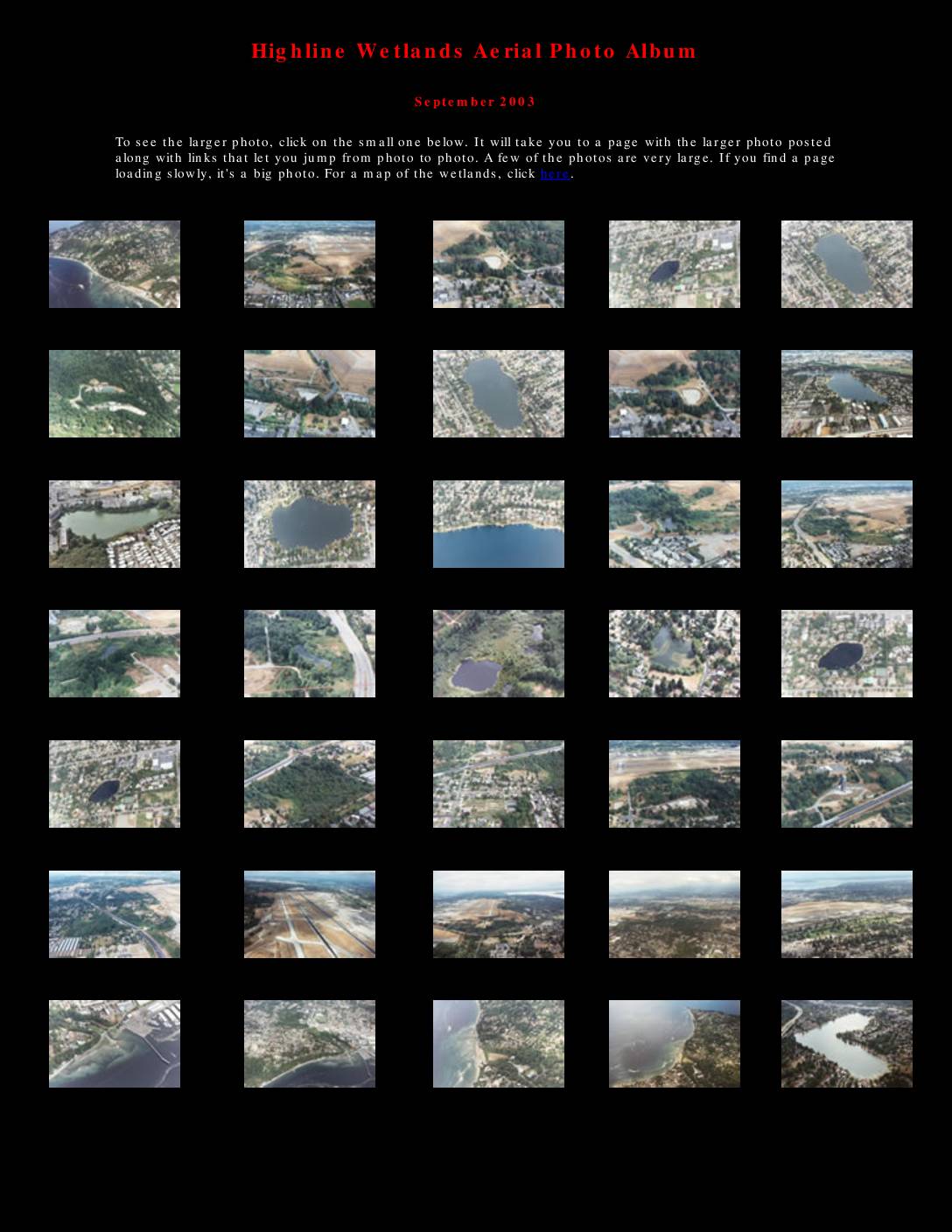
Highline Wetlands aerial photo album
The Highline Wetlands Aerial Photo Album, compiled in September 2003, presents a collection of aerial photographs documenting wetlands, lakes, and waterways in the Sea-Tac Airport area of Washington State. The album covers locations including Miller Creek, Walker Creek, Lake Burien, Angle Lake, and other water resources affected by the proposed Third Runway construction at Seattle-Tacoma International Airport. An accompanying map illustrates the runway's projected impact on local water resources, identifying proposed fill areas and the third runway site relative to surrounding communities such as Burien, Normandy Park, and Des Moines. -
 2003-08-26
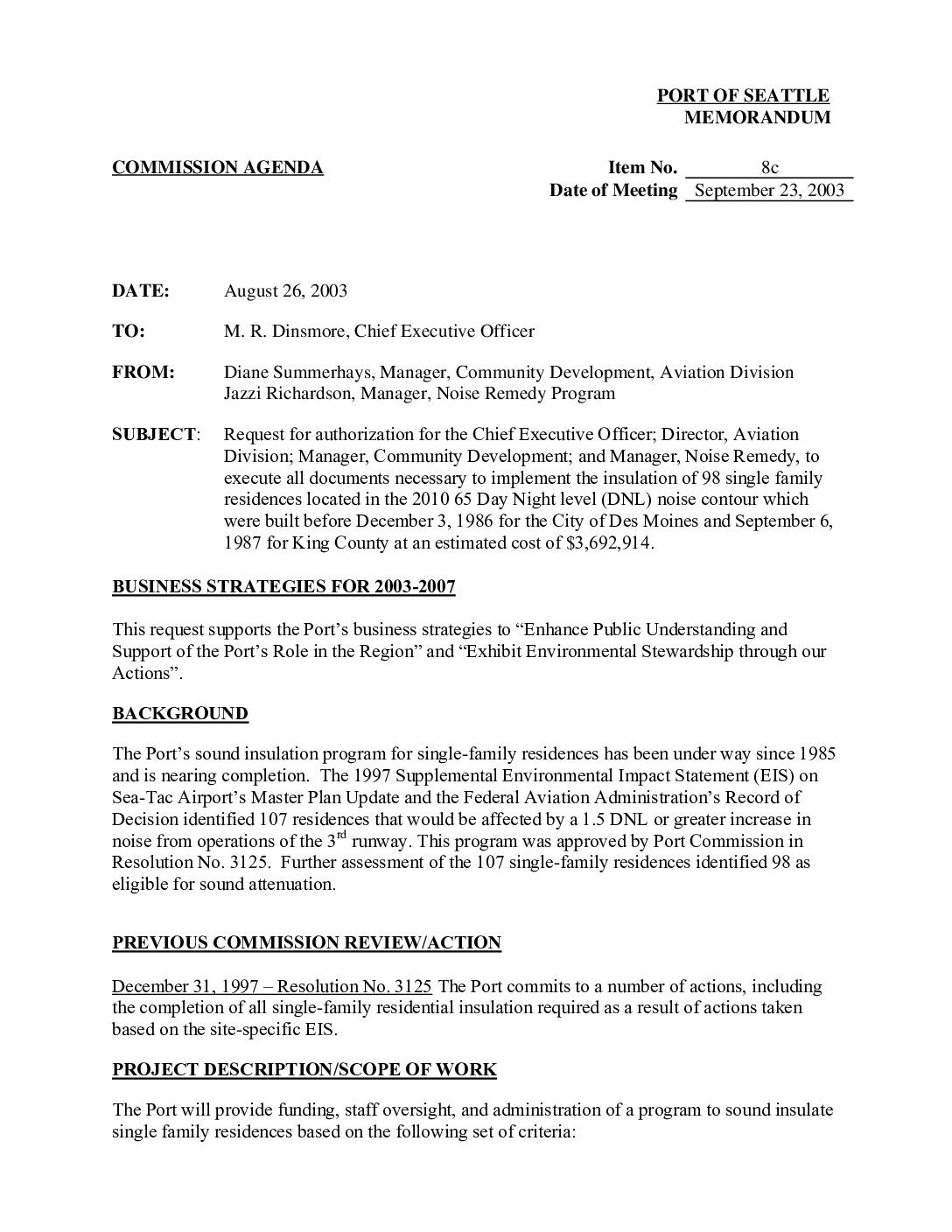
Request for authorization to implement sound insulation of 98 single family residences in the 2010 65 DNL noise contour
In September 2003, the Port of Seattle Commission considered authorizing a $3.69 million program to sound-insulate 98 single-family homes near Sea-Tac Airport that fell within the projected 2010 65 DNL noise contour and were built before local noise codes took effect. The project, stemming from a 1997 Environmental Impact Statement related to the airport's third runway, aimed to reduce interior noise levels by at least 5 decibels in eligible homes in Des Moines and unincorporated King County. Funding was to come primarily from federal Airport Improvement Program grants (80%), with the remainder drawn from the Airport Development Fund, and homeowners were required to grant the Port an avigation easement in exchange for the insulation work. -
Airport Communities Coalition v. Graves, 280 F. Supp. 2d 1207 (W.D. Wash. 2003)
U.S. District Court for the Western District of Washington – 280 F. Supp. 2d 1207 (W.D. Wash. 2003) August 18, 2003 280 F. Supp. 2d 1207 (2003) AIRPORT COMMUNITIES COALITION, Plaintiff, v. Colonel Ralph H. GRAVES, Commander and District Engineer of the Seattle District, United States Army Corps of Engineers; United States Army Corps of -
 2003-08-18
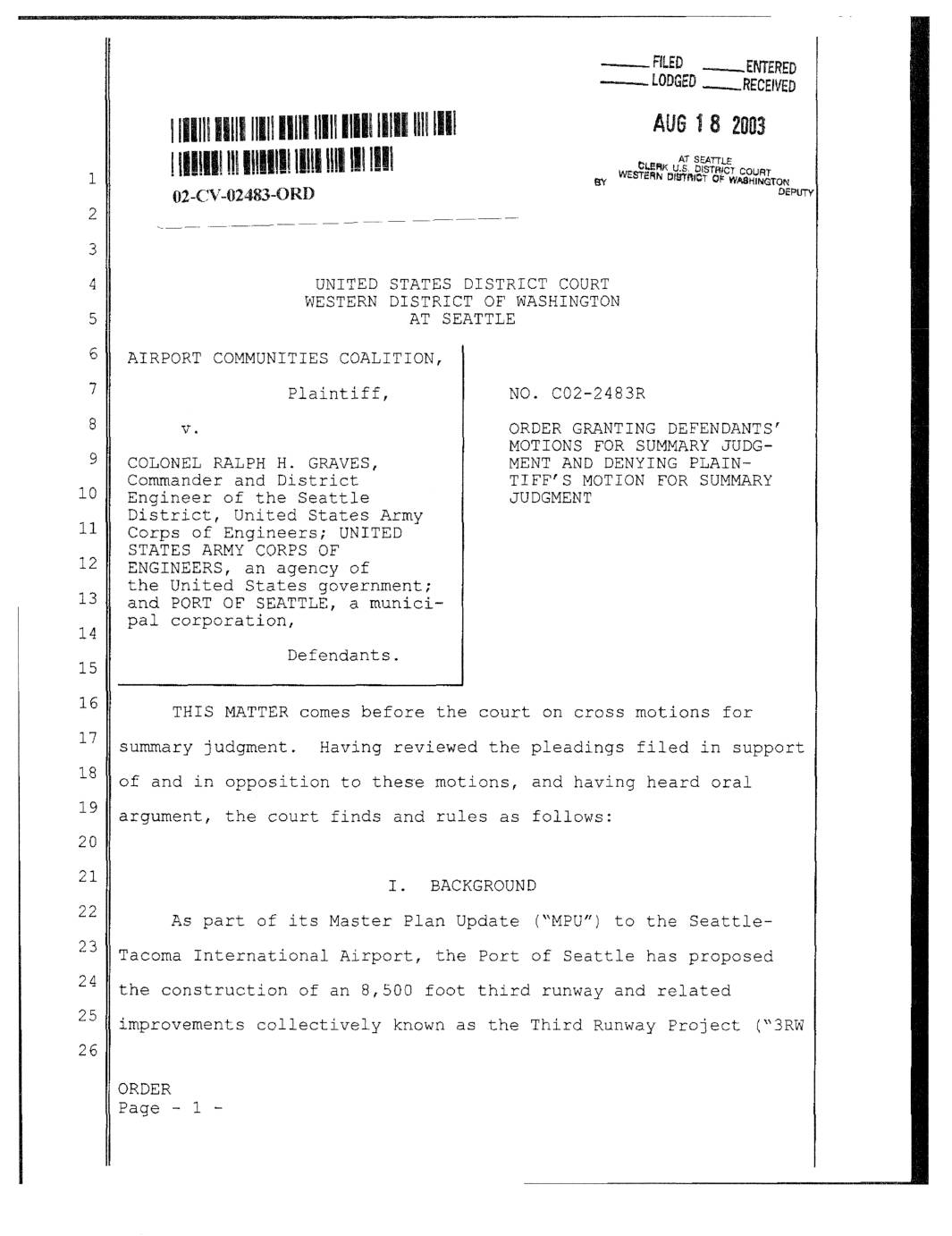
Order granting defendants’ motions for summary judgment and denying plaintiff’s motion for summary judgment
A federal court ruled in favor of the U.S. Army Corps of Engineers and the Port of Seattle, rejecting a legal challenge by the Airport Communities Coalition — a group of cities near Sea-Tac Airport — over a Clean Water Act permit issued in December 2002 for the airport's Third Runway Project. The permit authorizes filling approximately 50 wetlands with over 23 million cubic yards of material to support construction of a new 8,500-foot runway. The court found the Corps' decision was not arbitrary or capricious under the Administrative Procedures Act's standard of review. -
 2003-08-18
Airport Communities Coalition v. Graves, 280 F. Supp. 2d 1207 (W.D. Wash. 2003)
A U.S. District Court ruling from August 18, 2003, in the Western District of Washington at Seattle, in which Judge Rothstein granted defendants' motions for summary judgment and denied plaintiff's motion. The case involved the Airport Communities Coalition suing Colonel Ralph H. Graves and the U.S. Army Corps of Engineers, along with the Port of Seattle, relevant to Sea-Tac Airport development and permitting issues. -
 2003-07-22
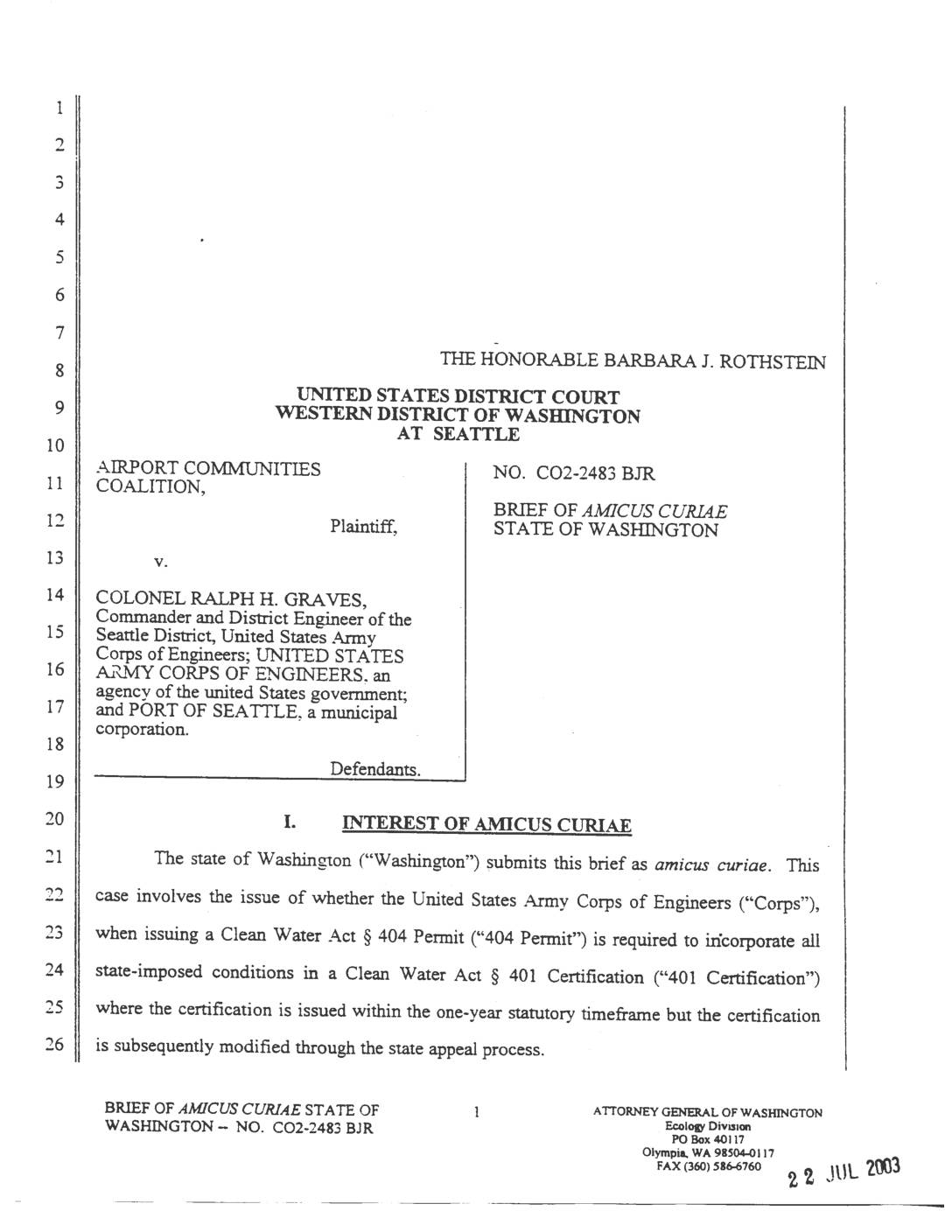
Brief of amicus curiae State of Washington
The State of Washington filed a friend-of-the-court brief in a 2003 federal case concerning the Port of Seattle's proposed third runway at Seattle-Tacoma International Airport. The case centered on whether the U.S. Army Corps of Engineers was required to include all conditions set by the Washington State Department of Ecology in its Clean Water Act Section 404 permit, after a state appeals board added sixteen conditions to the original water quality certification. Washington argued that federal law gives states sole authority to enforce their own water quality standards on federally permitted projects, and that the Corps improperly ignored nine of those sixteen conditions. -
IN RE: the RECALL Charges Against City of Des Moines Mayor Donald WASSON
Supreme Court of Washington,En Banc. IN RE: the RECALL Charges Against City of Des Moines Mayor Donald WASSON, Councilmember Richard Benjamin, Councilmember Gary Peterson and Councilmember Maggie Steenrod. No. 73036-9. Decided: July 10, 2003 David H. Middleton & Associates PS, David Middleton, Federal Way, for appellant. Des Moines City Attorney’s Office, Linda Marousek, Asst., Des