Skip to content
  • STNI
  • Statistics
    • Ops and Passengers
      • King County International Airport (Boeing Field) Annual Operations
    • Financials
    • Aviation fuel uplift in the State of Washington 2018 – 2025
      • Aviation Fuel Uplift at Sea-Tac Airport
    • Air Quality Monitoring
    • Flight Tracking
      • Flow and Flight Tracks
      • Five Year Comparison
      • Busiest Hours and Days
    • SEL Noise Reports & Graphs
      • About The Permanent Noise Monitors
      • Minutes of Quiet by Noise Monitor
      • Noise Events mapped
      • Noise Events (SEL)
    • Runways
    • Employees
    • Real Estate
      • Port Properties and Trees mapped
    • Parking
  • Events
  • Protest
    • Regular Events
    • Legislation 2026
    • Complain about a particular flight
    • Advocacy Organizations
    • Media Outlets
    • People
    • The Port of Seattle
      • Commission Meetings
      • Public Records Requests
      • StART
      • Highline Forum
    • Contact Your Electeds
  • Resources
    • FAQs
      • FAA Occurrences/Accidents/Indents
    • The unSustainable Airport Master Plan
      • SAMP Public Comment Template
        • Two versions of Appendix K: NEPA/SEPA 2018 vs 2023
      • SAMP NTP: 31 projects by the numbers
      • SEPA Draft EIS (2026)
      • SAMP Record of Decision/FONSI (2025)
      • SAMP Draft EA (October 2024)
      • 2018 Scoping
    • Port Packages
      • Port Package Property Costs
      • Port Packages mapped
      • The Port Package Explainer
      • So you want a (first-time) Port Package? Start here
      • Port Package Looker Upper
      • How do I determine if I have a Port Package or Avigation Easement?
      • Progress on Port Package Update legislation
      • Having a Port Package Problem?
      • Port Package Site Visit Follow-Up
    • Document Library
    • Explainers
      • The Airport Law Cheat Sheet
      • The Grant Explainer
    • External Articles
    • History
      • Timeline
      • The Sea-Tac Communities Plan
        • Sea-Tac Communities Plan – Planning Maps
      • PSRC Third Runway Decision Process
    • Studies
    • Videos
  • Stories
  • Mission
  • Subscribe
  • Contact
Scroll down to content

Get InformedStay Informedx

I understand that you will never share my information with anyone, you will only use it to keep me updated on relevant events and that I may unsubscribe at any time.

STNI

STNISea-Tac Noise.Info

  • Solve for Sea-Tac. Solve for every airport.
  • Since 2016, working to obtain justice for everyone living under the flight path.
  • Less Noise. Cleaner Air. Better Public Health. Compensation.
  • Everything you think you know about the airport is wrong.

TagStormwater(385)

Advanced Search Options

  • Dates
  • Media
    • External Articles
    • Images
    • PDFs
    • Video
    • Audio
  • Order By
  • 1998-07-06

    EXH AR024740: Internal Email — Section 4.3 Water Quality Facilities, Stormwater Mgmt RP

    A 1998 internal email exchange between Ken Ludwa and Kerry Ritland discusses edits to Section 4.3 of a stormwater management report related to Sea-Tac Airport. The section covers water quality facilities, explaining that new stormwater detention facilities would follow state Ecology guidelines using biofiltration and permanent water quality storage, while also complying with the Port's NPDES permit and Stormwater Pollution Prevention Plan (SWPPP). Ken Ludwa agreed to edit the section to reference Appendix F – Water Quality BMP Analysis once that appendix was further developed.
    TagsACC, NPDES, Pollution Control Hearings Board, Port Of Seattle, Stormwater, Third Runway, Water Quality
  • 1998-07-01

    EXH AR024741: Cost Figures StormFilter System — Email Ludwa to Fendt

    A July 1, 1998 internal email from Ken Ludwa to Paul Fendt outlines preliminary cost estimates for a StormFilter stormwater treatment system, based on a discussion with a VP of Stormwater Management. A 100 cfs system handling approximately 4,700 cartridges would cost roughly $2.3 million to design and build, while an 80 cfs system would cost approximately $1.8 million to build with $150,000 annually for cartridge replacement. Cartridge costs vary depending on total suspended solids (TSS) levels and rainfall, as cartridges are replaced on an as-needed basis.
    TagsACC, PCHB, Pollution Control Hearings Board, Stormwater, Third Runway
  • 1998-07-01

    EXH AR003158: Memorandum — Results of Reasonable Potential Analysis for STIA Third Runway Stormwater

    Memorandum from Ken Ludwa (Parametrix, Inc.) to Paul Fendt dated July 1, 1998, project number 55-2912-01, describing results of a Reasonable Potential Analysis (RPA) for the STIA Third Runway area stormwater runoff. Analysis conducted at a working meeting with Lisa Zinner (Ecology), Lori Terry (Preston, Gates, and Ellis), Tom Hubbard (POS), John Rogers (CH2M Hill),
    TagsACC, Miller Creek, NPDES, Pollution Control Hearings Board, Stormwater, Third Runway, Water Quality
  • 1998-07-01

    EXH AR033659: Preliminary Comprehensive Stormwater Management Plan for Sea-Tac Airport Master Plan Improvements — Appendix F: Stormwater Quality Management Plan

    Draft Stormwater Quality Management Plan (Appendix F) prepared by Parametrix, Inc. for Port Of Seattle, July 1998, as part of the Preliminary Comprehensive Stormwater Management Plan for Sea-Tac Airport Master Plan Improvements. Covers existing drainage conditions including Storm Drain System (SDS) and Industrial Waste System (IWS), Miller Creek and Des Moines Creek receiving systems, existing
    TagsACC, Pollution Control Hearings Board, Port Of Seattle, Sea-Tac Airport, Stormwater, Third Runway, Water Quality
  • 1998-07-01

    EXH AR024691: Memo — Reasonable Potential Analysis Results, STIA Third Runway

    A July 1, 1998 memorandum from Parametrix, Inc. summarizes the results of a Reasonable Potential Analysis (RPA) conducted for the Seattle-Tacoma International Airport (STIA) Third Runway project, assessing stormwater runoff quality against water quality criteria for Miller Creek and Des Moines Creek. The analysis found that most pollutant concentrations after treatment with best management practices (BMPs) such as bioswales, sand filters, and wet ponds would meet criteria, with the exception of copper, which remained above acceptable levels. The memo also notes that during storms, pollutant concentrations already present in the receiving waters exceeded criteria and were higher than those predicted from Third Runway stormwater runoff.
    TagsACC, Miller Creek, NPDES, Pollution Control Hearings Board, Stormwater, Third Runway, Water Quality
  • 1998-07-01

    EXH AR026404: Memo — Reasonable Potential Analysis Results, STIA Third Runway

    A 1998 internal memo from Parametrix, Inc. summarizes the results of a Reasonable Potential Analysis (RPA) conducted for the Seattle-Tacoma International Airport (STIA) Third Runway project, assessing whether stormwater runoff from the new runway could exceed water quality criteria in Miller Creek and Des Moines Creek. The analysis found that most pollutant concentrations after treatment with best management practices (BMPs) such as bioswales, sand filters, and wet ponds would meet criteria, with the exception of copper, which remained above acceptable levels. The memo also notes that existing pollutant concentrations in the receiving waterways during storms already exceeded criteria, even before accounting for Third Runway runoff.
    TagsACC, Des Moines Creek, Miller Creek, NPDES, Pollution Control Hearings Board, Stormwater, Third Runway
  • 1998-06-30

    EXH AR024742: Email — Compost Filter Info for Stormwater Management

    A June 30, 1998 email from John Rogers of CH2M to Thomas Hubbard and Ken Ludwa provides a website link (www.stormwatermgt.com) for a compost filter vendor, noting the company had recently changed its name. Rogers mentions that the vendor would be sending additional product information by overnight mail and water quality data by fax the following day. The correspondence relates to stormwater management and water filtration research being conducted in connection with Port of Seattle operations.
    TagsACC, PCHB, Pollution Control Hearings Board, Stormwater, Third Runway, Water Quality
  • 1998-06-30

    EXH AR024744: Email Ludwa to Kelley with BMP Removal Efficiency Data (Bmps.xls)

    A June 1998 internal email from Ken Ludwa to Jim Kelley includes spreadsheet data comparing removal efficiency percentages for various pollutants—including solids, phosphorus, nitrogen, BOD, iron, lead, zinc, copper, bacteria, and total petroleum hydrocarbons—across multiple published studies from the 1980s and 1990s. The tables compile findings from sources such as Marselek et al. (1996), Metro (1992), and the UW Short Course, and conclude with recommended removal efficiency values for each pollutant category. This document appears to relate to Best Management Practices (BMPs) for stormwater treatment, likely in the context of environmental review for airport-related runoff management.
    TagsACC, PCHB, Pollution Control Hearings Board, Stormwater, Third Runway
  • 1998-02-20

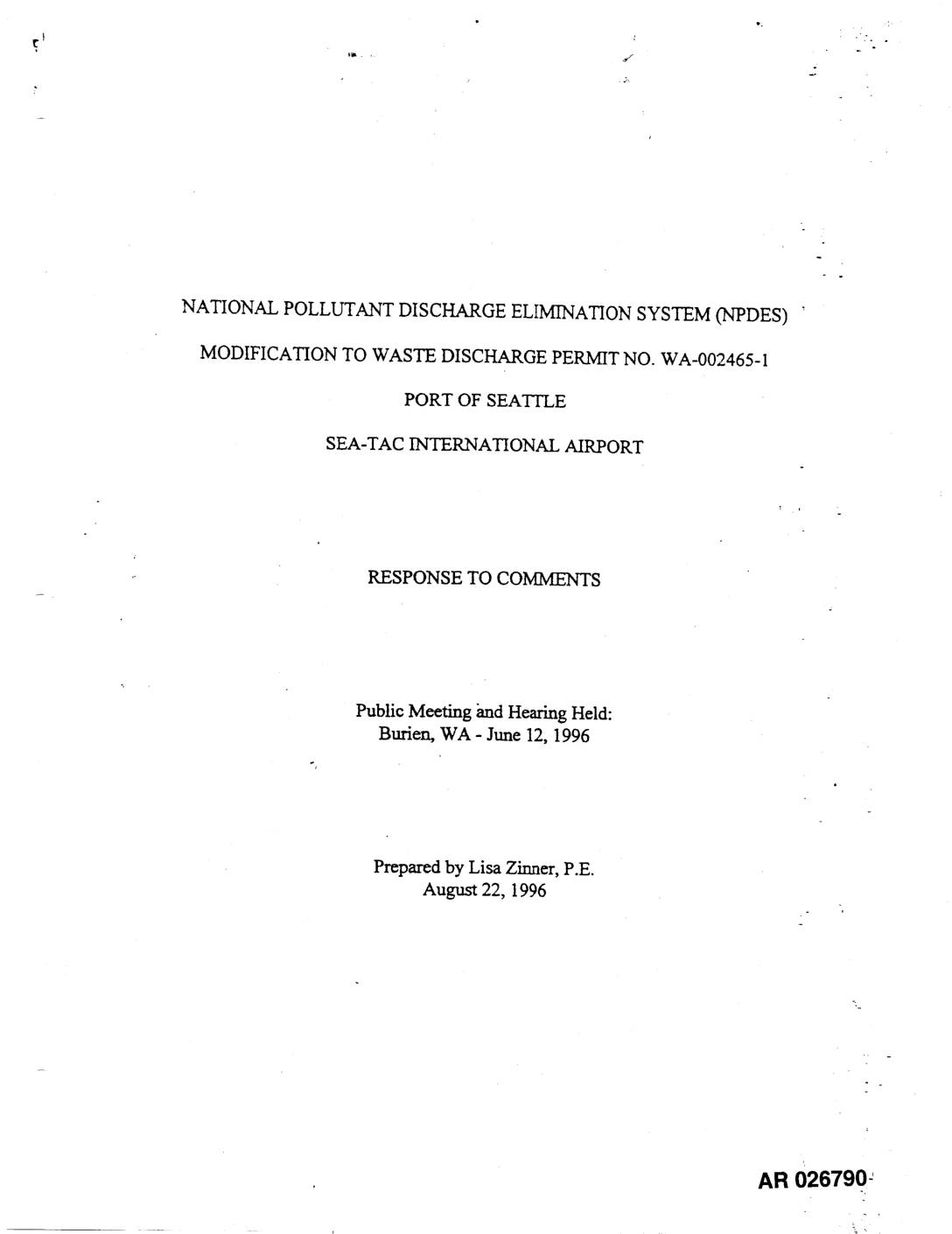
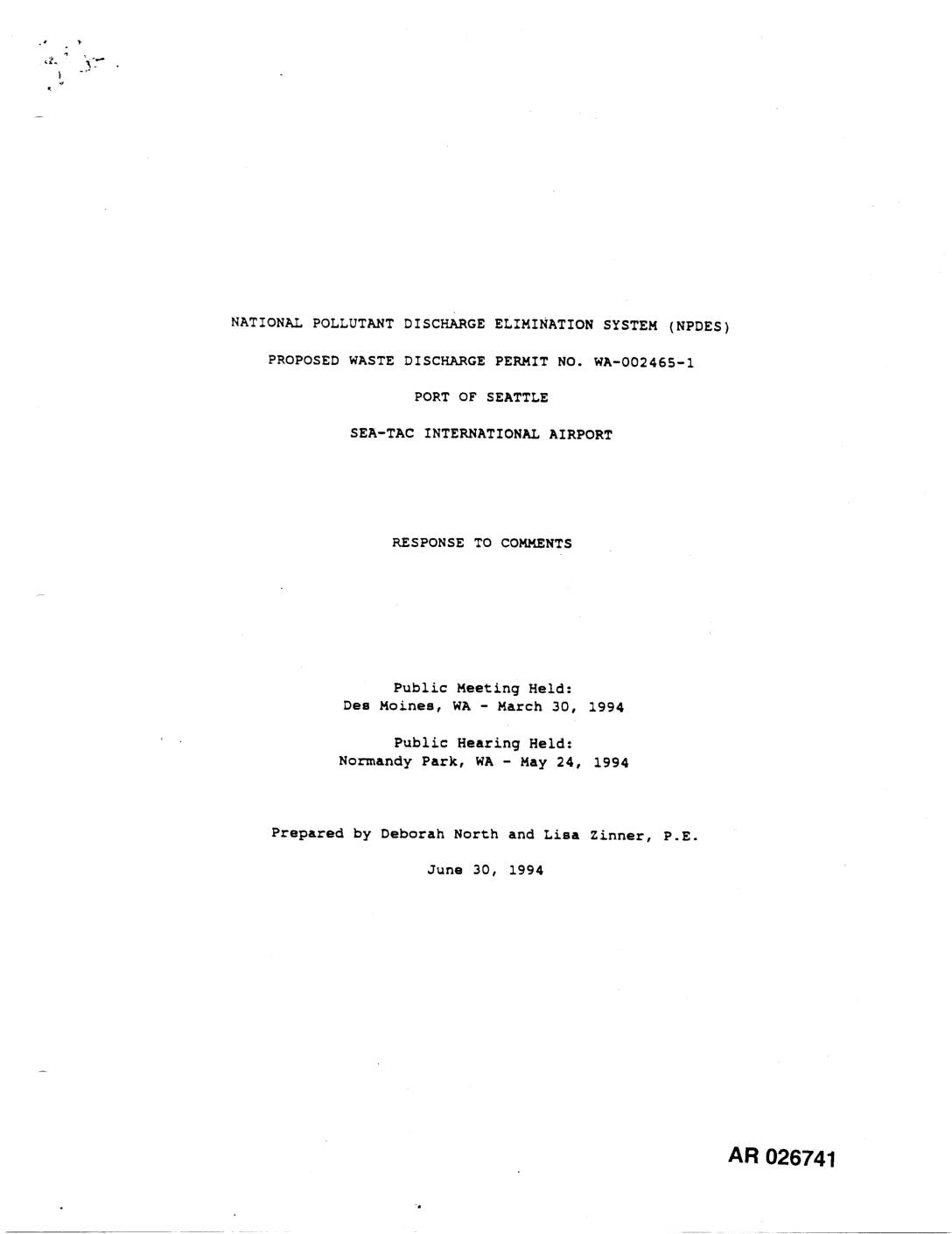
    EXH AR041460: NPDES Waste Discharge Permit No. WA-002465-1 — Port Of Seattle, Sea-Tac Airport

    NPDES Waste Discharge Permit No. WA-002465-1 issued by Washington State Department of Ecology (Northwest Regional Office) to Port Of Seattle for Seattle-Tacoma International Airport, King County, WA. Permit covers industrial wastewater discharge to Puget Sound (Outfall 001), stormwater discharges to Des Moines Creek (Outfalls 002-005, 009, 010, 014, 015), Miller Creek (Outfalls 006-008, 011), City
    TagsACC, NPDES, Pollution Control Hearings Board, Port Of Seattle, Sea-Tac Airport, Stormwater, Water Quality
  • 1998-02-20

    EXH AR17043: NPDES Waste Discharge Permit No. WA-002465-1 — Port Of Seattle, Sea-Tac Airport

    NPDES Waste Discharge Permit No. WA-002465-1 issued by Washington State Department of Ecology (Ecology) to Port Of Seattle for Seattle-Tacoma International Airport, effective March 1, 1998, expiring June 30, 2002. Authorizes discharge of industrial wastewater to Puget Sound (Outfall 001) and stormwater to Des Moines Creek (Outfalls 002-005, 009, 010, 014, 015), Miller Creek (Outfalls
    TagsACC, Clean Water Act, Ecology, NPDES, Pollution Control Hearings Board, Port Of Seattle, Stormwater

Posts pagination

Page 1 … Page 35 Page 36 Page 37 Page 38 Page 39
Sidebar On/Off

Upcoming Events

  • StART SEA Stakeholder Advisory Round Table
    Add to CalendarMWednesday Aug 26, 5:00pm - 7:00pm
    Zoom (Virtual Meeting)
    START meetingagenda 2026826 final 0 pdf

    Meeting Objectives Introduce the primary feedback themes identified by StART members regarding StART’s Operating Procedures and determine areas that may warrant future discussion. 5:00 PM – Welcome Meeting Management Welcome Lead: Andrés Mantilla, Facilitator, Uncommon Bridges; Wendy Reiter, Airport Managing Director, POS 5:15 PM – Dinner: All participants eat. 5:30 PM – StART Operating Procedures

    [...]
  • Commercial Aviation Work Group
    Add to CalendarMThursday Sep 3, 10:00am - 1:30pm
    Virtual Meeting (Zoom)
    Cawg agenda sep 3 26 virtual pdf

    Meeting Agenda 10:00 a.m. – 10:15 a.m. | Welcome – Evan Nordby, Chair a. Introductions and Agenda Reviewb. Status of appointments and non-voting member invitationsc. Other updates as necessary 10:15 a.m. – 11:00 a.m. | Is it practical and legal to operate the western Washington [Puget Sound] airports as a single airport system? – Consultant

    [...]

[See all...]


Help study childhood asthma. Get free HEPA filter!

read more...

Issues

Sea-Tac Airport is currently undergoing the largest and longest expansion in its history, collectively known as the Sustainable Airport Master Plan (SAMP). Some of it you can already hear, but you’re probably not aware of what it all means. Here’s what you need to know.
read more...

Read This!

As the source for federal transportation grants, the Puget Sound Regional Council was charged with developing a system to meet the growing need for commercial aviation. When the search for a second airport failed, they authorized the Port of Seattle to build the Third Runway, with a mandate to develop a noise abatement and mitigation program. In their effort to stop the Third Runway, the ACC argued over every detail of the Port's efforts--including property buyouts and sound insulation. The dispute was meant to be settled by a three member Expert Arbitration Panel. This is their final report. It finds 2-1, that the Port's program was insufficient in several respects. Despite that, funding for the Third Runway was approved by the PSRC, and the 'Port Package' program, proceeded largely unchanged. Expert Arbitration Panel's final decision finding that the Port of Seattle had not shown sufficient reduction in real on-the-ground noise impacts to satisfy noise reduction conditions required for approval of a third runway at Sea-Tac International Airport. The majority decision concluded the Port's noise abatement programs were insufficient despite being impressive in scope.
continue...

The Podcast!

Subscribe to the only podcast devoted to policies, politics, history, impacts for people living under the flight path everywhere. It’s definitely not just about noise!
  • Sea-Tac Noise.Info
  • Connect with STNI

    • Subscribe
    • Port Package Problem?
    • Donate
    • Podcast
    • Socials
      • Facebook
      • X (Twitter)
      • Bluesky
      • Instagram

    "PCHB Doc 01-133/01-160: Ecology Statement of Issues, Preliminary Witness and Exhibit List — ACC v. Ecology and Port Of Seattle" — , 2001

  • Learn

    • Frequently Asked Questions
    • Explainers
    • Youtube
    • Research Requests
    • Make a complaint
  • Goals

    Fulfill the promises of 1976:
    • Compensation
    • Reduced noise
    • Improved air quality
    • Environmental remediation
Login/Register
©2026•Data Privacy

Message

We use cookies to provide basic functionality. We also provide access to search engines in order to provide site analytics. We do not sell or share your data.
V V