TagState of Washington(113)
-
 2001-02-01
EXH AR026134: Guidelines Preparing Quality Assurance Project Plans Environmental Studies
This Washington State Department of Ecology publication, authored by Stewart M. Lombard and Cliff J. Kirchmer and released in February 2001, provides guidelines for preparing Quality Assurance Project Plans (QAPPs) for environmental studies. It outlines standards and procedures to ensure that data collected during environmental investigations meets defined quality and reliability requirements. -
 2001-01-01
EXH AR032664: Water Quality Program Permit Writer’s Manual
Washington State Department of Ecology Water Quality Program Permit Writer’s Manual, Publication Number 92-109, revised January 2001, prepared by Gary Bailey. Covers NPDES permit writing procedures and water quality standards for Washington State. AR 032664, Exhibit-2077. -
 2000-06-01
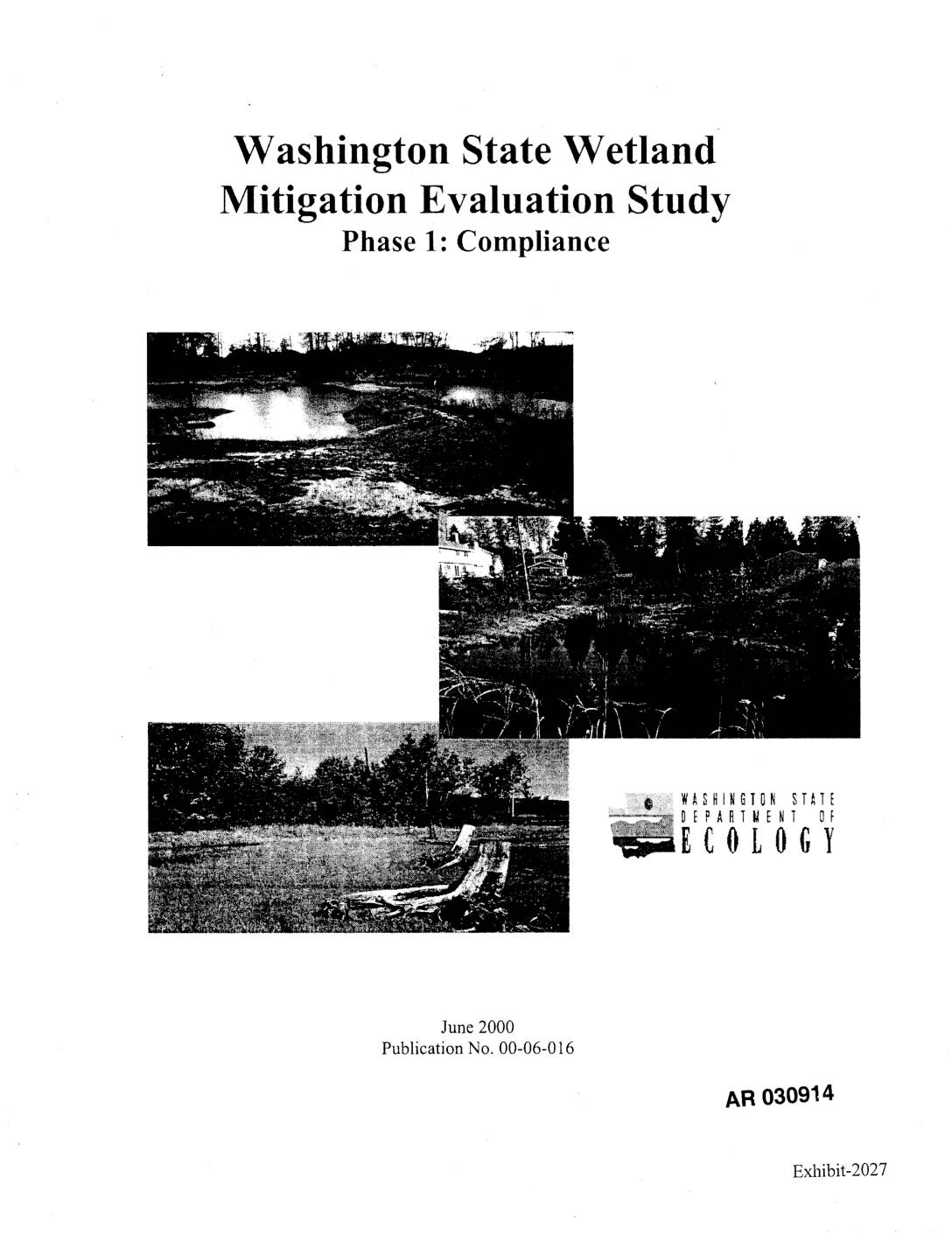
EXH AR030914: Washington State Wetland Mitigation Evaluation Study, Phase 1: Compliance
Washington State Department of Ecology (Ecology) Publication No. 00-06-016, authored by Patricia A. Johnson, Dana L. Mock, Emily J. Teachout, and Andy McMillan. Phase 1 compliance study of wetland mitigation in Washington State, published June 2000 by the Shorelands & Environmental Assistance Program, Lacey, WA. Exhibit-2027, AR 030914. -
 2000-02-10
EXH AR034771: State of Washington Alternative Mitigation Policy Guidance for Aquatic Permitting Requirements from the Departments of Ecology and Fish and Wildlife
State of Washington interagency policy guidance (AR 034771, Exhibit 2193) adopted by Washington Department of Fish and Wildlife (WDFW) and Washington Department of Ecology (WDOE) for evaluating aquatic mitigation alternatives under section 401 of the Clean Water Act, the Shoreline Management Act (RCW 90.58), and the Hydraulic Code (RCW 75.20). Covers mitigation sequencing (avoiding, minimizing, -
 1998-11-25
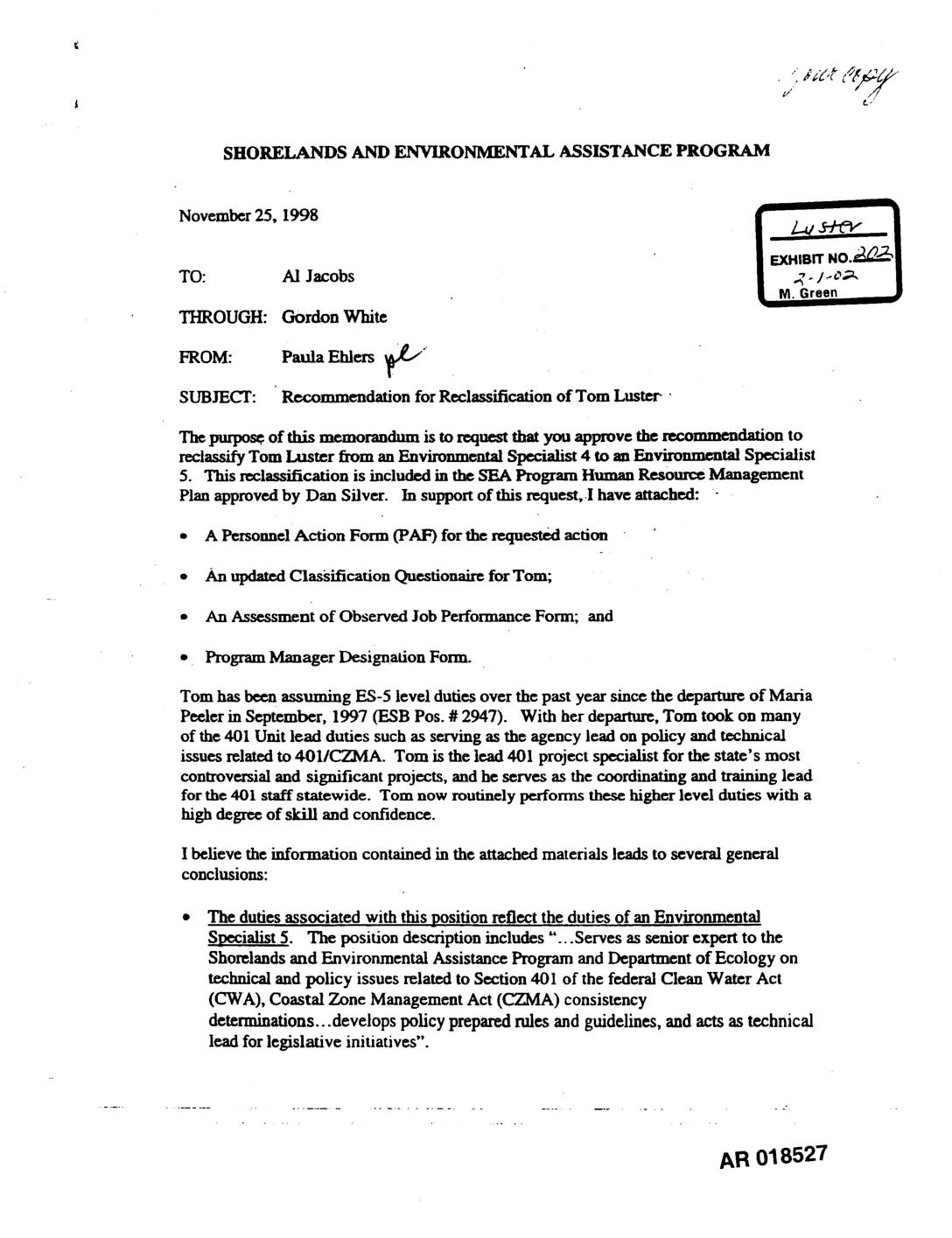
Exhibit 202: Recommendation for Reclassification of Tom Luster — Shorelands and Environmental Assistance Program
A 1998 internal memorandum from Washington State's Shorelands and Environmental Assistance Program recommends reclassifying employee Tom Luster from Environmental Specialist 4 to Environmental Specialist 5, citing his assumption of higher-level duties following a colleague's departure in 1997. Luster's qualifications, including a Master's degree in Geography and over 10 years of experience, along with the cost-neutral budget impact, are presented as justification for the upgrade. -
 1998-04-01
EXH AR030867: How Ecology Regulates Wetlands
Washington State Department of Ecology publication (No. 97-112, April 1998), authored by Andy McMillan of the Shorelands & Environmental Assistance Program. Introduces regulatory authority over wetlands, wetland definitions and delineation, wetland characterization and function assessment, wetland mitigation, and buffers. Covers Washington State wetland regulation under state law, published by Ecology’s Shorelands & Environmental Assistance Program, -
 1998-02-01
EXH AR041523: Washington State Department of Ecology Water Quality Program — Whole Effluent Toxicity (WET) Program Evaluation
Whole Effluent Toxicity (WET) Program Evaluation prepared by Randall Marshall, WET Coordinator, Washington State Department of Ecology Water Quality Program, February 1998 (Publication #98-03). Evaluates implementation of Washington State’s WET regulation adopted October 1993, covering WET test review, effluent toxicity data, the state’s WET rule (WAC), EPA WET policy, SETAC Pellston Workshop (September 1995), EPA -
 1997-03-31
EXH AR040438: Laboratory Guidance and Whole Effluent Toxicity Test Review Criteria
Washington State Department of Ecology, Water Quality Program publication WQ-R-95-80 (revised March 1997) titled ‘Laboratory Guidance and Whole Effluent Toxicity Test Review Criteria.’ Provides laboratory guidance and whole effluent toxicity (WET) test review criteria. Published by Ecology, printed on recycled paper, available through the Department of Ecology Publications Distribution Center, Olympia, WA 98504-7600. Document held -
 1996-04-01
EXH AR030803: Water Quality Guidelines for Wetlands — Using the Surface Water Quality Standards for Activities Involving Wetlands
Washington State Department of Ecology, Shorelands and Water Resources Program, Publication No. 96-06 (April 1996). Guidance document titled ‘Water Quality Guidelines for Wetlands: Using the Surface Water Quality Standards for Activities Involving Wetlands.’ Provides direction on applying Washington State surface water quality standards to activities involving wetlands. Administrative Record number AR030803, Exhibit-2024. -
 1995-11-22
EXH AR027698: Draft Amendments to Initial Watershed Assessment, Water Resources Inventory Area 9, Green-Duwamish Watershed
Draft amendments prepared by Tom Culhane and Jerry Liszak of Washington Department of Ecology Northwest Regional Office, Water Resources Program, replacing text of OFTR 95-01 for the Initial Watershed Assessment of Water Resources Inventory Area 9 (WRIA 9), Green-Duwamish Watershed. Document covers hydrogeology, ground water-surface water interaction, water demand, streamflow status, water rights and claims