TagSocioeconomic Impacts(17)
-
 2018-08-01
Sea-Tac International Airport Economic Impacts
This report, produced by Community Attributes Inc. for the Port of Seattle and revised in August 2018, analyzes the economic impacts of Seattle-Tacoma International Airport (Sea-Tac). It is included as Appendix K in a broader study covering socioeconomics and children's health topics related to airport operations. The findings are intended to inform decision makers about the airport's role in the regional economy and its effects on surrounding communities. -
 2018-01-30
Sea-Tac International Airport economic impacts
A January 2018 Port of Seattle report presented to the Port Commission details the economic impacts of Seattle-Tacoma International Airport, showing that Sea-Tac supported approximately 87,300 jobs and generated over $11.4 billion in business revenue in 2017. The impacts span on-site airport activities—including airlines, cargo, and ground transportation—as well as visitor spending, which alone accounted for 68,200 jobs and nearly $5.9 billion in revenue. The report provides a comprehensive breakdown of wages, compensation, and business revenue across all airport-related sectors. -
 2015-05-01
Residential Sorting and Environmental Externalities: the Case of Non-linearities and Stigma in Aviation Noise Values
Academic journal article by Sotirios Thanos, Abigail L. Bristow, and Mark R. Wardman, published in the Journal of Regional Science (May 2015), examining residential sorting in response to aviation noise exposure in a housing market. Uses Spatiotemporal Hedonic Pricing (HP) and Stated Choice (SC) methods to quantify nonlinear noise depreciation ranging from 0.40 to 2.38 -
 1997-02-01
Sea-Tac International Airport Impact Mitigation Study: Initial Assessment and Recommendations — Section 9, Potential Socio-Economic Impacts and Mitigation
A 1997 study commissioned by cities and institutions near Seattle-Tacoma International Airport found that airport operations depress nearby property values compared to similar homes elsewhere in King County, and that properties directly under flight paths suffer additional losses from noise, visual pollution, and reduced quality of life. Researchers compared single-family homes around Sea-Tac with comparable homes in Northwest King County (Shoreline area), using strict criteria to ensure fair comparisons. The study notes that while overall regional growth means nearby home values may still rise over time, they appreciate more slowly than they would without the airport's presence. -
 1997-02-01
Sea-Tac International Airport impact mitigation study: Initial assessment and recommendations
A 1997 impact mitigation study found that the expansion of Sea-Tac International Airport, including a proposed Third Runway, would impose significant costs on surrounding communities — with Burien and Des Moines alone accounting for nearly 80% of an estimated $2.95 billion in mitigation needs. The study examined 26 specific environmental impacts across areas such as noise, air quality, and water quality, and recommended establishing a permanent noise monitoring program to ensure projected noise contours are not exceeded. It also called for a comprehensive South King County planning effort to balance the needs of communities, schools, hospitals, and the airport. -
 1996-10-21
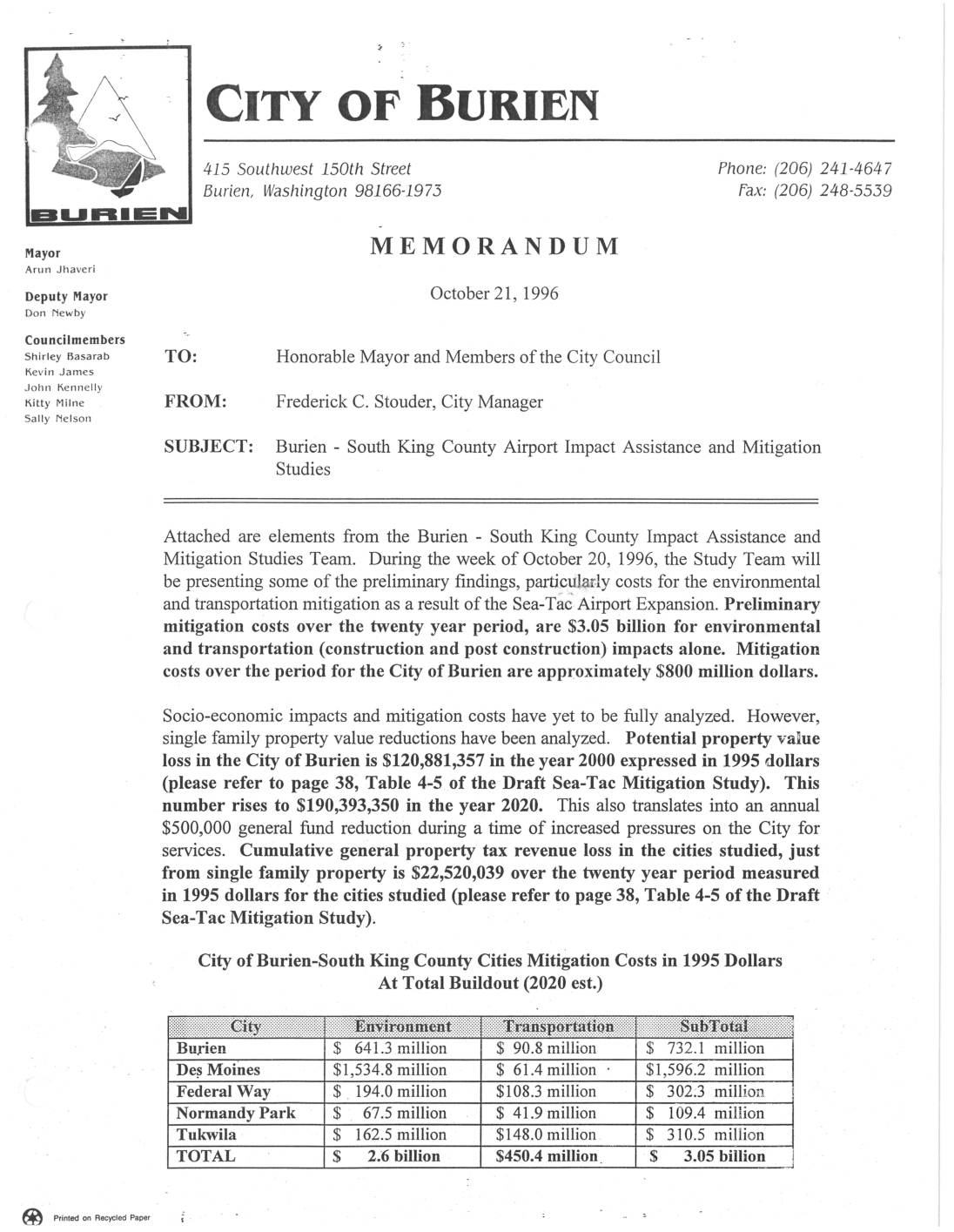
City of Burien Memorandum: South King County Airport Impact Assistance and Mitigation Studies
A 1996 City of Burien memorandum outlines preliminary findings from a regional study on the socio-economic and environmental impacts of Sea-Tac Airport's proposed expansion and third runway. Estimated mitigation costs for five South King County cities totaled $3.05 billion over twenty years, with Burien alone facing roughly $800 million in costs and over $190 million in single-family property value losses by 2020. The study argues that because the airport's benefits are spread across the broader Puget Sound region while its costs—including noise, traffic, and a reduced tax base—fall disproportionately on a handful of nearby communities, targeted mitigation funding is both an equity issue and a necessity. -
 1996-01-22
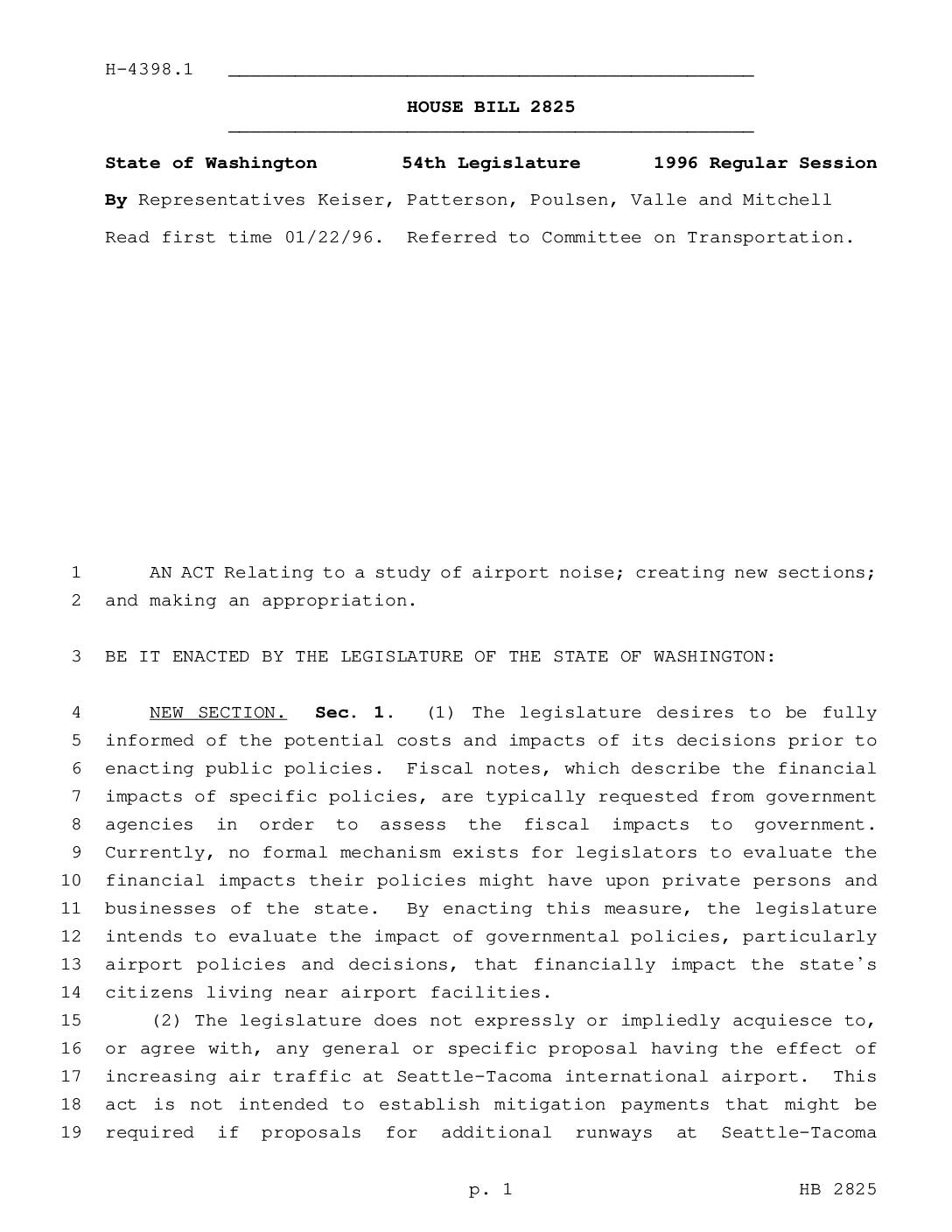
HB2825 – 1996 proposed study of impacts of airport noise on property values
Washington House Bill 2825, introduced in January 1996, directed the state's Legislative Transportation Committee to study how airport-related impacts — including noise, air quality, water quality, and traffic — affect residential property values near Seattle-Tacoma International Airport. The study area was to include all homes within the 55 LDN noise contour and the nearby cities of Burien, Des Moines, Normandy Park, Sea-Tac, and Tukwila, using accepted methods such as the 'neighborhood pair' model. Up to $75,000 was appropriated for the study, with a final report due to legislative committees by December 15, 1996.