TagRCAA(206)
-
 1997-02-01
Sea-Tac International Airport impact mitigation study: Initial assessment and recommendations
A 1997 impact mitigation study found that the expansion of Sea-Tac International Airport, including a proposed Third Runway, would impose significant costs on surrounding communities — with Burien and Des Moines alone accounting for nearly 80% of an estimated $2.95 billion in mitigation needs. The study examined 26 specific environmental impacts across areas such as noise, air quality, and water quality, and recommended establishing a permanent noise monitoring program to ensure projected noise contours are not exceeded. It also called for a comprehensive South King County planning effort to balance the needs of communities, schools, hospitals, and the airport. -
 1997-02-01
Sea-Tac International Airport Impact Mitigation Study: Initial Assessment and Recommendations — Section 9, Potential Socio-Economic Impacts and Mitigation
A 1997 study commissioned by cities and institutions near Seattle-Tacoma International Airport found that airport operations depress nearby property values compared to similar homes elsewhere in King County, and that properties directly under flight paths suffer additional losses from noise, visual pollution, and reduced quality of life. Researchers compared single-family homes around Sea-Tac with comparable homes in Northwest King County (Shoreline area), using strict criteria to ensure fair comparisons. The study notes that while overall regional growth means nearby home values may still rise over time, they appreciate more slowly than they would without the airport's presence. -
 1997-02-01
Sea-Tac International Airport impact mitigation study: Initial assessment and recommendations – Appendix A: Equity issues and socio-economic impacts
A 1997 study examined the unequal distribution of costs and benefits generated by Seattle-Tacoma International Airport, finding that while the airport's economic benefits (jobs, income, and travel services) spread across the broader Puget Sound region, its harms—including noise, traffic, and reduced property values—fell disproportionately on a small number of nearby cities: Burien, Des Moines, Federal Way, Normandy Park, and Tukwila. Data from a 1991 passenger survey showed that these five heavily impacted communities accounted for only 5.9% of home-originating enplanements, while King County as a whole contributed 57.2%. The study concluded that mitigation measures were needed to redirect some of the airport's regional benefits back to the communities bearing the greatest burden of its operations. -
 1996-10-01
Flying off course: Environmental impacts of America’s airports
A 1996 Natural Resources Defense Council report examines the environmental impacts of America's airports, including aircraft noise, air pollution, water quality, and climate change, based on a 1995 survey of 125 of the nation's busiest airports. The report finds that the FAA's current noise threshold of 65 dB DNL inadequately measures the true impact of aircraft noise on nearby communities, and that noise problems are likely to worsen as air travel grows. NRDC recommends updating noise measurement standards and improving land-use planning around airports to better protect residents from aviation-related environmental harms. -
 1996-08-23
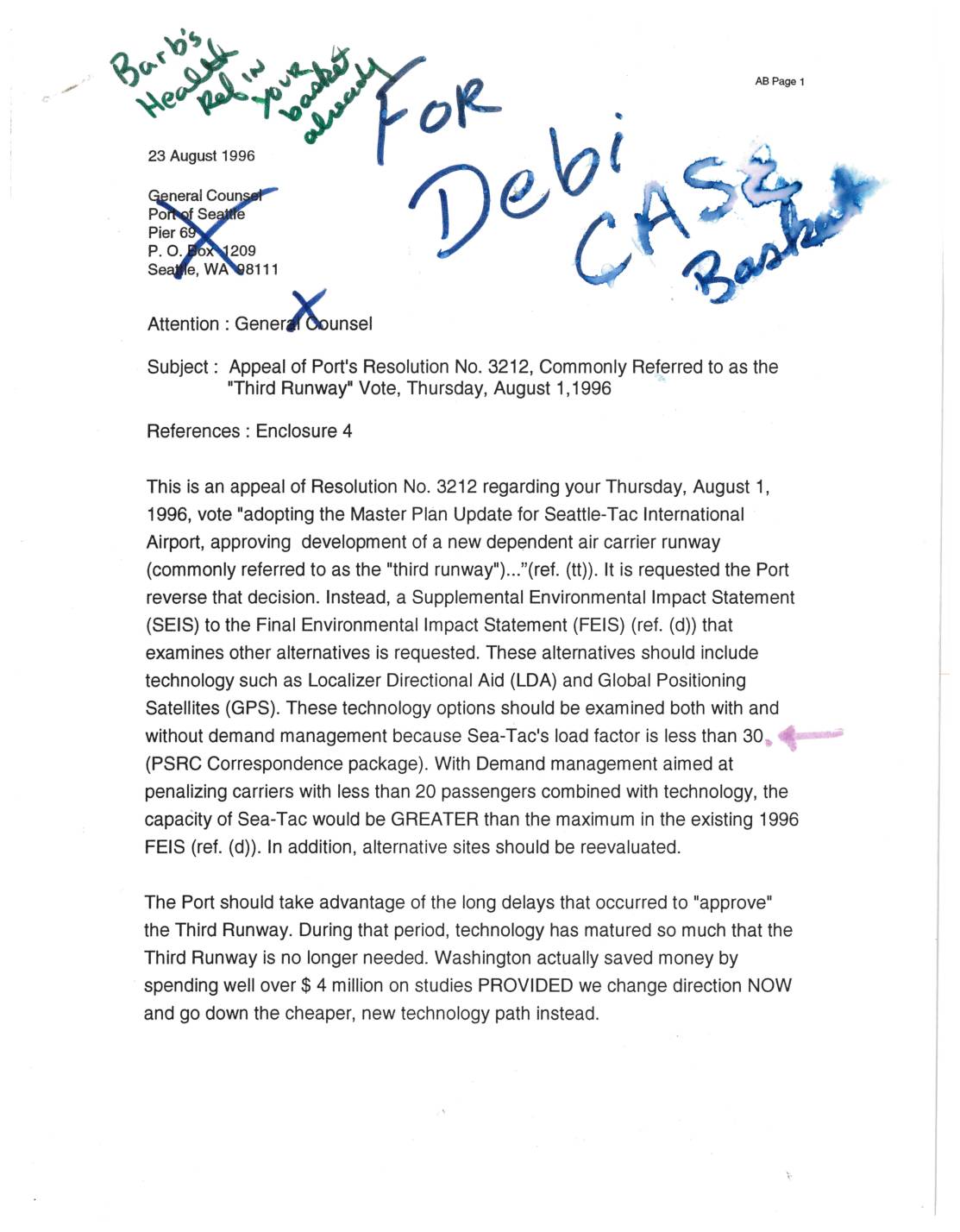
CASE & RCAA Appeal of Port Of Seattle Resolution No. 3212 (Third Runway Vote)
In August 1996, community groups CASE and RCAA formally appealed the Port of Seattle's Resolution No. 3212, which approved construction of a third runway at Seattle-Tacoma International Airport. The appeal argued that newer navigation technologies such as Localizer Directional Aid (LDA) and GPS, combined with demand management strategies, could provide equivalent airport capacity at far lower cost and with less environmental harm. The groups requested a Supplemental Environmental Impact Statement to evaluate these technology-based alternatives and reconsider the third runway decision. -
 1996-05-01
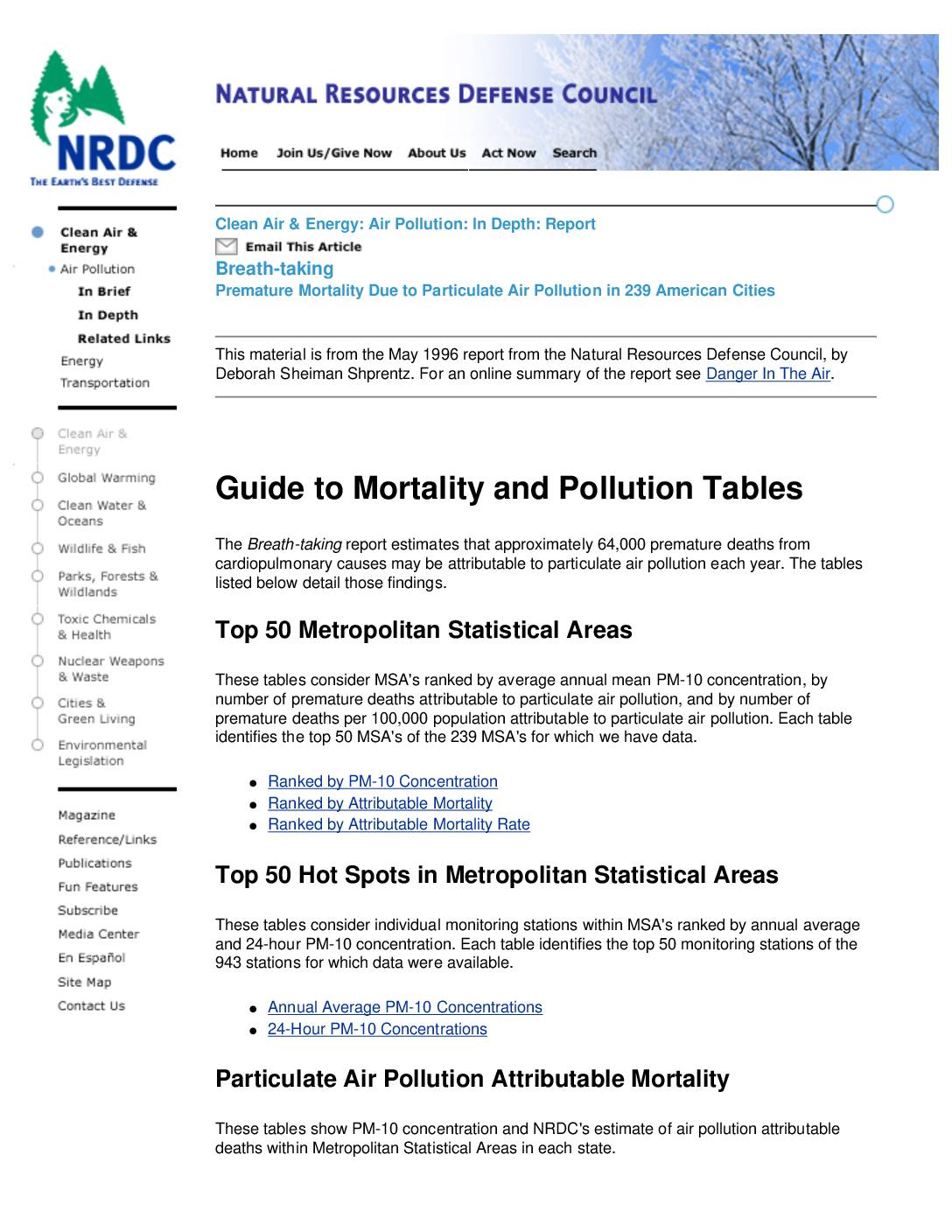
Breath-taking: Premature mortality due to particulate air pollution in 239 American cities
A 1996 Natural Resources Defense Council report estimates that approximately 64,000 premature deaths from cardiopulmonary causes occur each year due to particulate air pollution (PM-10) across 239 American cities. The report ranks metropolitan areas by PM-10 concentration, attributable mortality, and mortality rate, with California cities like Visalia, Bakersfield, and Fresno topping the pollution charts. Note: this document addresses urban air quality and public health broadly and does not contain content specifically related to Sea-Tac Airport noise policy. -
 1996-03-18
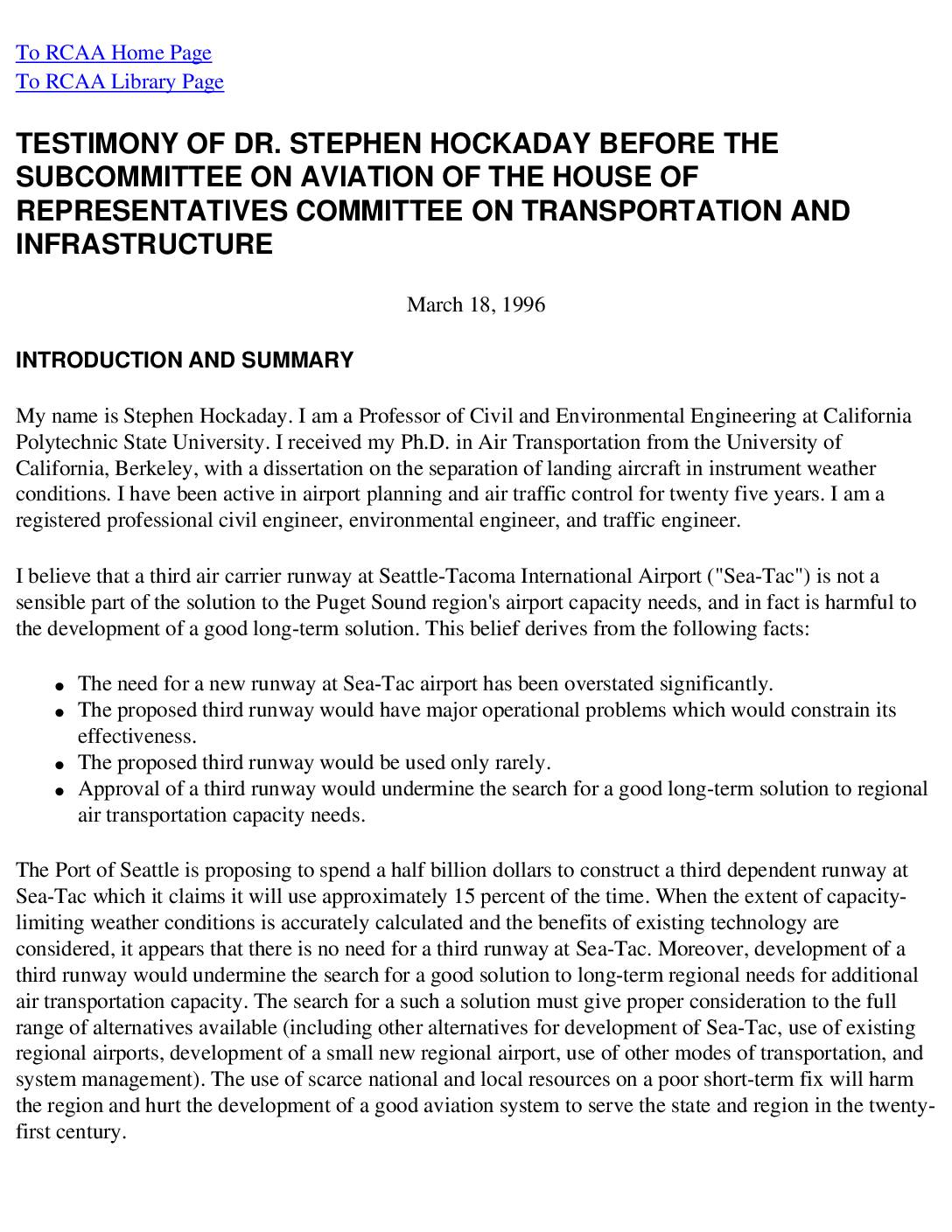
Testimony of Dr. Stephen Hockaday before the Subcommittee on Aviation of the House of Representatives Committee on Transportation and Infrastructure
In 1996 congressional testimony, Dr. Stephen Hockaday argued against building a costly third runway at Seattle-Tacoma International Airport, contending that the Port of Seattle greatly overstated the frequency of poor weather conditions that would require it. He presented evidence that true instrument flight conditions occur less than 8% of the year—not the 44% the Port claimed—and that existing navigation technologies like Localizer Directional Aid approaches could address capacity needs at far lower cost. Hockaday warned that spending half a billion dollars on a runway used only 15% of the time would divert resources from better long-term regional aviation solutions. -
 1995-08-16
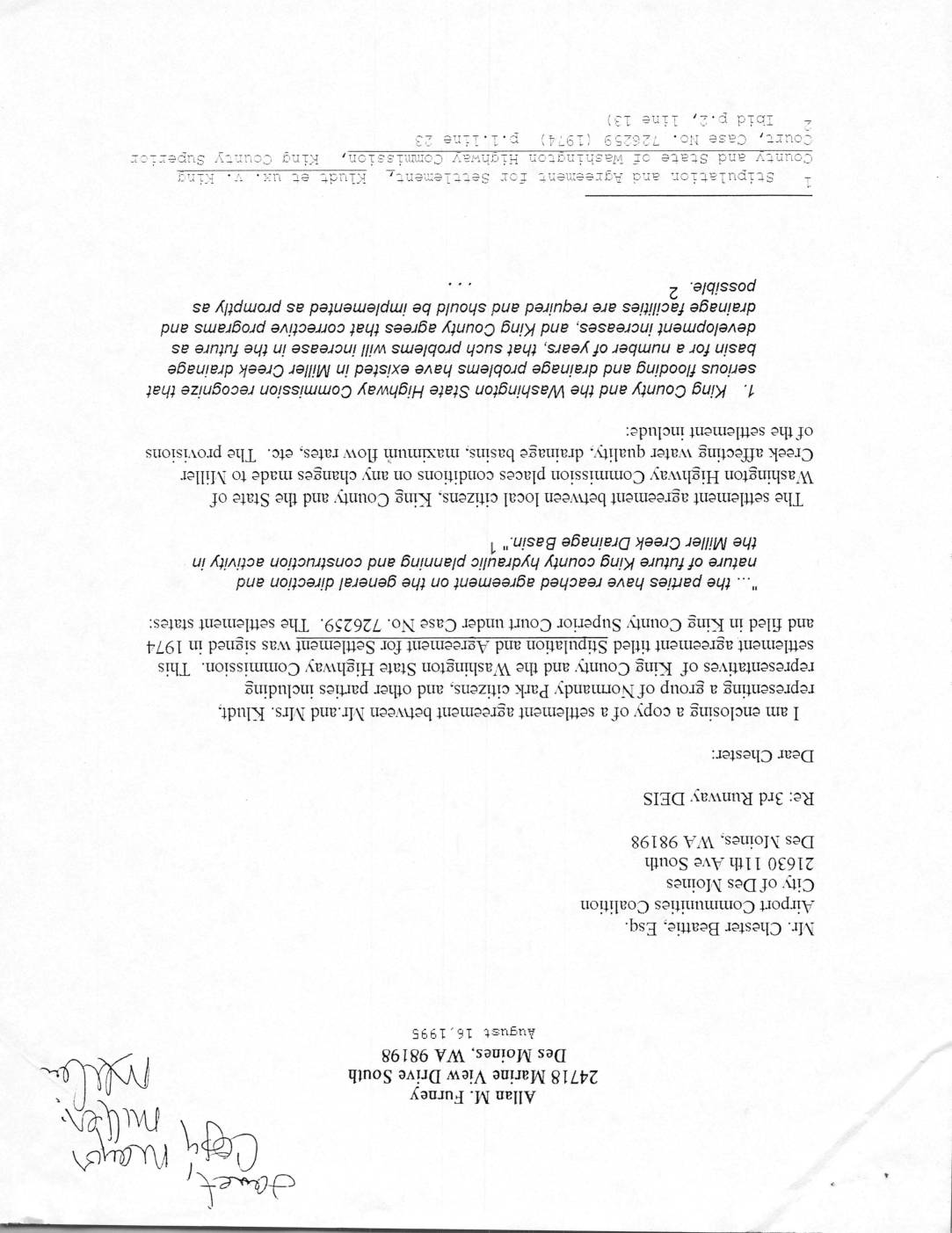
Letter regarding 3rd Runway DEIS and Miller Creek drainage settlement agreement
A 1995 letter from Allan M. Furney to Chester Beattie of the Airport Communities Coalition summarizes a 1974 settlement agreement between King County, the Washington State Highway Commission, and local citizens regarding flooding and drainage problems in the Miller Creek watershed. The settlement requires King County to improve water quality, prevent excess stormwater runoff into Miller Creek, and construct appropriate drainage facilities, while prohibiting full channelization of the creek. The letter raises concerns that proposed SeaTac Airport third-runway expansion plans, as outlined in the Draft EIS, would violate these settlement provisions by significantly increasing impervious surface area and stormwater flows into the Miller Creek drainage basin. -
 1995-07-05
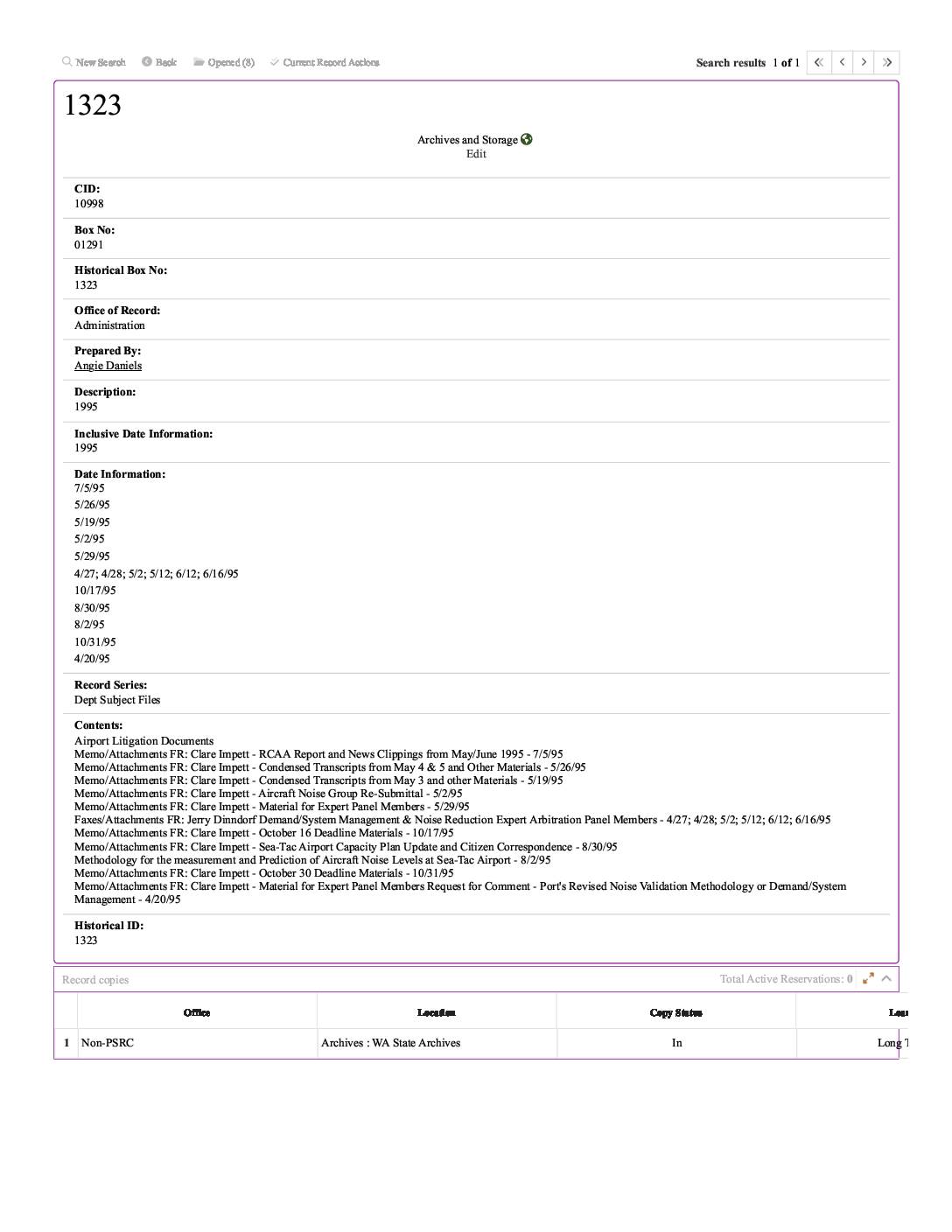
Archive Record 1323: Airport Litigation Documents and RCAA Reports, 1995
This archival record (Box 1323) from the Port of Seattle's Administration office contains airport litigation documents related to Sea-Tac Airport noise issues from 1995. The materials include memos and attachments from Clare Impett covering topics such as RCAA reports, condensed transcripts, aircraft noise group submissions, and expert panel materials for arbitration on demand/system management and noise reduction. Also included is a methodology document for measuring and predicting aircraft noise levels at Sea-Tac Airport, stored at the Washington State Archives. -
1995-07-05
Archive Record 1323: Airport Litigation Documents and RCAA Reports, 1995
This is an Archives and Storage record (CID 10998, Box 01291) from the Port of Seattle Administration office, prepared by Angie Daniels, containing 1995 Airport Litigation Documents related to Sea-Tac Airport noise issues. Contents include memos and attachments from Clare Impett covering RCAA reports, condensed transcripts, aircraft noise group submittals, expert panel materials, and methodology for measurement and prediction of aircraft noise levels, as well as faxes from Jerry Dinndorf regarding Demand/System Management and Noise Reduction Expert Arbitration Panel Members.