TagRCAA(206)
-
 1995-04-20
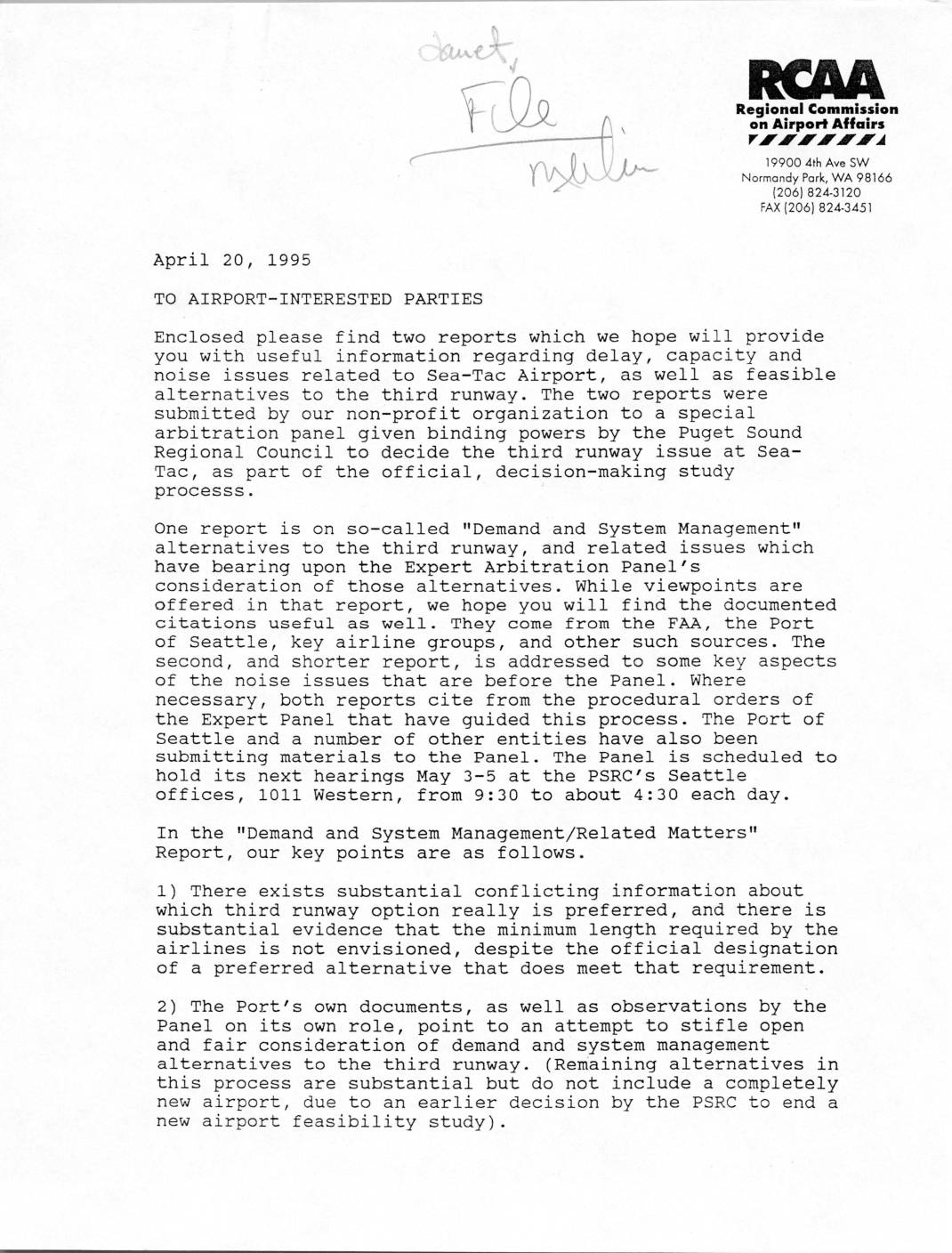
Letter to airport-interested parties regarding Sea-Tac third runway reports
A 1995 letter from the Regional Commission on Airport Affairs to airport-interested parties summarizes two reports submitted to an arbitration panel deciding the Sea-Tac Airport third runway issue. The reports argue that alternatives to the third runway—such as regional airport system use and peak-hour pricing—were not fairly considered, that flight delay figures cited to justify the runway were overstated, and that the project itself may never be buildable due to cost, financing, and construction obstacles. A separate shorter report addresses noise concerns related to the proposed runway. -
 1995-01-01
Box 1323: Airport Litigation Documents — RCAA Report and Correspondence, 1995
This archival box (Box No. 01291, Title 1323) from the Administration office contains Airport Litigation Documents dating from 1995, prepared by Angie Daniels. The contents include memos, attachments, faxes, and condensed transcripts from Clare Impett and Jerry Dinndorf related to RCAA reports, aircraft noise group resubmittals, expert arbitration panel materials, and Sea-Tac Airport capacity plan updates and citizen correspondence. The records are classified under the Dept Subject Files series and cover key dates between April and October 1995. -
1995-01-01
Box 1323: Airport Litigation Documents — RCAA Report and Correspondence, 1995
A Soutron LMS database record entry dated 7/31/26 for archival box number 01291, historical box number 1323, assigned to the Office of Record 'Administration,' prepared by Angie Daniels, with a description noting '1995.' The record is part of the Content & Record: Archives and Storage classification under Function: General. -
 1994-04-01
Archive Record 1322: PSRC Administration Files, Sea-Tac Airport Correspondence and Implementation Resolution A-93-03 Records, 1992–1994
This archival record (Box 01290, Historical Box 1322) contains administrative files from 1992–1994 related to Sea-Tac Airport planning and noise policy, including litigation documents, Environmental Impact Statement (EIS) comments on a proposed third runway, capacity enhancement plans, and correspondence from citizens, city officials, and state agencies. It also includes records tied to Implementation Resolution A-93-03, covering communications with groups such as Apogee, Bricklin Gendler, and the Airport Communities Coalition. The files were prepared by Angie Daniels and are classified under the Department Subject Files record series. -
1994-04-01
Archive Record 1322: PSRC Administration Files, Sea-Tac Airport Correspondence and Implementation Resolution A-93-03 Records, 1992–1994
A search results screen showing '1 of 1' result with navigation controls. The toolbar includes options for New Search, Back, Opened (8), and Current Record Actions, consistent with a library or document database interface. -
 1993-03-03
RCAA letter to John Sandelius
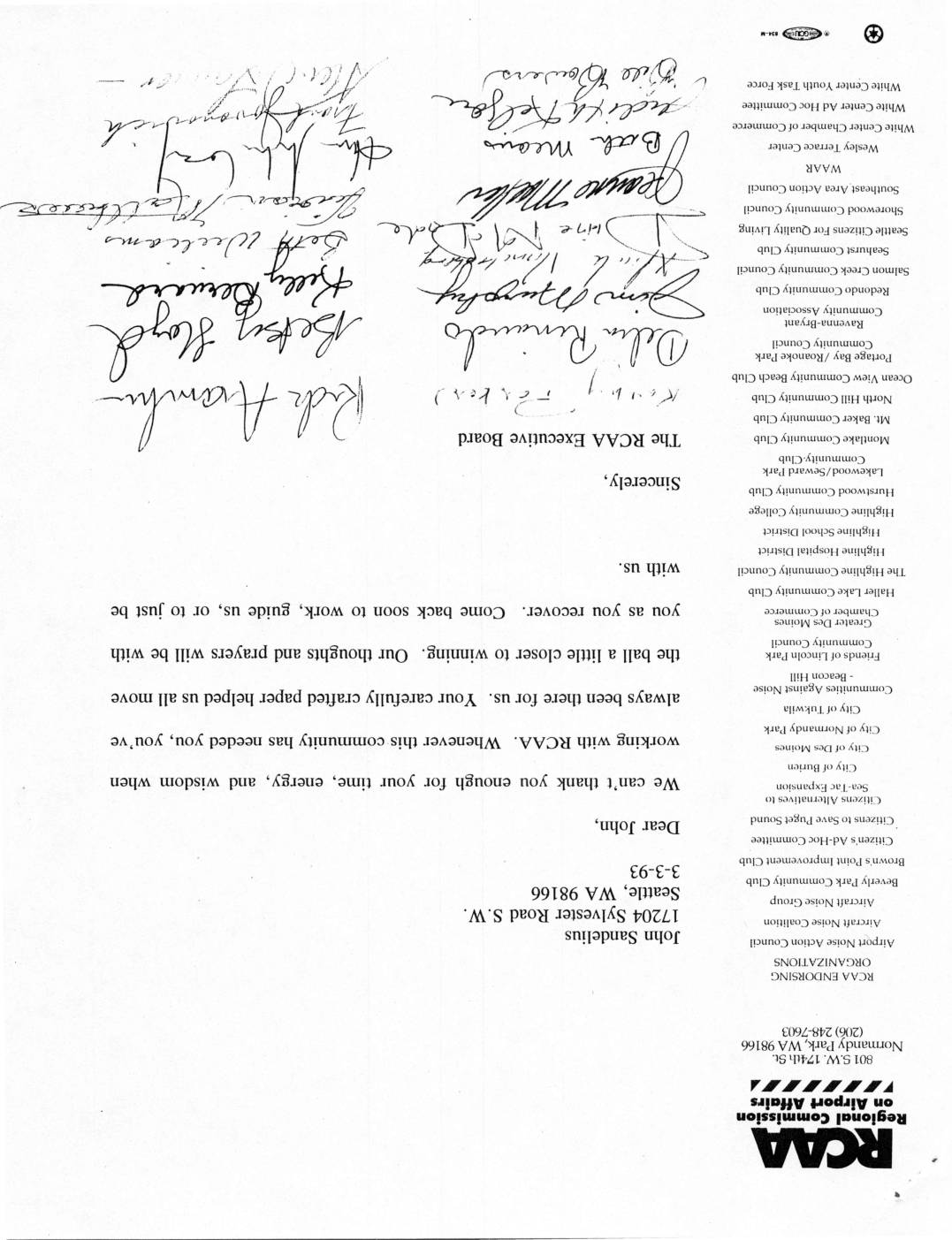
A March 1993 letter from the RCAA (Regional Commission on Airport Affairs) Executive Board addressed to John Sandelius of Seattle, thanking him for his time, energy, and wisdom contributed to the organization's efforts regarding Sea-Tac Airport noise issues. The letter expresses well-wishes for his recovery and notes that his work was valued whenever the community needed him. The document is endorsed by a wide coalition of over 50 community organizations, city governments, and civic groups from the greater Seattle and South King County area opposing airport noise expansion. -
 1993-01-28
RCAA letter to Transportation Policy and Executive Board
A January 28, 1993 letter from James T. Murphy of the Regional Commission on Airport Affairs (RCAA) to the Transportation Policy and Executive Board, presenting independent consultant research on air capacity options for the Puget Sound region. The letter notes that RCAA had delivered three volumes of material over three weeks, with a final compilation to follow, aimed at helping the Board make informed decisions about managing airport capacity. The RCAA, backed by dozens of community organizations and cities including Burien, Des Moines, Normandy Park, and Tukwila, framed its work as an alternative voice on Sea-Tac Airport expansion and noise policy. -
 1993-01-26
RCAA Regional Commission on Airport Affairs information packet
The Regional Commission on Airport Affairs (RCAA) was a coalition of cities and citizen groups in the Puget Sound region that opposed the proposed third dependent runway at Seattle-Tacoma International Airport in the early 1990s. The organization compiled expert research and white papers covering noise impacts, public health effects, environmental and social consequences, and economic costs associated with airport expansion. Their goal was to identify financially feasible and environmentally responsible alternatives to meet the region's air capacity needs without further expanding Sea-Tac. -
 1993-01-21
RCAA presentation materials on demand management, airport planning, and system alternatives
This January 1993 document from the Regional Commission on Airport Affairs (RCAA) presents materials to the Puget Sound Regional Council's Transportation Policy and Executive Board covering demand management, airport planning, and regional air capacity alternatives. The packet includes analysis of flight delays, airspace and runway capacity issues, and landside capacity concerns prepared by consultants J. Richard Aramburu and Gerald Bogan, along with alternative airport development ideas from locations such as Grays Harbor County, Toledo-Winlock, and Moses Lake. The RCAA, backed by dozens of community groups and several cities in the Sea-Tac area, sought to offer expert-driven solutions to address long-term aviation capacity needs while addressing aircraft noise concerns affecting surrounding neighborhoods. -
 1993-01-14
Regional Commission on Airport Affairs Book #1
This is Book #1 of materials compiled by the Regional Commission on Airport Affairs (RCAA), a coalition of community organizations and cities in the Puget Sound region, submitted to the Transportation Policy Board in January 1993. The packet presents expert reports on air traffic forecasting, economic impacts, noise, effects on children's education, public health, and air pollution—all focused on the proposed expansion of Seattle-Tacoma (Sea-Tac) International Airport. The RCAA argues against airport expansion on the grounds of quality of life, environmental harm, and equity for surrounding communities.