TagProperty Values(25)
-
 2020-09-24
The Impact of Airport Proximity on Single-Family House Prices—Evidence from Poland
Academic journal article published in MDPI Sustainability (2020, vol. 12, 7928) by Mirosław Bełej, Radosław Cellmer (University of Warmia and Mazury in Olsztyn), and Michał Głuszak (Cracow University of Economics) examining the impact of airport proximity on single-family house prices in Poland, 2013–2017. Analyzes Gdańsk Lech Walesa Airport and Warsaw Chopin Airport limited use areas -
2020-09-24
The Impact of Airport Proximity on Single-Family House Prices—Evidence from Poland
Academic journal article published in MDPI Sustainability (2020, vol. 12, 7928) by Mirosław Bełej, Radosław Cellmer (University of Warmia and Mazury in Olsztyn), and Michał Głuszak (Cracow University of Economics) examining the impact of airport proximity on single-family house prices in Poland, 2013–2017. Analyzes Gdańsk Lech Walesa Airport and Warsaw Chopin Airport limited use areas -
 2018-06-24
Declaration of Mary L. Vigilante in Opposition to Plaintiffs’ Amended Motion for Class Certification
Bearse v. Port Of Seattle -
 2015-05-01
Residential Sorting and Environmental Externalities: the Case of Non-linearities and Stigma in Aviation Noise Values
Academic journal article by Sotirios Thanos, Abigail L. Bristow, and Mark R. Wardman, published in the Journal of Regional Science (May 2015), examining residential sorting in response to aviation noise exposure in a housing market. Uses Spatiotemporal Hedonic Pricing (HP) and Stated Choice (SC) methods to quantify nonlinear noise depreciation ranging from 0.40 to 2.38 -
2015-05-01
Residential Sorting and Environmental Externalities: the Case of Non-linearities and Stigma in Aviation Noise Values
Academic journal article by Sotirios Thanos, Abigail L. Bristow, and Mark R. Wardman, published in the Journal of Regional Science (May 2015), examining residential sorting in response to aviation noise exposure in a housing market. Uses Spatiotemporal Hedonic Pricing (HP) and Stated Choice (SC) methods to quantify nonlinear noise depreciation ranging from 0.40 to 2.38 -
2014-10-27
Admasu v. Port of Seattle (2014) 70220–3–I
Court of Appeals of Washington,Division 1. Kebede ADMASU, et al., Appellants, v. PORT OF SEATTLE, a Washington municipal corporation, Respondent. No. 70220–3–I. Decided: October 27, 2014 Darrell L. Cochran, Kevin Michael Hastings Pfau Cochran VertetisAmala PLLC, Tacoma, WA, Jason Paul Amala, Pfau Cochran Vertetis Amala PLLC, Seattle, WA, for Petitioner. Timothy J. Filer, Patrick J. -
 2013-02-19
Order Granting the Port Of Seattle’s Motion for Summary Judgment Based on Express Avigation Easements
This is a proposed court order from the King County Superior Court in the case of Kebede Admasu et al. v. the Port of Seattle, in which the Port sought summary judgment against plaintiffs based on express avigation easements tied to Sea-Tac Airport. The order lists the numerous declarations and filings considered by the court, including submissions from both the Port and affected property owners. The case centers on whether recorded avigation easements legally shield the Port from noise and property-related claims brought by neighboring residents. -
 2011-11-10
Final Notice: Third Runway Lawsuit — Pfau Cochran Vertetis Amala PLLC Mailer to Normandy Park Residents (November 10, 2011)
A 2011 legal notice from law firm Pfau Cochran Vertetis Amala PLLC informing Normandy Park and surrounding Seattle-area residents about a class action lawsuit against the Port of Seattle over damages caused by the airport's Third Runway operations. The notice warns that while the class action covers real property value losses, Washington law requires separate lawsuits to be filed within three years for other damages such as personal injury or annoyance. Residents were urged to contact the firm no later than November 10, 2011, to protect their legal rights. -
 1997-02-01
Sea-Tac International Airport Impact Mitigation Study: Initial Assessment and Recommendations — Section 9, Potential Socio-Economic Impacts and Mitigation
A 1997 study commissioned by cities and institutions near Seattle-Tacoma International Airport found that airport operations depress nearby property values compared to similar homes elsewhere in King County, and that properties directly under flight paths suffer additional losses from noise, visual pollution, and reduced quality of life. Researchers compared single-family homes around Sea-Tac with comparable homes in Northwest King County (Shoreline area), using strict criteria to ensure fair comparisons. The study notes that while overall regional growth means nearby home values may still rise over time, they appreciate more slowly than they would without the airport's presence. -
 1996-11-25
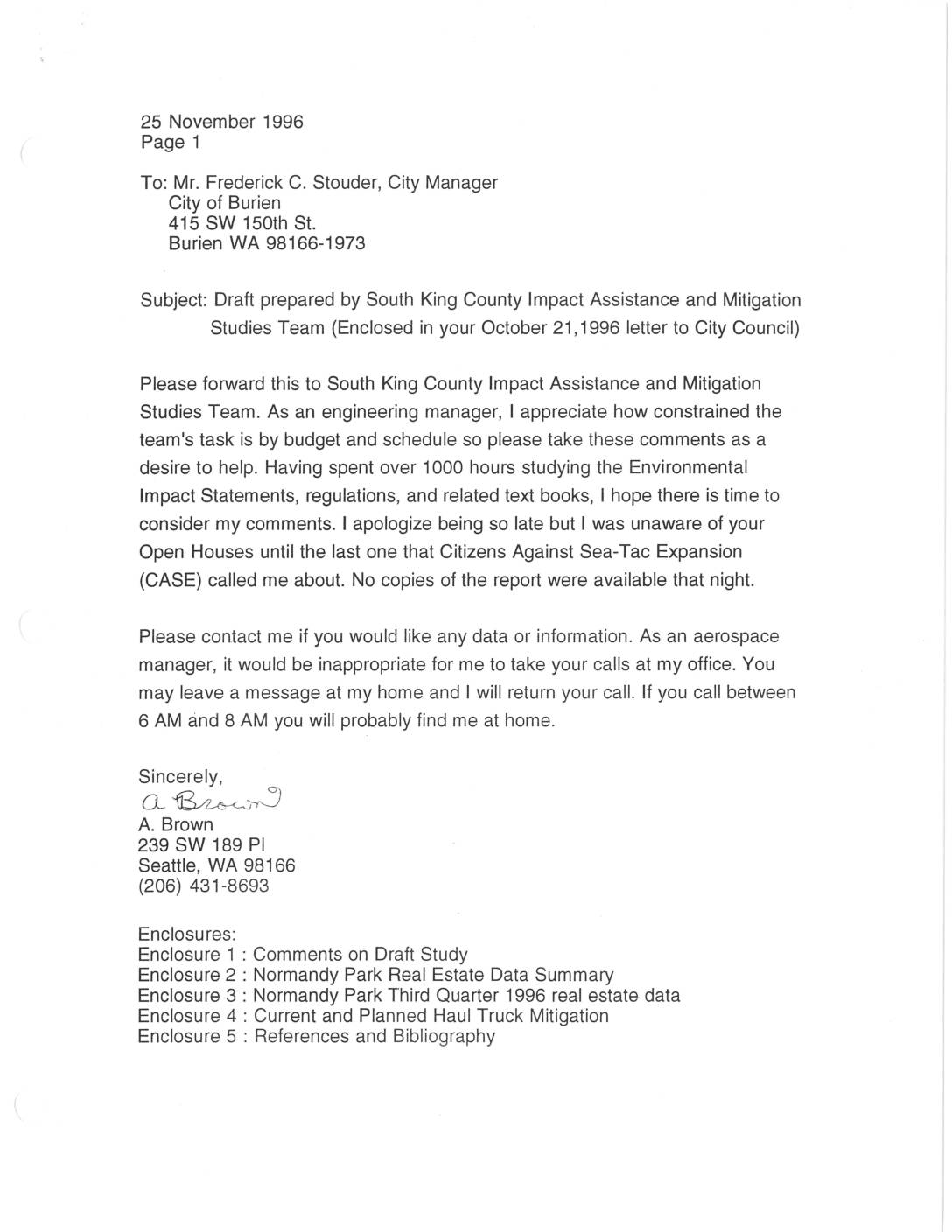
Letter from A. Brown to City of Burien: Comments on South King County Impact Assistance and Mitigation Studies Team Draft
A Normandy Park resident and aerospace engineering manager submitted detailed comments in November 1996 criticizing a draft impact study related to Sea-Tac Airport's proposed Third Runway, arguing that the analysis underestimated real estate value losses, air pollution risks, and traffic disruptions caused by the project. The letter contends that home values in Normandy Park stagnated or declined after the Third Runway was publicly announced, and that any valid property value assessment must use baseline figures from before negative publicity began. The author also challenges the study's air quality modeling assumptions and traffic analysis, warning that the Port of Seattle would selectively cite favorable findings while ignoring methodological flaws.