TagPort Of Seattle(2349)
-
 2018-05-15
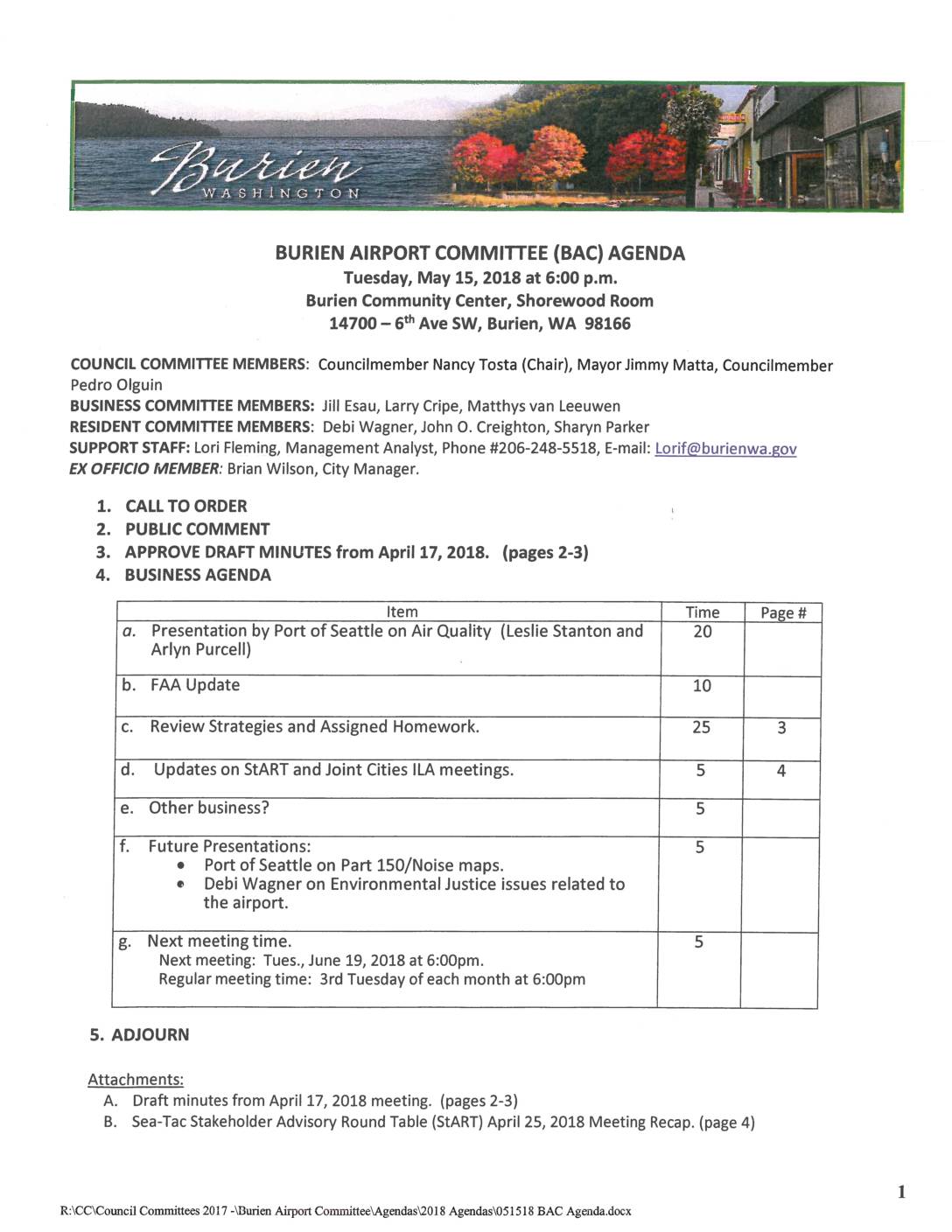
Burien Airport Committee (BAC) agenda, May 15, 2018
The Burien Airport Committee (BAC) met on May 15, 2018 to discuss air quality, FAA updates, and strategies for addressing Seattle-Tacoma International Airport's impact on the Burien community. Key priorities included updating noise contour maps, gathering environmental justice data, reviewing air pollution studies, and identifying economic benefits for Burien from its proximity to the airport. The committee also reviewed draft minutes from its April 17, 2018 meeting, where members were assigned tasks such as drafting a resolution on airport noise and emission concerns. -
 2018-05-15
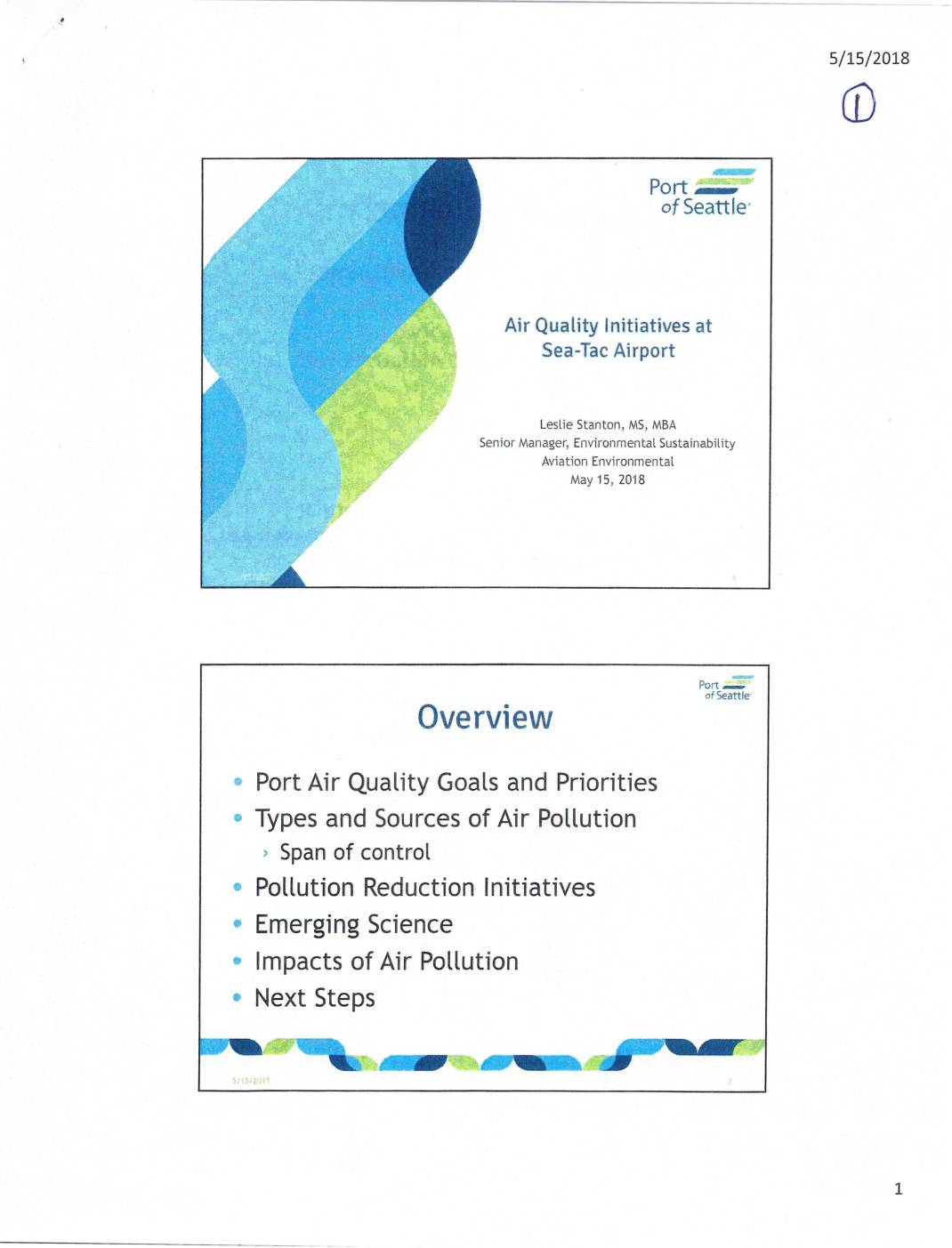
Air quality initiatives at Sea-Tac Airport
This 2018 presentation by Port of Seattle Senior Manager Leslie Stanton outlines air quality initiatives at Sea-Tac Airport, covering the types and sources of air pollution including greenhouse gases and regulated pollutants such as NOx, SOx, and particulate matter. It highlights efforts to reduce emissions through clean vehicle programs, including Sea-Tac's distinction as the first US airport to require green taxis and green TNCs, conversion of CNG buses to electric, and expanded EV charging infrastructure. The presentation also addresses passenger ground transportation planning aimed at improving public transit access and reducing the airport's overall environmental footprint. -
 2018-05-08
Airport Financial Forecast & SAMP Impacts: Commission Briefing
A May 2018 Port of Seattle Commission briefing assessed the financial impact of the Sustainable Airport Master Plan (SAMP) on Sea-Tac Airport, finding that adding SAMP projects could push airline cost-per-enplaned-passenger (CPE) to an infeasible $36 by 2027. To keep costs within an acceptable range of $25–$30, the Port identified the need to increase non-aeronautical revenues, control operating and maintenance expenses, and reduce projected capital spending. The briefing concluded that SAMP is financially achievable, but only with vigilant cost management. -
 2018-05-07
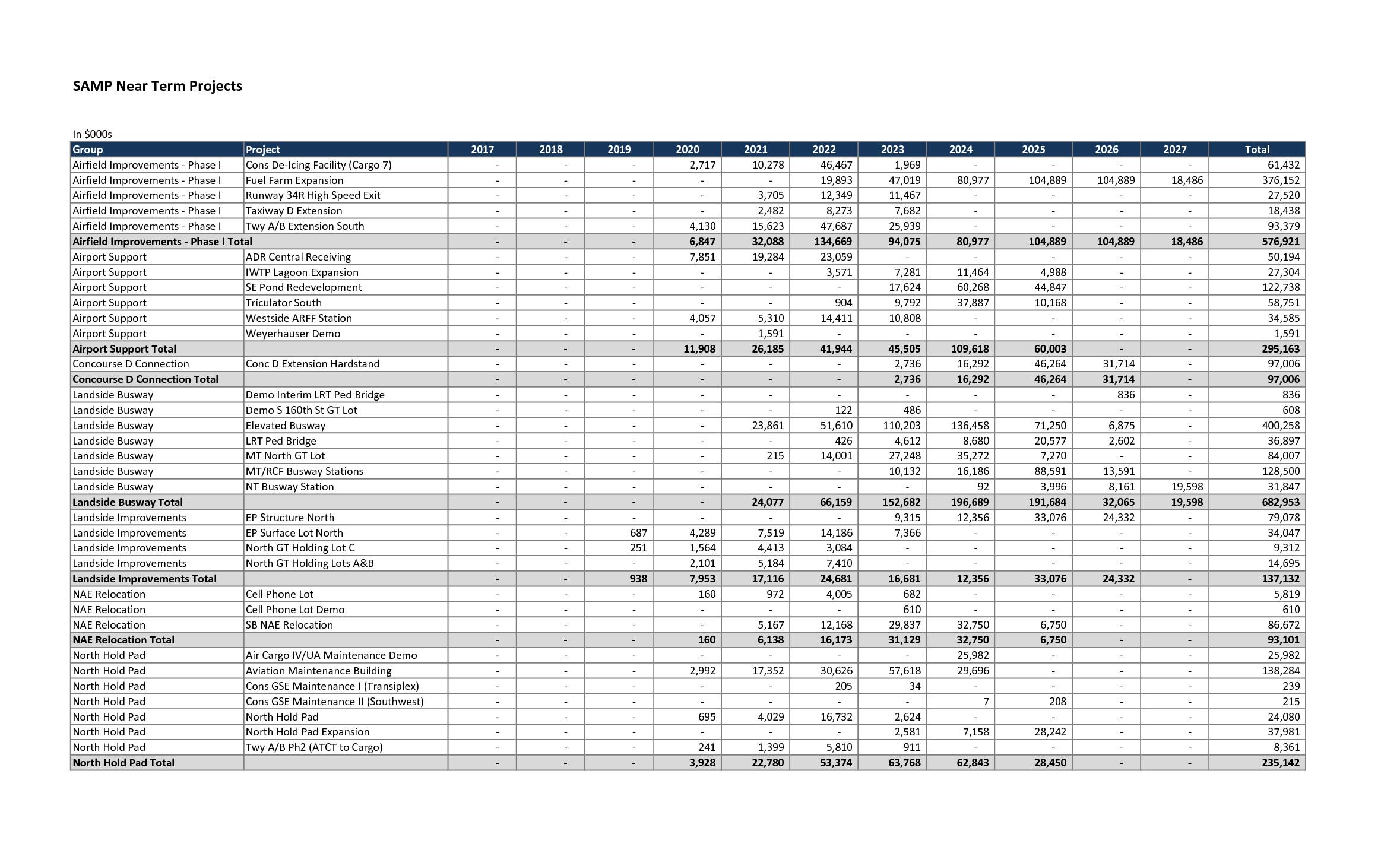
SAMP Near Term Projects Capital Cost Summary by Group and Project (2017–2027)
This document outlines the Seattle-Tacoma International Airport Master Plan (SAMP) near-term capital improvement projects spanning 2017 through 2027, totaling approximately $4.47 billion in planned investments. Major project groups include a new North Terminal complex, landside busway improvements, airfield upgrades, and temporary gate expansions, with peak spending projected around 2024–2026. The plan reflects Sea-Tac's long-range strategy to expand capacity, modernize infrastructure, and accommodate growing passenger and cargo demand. -
 2018-05-04
Sustainable Airport Master Plan (SAMP) Update: International Boulevard Business Operators & Transportation Review Committee Briefing
The Port of Seattle presented a Sustainable Airport Master Plan (SAMP) Update to the International Boulevard Business Operators and Transportation Review Committee on May 4, 2018, outlining the airport's long-term vision and near-term projects. The update covered planning progress, including completed steps such as FAA-approved market demand analysis and two rounds of public open houses, with a third open house planned for May 30. Three conceptual alternatives for a second terminal and roadway configuration were introduced, all requiring further study to assess feasibility, cost, and operational efficiency. -
 2018-05-01
Technical Memorandum No. 7: Facilities Implementation and Financial Feasibility — Seattle-Tacoma International Airport
This May 2018 technical memorandum, prepared by Leigh Fisher for the Port of Seattle, outlines near-term capital projects and long-term facility improvements planned for Seattle-Tacoma International Airport as part of the Sustainable Airport Master Plan. It evaluates the financial and operational feasibility of major airside, terminal, cargo, and landside projects, and recommends key actions for implementation following completion of the planning process. Note that this document focuses on facilities and financial planning rather than noise policy specifically. -
 2018-05-01
Technical Memorandum No. 7: Facilities Implementation and Financial Feasibility — Seattle-Tacoma International Airport
This 2018 technical memorandum, prepared by Leigh Fisher for the Port of Seattle, outlines near-term construction projects, financial feasibility, and long-term vision for Seattle-Tacoma International Airport as part of its Sustainable Airport Master Plan. It covers major airside, terminal, cargo, and landside projects, along with an assessment of airfield operational feasibility and recommended actions following the plan's completion. While focused primarily on facilities and finance, the document provides context for infrastructure decisions that may affect airport operations and surrounding communities. -
 2018-05-01
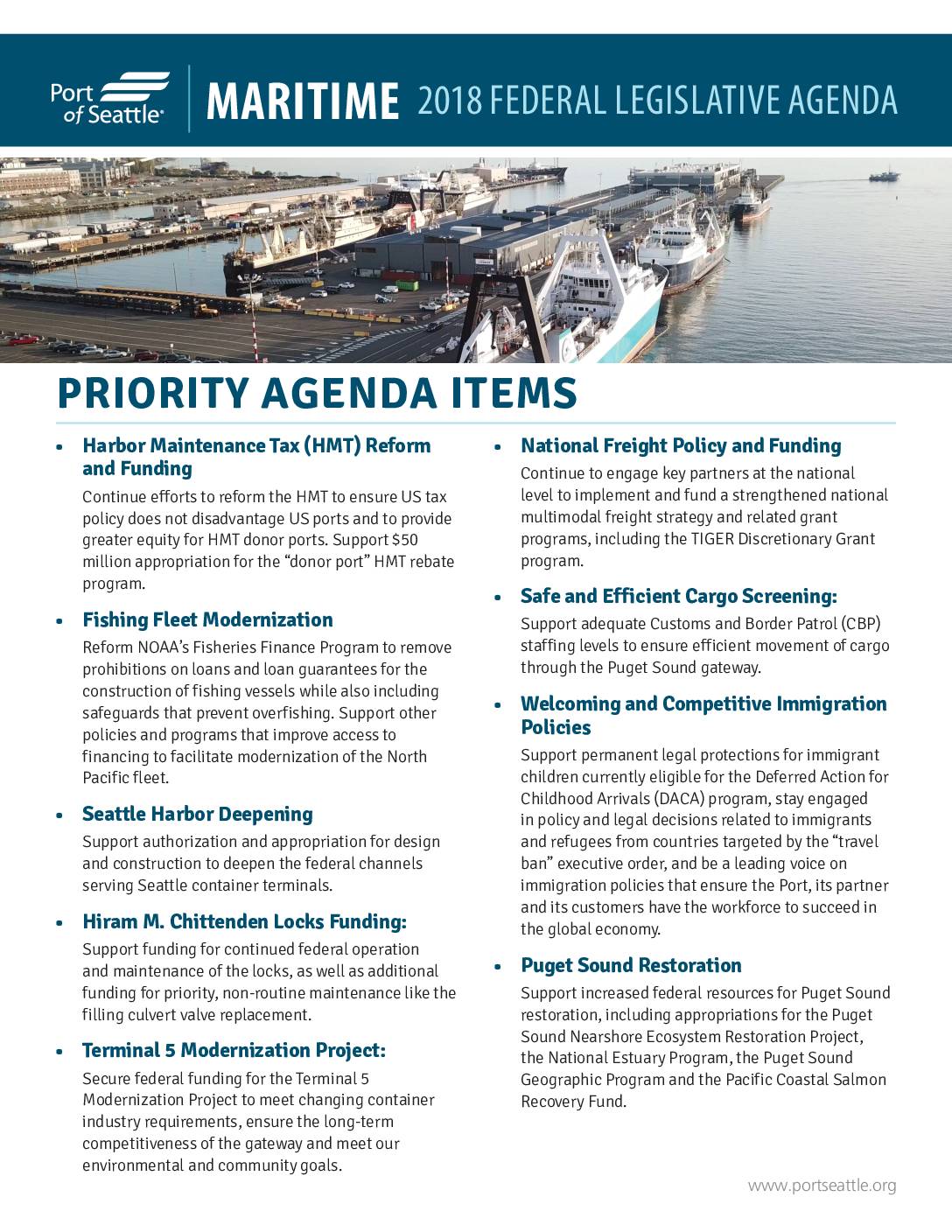
Maritime 2018 federal legislative agenda
This document outlines the Port of Seattle's 2018 Federal Maritime Legislative Agenda, detailing priority issues such as Harbor Maintenance Tax reform, fishing fleet modernization, Seattle Harbor deepening, and Terminal 5 upgrades. It also addresses immigration policies, Puget Sound restoration, and trade priorities. Note that this document focuses exclusively on maritime and cargo port operations and does not contain information related to Sea-Tac Airport noise policy. -
 2018-05-01
Technical Memorandum No. 9: Sustainability Planning and Management Strategy — Seattle-Tacoma International Airport
This 2018 technical memorandum outlines a Sustainability Planning and Management Strategy for Seattle-Tacoma International Airport, developed by Leigh Fisher and Synergy Consultants for the Port of Seattle. It establishes sustainability goals, objectives, and metrics across financial, environmental, and social focus areas, drawing on FAA guidance and Port of Seattle commitments. The document also addresses climate change risks to airport facilities and provides a framework for integrating sustainability into near-term airport development decisions. -
 2018-05-01
Technical Memorandum No. 8: Environmental Overview, Seattle-Tacoma International Airport
This 2018 technical memorandum prepared by Leigh Fisher for the Port of Seattle provides an environmental overview of Seattle-Tacoma International Airport as part of its Sustainable Airport Master Plan. It examines existing environmental conditions across topics such as air quality, noise, water resources, biological resources, and hazardous materials, then assesses how the airport's near-term construction and improvement projects could affect those resources. The document is intended to guide planners in understanding potential environmental impacts — including noise and compatible land use — before major airport development decisions are finalized.