TagPort Of Seattle(2403)
-
 2001-08-06
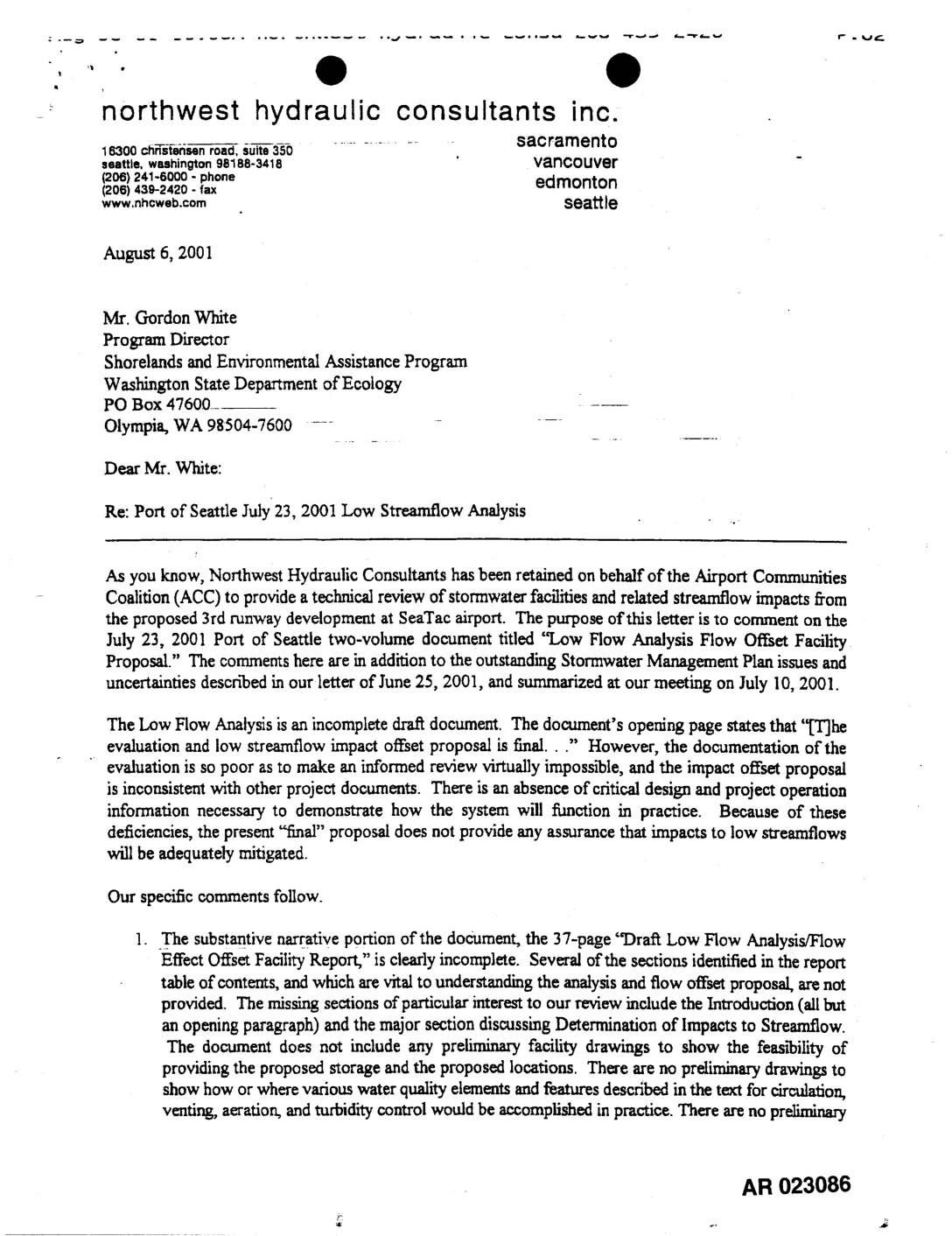
EXH AR023086: NHC Letter to Ecology — Technical Review Low Flow Analysis Flow Offset Facility Proposal (Third Runway)
A technical review letter from Northwest Hydraulic Consultants, written on behalf of the Airport Communities Coalition, raises serious concerns about the Port of Seattle's Low Flow Analysis related to the proposed 3rd runway at SeaTac Airport. The letter identifies the July 23, 2001 document as incomplete and inconsistent with other project plans, citing missing sections, absent facility drawings, and unresolved questions about how water storage and release systems would function in practice. Key technical issues flagged include inadequate accounting for water transit losses, potentially impractical small-orifice flow controls, and poor calibration of streamflow models for Walker Creek. -
 2001-08-06
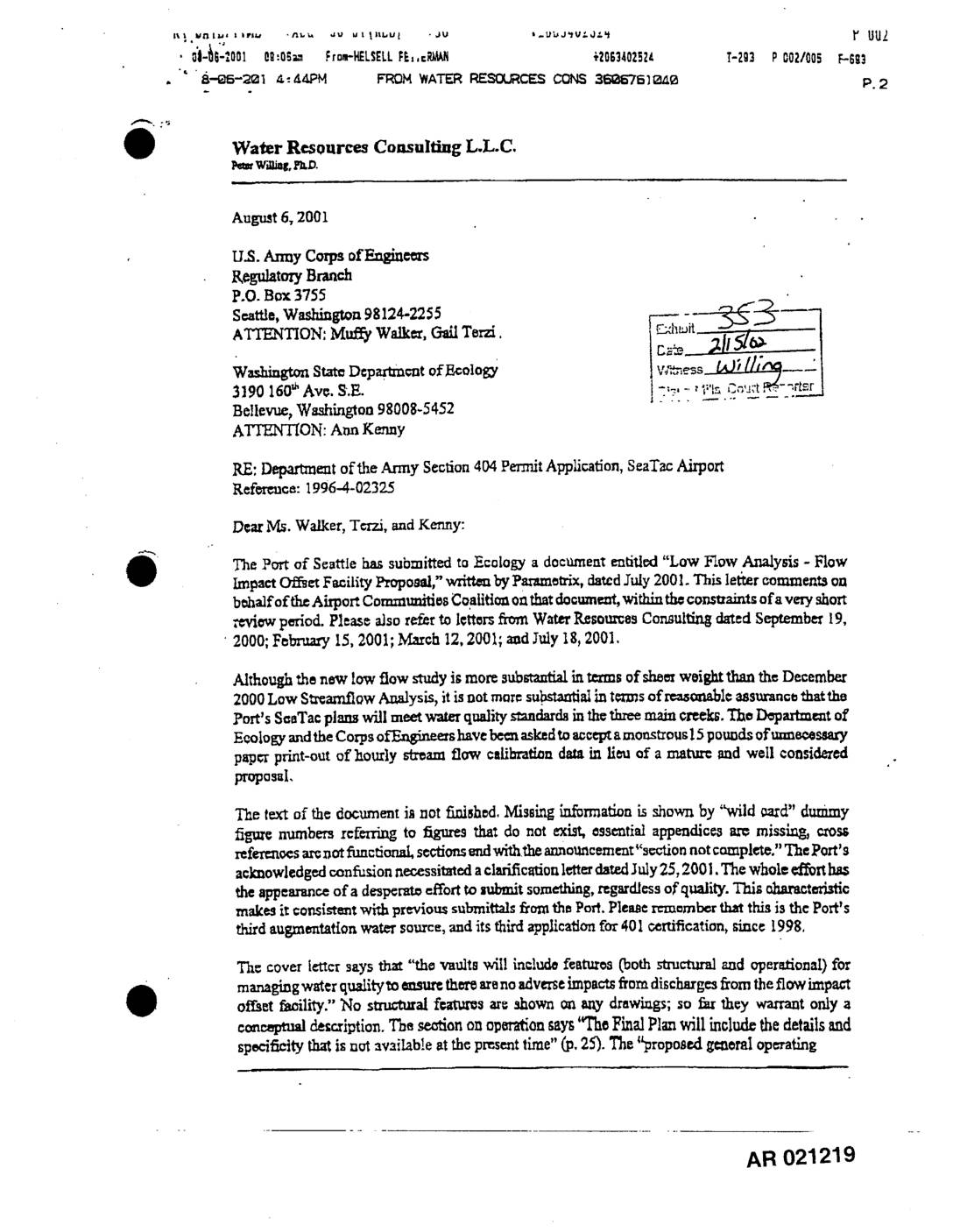
EXH 353: ACC Comment Letter Low Flow Analysis – Flow Impact Offset Facility Proposal (§404 Permit, STIA)
A August 6, 2001 letter from Water Resources Consulting L.L.C. on behalf of the Airport Communities Coalition critiques the Port of Seattle's 'Low Flow Analysis - Flow Impact Offset Facility Proposal' submitted in support of its Section 404/401 permit application for SeaTac Airport expansion. The letter argues that the Port's plan fails to provide reasonable assurance that the airport's stormwater management will meet water quality standards in Miller Creek, Walker Creek, and Des Moines Creek. Key concerns include an incomplete and unfinished proposal, insufficient stormwater storage capacity, unproven water quality treatment methods, and reliance on vague future 'adaptive management' rather than concrete, enforceable designs. -
 2001-08-06
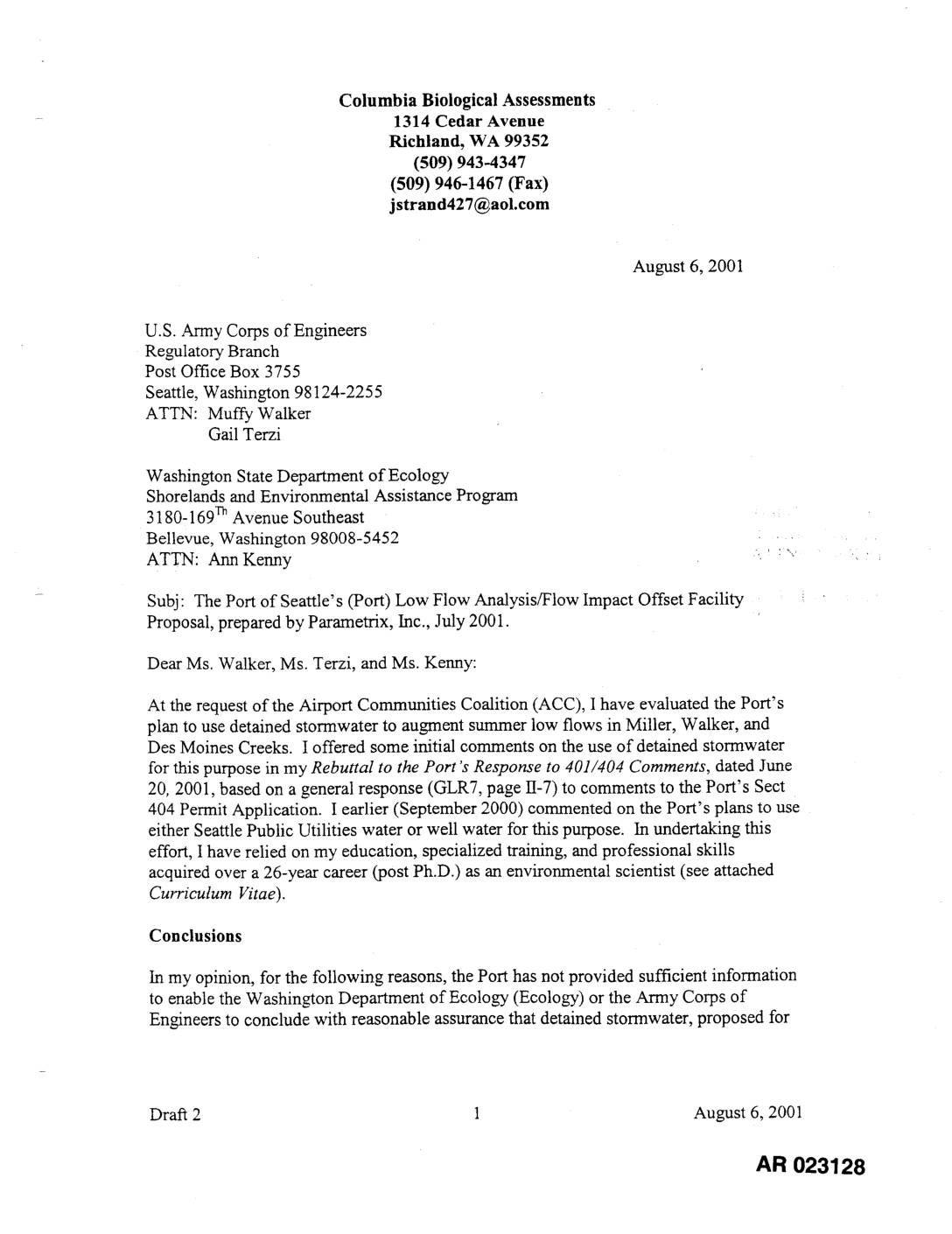
EXH AR023128: Letter from Columbia Biological Assessments to Army Corps of Engineers and Ecology re Port Of Seattle Low Flow Analysis/Flow Impact Offset Facility Proposal
A biological scientist hired by the Airport Communities Coalition reviewed the Port of Seattle's plan to store airport stormwater in detention vaults and release it into Miller, Walker, and Des Moines Creeks during summer low-flow periods. The review found that the plan could worsen water quality in those creeks, because stored sediments may release toxic levels of copper and zinc, and potentially harbor human pathogens from airplane wastewater. The scientist concluded that regulators lacked sufficient information to approve the proposal without further testing, modeling, and independent scientific review. -
 2001-08-05
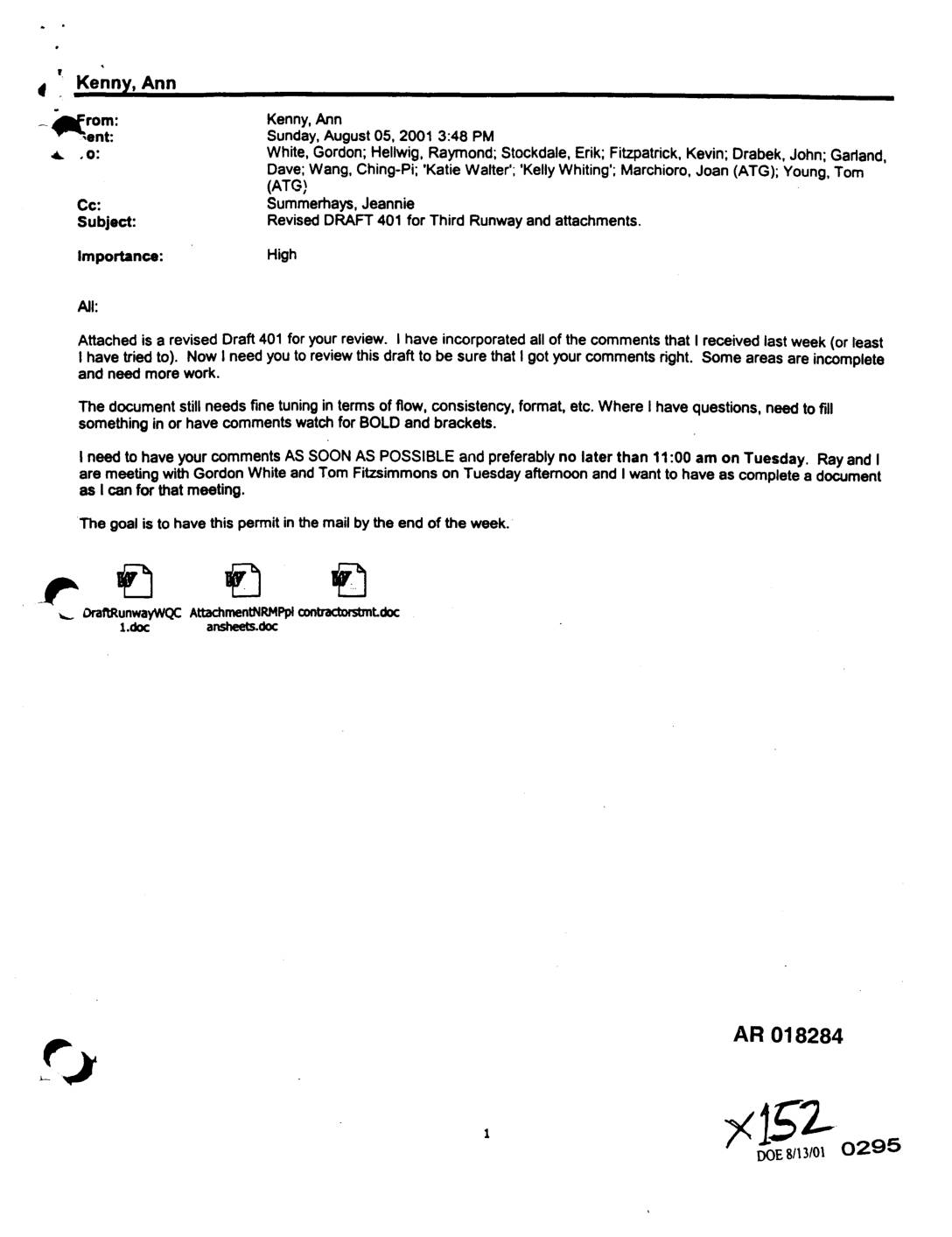
EXH AR018284: Ecology Draft 401 Water Quality Certification for Third Runway at STIA — Revised Draft and Attachments
Email from Ann Kenny (Washington State Department of Ecology) dated August 5, 2001, distributing a revised Draft 401 Water Quality Certification for the construction of a Third Runway and related projects at Seattle-Tacoma International Airport (STIA) in the Miller, Walker, and Des Moines Creek watersheds and wetlands in SeaTac and Auburn, King County, Washington. The -
 2001-08-05
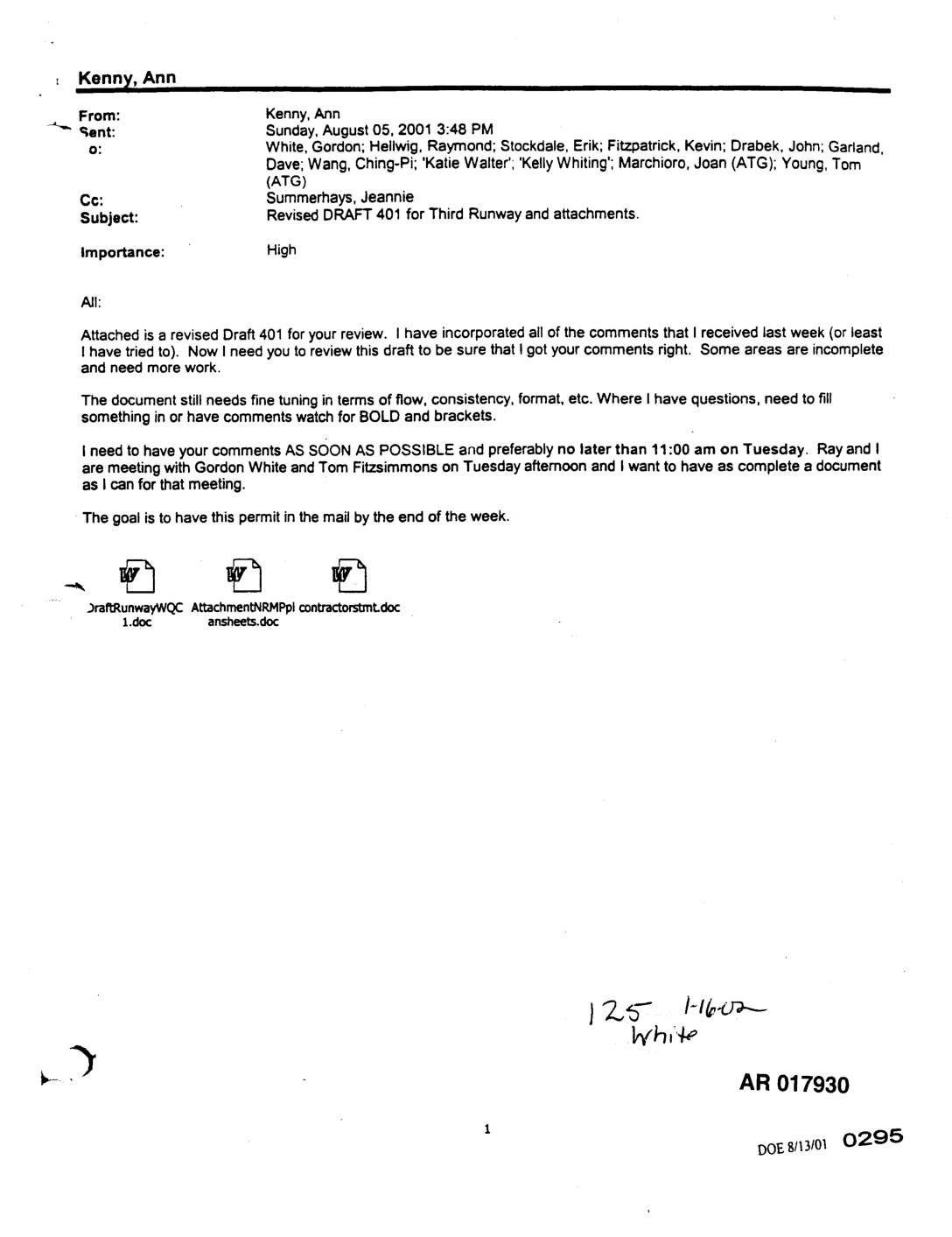
EXH AR017930: Ecology Draft 401 Water Quality Certification for Third Runway at STIA — Internal Review Email and Draft Letter
Email from Ann Kenny (Washington State Department of Ecology) dated August 5, 2001, circulating a revised Draft 401 Water Quality Certification for the Port Of Seattle’s Third Runway construction at Seattle-Tacoma International Airport (STIA). Recipients include Gordon White, Raymond Hellwig, Erik Stockdale, Kevin Fitzpatrick, John Drabek, Dave Garland, Ching-Pi Wang, Katie Walter, Kelly Whiting, Joan -
 2001-08-03
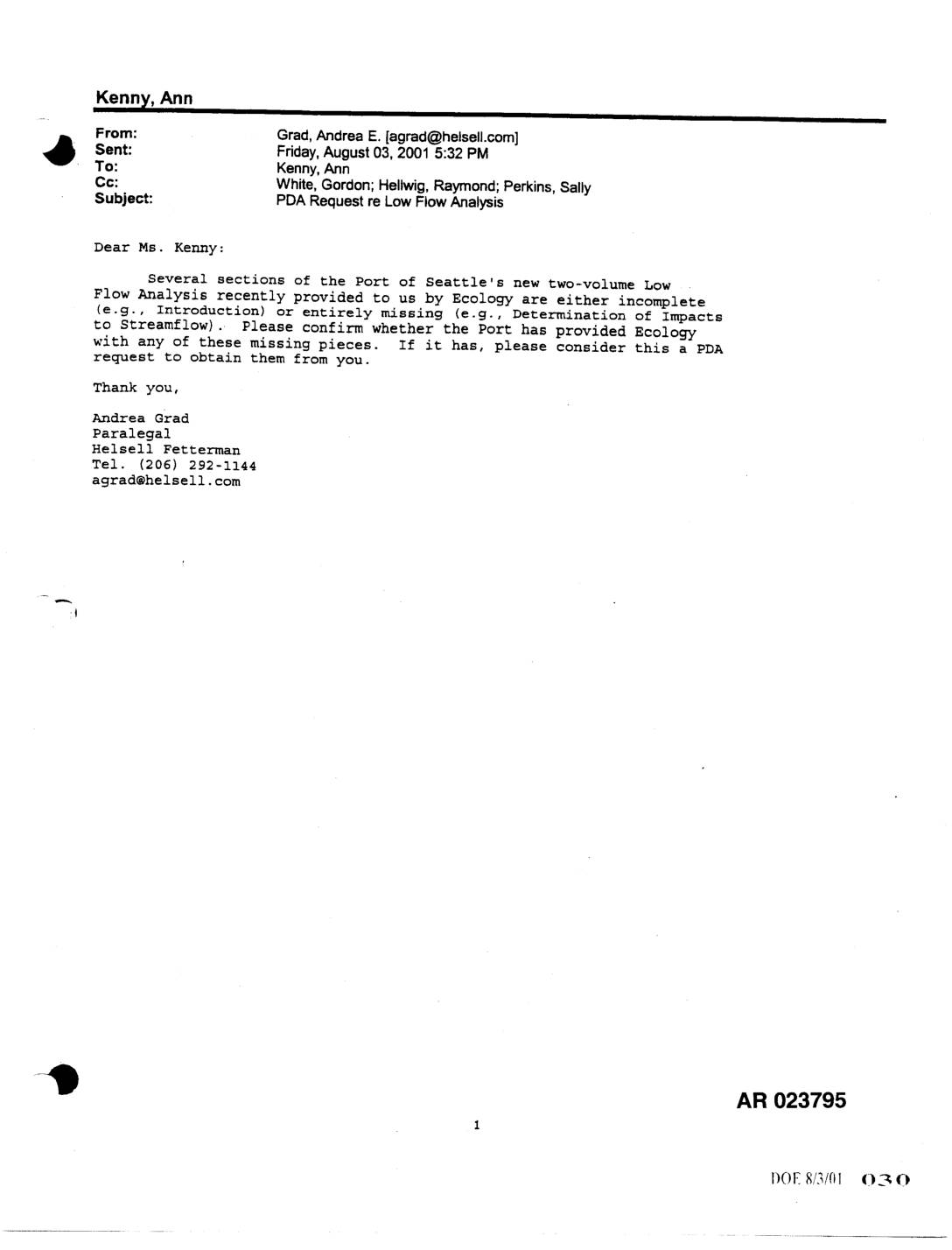
EXH AR023795: PDA Request Low Flow Analysis — Helsell Fetterman to Ecology
In this August 3, 2001 email, Andrea Grad, a paralegal at Helsell Fetterman, submits a Public Disclosure Act (PDA) request to Ann Kenny at the Washington State Department of Ecology. Grad notes that several sections of the Port of Seattle's two-volume Low Flow Analysis — including the Introduction and the section on Determination of Impacts to Streamflow — were either incomplete or entirely missing from the copy provided by Ecology. She asks Ecology to confirm whether the Port had submitted the missing sections, and requests copies of any such materials. -
 2001-08-03
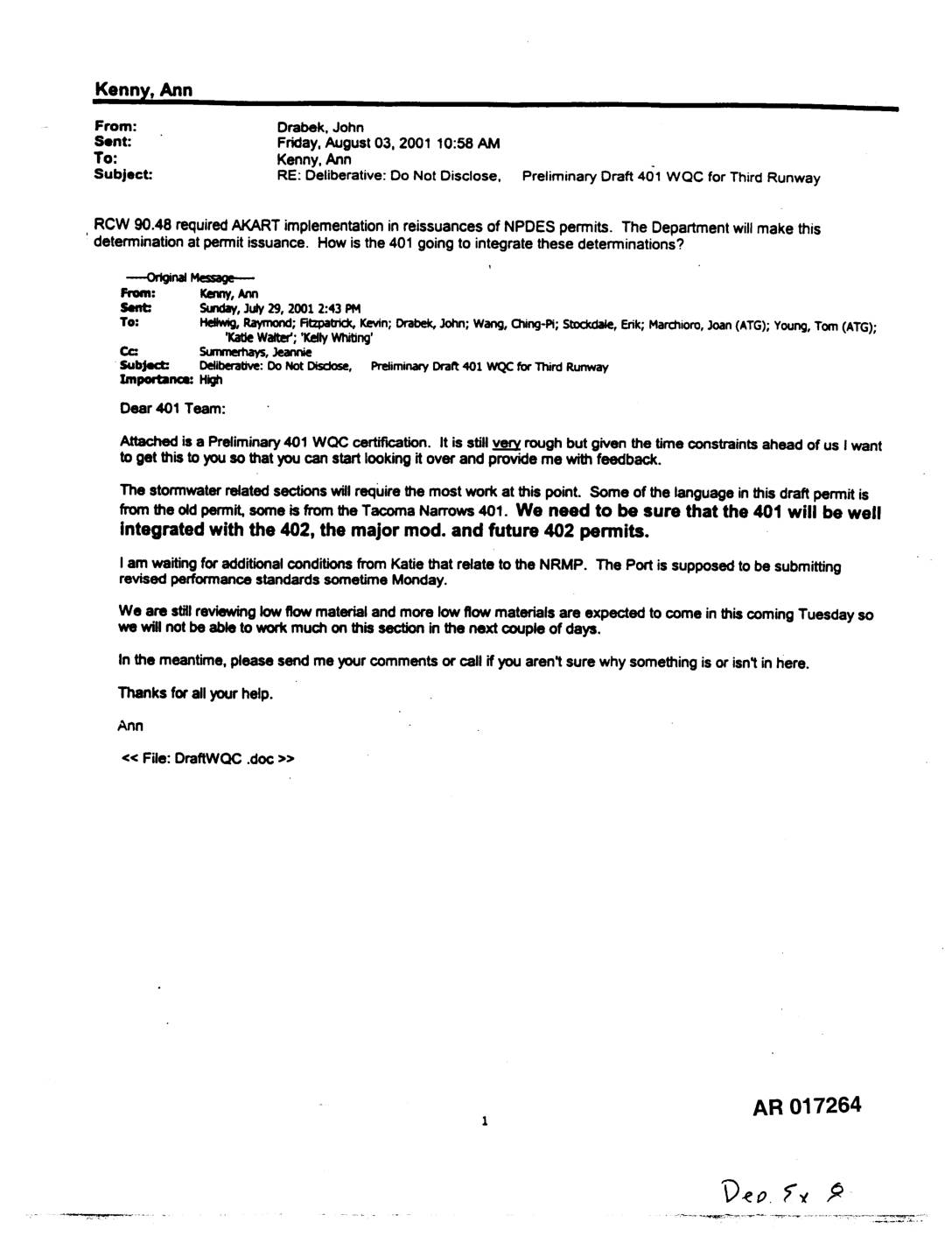
EXH AR017264: Email Chain RE: Deliberative Draft 401 WQC for Third Runway — Drabek to Kenny
Email chain between John Drabek and Ann Kenny (Washington State Department of Ecology) dated August 3, 2001, regarding a preliminary deliberative draft Section 401 Water Quality Certification (WQC) for the Sea-Tac Airport Third Runway. Drabek raises question about RCW 90.48 required AKART implementation in NPDES permit reissuances and integration with the 401. Kenny’s original email -
 2001-08-03
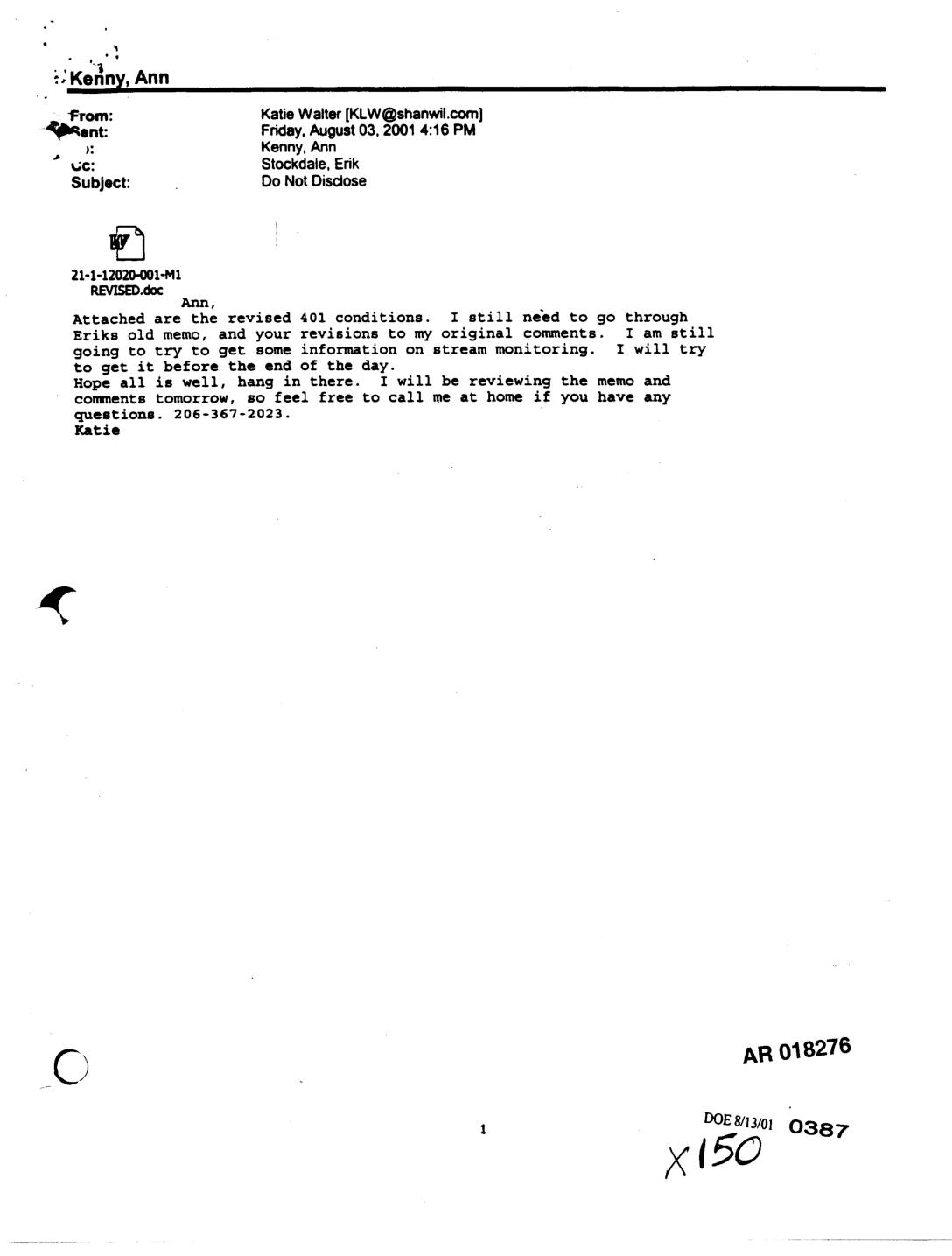
EXH AR018276: Draft 401 Conditions for Port Of Seattle NRMP Auburn Mitigation Site — Memorandum from Katie Walter to Ann Kenny
Deliberative memorandum dated August 3, 2001 from Katie Walter (Shannon & Wilson, Inc.) to Ann Kenny (Washington State Department of Ecology), transmitting revised draft 401 conditions for the Port Of Seattle Natural Resources Mitigation Plan (NRMP) Auburn Mitigation Site. Document 21-1-12020-001-M1 REVISED.doc covers Auburn Mitigation Site revisions including culvert placement issues on June 28, 2001 -
 2001-08-03
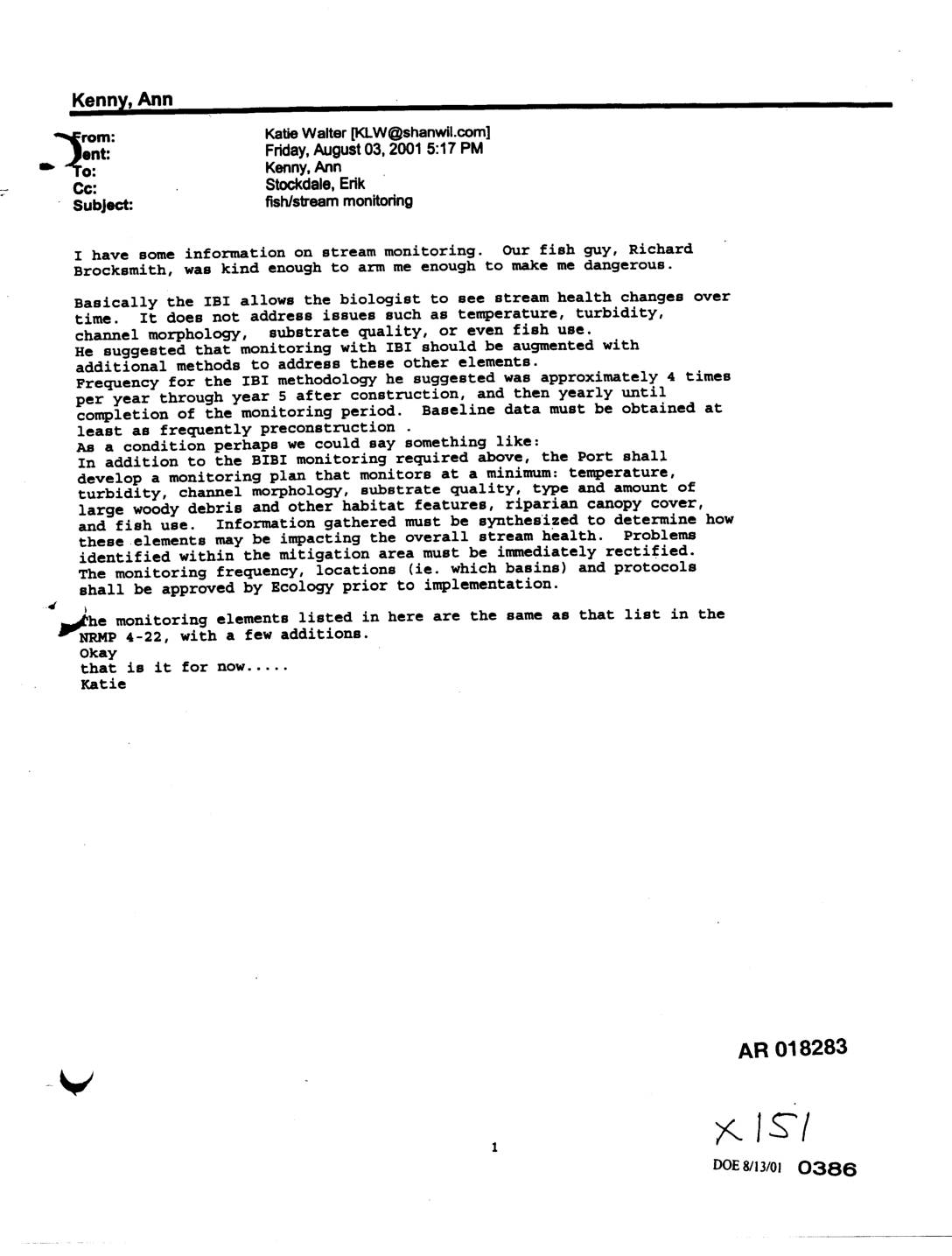
EXH AR018283: Email from Katie Walter to Ann Kenny Regarding Fish/Stream Monitoring Plan
Email dated August 3, 2001 from Katie Walter (KLW@shanwil.com) to Ann Kenny, cc Erik Stockdale, regarding fish and stream monitoring recommendations for Port Of Seattle mitigation area. Discusses IBI (Index of Biotic Integrity) methodology limitations and augmentation with monitoring of temperature, turbidity, channel morphology, substrate quality, large woody debris, riparian canopy cover, and fish use. -
 2001-08-03
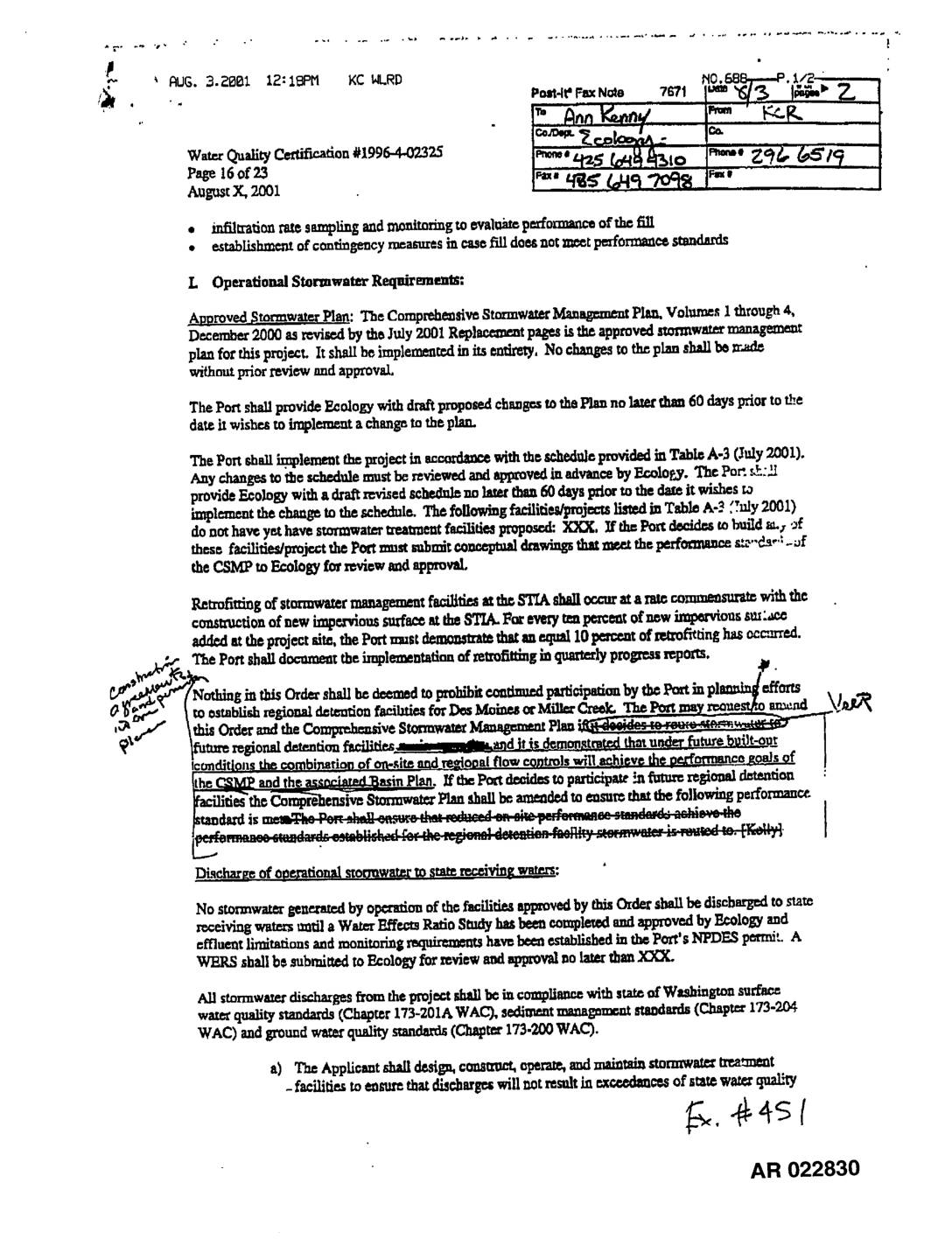
Exhibit 451: Water Quality Certification #1996-4-02325 Draft — Operational Stormwater Requirements (Pages 16–17)
This August 2001 draft document outlines Water Quality Certification conditions (#1996-4-02325) governing stormwater management at Seattle-Tacoma International Airport (Sea-Tac). It sets requirements for the Port of Seattle to implement and maintain a Comprehensive Stormwater Management Plan, including retrofitting existing impervious surfaces, meeting state water quality standards, and obtaining Ecology approval before discharging stormwater to receiving waters. The document also addresses scheduling, flow control benchmarks, and the use of all known available and reasonable treatment methods (AKART) for runoff from impervious surfaces.