TagPart 150(269)
-
 1998-02-04
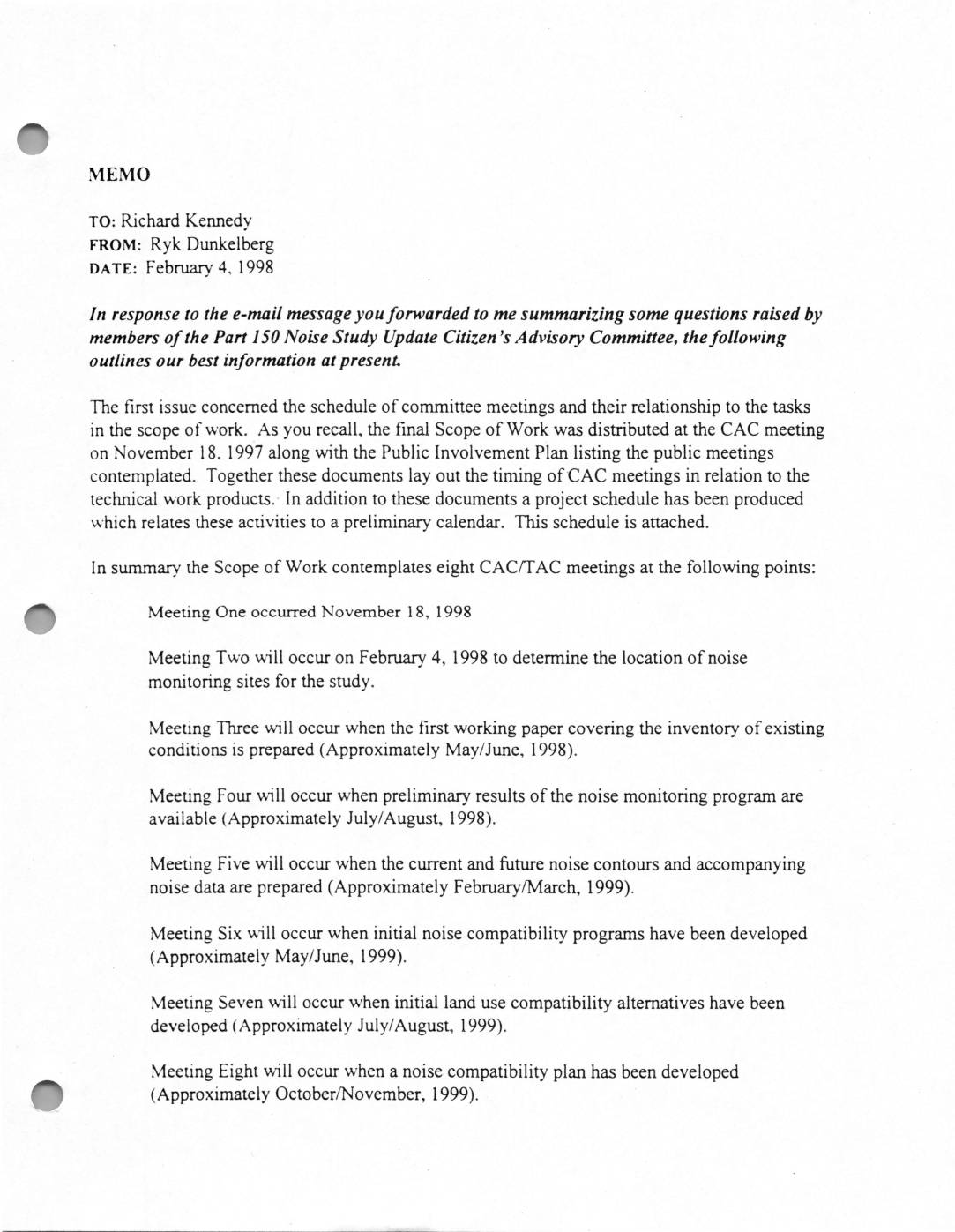
Memo: Ryk Dunkelberg to Richard Kennedy on Part 150 CAC Meeting Schedule and Part 161 FAQs
A 1998 internal memo from Ryk Dunkelberg to Richard Kennedy outlines the schedule of eight public CAC/TAC meetings planned through 1999 for the Part 150 Noise Study Update at Sea-Tac Airport, along with broader public engagement activities such as workshops, newsletters, and a project website. The memo also explains the Port of Seattle's cautious policy toward FAR Part 161 aircraft noise regulations, noting that no such studies have ever been successfully approved by the FAA and that pursuing one could jeopardize existing noise abatement programs. Additionally, it addresses the potential acquisition of residential properties in the Approach Transition Areas, stating that no decision has been made and that further study and federal funding would be required. -
 1998-01-01
MAC Part 150 Residential Sound Insulation Program: 1992–1997 Completion & Funding Summary
The MAC Part 150 Residential Sound Insulation Program completed sound insulation work on 3,673 homes near Minneapolis-St. Paul International Airport between 1992 and 1997, at a total cost of $76.6 million. Funding came from two sources: $28.7 million in FAA Airport Improvement Program (AIP) grants and $48.6 million in MSP Passenger Facility Charges (PFC). The program grew significantly over its six-year run, peaking in 1996 with 1,002 homes insulated at a cost of $20.7 million. -
 1996-08-01
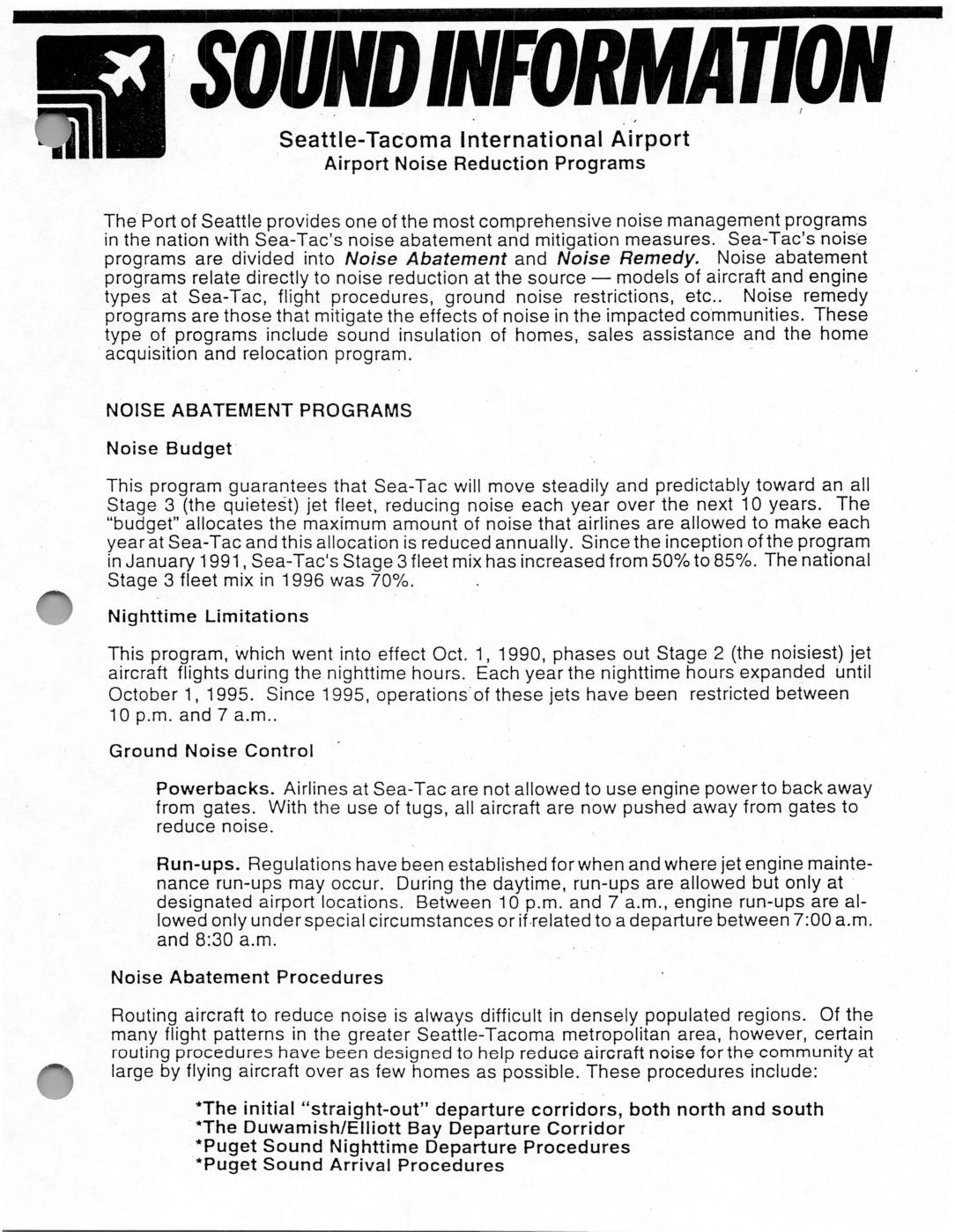
STIA Airport Noise Reduction Programs: Sound Information Fact Sheets
Seattle-Tacoma International Airport operates one of the nation's most comprehensive airport noise management programs, divided into Noise Abatement measures — such as restricting the noisiest Stage 2 jets at night, controlling ground engine use, and routing flight paths over fewer homes — and Noise Remedy programs that help affected residents through home sound insulation, sales assistance, and a completed acquisition program that purchased 1,400 severely impacted homes. The Port of Seattle also monitors noise levels through an 11-station system and tracks flight paths using FAA radar data to ensure compliance. Residents can report concerns or request information 24 hours a day via the Noise Information/Complaint Line at 433-5393 or toll-free at 1-800-826-1147. -
 1996-03-27
Comparison of Expert Arbitration Panel’s review of noise and demand/system management issues at Sea-Tac Airport in March 1996 and FAA’s record of approval of Sea-Tac’s Part 150 noise compatibility program
This document compares a 1996 Expert Arbitration Panel's findings on aircraft noise at Seattle-Tacoma International Airport with the FAA's 2013-2018 Part 150 Noise Compatibility Program approval, revealing that many of the same unresolved noise abatement and mitigation issues identified decades ago remain unaddressed today. Communities surrounding Sea-Tac — including Burien, Normandy Park, and Des Moines — continue to experience increasing noise and air pollution as flight operations have grown from 387,000 in 1995 to over 438,000 in 2018. The document calls out regulators and the Port of Seattle for failing to make meaningful progress on commitments such as nighttime flight restrictions, engine run-up controls, and departure corridor compliance. -
 1994-05-18
Seattle-Tacoma International Airport FAR Part 150 Noise Compatibility Program: 1993 Amendments
This document presents the Seattle-Tacoma International Airport FAR Part 150 Noise Compatibility Program: 1993 Amendments, submitted by the Port of Seattle and approved by the Federal Aviation Administration on May 18, 1994. It outlines updates to existing noise-reduction measures—including sound insulation for homes and public buildings, a transaction assistance program, and an expanded noise monitoring system—as well as newly recommended measures such as community planning forums and operational reviews. The program aims to reduce noncompatible land uses around Sea-Tac Airport and prevent the introduction of new ones. -
 1994-05-18
Seattle-Tacoma International Airport FAR Part 150 Noise Compatibility Program: 1993 Amendments
This document presents the Seattle-Tacoma International Airport FAR Part 150 Noise Compatibility Program: 1993 Amendments, submitted by the Port of Seattle and approved by the Federal Aviation Administration on May 18, 1994. It outlines a series of noise mitigation measures—including sound insulation programs for homes and public buildings, a transaction assistance program for affected property owners, and an expanded noise monitoring system—aimed at reducing noncompatible land uses around Sea-Tac Airport. Three new measures were also recommended, covering funding for land use planning, a community planners forum, and ongoing operations review and noise exposure map updates. -
 1994-01-01
Archive Box 1319: MSA Expert Panel Correspondence, Port Of Seattle Noise Management Reports, and Airport Litigation Documents (1994–1996)
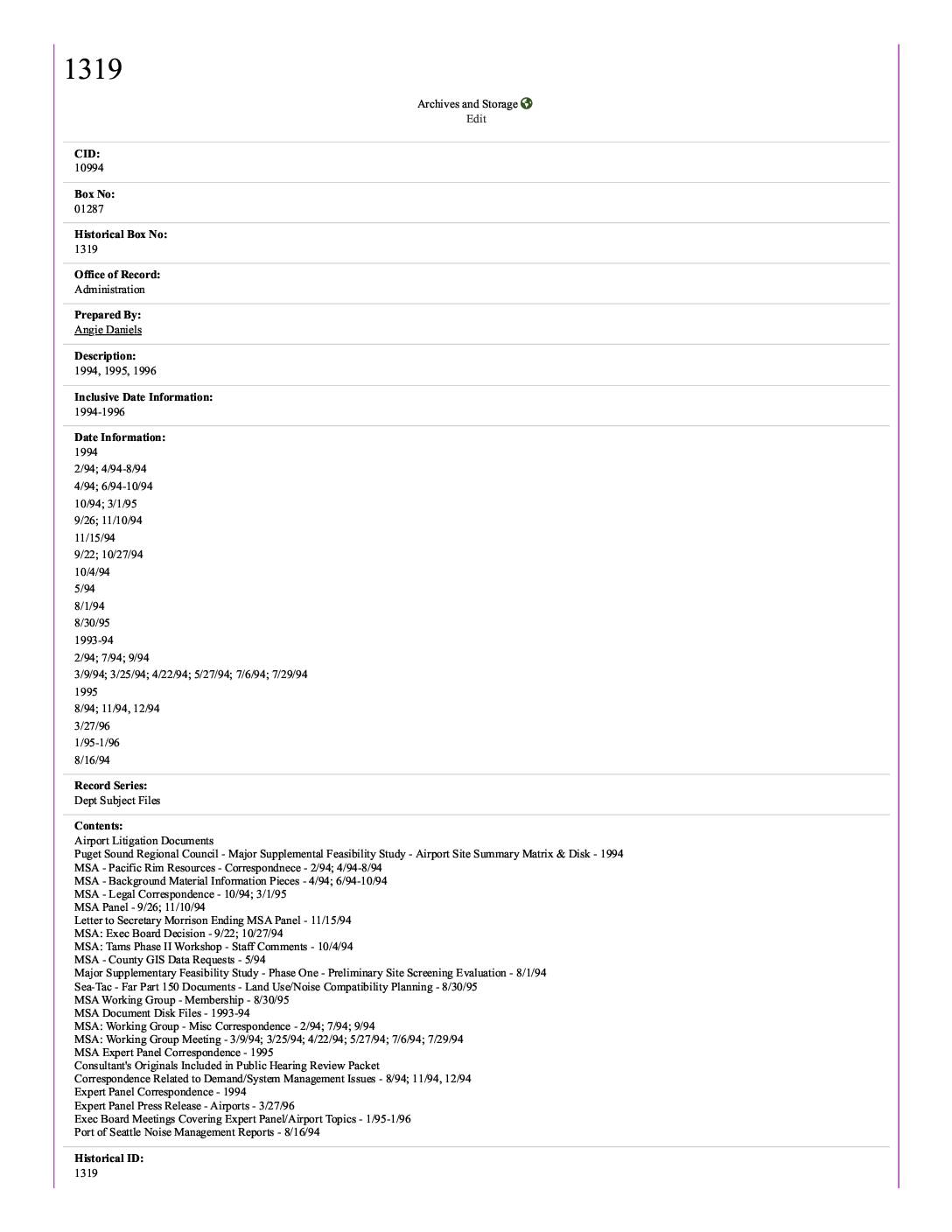
This archival box (Historical Box No. 1319) contains administrative records from 1994–1996 related to Sea-Tac Airport noise and site planning, including MSA Expert Panel correspondence, airport litigation documents, Puget Sound Regional Council feasibility study materials, and Port of Seattle Noise Management Reports. The files document working group meetings, legal correspondence, executive board decisions, and public hearing review packets connected to major supplementary feasibility studies and land use/noise compatibility planning. Records are held at the Washington State Archives. -
1994-01-01
Archive Box 1319: MSA Expert Panel Correspondence, Port Of Seattle Noise Management Reports, and Airport Litigation Documents (1994–1996)
This is an archival catalog record (CID 10994, Box 01287, Historical Box 1319) from the Port of Seattle Administration, prepared by Angie Daniels. It documents Dept Subject Files covering 1994–1996, including MSA (Major Supplementary Airport) feasibility studies, Puget Sound Regional Council airport site screening, Sea-Tac Far Part 150 land use/noise compatibility planning, expert panel correspondence, and exec board meetings on airport/noise topics. -
 1993-04-15
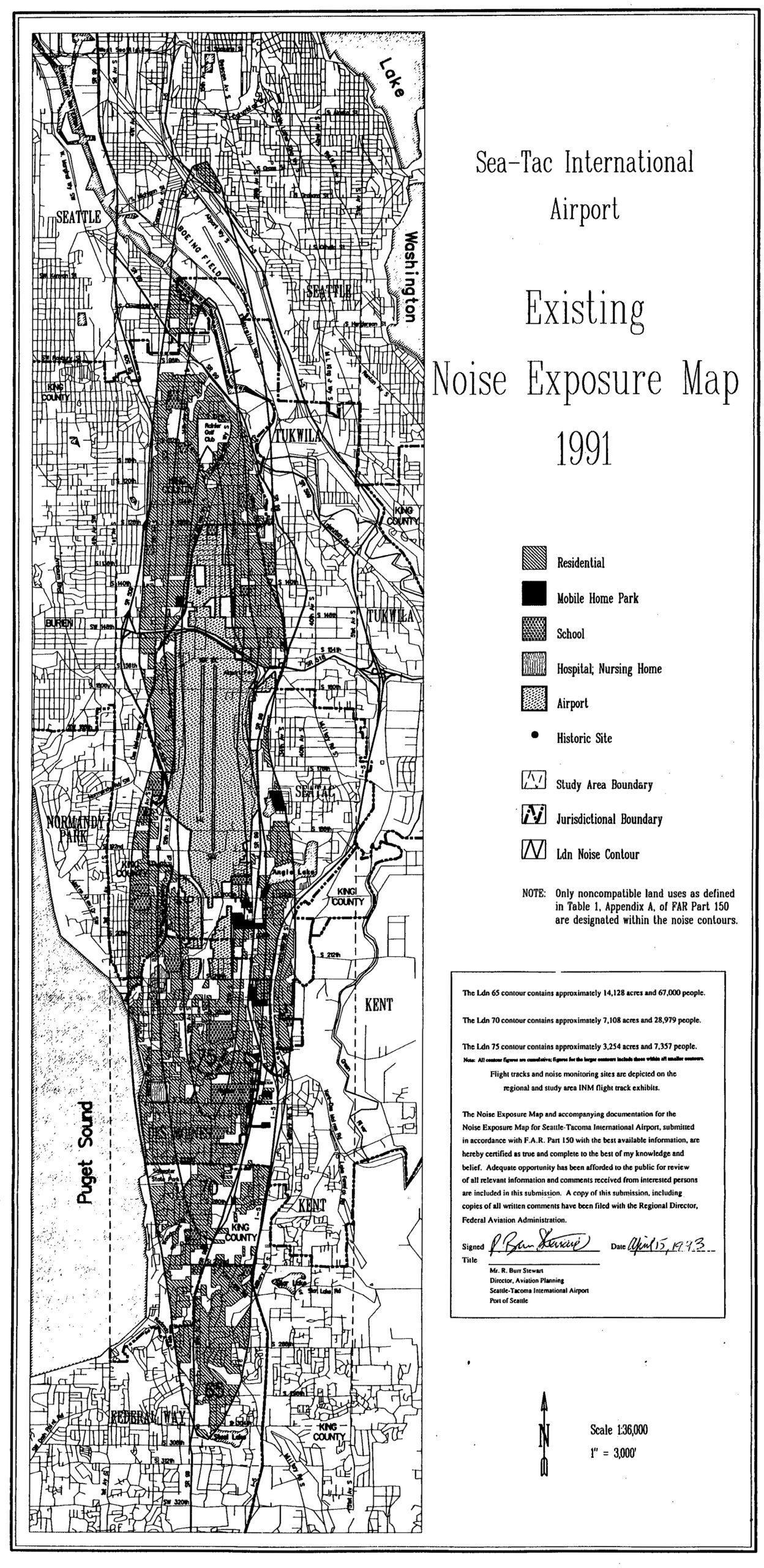
1991 Sea-Tac Part 150 Noise Exposure Map NEM
This is the official 1991 Existing Noise Exposure Map for Seattle-Tacoma International Airport, submitted in accordance with F.A.R. Part 150, signed by R. Bun Stewart, Director of Aviation Planning, Port of Seattle, on April 15, 1993. The map depicts Ldn noise contours (65, 70, and 75) over the surrounding communities including Seattle, Tukwila, SeaTac, Normandy Park, Burien, Kent, and Federal Way, with the Ldn 65 contour encompassing approximately 14,128 acres and 67,000 people. -
 1993-04-15
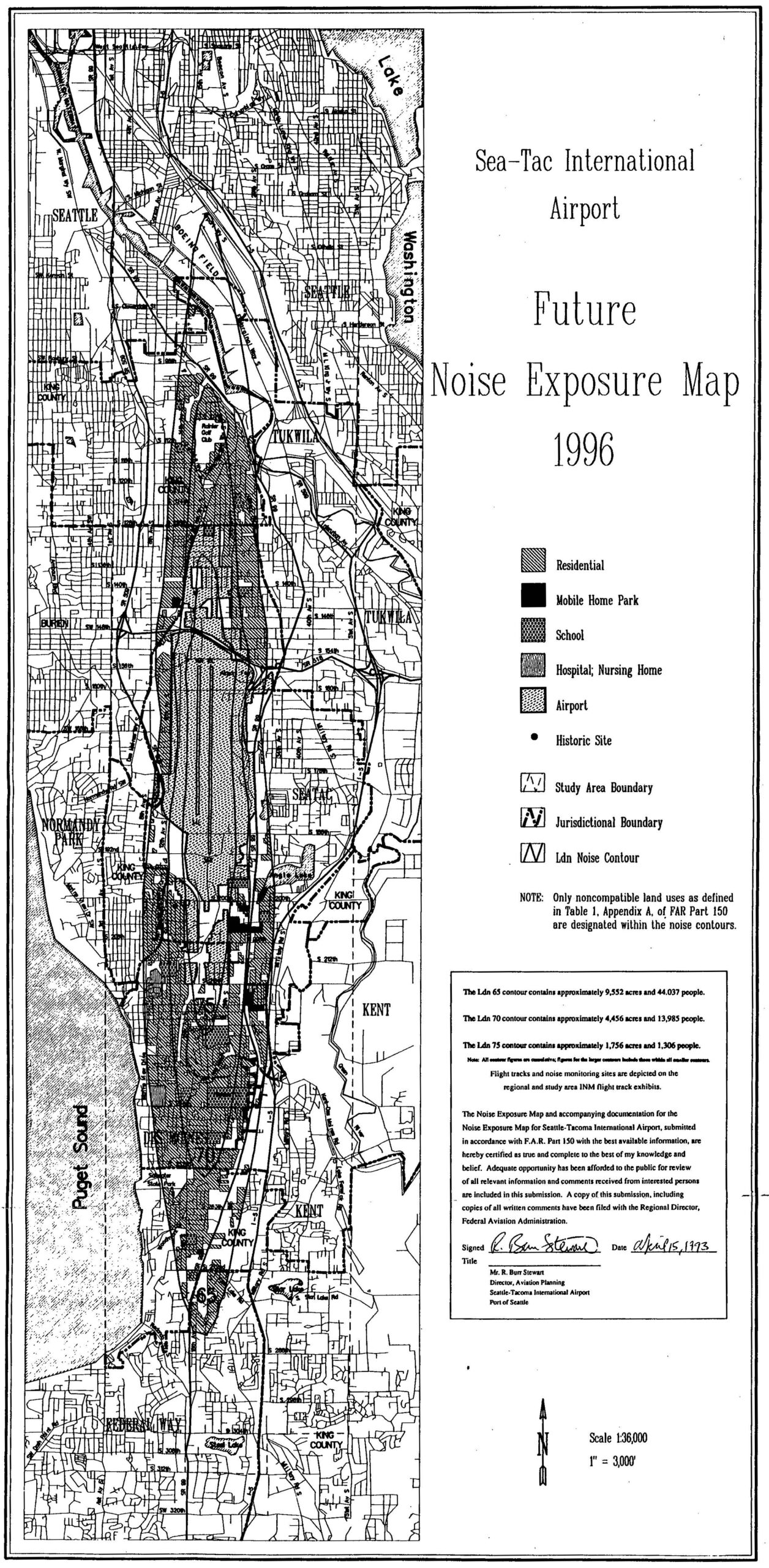
Noise Exposure Map NEM Future 1996 pg 210 from 1993 Part 150 Study
A Future Noise Exposure Map for Seattle-Tacoma International Airport projecting 1996 noise contours (Ldn 65, 70, and 75), showing affected land uses including residential, schools, and hospitals across the Sea-Tac area. Signed by R. Burr Stewart, Director of Aviation Planning, Port of Seattle, and dated April 15, 1993, at a scale of 1:36,000.