TagNPDES(130)
-
 1998-12-17
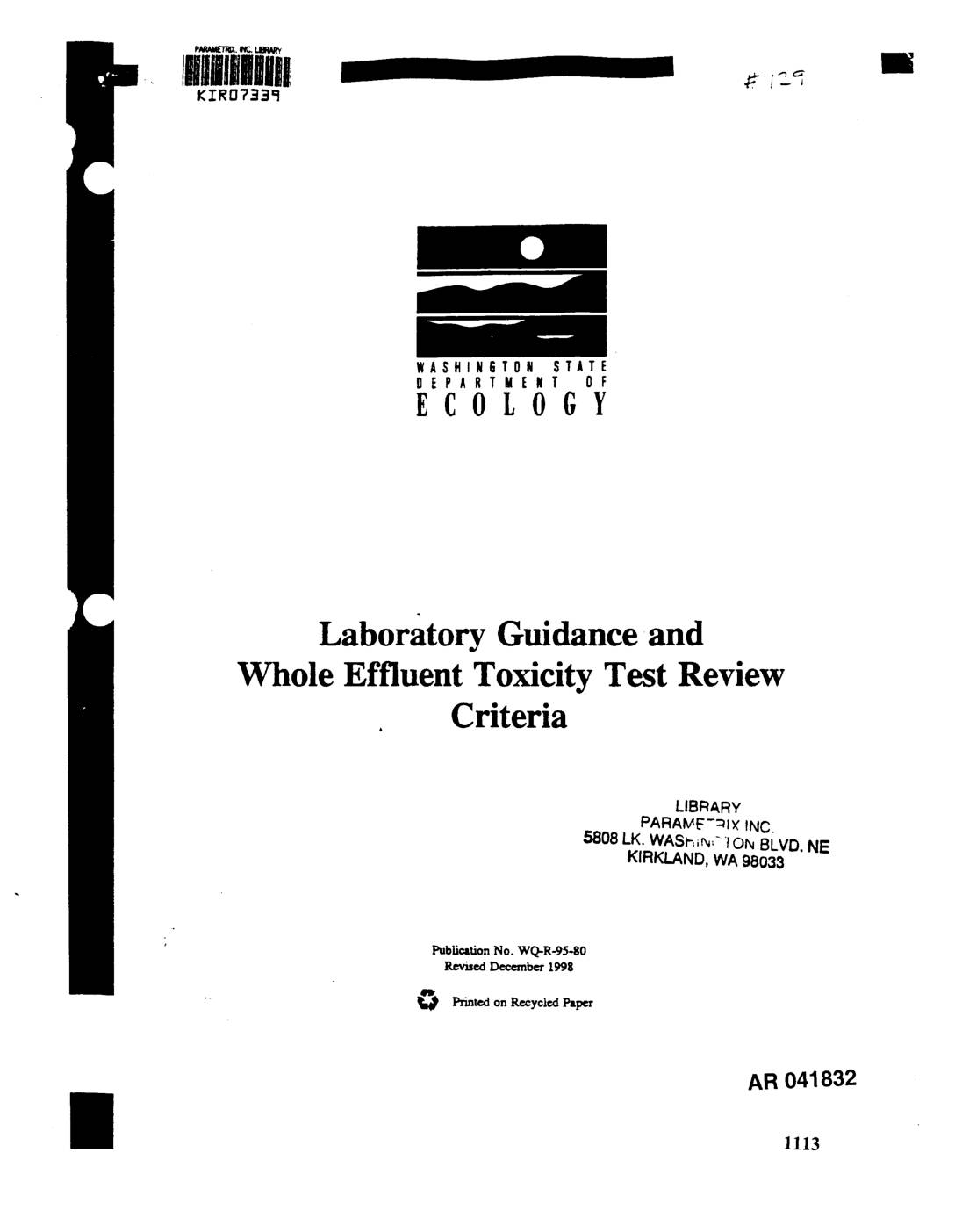
EXH AR041832: Laboratory Guidance and Whole Effluent Toxicity Test Review Criteria
Washington State Department of Ecology, Water Quality Program publication (WQ-R-95-80, revised December 1998) providing laboratory guidance and Whole Effluent Toxicity (WET) test review criteria. Covers WET testing requirements in NPDES permits, options for permittees, invalid test criteria including EPA statistical flowcharts, negative controls, test termination, acceptable start counts, pH adjustment, randomization, and power standards. Also -
 1998-11-21
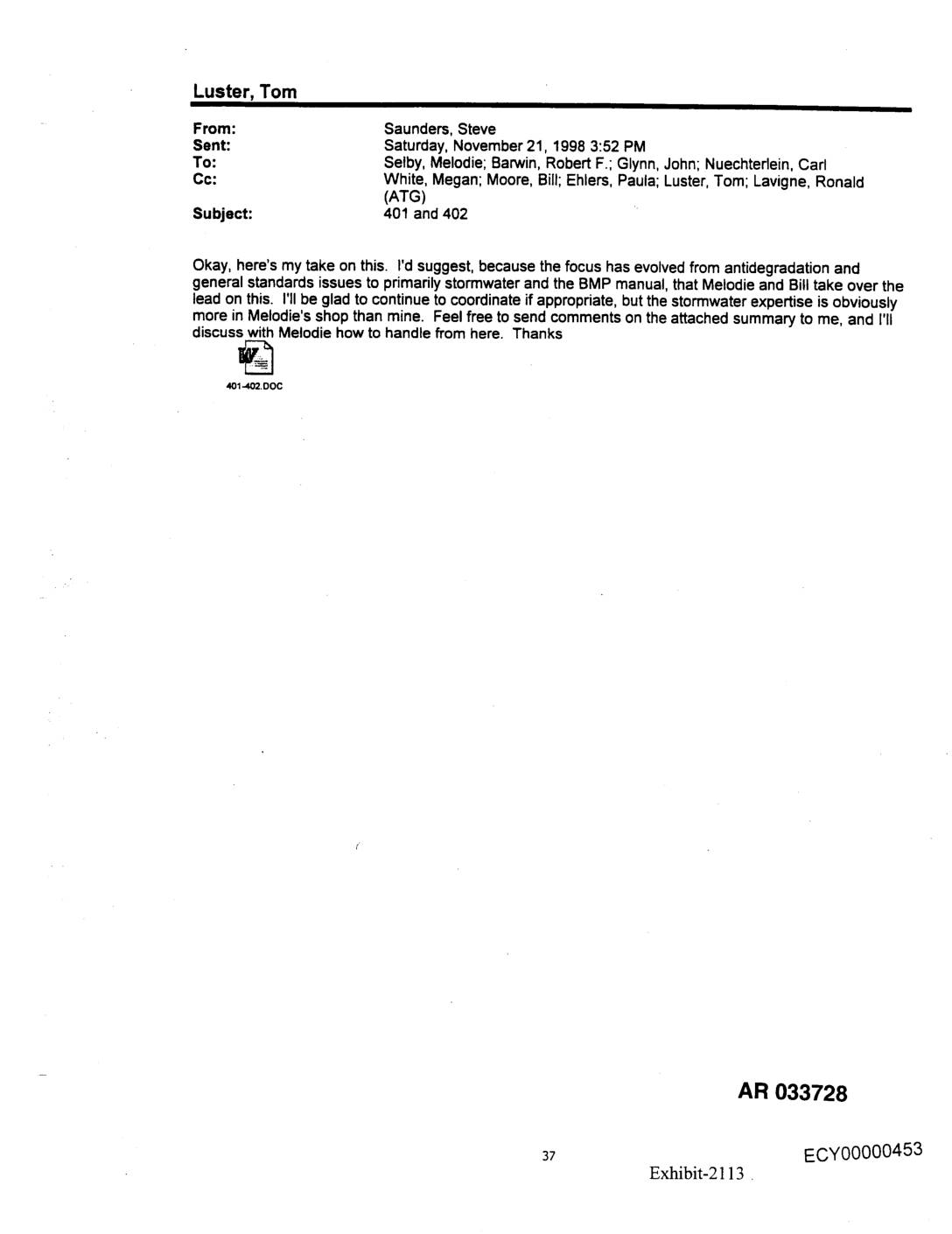
EXH AR033728: Ecology Water Quality Program — Relationship Between Clean Water Act Sections 401 and 402
Email from Steve Saunders (November 21, 1998) to Melodie Selby, Robert Barwin, John Glynn, Carl Nuechterlein, and others, recommending that Melodie Selby and Bill Moore take lead on CWA Sections 401 and 402 coordination due to stormwater and BMP manual focus. Attached is a Washington State Department of Ecology Water Quality Program summary memo analyzing -
 1998-11-17
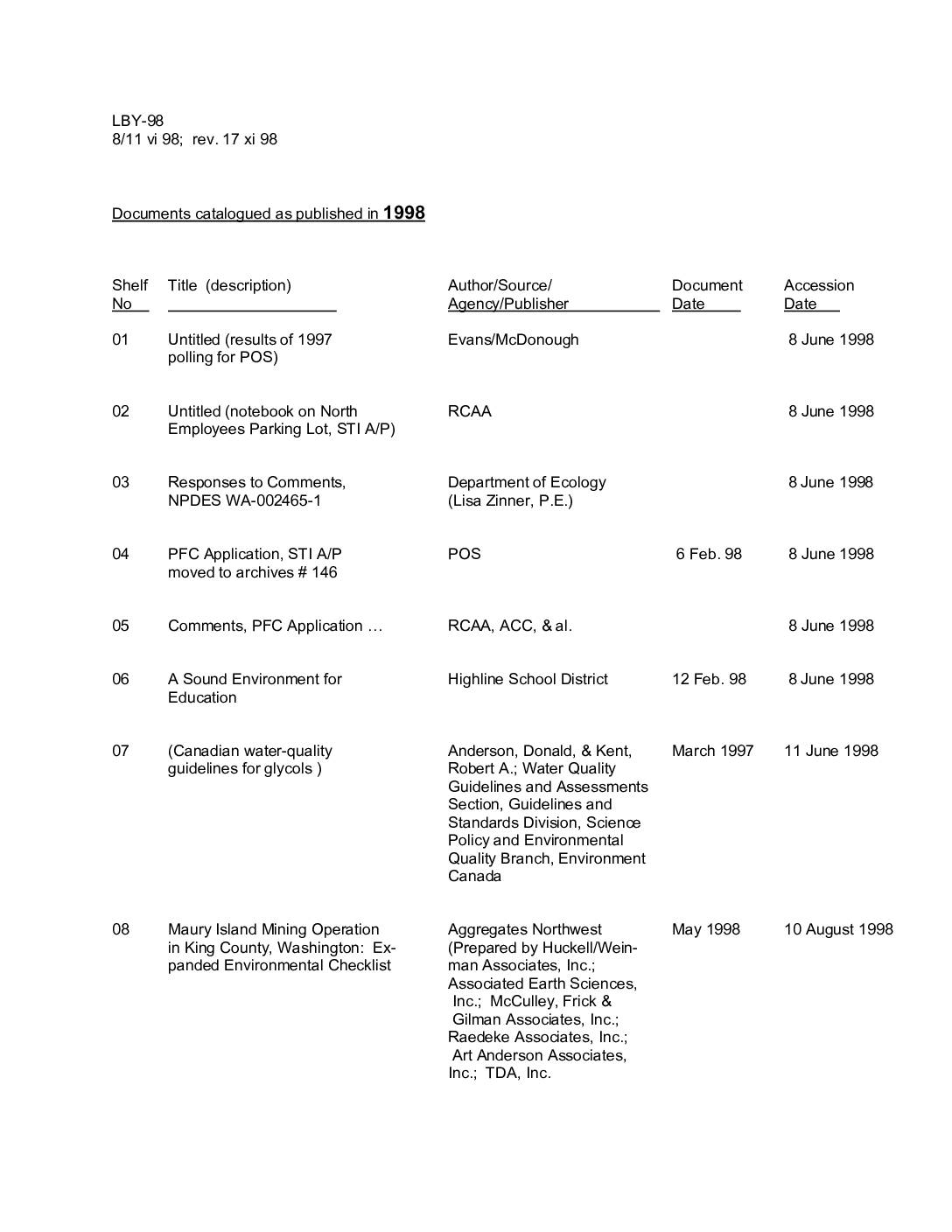
Documents catalogued as published in 1998
This is a catalog of 27 documents acquired by a library or archive in 1998, covering topics related to Seattle-Tacoma International Airport and its surrounding communities. The collection includes environmental reports, noise studies, NPDES water-quality permits, stormwater monitoring data, FAA safety materials, and a third-runway geotechnical study, as well as community-focused documents addressing aircraft noise impacts on local schools and residential areas. Each entry lists the document title, author or agency, original publication date, and the date it was added to the collection. -
 1998-11-01
EXH AR022233: Stormwater Pollution Prevention Plan — STIA
This Stormwater Pollution Prevention Plan (SWPPP), prepared by the Port of Seattle for Seattle-Tacoma International Airport in November 1998 (with revisions through December 2001), outlines strategies and best management practices (BMPs) to prevent pollutants from contaminating stormwater runoff at Sea-Tac Airport. The plan covers a range of potential pollution sources including aircraft servicing, deicing operations, spills, construction sites, and vehicle maintenance, and describes the airport's drainage systems and inspection requirements under its NPDES permit. It serves as a regulatory compliance document ensuring that airport operations minimize their impact on local water quality. -
 1998-11-01
EXH AR052594: Stormwater Pollution Prevention Plan — Seattle-Tacoma International Airport, Port Of Seattle
Stormwater Pollution Prevention Plan (SWPPP) for Seattle-Tacoma International Airport (Sea-Tac Airport), prepared by Port Of Seattle, originally November 1998 with Revision 1 (April 1999) and Revision 2 (December 2001). AR 052594. Covers drainage system description, potential pollution sources and Best Management Practices (BMPs) for aircraft servicing, ground anti-icing/deicing of roads and paved surfaces, snow storage, -
 1998-07-06
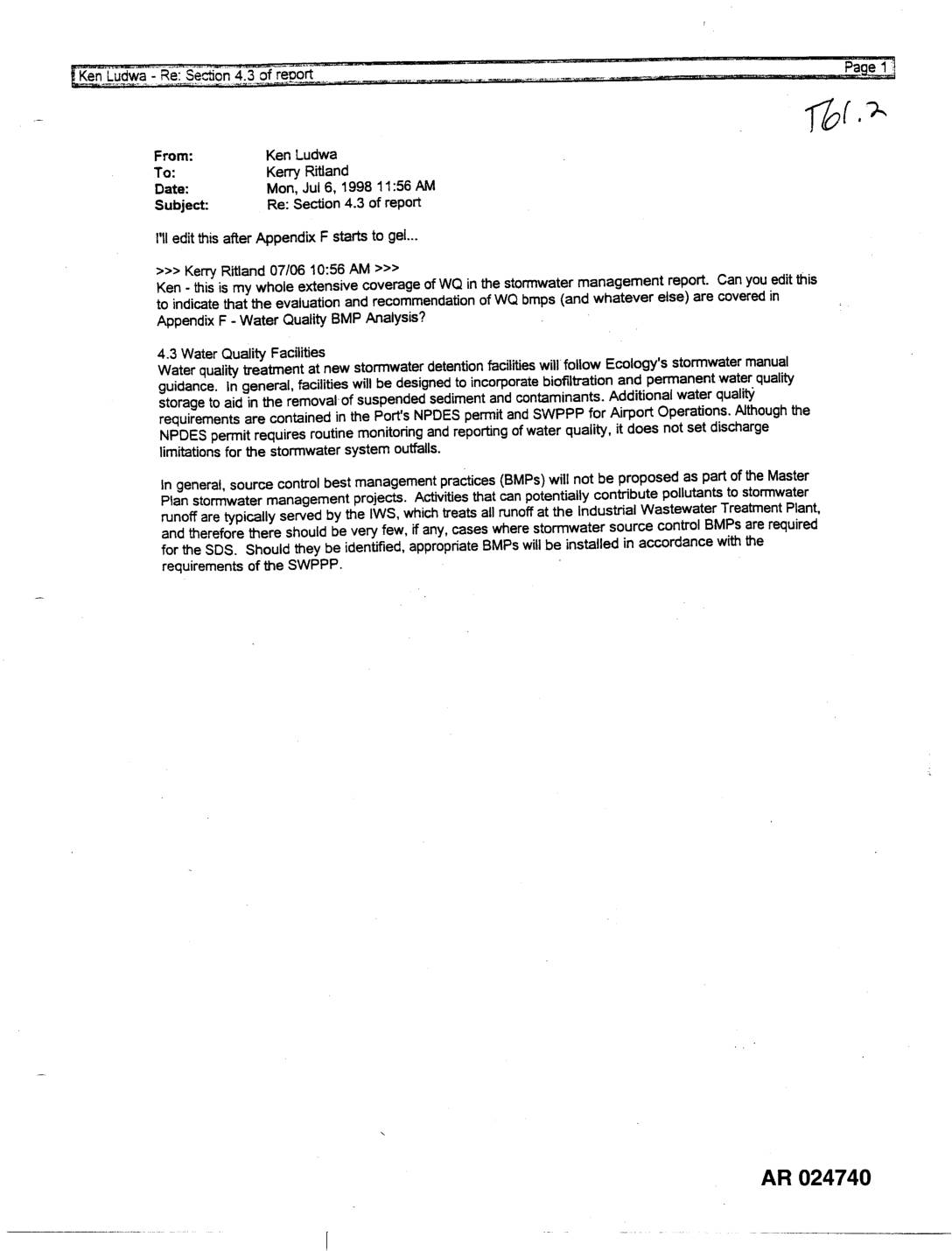
EXH AR024740: Internal Email — Section 4.3 Water Quality Facilities, Stormwater Mgmt RP
A 1998 internal email exchange between Ken Ludwa and Kerry Ritland discusses edits to Section 4.3 of a stormwater management report related to Sea-Tac Airport. The section covers water quality facilities, explaining that new stormwater detention facilities would follow state Ecology guidelines using biofiltration and permanent water quality storage, while also complying with the Port's NPDES permit and Stormwater Pollution Prevention Plan (SWPPP). Ken Ludwa agreed to edit the section to reference Appendix F – Water Quality BMP Analysis once that appendix was further developed. -
 1998-07-01
EXH AR024691: Memo — Reasonable Potential Analysis Results, STIA Third Runway
A July 1, 1998 memorandum from Parametrix, Inc. summarizes the results of a Reasonable Potential Analysis (RPA) conducted for the Seattle-Tacoma International Airport (STIA) Third Runway project, assessing stormwater runoff quality against water quality criteria for Miller Creek and Des Moines Creek. The analysis found that most pollutant concentrations after treatment with best management practices (BMPs) such as bioswales, sand filters, and wet ponds would meet criteria, with the exception of copper, which remained above acceptable levels. The memo also notes that during storms, pollutant concentrations already present in the receiving waters exceeded criteria and were higher than those predicted from Third Runway stormwater runoff. -
 1998-07-01
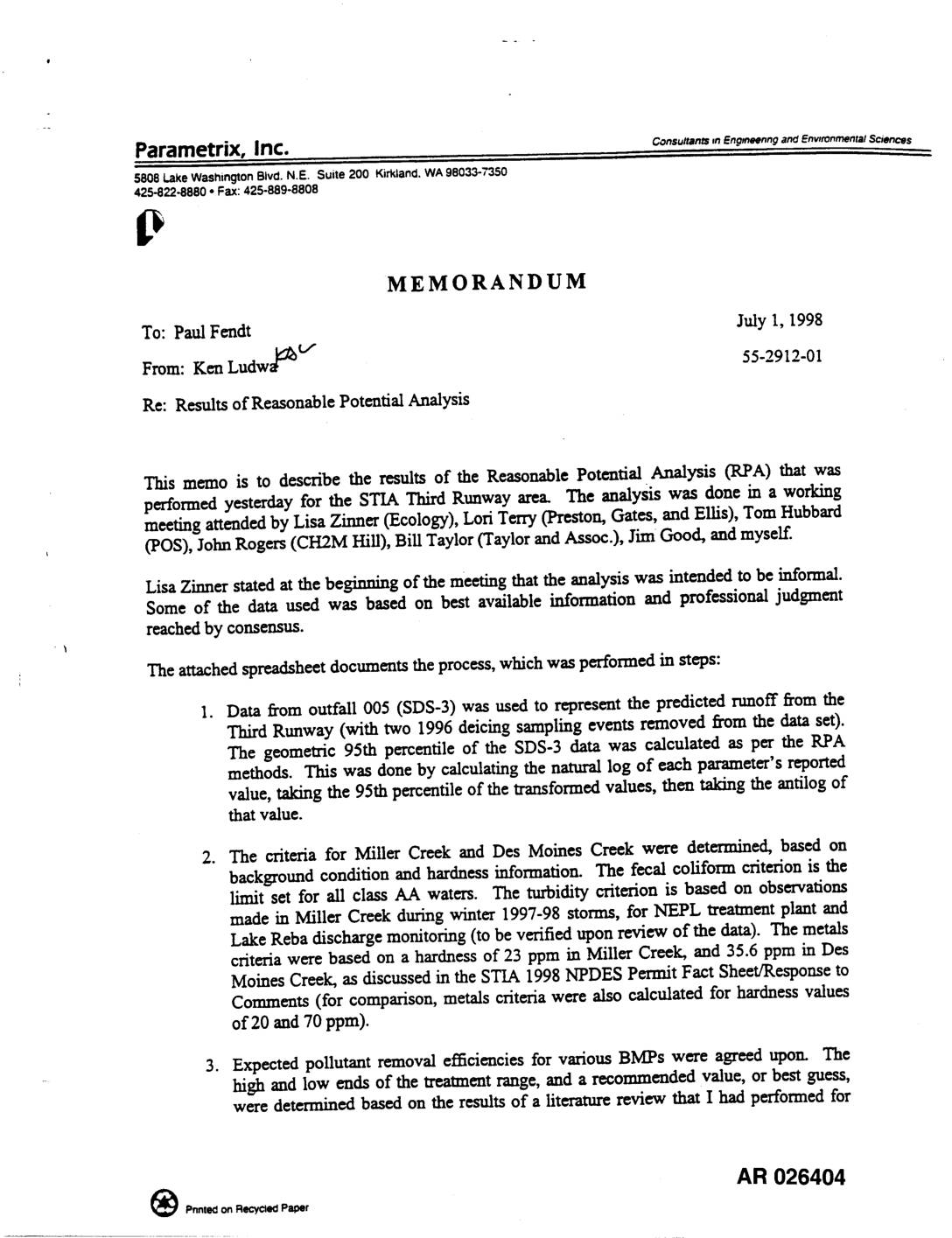
EXH AR026404: Memo — Reasonable Potential Analysis Results, STIA Third Runway
A 1998 internal memo from Parametrix, Inc. summarizes the results of a Reasonable Potential Analysis (RPA) conducted for the Seattle-Tacoma International Airport (STIA) Third Runway project, assessing whether stormwater runoff from the new runway could exceed water quality criteria in Miller Creek and Des Moines Creek. The analysis found that most pollutant concentrations after treatment with best management practices (BMPs) such as bioswales, sand filters, and wet ponds would meet criteria, with the exception of copper, which remained above acceptable levels. The memo also notes that existing pollutant concentrations in the receiving waterways during storms already exceeded criteria, even before accounting for Third Runway runoff. -
 1998-07-01
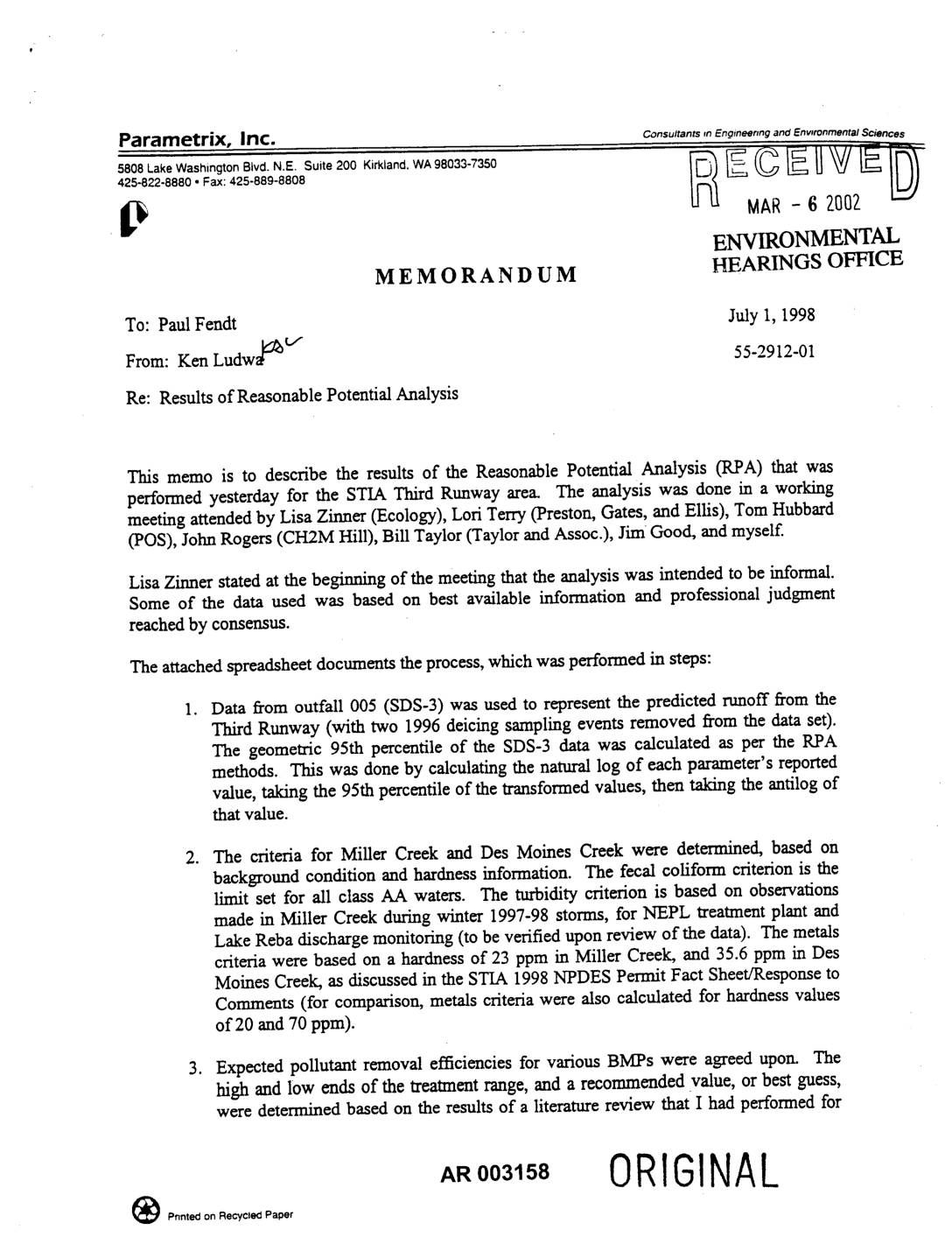
EXH AR003158: Memorandum — Results of Reasonable Potential Analysis for STIA Third Runway Stormwater
Memorandum from Ken Ludwa (Parametrix, Inc.) to Paul Fendt dated July 1, 1998, project number 55-2912-01, describing results of a Reasonable Potential Analysis (RPA) for the STIA Third Runway area stormwater runoff. Analysis conducted at a working meeting with Lisa Zinner (Ecology), Lori Terry (Preston, Gates, and Ellis), Tom Hubbard (POS), John Rogers (CH2M Hill), -
 1998-04-01
EXH AR027166: DMR April 1998 — Sea-Tac Airport Discharge Monitoring Report
Discharge Monitoring Report (DMR) for April 1998, permit number WA-002465-1, discharge number 001 (IWS), submitted by Port Of Seattle for Sea-Tac Airport (facility #681), P.O. Box 68727, Seattle WA 98168. Monitoring period covers April 1–30, 1998. Parameters monitored include flow (GPM), pH, oil and grease (mg/L), TSS (mg/L), BOD5 (mg/L), total glycols (mg/L), and TPH