Tagletter(41)
-
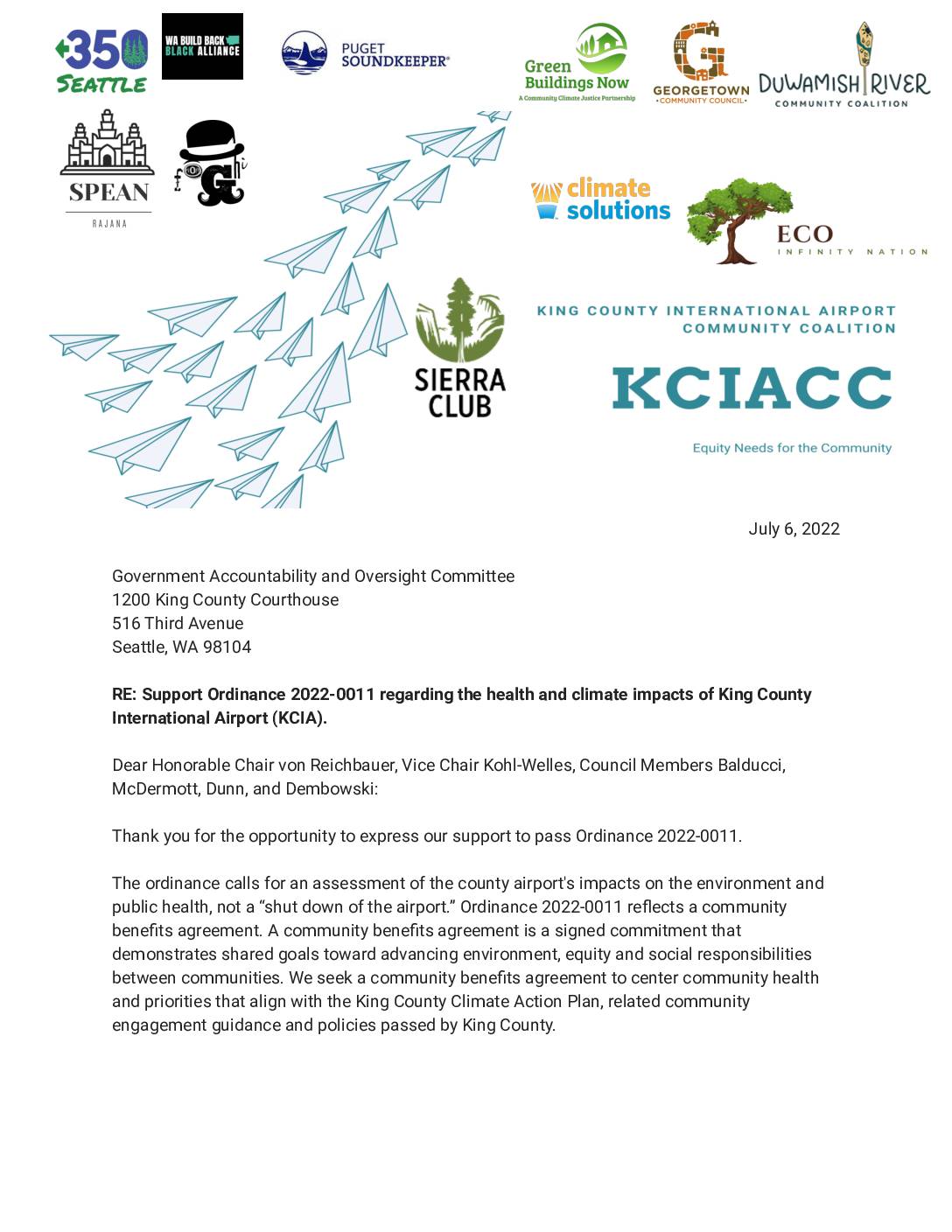 2022-07-06 00:00
Support Ordinance 2022-0011 regarding the health and climate impacts of King County International Airport (KCIA)
Letter from KCIACC and community organizations supporting Ordinance 2022-0011, which calls for environmental and health impact assessments at King County International Airport and establishment of a community-led advisory committee. The letter emphasizes the need for community benefits agreements and environmental justice for communities disproportionately impacted by airport operations. -
2019-06-21 11:36
Letter To PPP Members (July 2019)
An update on what we’ve been doing.First off, yes, I am running for City Council in Des Moines. And yes I did tell y’all that was not going to happen. Which already establishes my qualifications for a career in politics, right? 😀 But the reasons are pretty basic. First off,, win or lose, the act -
2018-08-24 10:40
Letter: Attend The Highline College SAMP Public Scoping Meeting
Directions To Highline College I’m writing to tell Des Moines residents about a very important public meeting with the Port Of Seattle at Highline College Student Union on Monday, September 10th at 5:30pm. At this meeting, the Port will explain something you may not be aware of: The Sustainable Airport Master Plan or ‘SAMP’. In -
 1996-10-21 00:00
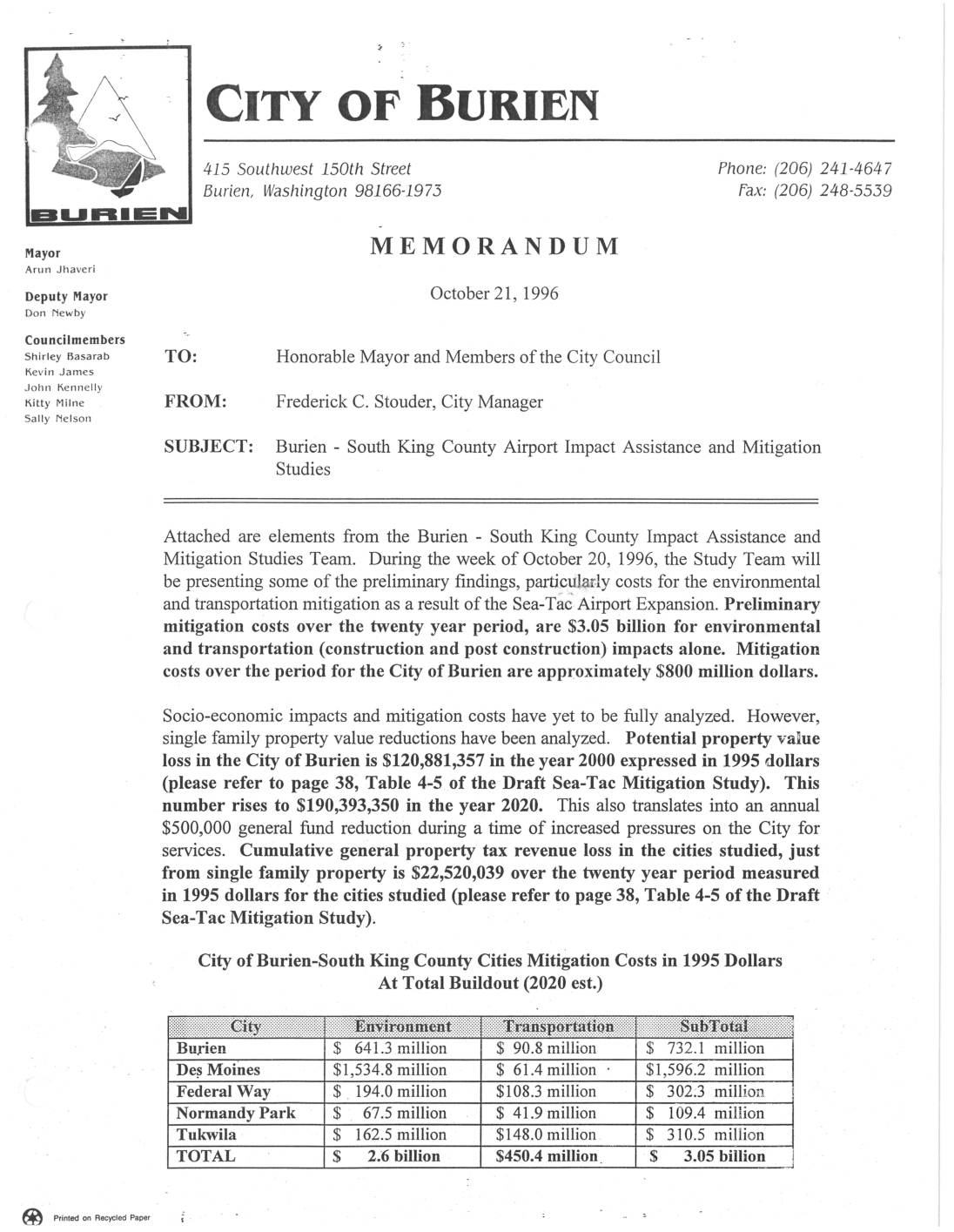
Burien – South King County Airport Impact Assistance and Mitigation
City Manager Fred Strouder letter with excerpts from 1997 Mitigation Study -
 1996-08-23 10:23
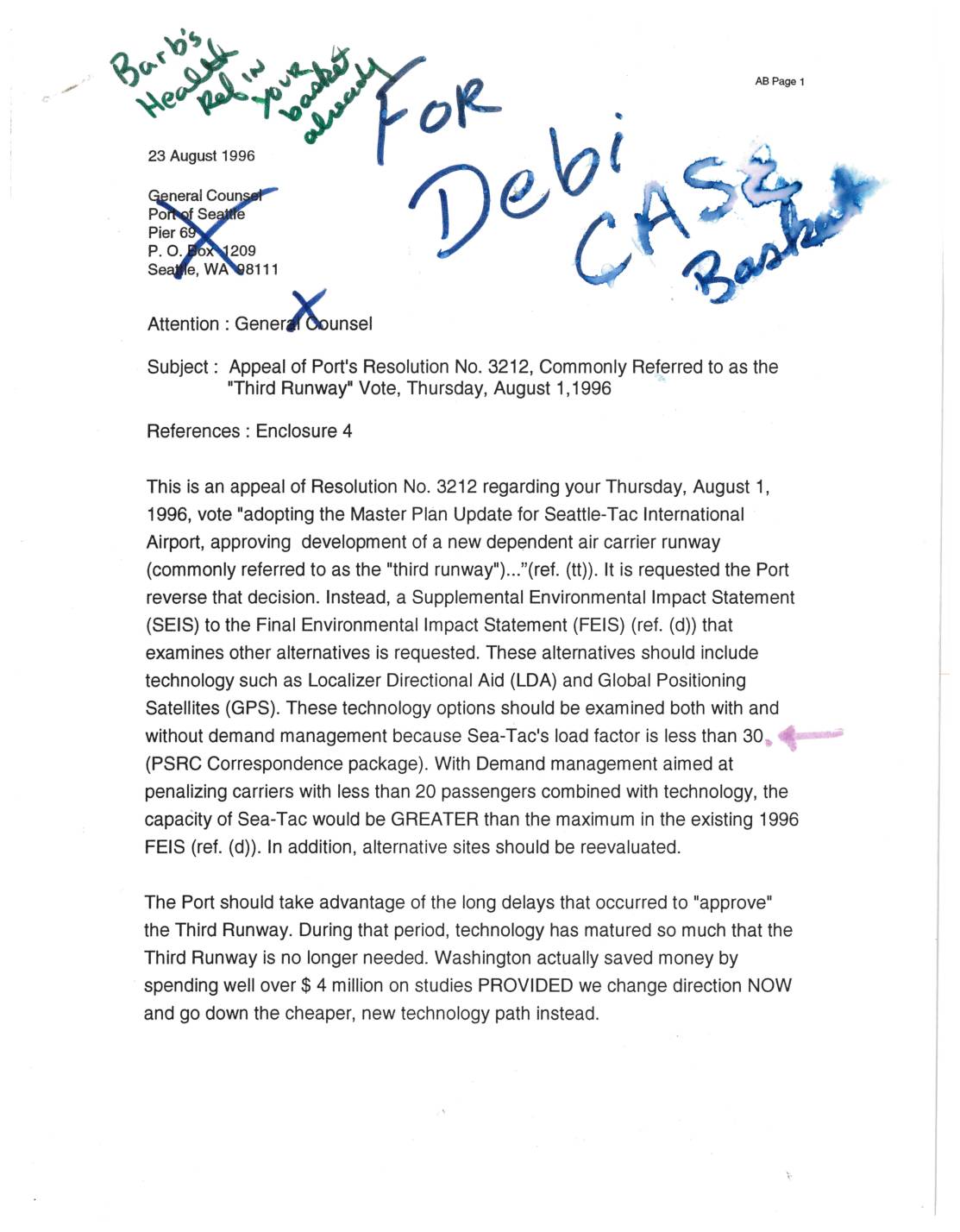
CASE Appeal of Port’s Resolution No. 3212 (Third Runway)
Subject: Appeal of Port's Resolution No. 3212, Commonly Referred to as the "Third Runway" Vote, Thursday, August 1,1996 References: Enclosure 4 This is an appeal of Resolution No. 3212 regarding your Thursday, August 1, 1996, vote "adopting the Master Plan Update for Seattle-Tac International Airport, approving development of a new dependent air carrier runway (commonly referred to as the "third runway") ... "(ref. (tt)) . It is requested the Port reverse that decision. Instead, a Supplemental Environmental Impact Statement (SEIS) to the Final Environmental Impact Statement (FEIS) (ref. (d)) that examines other alternatives is requested. These alternatives should include technology such as Localizer Directional Aid (LOA) and Global Positioning Satellites (GPS). These technology options should be examined both with and without demand management because Sea-Tac's load factor is less than 30• (PSRC Correspondence package). With Demand management aimed at penalizing carriers with less than 20 passengers combined with technology, the capaCity of Sea-Tac would be GREATER than the maximum in the existing 1996 FEIS (ref. (d)). In addition, alternative sites should be reevaluated. The Port should take advantage of the long delays that occurred to "approve" the Third Runway. During that period, technology has matured so much that the Third Runway is no longer needed. Washington actually saved money by spending well over$ 4 million on studies PROVIDED we change direction NOW and go down the cheaper, new technology path instead. .. r · .. '· The Port needs to consider the Air Transport Authority's March 20,1996 statement (ref. (rr)):… -
 1996-03-18 00:00
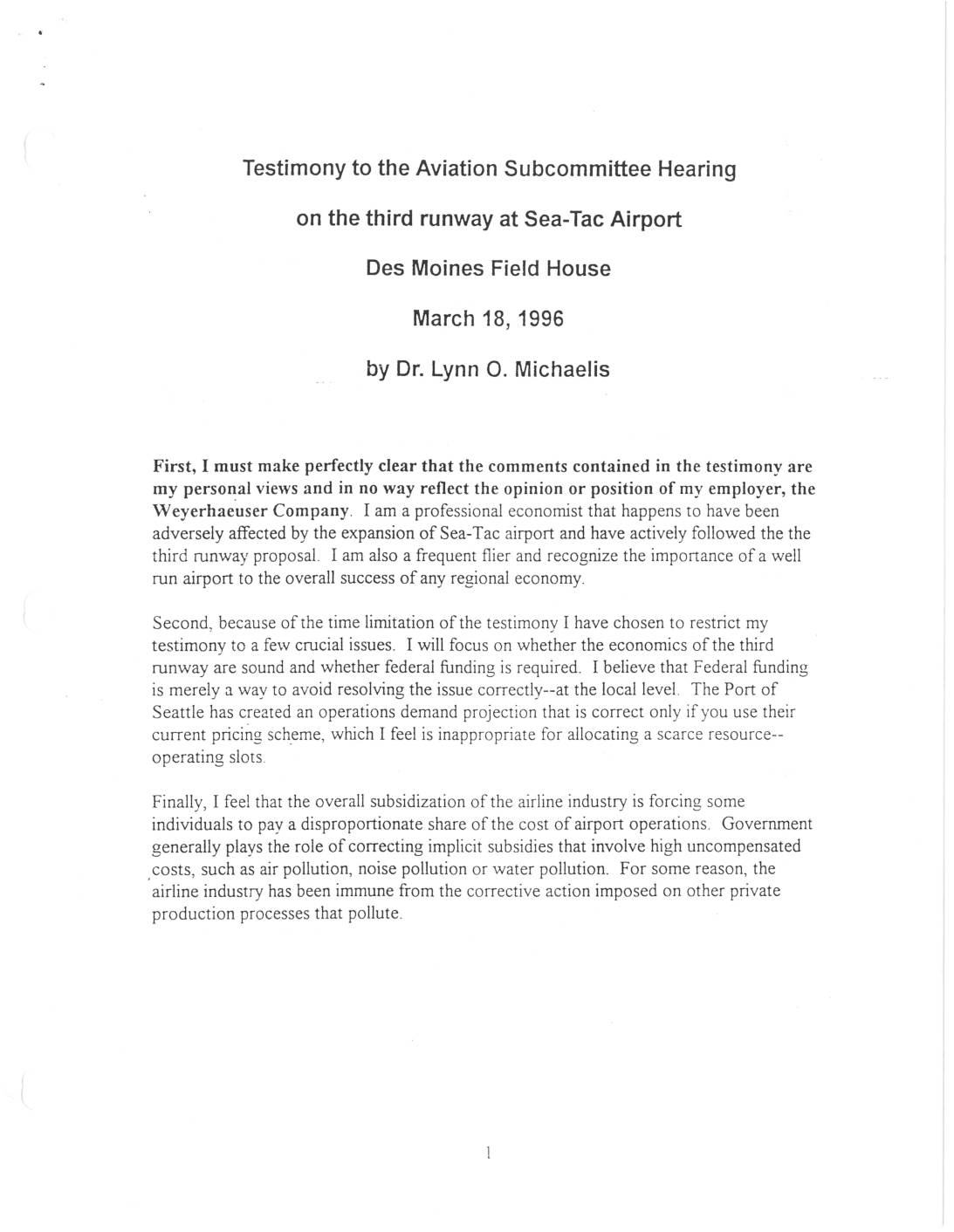
Dr. Lynn 0. Michaelis – Des Moines Fieldhouse Testimony To Aviation Subcommittee 03-18-1996
on the third runway at Sea-Tac Airport Des Moines Field House March 18, 1996 by Dr. Lynn 0. Michaelis First, I must make perfectly clear that the comments contained in the testimony are my personal views and in no way reflect the opinion or position of my employer, the Weyerhaeuser Company. I am a professional economist that happens to have been adversely affected by the expansion of Sea-Tac airport and have actively followed the the third runway proposal. I am also a frequent flier and recognize the importance of a well run airport to the overall success of any regional economy. Second, because of the time limitation of the testimony I have chosen to restrict my testimony to a few crucial issues. I will focus on whether the economics of the third runway are sound and whether federal funding is required. I believe that Federal funding is merely a way to avoid resolving the issue correctly--at the local level. The Port of Seattle has created an operations demand projection that is correct only if you use their current pricing scheme, which I feel is inappropriate for allocating a scarce resource-- operating slots Finally, I feel that the overall subsidization of the airline industry is forcing some individuals to pay a disproportionate share of the cost of airport operations. Government generally plays the role of correcting implicit subsidies that involve high uncompensated .costs, such as air pollution, noise pollution or water pollution. For some reason, the airline industry has been immune… -
 1993-12-22 00:00
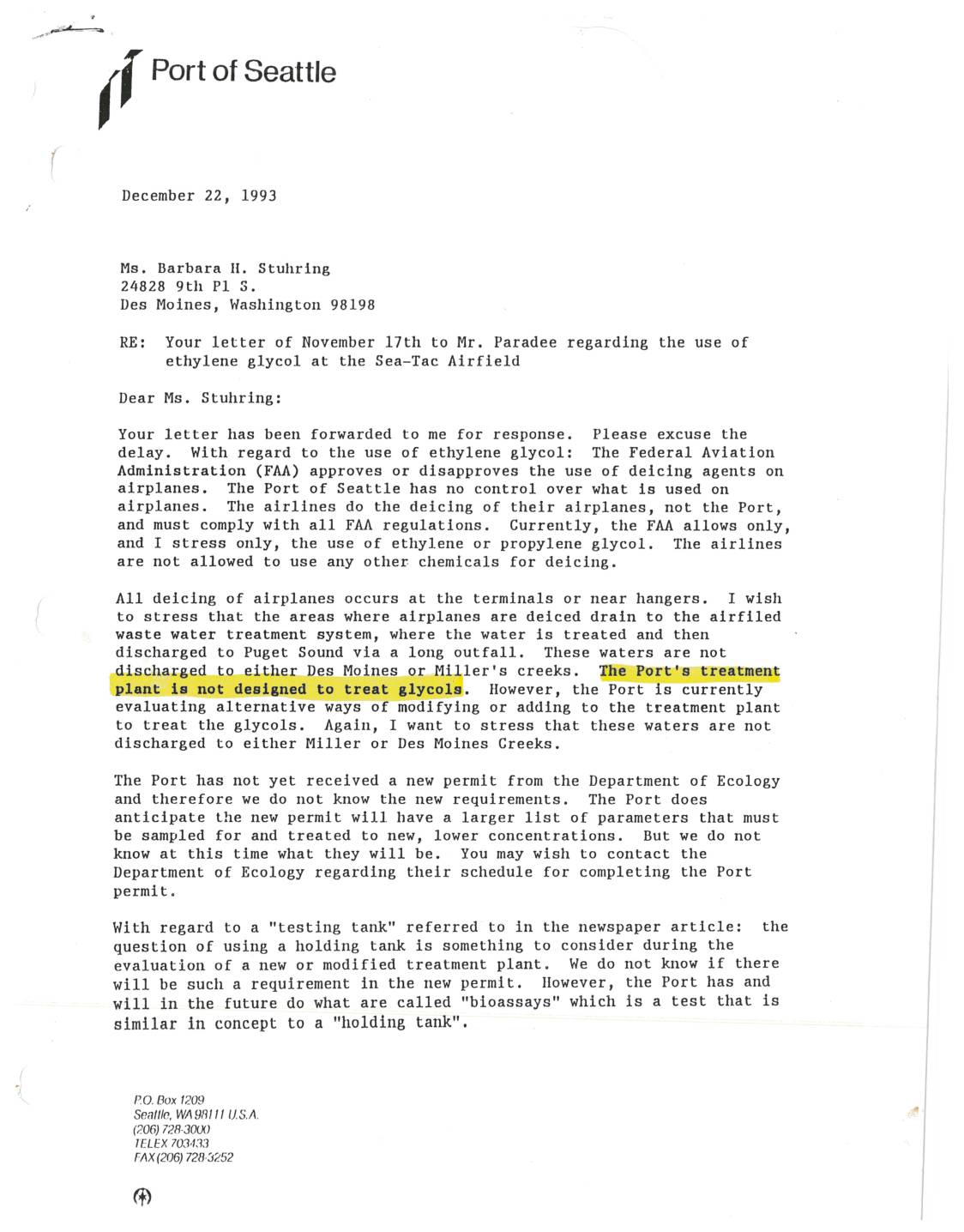
Letter to Barbara Stuhring re Deicing Ethylene Glycol water treatment
RE: Your letter of November 17th to Mr. Paradee regarding the use of ethylene glycol at the Sea-Tac Airfield Dear Ms. Stuhring: Your letter has been forwarded to me for response. Please excuse the delay. With regard to the use of ethylene glycol: The Federal Aviation Administration (FAA) approves or disapproves the use of deicing agents on airplanes. The Port of Seattle has no control over what is used on airplanes. The airlines do the deicing of their airplanes, not the Port, and must comply with all FAA regulations. Currently, the FAA allows only, and I stress only, the use of ethylene or propylene glycol. The airlines are not allowed to use any other chemicals for deicing. All deicing of airplanes occurs at the terminals or near hangers. I wish to stress that the areas where airplanes are deiced drain to the airfiled waste water treatment system, where the water is treated and then discharged to Puget Sound via a long outfall. These waters are not discharged to either Des Moines or Miller's creeks. The Port's rea~ment plant is not designed to treat glycols. However, the Port is currently evaluating alternative ways of modifying or adding to the treatment plant to treat the glycols. Again, I want to stress that these waters are not discharged to either Miller or Des Moines Greeks. The Port has not yet received a new permit from the Department of Ecology and therefore we do not know the new requirements. The Port does anticipate the… -
1992-06-12 20:31
Flight Patterns – FAA’s ‘Four Post’ traffic plan for planes is illogical, insulting
June 12, 1992 Publication: THE SEATTLE TIMES Page: A9 Word Count: 354 The Ninth Circuit in San Francisco recently voted that since the noise level was not above 65 decibels (recently raised from 55 decibels) the Federal Aviation Administration did not have to be subject to any environmental impact requirements. Therefore, the FAA’s brilliant “four post” plan remains -
 1984-07-19 00:00
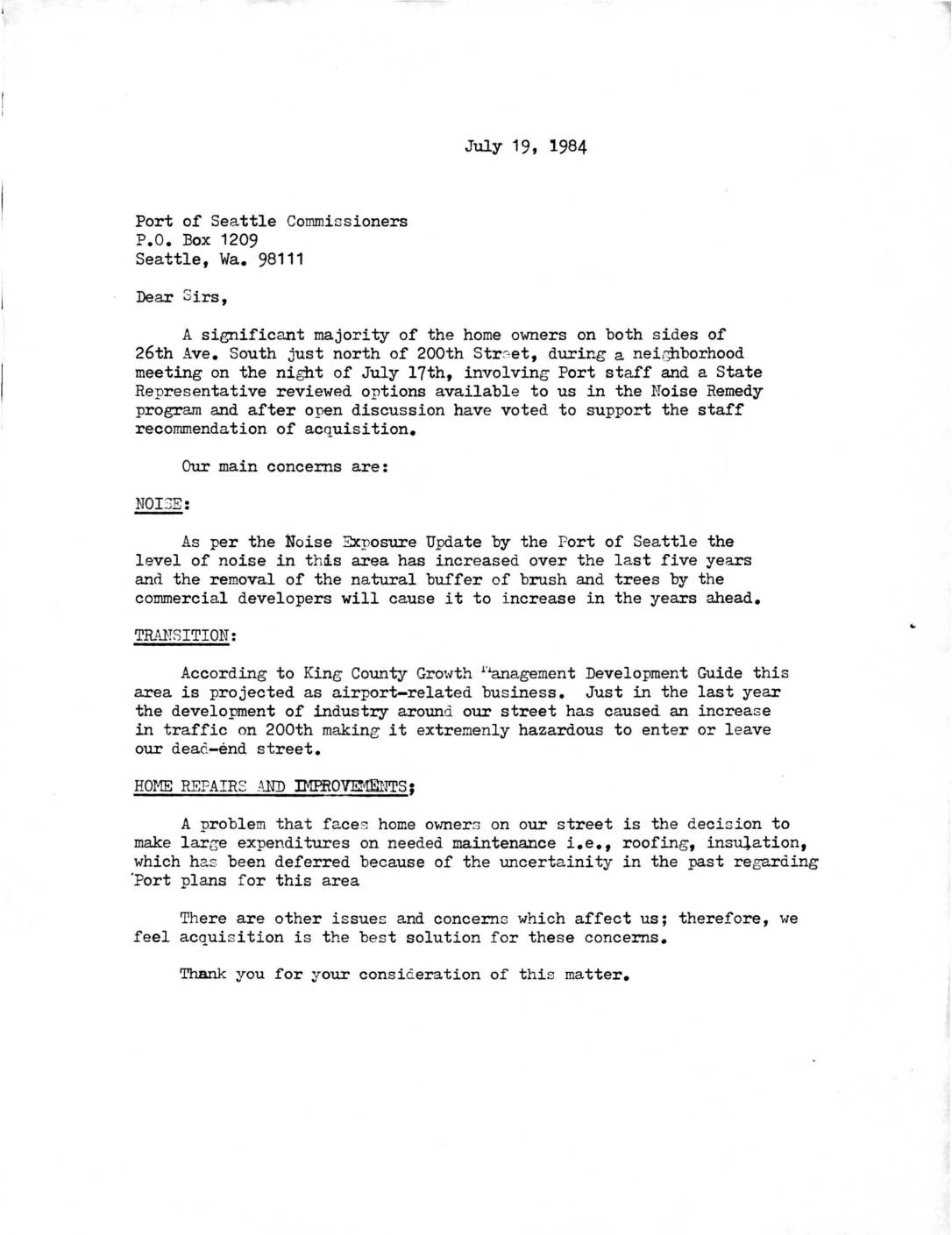
Homeowners Letter Supporting Port of Seattle Acquisition Program
Letter from homeowners on 26th Ave. South near 200th Street to Port of Seattle Commissioners requesting acquisition of their properties through the Noise Remedy program. The residents cite increasing noise levels, commercial development impacts, traffic hazards, and deferred home maintenance as reasons for supporting acquisition. -
 1984-01-23 19:43
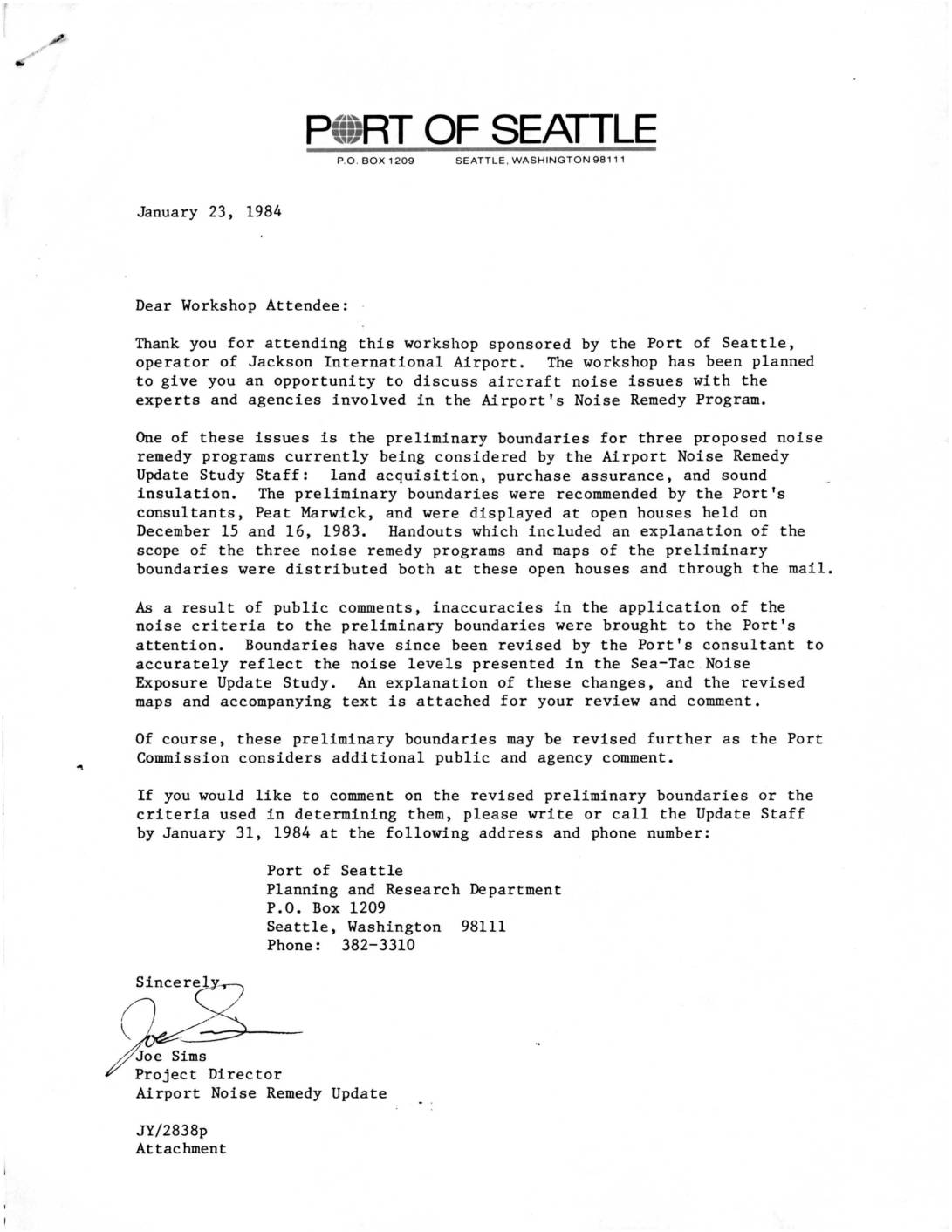
Noise Remedy Workshop: List of off-airport modifications to Chapter 5
Thank you for attending this workshop sponsored by the Port of Seattle, operator of Jackson International Airport. The workshop has been planned to give you an opportunity to discuss aircraft noise issues with the experts and agencies involved in the Airport's Noise Remedy Program. One of these issues is the preliminary boundaries for three proposed noise remedy programs currently being considered by the Airport Noise Remedy Update Study Staff: land acquisition, purchase assurance, and sound insulation. The preliminary boundaries were recommended by the Port's consultants, Peat Marwick, and were displayed at open houses held on December 15 and 16, 1983. Handouts which included an explanation of the scope of the three noise remedy programs and maps of the preliminary boundaries were distributed both at these open houses and through the mail. As a result of public comments, inaccuracies in the application of the noise criteria to the preliminary boundaries were brought to the Port's attention. Boundaries have since been revised by the Port's consultant to accurately reflect the noise levels presented in the Sea-Tac . Noise Exposure Update Study. An explanation of these changes, and the revised maps and accompanying text is attached for your review and comment. Of course, these preliminary boundaries may be revised further as the Port Commission considers additional public and agency comment • If you would like to comment on the revised preliminary boundaries or the criteria used in determining them, please write or call the Update Staff by January 31, 1984 at the following…