Tagenvironmental assessment(30)
-
 2012-11-01
Final Environmental Assessment for Greener Skies Over Seattle: Proposed Arrival Procedures to Seattle-Tacoma International Airport — Volume 2 Appendices
This November 2012 Federal Aviation Administration report evaluates the environmental impacts of proposed new arrival flight procedures at Seattle-Tacoma International Airport, part of the 'Greener Skies Over Seattle' initiative. It includes detailed appendices covering noise modeling, effects of aircraft noise on communities, historic and endangered species considerations, and agency coordination records. The goal of the proposed procedures was to reduce fuel consumption and emissions while assessing changes in noise exposure for surrounding neighborhoods. -
 2012-11-01
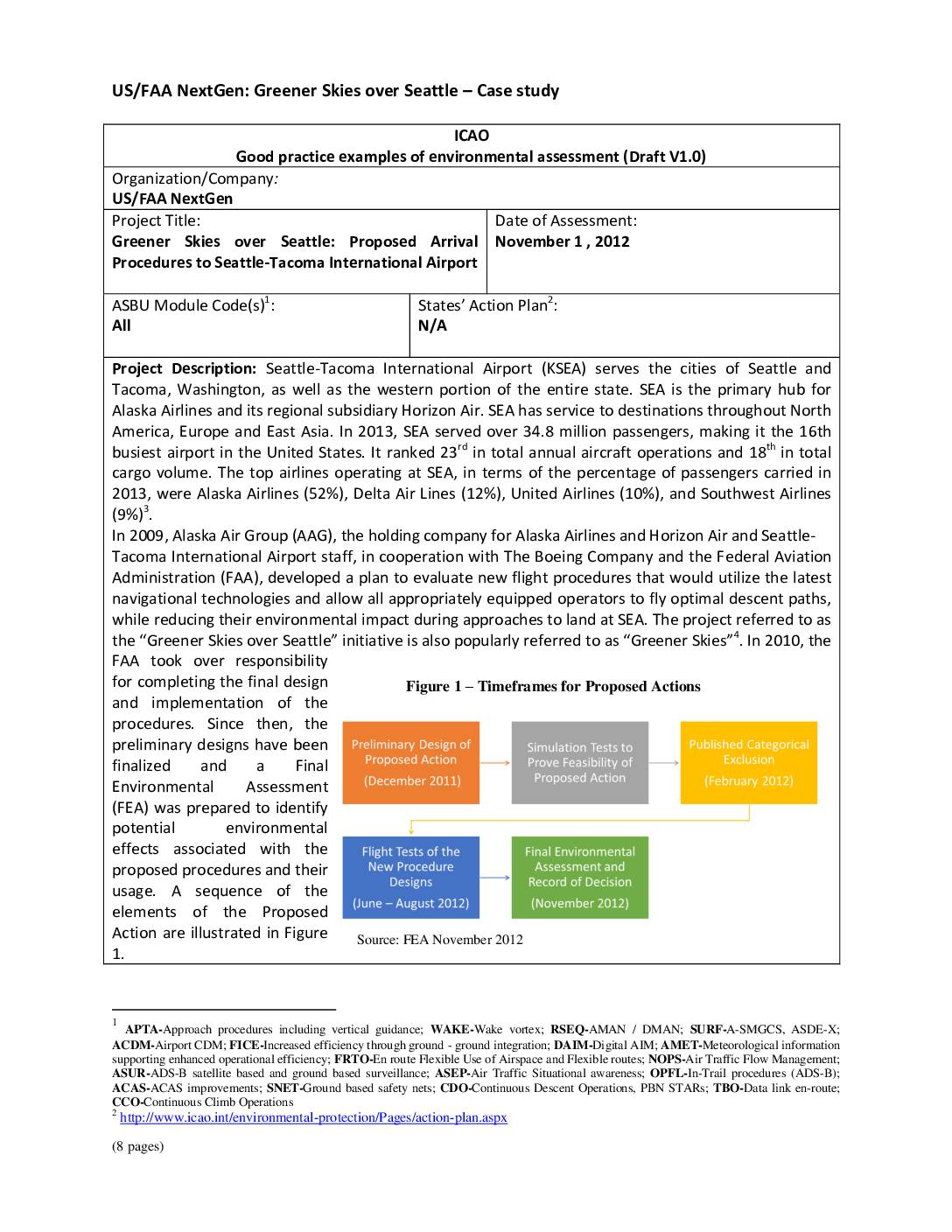
Greener Skies over Seattle: Proposed Arrival Procedures to Seattle-Tacoma International Airport — ICAO Good Practice Case Study
ICAO good practice case study documenting the US/FAA NextGen ‘Greener Skies over Seattle’ initiative — a Final Environmental Assessment (FEA) completed November 1, 2012 for proposed PBN arrival procedures (STARs and RNP with Optimized Profile Descents) at Seattle-Tacoma International Airport (KSEA/Sea-Tac Airport). Collaborative project between FAA, Alaska Air Group (Alaska Airlines, Horizon Air), The Boeing -
 2012-10-31
Draft Environmental Assessment for Greener Skies Over Seattle: Proposed Arrival Procedures to Seattle-Tacoma International Airport, Volume 2 – Appendices
FAA Draft Environmental Assessment (EA), Volume 2 Appendices, for the Greener Skies Over Seattle project proposing new arrival procedures to Seattle-Tacoma International Airport (Sea-Tac Airport / KSEA), dated 31 October 2012. Appendices cover noise metrics (DNL, SEL, Leq, dBA), NIRS noise modeling technical report, aircraft operations and flight tracks, runway utilization, meteorological conditions, historic resource -
 2001-02-01
EXH AR026134: Guidelines Preparing Quality Assurance Project Plans Environmental Studies
This Washington State Department of Ecology publication, authored by Stewart M. Lombard and Cliff J. Kirchmer and released in February 2001, provides guidelines for preparing Quality Assurance Project Plans (QAPPs) for environmental studies. It outlines standards and procedures to ensure that data collected during environmental investigations meets defined quality and reliability requirements. -
 2000-07-17
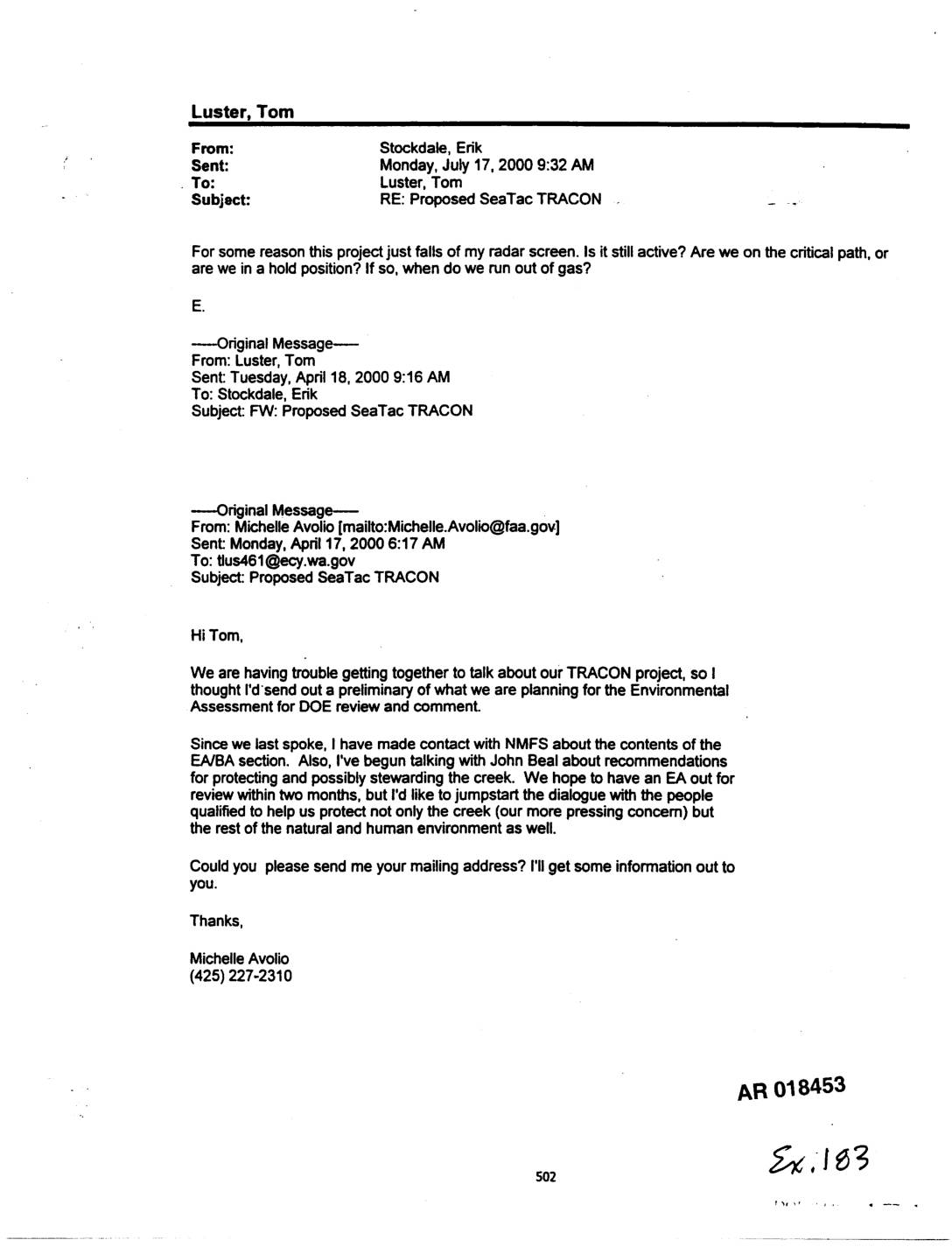
Exhibit 183: Email Chain RE: Proposed Sea-Tac TRACON — Stockdale, Luster, Avolio
Email chain (AR 018453) among Erik Stockdale, Tom Luster (Ecology, tlus461@ecy.wa.gov), and Michelle Avolio (FAA, Michelle.Avolio@faa.gov) regarding the proposed SeaTac TRACON project. Avolio’s April 17, 2000 email to Luster describes FAA planning for an Environmental Assessment (EA) and Biological Assessment (BA) for DOE review and comment, contact with NMFS regarding EA/BA section contents, and discussions -
 1990-03-27
Final environmental assessment for proposed changes to air traffic arrival and departure routes at Seattle-Tacoma International Airport
This 1990 Final Environmental Assessment, prepared by the FAA's Air Traffic Division in Seattle, evaluates proposed changes to arrival and departure flight routes at Seattle-Tacoma International Airport. The document was signed by Air Traffic Division Manager Temple H. Johnson, Jr. on March 27, 1990, and examines the potential environmental impacts of rerouting aircraft traffic in and out of Sea-Tac. It serves as an official federal record relevant to noise and environmental policy affecting communities around the airport. -
 1990-01-01
Final environmental assessment: Proposed changes to air traffic arrival and departure routes at Seattle-Tacoma International Airport, Volume II
This 1990 Final Environmental Assessment, published by the U.S. Department of Transportation's Federal Aviation Administration, examines proposed changes to air traffic arrival and departure routes at Seattle-Tacoma International Airport. Volume II of the document compiles public comments received in response to the Draft Environmental Assessment, reflecting community input on how the proposed route changes could affect noise and other environmental conditions in the Seattle, Washington area. -
 1989-12-01
Draft Environmental Assessment for Proposed Changes to Air Traffic Arrival and Departure Routes at Seattle-Tacoma International Airport
This 1989 draft Environmental Assessment, prepared by the FAA's Air Traffic Division, evaluates proposed changes to arrival and departure flight routes at Seattle-Tacoma International Airport. The changes aimed to reduce air traffic congestion and improve airspace efficiency, particularly during peak demand periods when south-arrival capacity (42 aircraft/hour) lagged significantly behind north-arrival capacity (56 aircraft/hour). The inefficiency was linked to a requirement routing turbojet aircraft through Elliott Bay, a legacy of noise abatement agreements with local governments and the Port of Seattle dating back to 1970. -
 1989-12-01
Draft environmental assessment for proposed changes to air traffic arrival and departure routes at Seattle-Tacoma International Airport
This 1989 FAA draft Environmental Assessment examines proposed changes to arrival and departure flight routes at Seattle-Tacoma International Airport, aimed at reducing air traffic congestion and improving airspace efficiency. The document identifies a key inefficiency: during good weather and peak demand, south-landing capacity (42 aircraft/hour) was significantly lower than north-landing capacity (56 aircraft/hour), largely due to a requirement routing turbojet aircraft through Elliott Bay. The assessment traces the issue back to noise abatement procedures established since 1970 that prioritized limiting jet overflights in certain Seattle metropolitan areas over operational efficiency. -
 1979-02-08
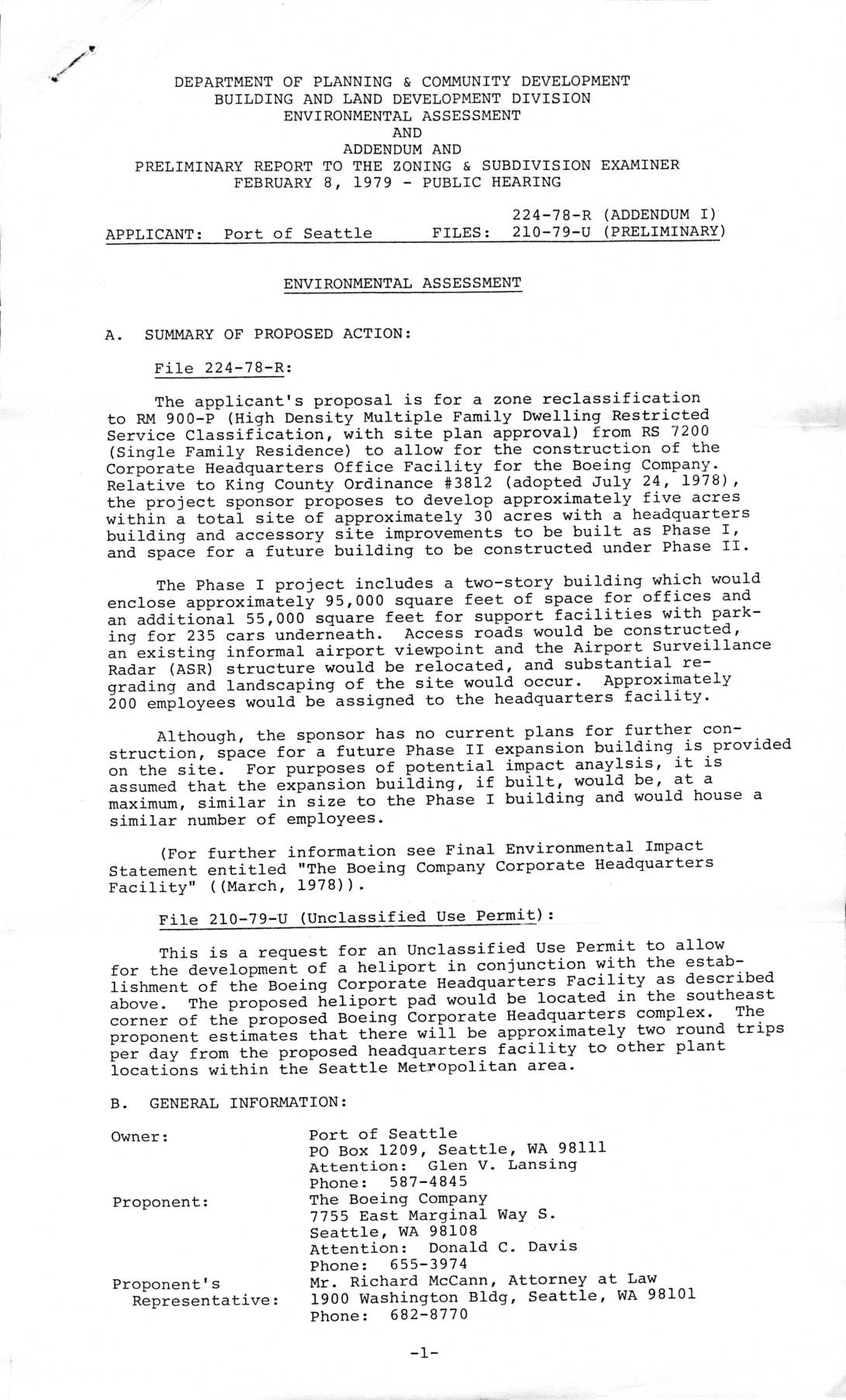
Environmental Assessment and Addendum: File 224-78-R and 210-79-U — Proposed Boeing Corporate Headquarters Facility, Port Of Seattle, February 8, 1979
This 1979 environmental assessment from King County's Department of Planning & Community Development evaluates the Port of Seattle's application to rezone approximately five acres near Sea-Tac Airport to allow Boeing to build a corporate headquarters facility, including offices, parking, and a heliport. The proposed Phase I development would include a two-story building with roughly 95,000 square feet of office space and parking for 235 cars, with approximately 200 employees on site. The document also outlines the county's land use history and ordinances governing development on the west side of Sea-Tac Airport, emphasizing protections for adjacent residential neighborhoods.