TagEIS(52)
-
 1997-03-19
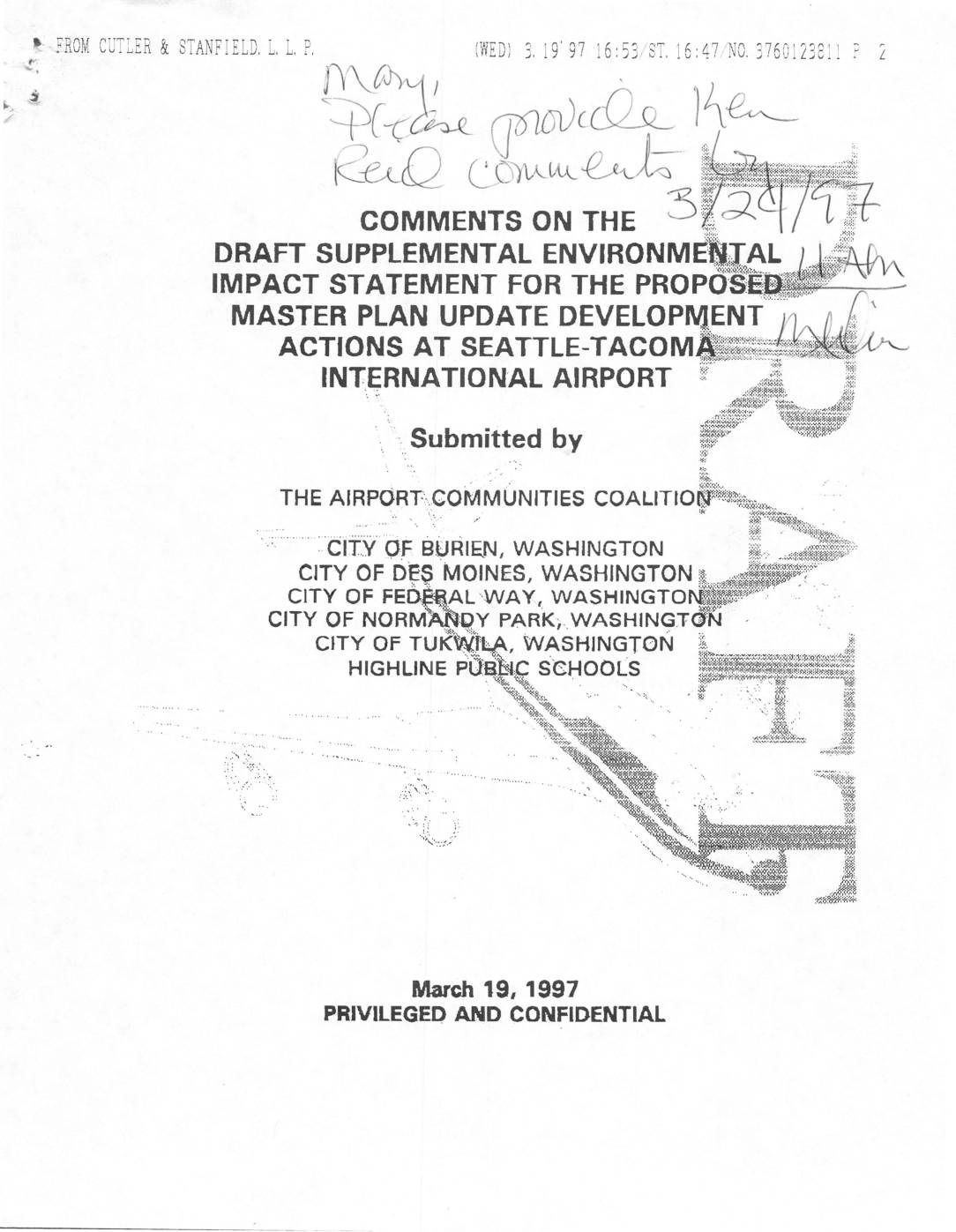
ACC Comments on Draft Supplemental EIS for Proposed Master Plan Update March 19, 1997
In March 1997, the Airport Communities Coalition — representing the cities of Burien, Des Moines, Federal Way, Normandy Park, and Tukwila, as well as Highline Public Schools — submitted formal comments on the Draft Supplemental Environmental Impact Statement for proposed development actions at Seattle-Tacoma International Airport. The comments were prepared by Washington, D.C. law firm Cutler & Stanfield, L.L.P., in consultation with a team of noise, engineering, and environmental experts from across the country. The document reflects community concerns about the environmental and noise impacts of the airport's Master Plan Update on surrounding neighborhoods. -
 1997-03-01
Why the Port Of Seattle’s 3rd runway EIS fails adequately to examine impacts to wetlands and prescribes inadequate mitigation
This 1997 document argues that the Port of Seattle's Environmental Impact Statement (EIS) for a proposed third runway at Sea-Tac Airport inadequately examines impacts on wetlands and fails to prescribe sufficient mitigation measures. It contends that the FAA and Port must meet federal and state legal requirements — including Section 404 of the Clean Water Act and Washington's Growth Management Act — before any construction affecting wetlands can proceed. The document asserts that the EIS does not consider a broad enough range of alternatives, making it legally insufficient as a basis for approving the runway project. -
 1997-02-01
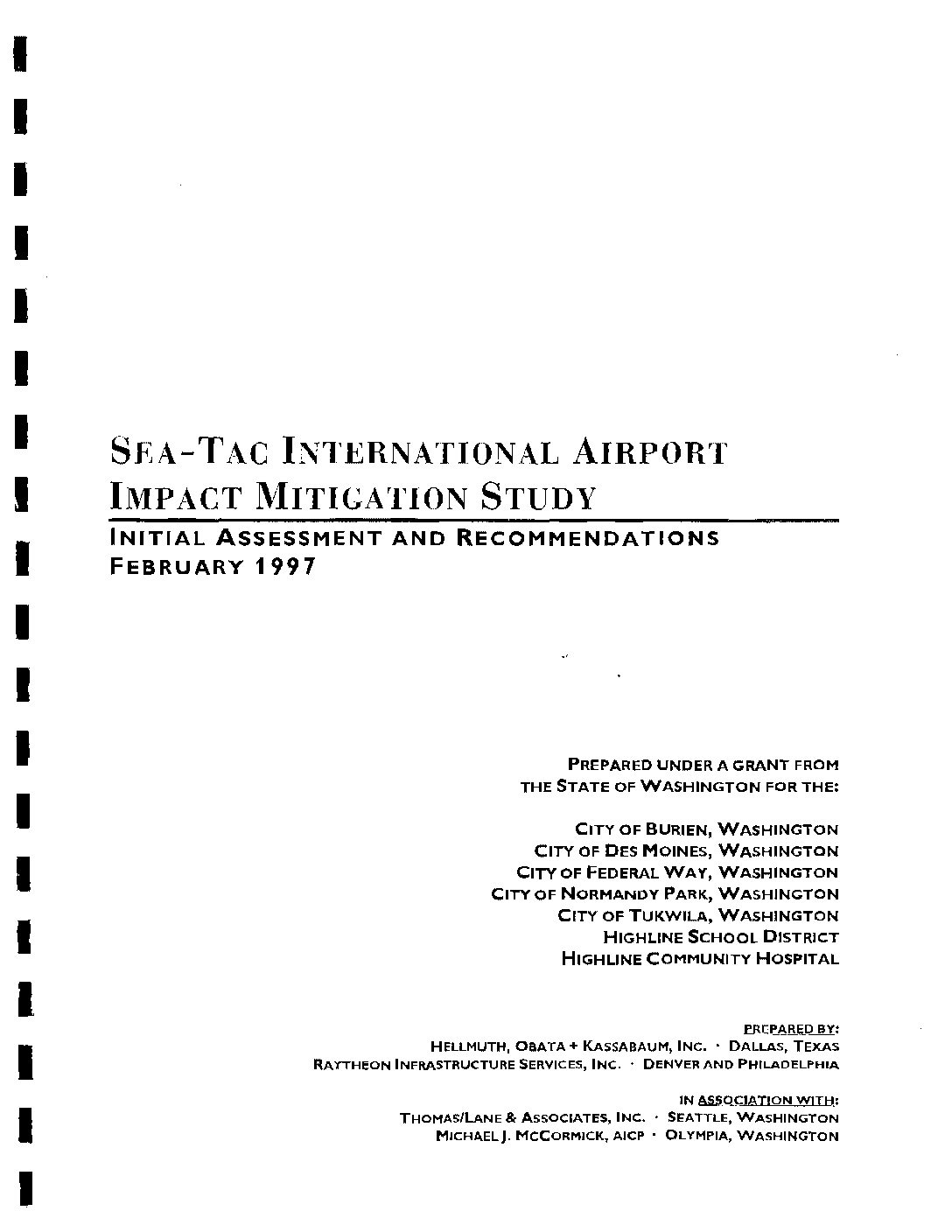
Sea-Tac International Airport impact mitigation study: Initial assessment and recommendations
★ 32The HOK Study. 1997 initial assessment and recommendations report for the Sea-Tac International Airport Impact Mitigation Study, prepared by Hellmuth, Obata + Kassabaum and Raytheon Infrastructure Services. The study was funded by a State of Washington grant on behalf of the cities of Burien, Des Moines, Federal Way, Normandy Park, and Tukwila, as well as -
 1997-02-01
Sea-Tac International Airport Impact Mitigation Study: Initial Assessment and Recommendations — Section 9, Potential Socio-Economic Impacts and Mitigation
A 1997 study commissioned by cities and institutions near Seattle-Tacoma International Airport found that airport operations depress nearby property values compared to similar homes elsewhere in King County, and that properties directly under flight paths suffer additional losses from noise, visual pollution, and reduced quality of life. Researchers compared single-family homes around Sea-Tac with comparable homes in Northwest King County (Shoreline area), using strict criteria to ensure fair comparisons. The study notes that while overall regional growth means nearby home values may still rise over time, they appreciate more slowly than they would without the airport's presence. -
 1996-10-01
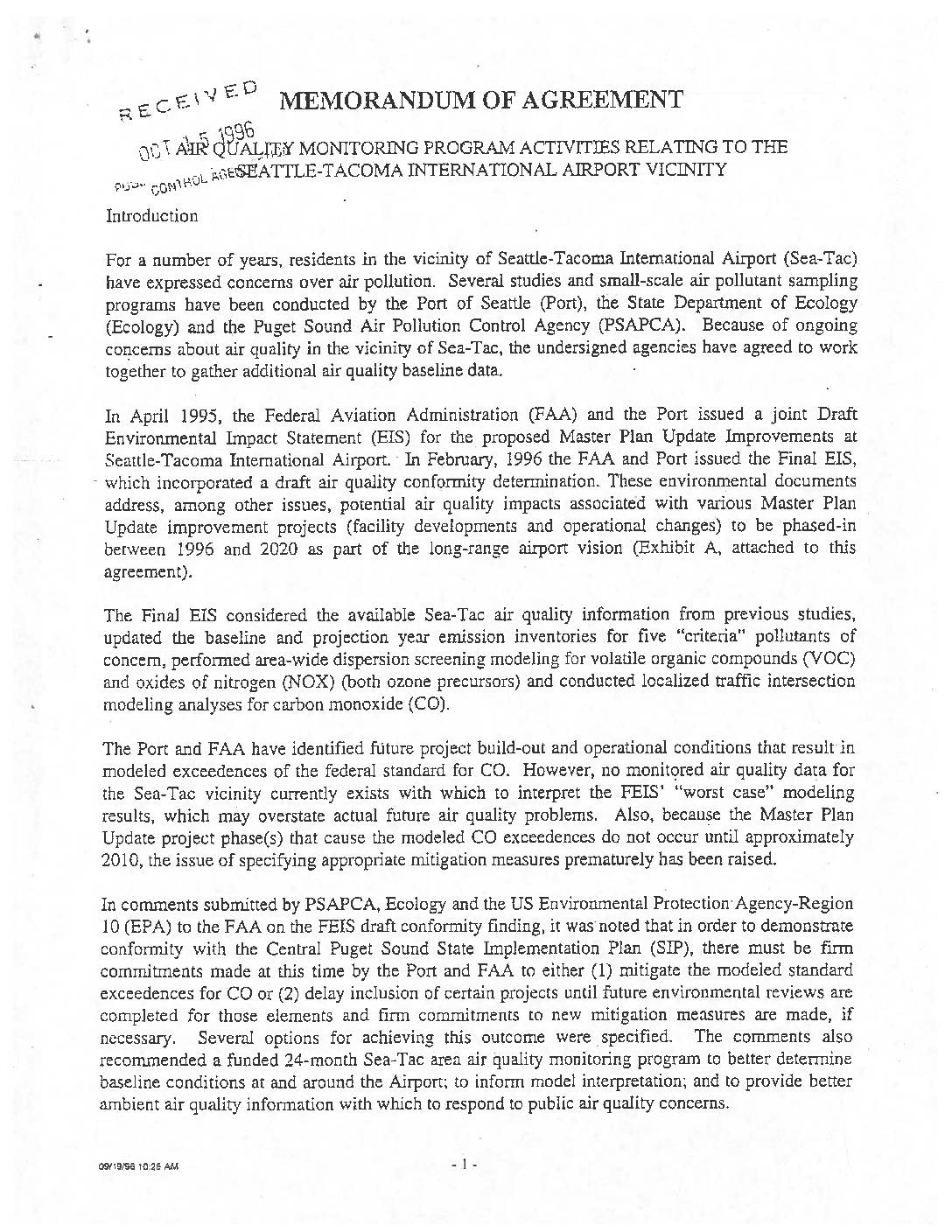
Memorandum of Agreement: Air Quality Monitoring Program Activities Relating to the Seattle-Tacoma International Airport Vicinity
This 1996 Memorandum of Agreement establishes a 24-month air quality monitoring program near Seattle-Tacoma International Airport, involving the Port of Seattle, FAA, EPA, Washington State Department of Ecology, and the Puget Sound Air Pollution Control Agency. The program, funded at $195,000, focuses on measuring carbon monoxide, nitrogen oxides, and aircraft fuel particle residue to establish baseline air quality data and evaluate potential pollution impacts from planned airport expansion projects. The Port agreed not to proceed with expansion elements projected to cause carbon monoxide standard violations until monitoring is complete and, if necessary, mitigation measures are identified. -
 1996-09-19
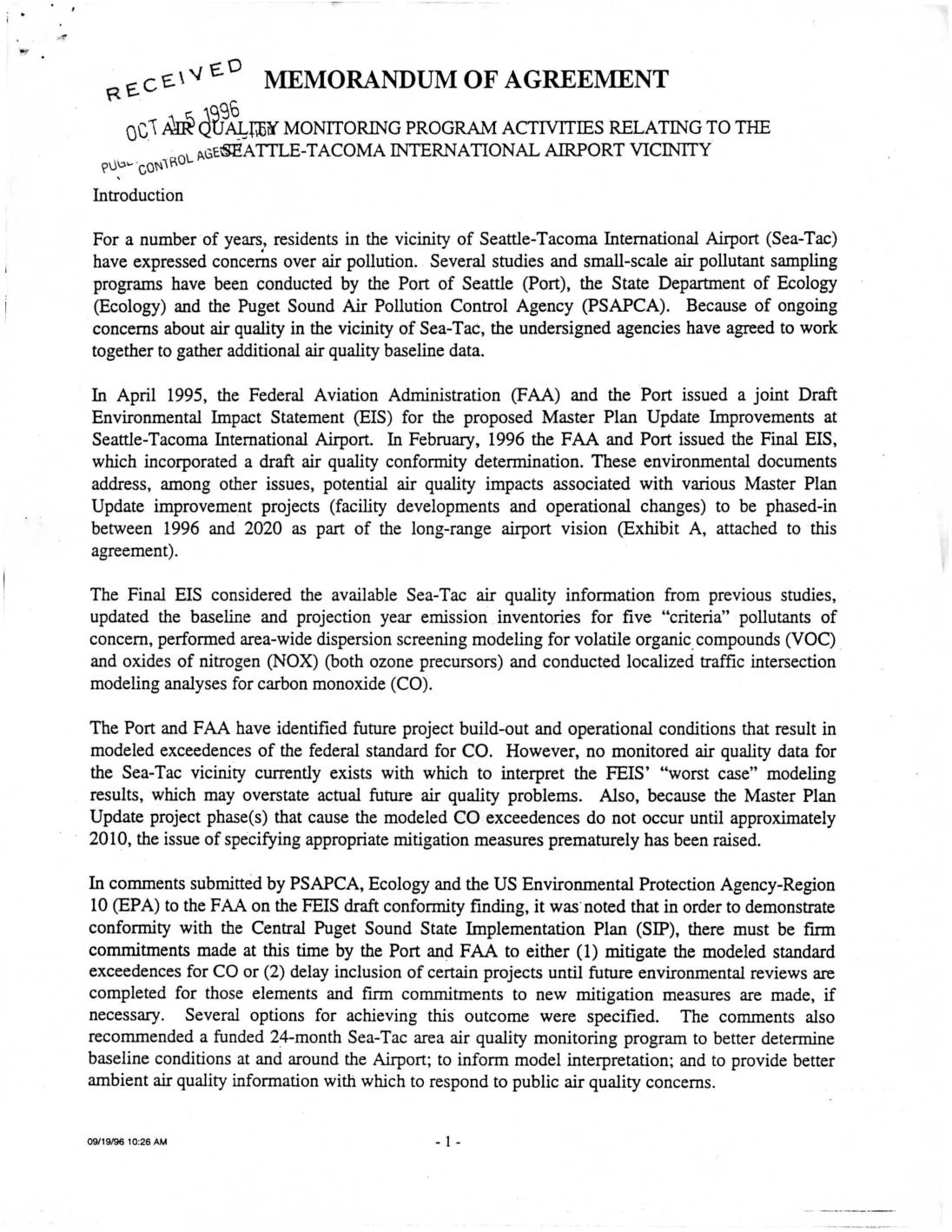
Memorandum of Agreement: Air Quality Monitoring Program Activities Relating to the Seattle-Tacoma International Airport Vicinity
A 1996 Memorandum of Agreement between the Port of Seattle, FAA, EPA, Washington State Department of Ecology, and the Puget Sound Air Pollution Control Agency established a 24-month air quality monitoring program near Seattle-Tacoma International Airport. The $195,000 program was designed to measure carbon monoxide, nitrogen oxides, and aircraft fuel particle residue in order to establish baseline pollution data and assess the accuracy of earlier 'worst case' air quality models from the airport's Final Environmental Impact Statement. The Port agreed not to proceed with Master Plan expansion projects projected to cause CO standard exceedances until monitoring was complete and, if necessary, appropriate mitigation measures were identified. -
 1996-03-27
Appendix E: Comments Concerning the Final Environmental Impact Statement — Sea-Tac Airport Master Plan Update
Appendix E contains public comments submitted in response to the Final Environmental Impact Statement (FEIS) for the Seattle-Tacoma International Airport Master Plan Update. Commenters include the Highline Water District, the Washington State Department of Ecology, the U.S. Public Health Service, and the Washington State Department of Natural Resources, raising concerns about groundwater contamination, the handling of aircraft de-icing glycols, storm water runoff, and surface mining permit requirements for borrow sites on Port of Seattle property. The agencies generally called for stronger mitigation measures and clearer answers to environmental questions before approving the proposed airport expansion. -
 1996-02-01
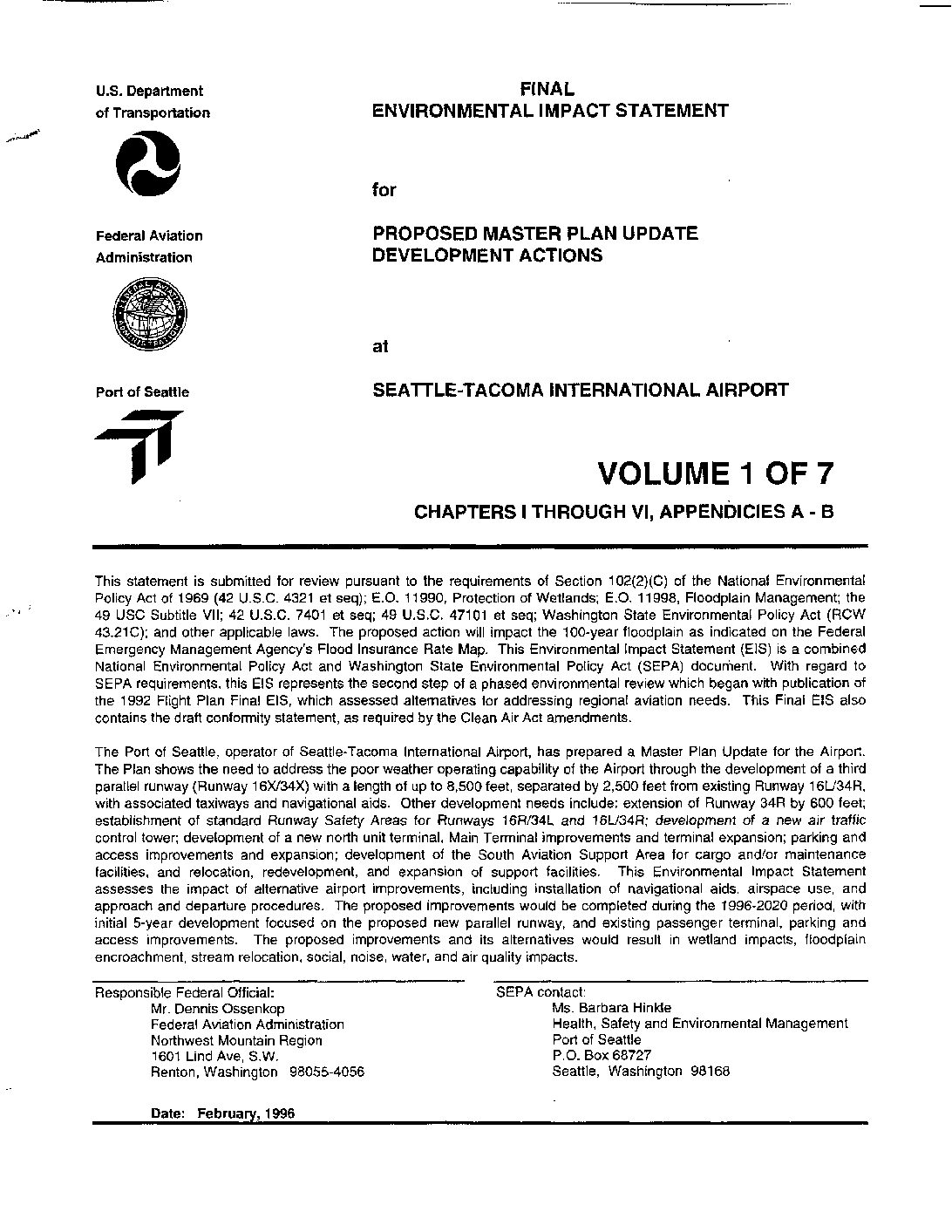
Final Environmental Impact Statement for proposed Master Plan Update development actions at Seattle-Tacoma International Airport
This 1996 Final Environmental Impact Statement, prepared jointly by the FAA and the Port of Seattle, evaluates proposed expansion plans at Seattle-Tacoma International Airport through the year 2020, including the construction of a third parallel runway up to 8,500 feet long, a new north terminal, and various landside improvements. The document assesses environmental consequences across 24 categories—including noise, air quality, water quality, and human health—for a range of alternatives, from building a new regional airport to a no-build option. Ultimately, the Port of Seattle selected Alternative 3 as the preferred option, concluding that Sea-Tac was the only feasible site to address the region's growing air transportation needs. -
 1996-02-01
Final Environmental Impact Statement for proposed master plan update development actions at Seattle-Tacoma International Airport, Volume 3 of 7
This 1996 Final Environmental Impact Statement, prepared jointly by the FAA and the Port of Seattle, evaluates the environmental effects of proposed expansion and improvement projects at Seattle-Tacoma International Airport, including the construction of a third parallel runway, terminal upgrades, and expanded parking and cargo facilities. The document examines a range of impacts such as wetland disturbance, floodplain encroachment, stream relocation, and noise, water, and air quality effects on surrounding communities. The proposed improvements were planned for completion between 1996 and 2020, with early phases prioritizing the new runway and existing terminal and access enhancements. -
 1996-02-01
Final environmental impact statement for proposed master plan update development actions at Seattle-Tacoma International Airport, Volume 4 of 7: Appendices Q-A – S
This 1996 Final Environmental Impact Statement, prepared by the Port of Seattle and the Federal Aviation Administration, evaluates proposed improvements at Seattle-Tacoma International Airport through the year 2020, including the construction of a third parallel runway, terminal expansions, and parking upgrades. The document assesses a range of environmental impacts such as noise, air and water quality, wetlands, and floodplain encroachment resulting from the planned development. It was prepared in compliance with both the National Environmental Policy Act and Washington State Environmental Policy Act.