TagAviation Noise & Emissions Symposium(24)
-
 2023-05-01
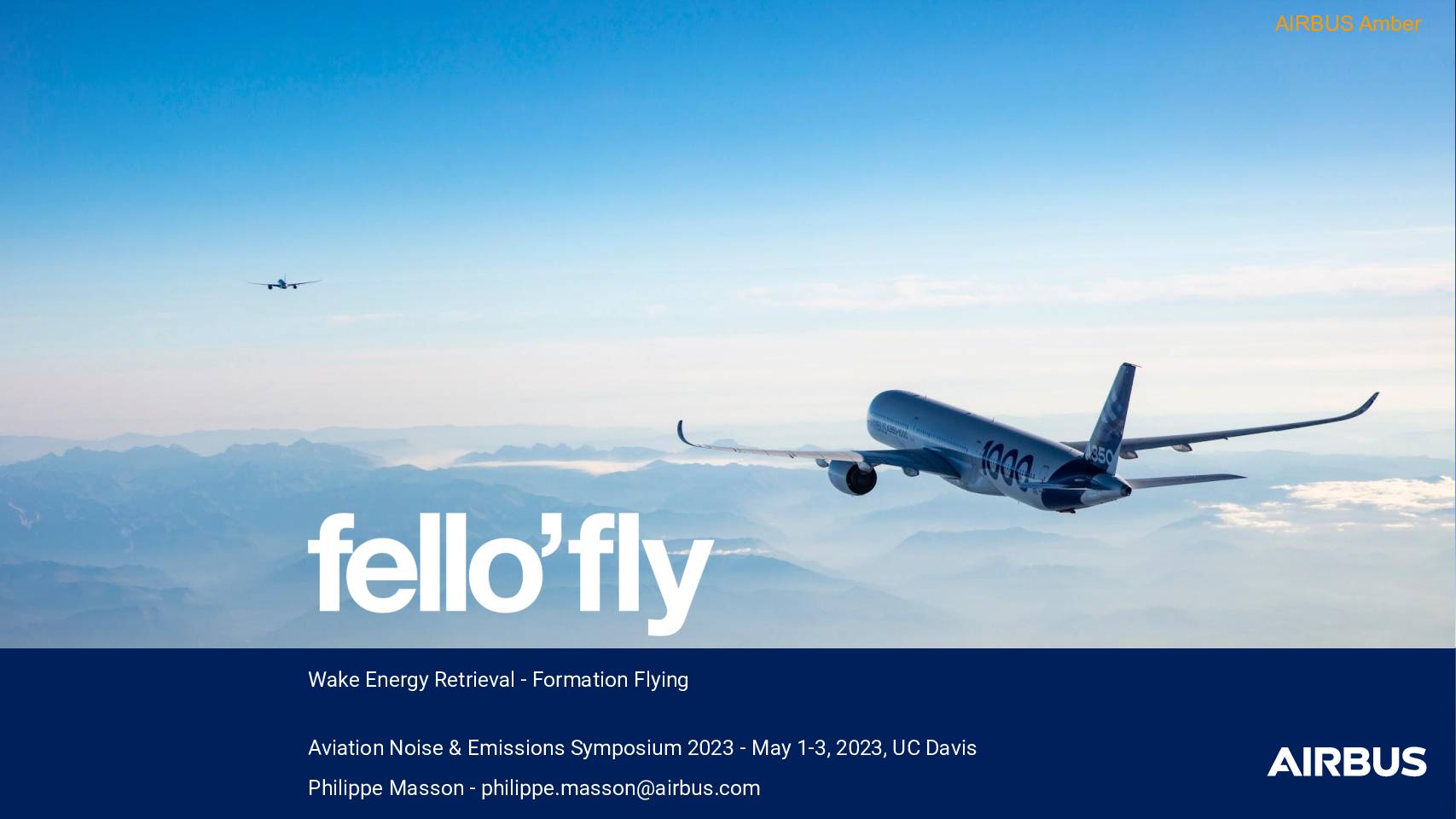
Fello’fly: Wake Energy Retrieval – Formation Flying
Airbus's 'fello'fly' program explores formation flying as a fuel-saving technique, where a follower aircraft positions itself in the smooth updraft of a leading aircraft's wake to recover otherwise wasted kinetic energy. This approach can reduce trip fuel consumption and emissions by around 5% for the follower aircraft, making it most beneficial on long-haul routes exceeding 2,000 nautical miles. Key factors affecting savings include aircraft pairing, the follower's position on the vortex, time spent in formation, and fuel used to enter the formation. -
 2023-01-01
FAA Community Engagement Scorecard: Is the FAA’s community engagement improving?
At the 2023 ANE Symposium, Darlene Yaplee of the Aviation-Impacted Communities Alliance presented the FAA Community Engagement Scorecard (FAACES), a project designed to gather and analyze feedback from community groups on their experiences with FAA community engagement between 2020 and 2022 compared to before 2020. The scorecard examines whether FAA initiatives—such as the Community Involvement Manual, Chief Engagement Officers, noise portals, and roundtables—have led to meaningful improvements from the perspective of affected communities. The findings aim to identify recurring themes in community responses and offer recommendations for improving FAA outreach and engagement practices. -
 2021-10-01
Ground Noise Study Progress Update
★This October 2021 progress update presents findings from a Ground Noise Study conducted at Seattle-Tacoma International Airport (SEA). The presentation covers key acoustic concepts—including Maximum Sound Level (Lmax), Sound Exposure Level (SEL), and Equivalent Sound Level (Leq)—alongside topics such as sound propagation, the study's scope of work, noise monitoring activities, and planned next steps. The study aims to better understand and document ground-level noise impacts in and around the airport. -
 2021-02-26
Aircraft noise and emissions legislation in the next Congress: Priorities, perspectives, and predictions
This presentation by attorney Peter J. Kirsch, delivered at the 2021 Aviation Noise and Emissions Symposium, examines anticipated legislative priorities related to aircraft noise and emissions in the new Congress. It references key noise measurement tools, including the Schultz Curve and a updated National Curve, both of which plot the percentage of people highly annoyed against Day-Night Average Sound Level (DNL) in decibels. The materials suggest growing public sensitivity to aircraft noise even at lower decibel levels, with implications for how policymakers may revisit the longstanding 65 DNL threshold used in federal noise compatibility programs. -
 2021-02-26
Legislation in the next Congress: priorities, perspectives, and predictions
This presentation by Sanford Fidell and Vincent Mestre, delivered at the UC Davis Aviation Noise and Emissions Symposium on February 26, 2021, discusses priorities and predictions for U.S. aircraft noise legislation. It is based on their book 'A Guide to U.S. Aircraft Noise Regulatory Policy,' which covers topics ranging from the history of noise regulation and its effects on communities to airport land use planning, noise mitigation, and potential future changes to regulatory policy. -
 2021-02-23
Civil society expectations for a green recovery
A presentation by Tim Johnson of the Aviation Environment Federation, delivered at the Aviation Noise & Emission Symposium in February 2021, examines what civil society expects from a green recovery in the aviation sector. It highlights growing airline commitments to net-zero emissions by 2050, including pledges from British Airways, United Airlines, and others, while raising the question of whether 2019 may have been the peak year for aviation CO2 emissions. The talk explores the intersection of post-pandemic recovery and environmental accountability in the airline industry. -
 2021-02-17
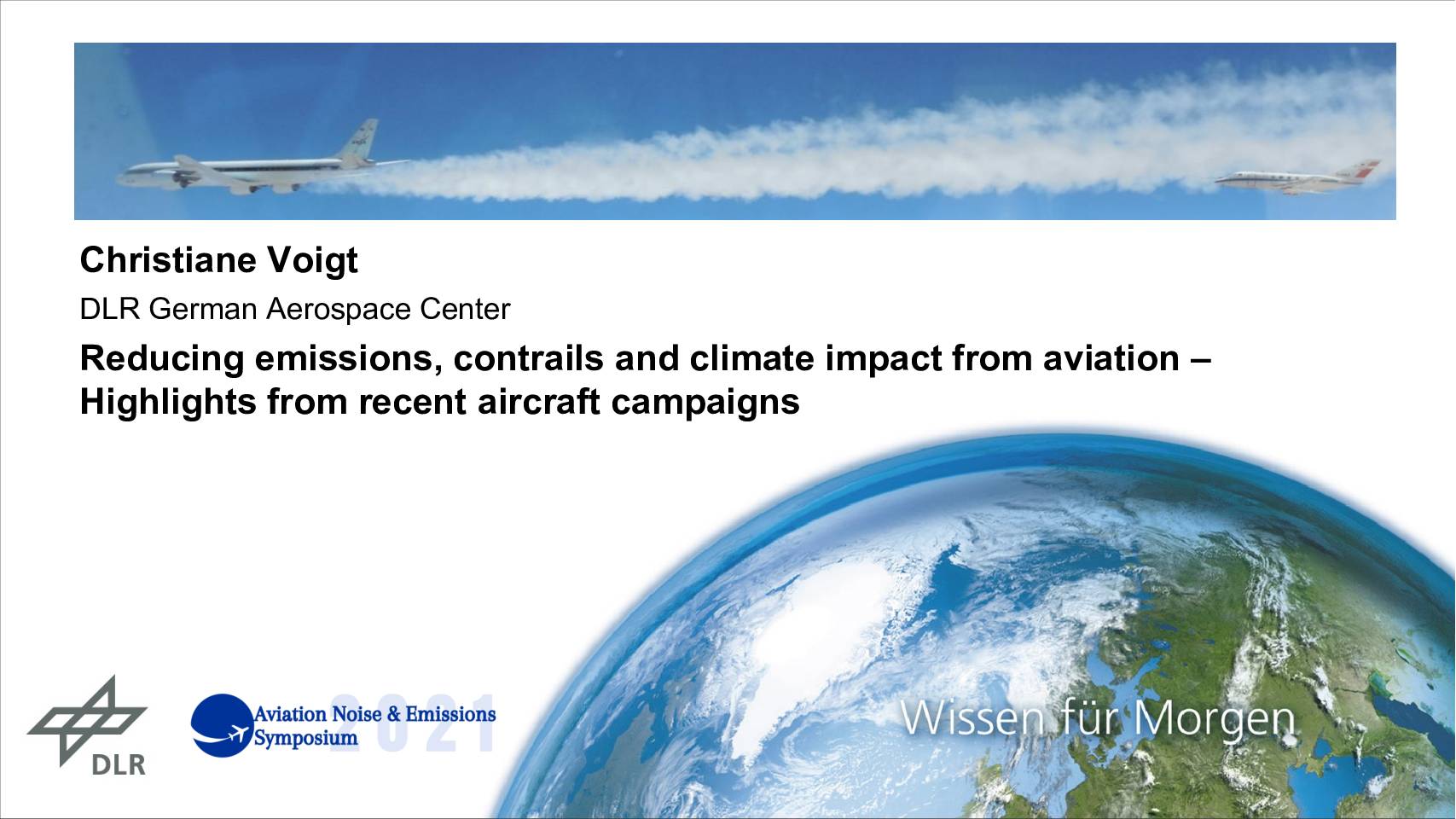
Reducing emissions, contrails and climate impact from aviation – Highlights from recent aircraft campaigns
A 2021 seminar by DLR researcher Christiane Voigt examines how aviation contributes to climate change through CO2 emissions, contrail cirrus clouds, and NOx gases, with contrail cirrus identified as the largest single warming factor at 57.4 mW m⁻². The presentation outlines strategies to reduce aviation's climate footprint, including the use of alternative fuels, lean combustion technology, and contrail avoidance routing. Findings draw on data from recent aircraft measurement campaigns and observed emission reductions during the 2020 COVID-19 lockdown. -
 2021-02-01
Dispersion in the age of RNAV
This presentation by aviation consultant Jim Allerdice explores 'dispersion,' a strategy for reducing repetitive aircraft noise over residential neighborhoods by intentionally varying the lateral flight paths of aircraft. It distinguishes between natural dispersion, which occurs randomly with manually flown routes and air traffic control vectors, and systematic dispersion, which uses satellite-based navigation (RNAV) to spread flights across multiple precise, predictable tracks in a controlled way. Examples of systematic dispersion techniques discussed include radar vectors to RNAV, open Standard Instrument Departures (SIDs), and Equivalent Lateral Spacing Operations (ELSO). -
 2021-02-01
Dispersion in the Age of RNAV Jim Allerdice, Jr. ABCx2 ANES
This 2021 presentation by aviation consultant Jim Allerdice examines 'dispersion' — the practice of intentionally varying flight paths so that aircraft noise is spread across a wider area rather than repeatedly concentrated over the same neighborhoods. It explores the tension between the FAA's preference for Performance-Based Navigation (PBN/RNAV), which promotes precise, repeatable flight paths for safety and efficiency, and the concerns of communities living under those concentrated flight corridors. The material is relevant to ongoing debates about how airports like Sea-Tac can balance operational efficiency with equitable distribution of aircraft noise impacts. -
 2021-01-01
Community perspectives on legislation: Aircraft noise and emissions legislation in the next Congress
A 2021 presentation by Darlene Yaplee, founding member of the Aviation-Impacted Communities Alliance (AICA), argues that the FAA's current systems for assessing and addressing aircraft noise and health impacts are outdated and in need of legislative reform. The document outlines community perspectives on aircraft noise and emissions legislation, covering problem framing, insights for future laws, noise reduction strategies, and real examples of community input. Residents across impacted communities are calling for meaningful relief from the noise and emissions burdens caused by modern air traffic.