TagWater Quality(475)
-
 2001-07-29
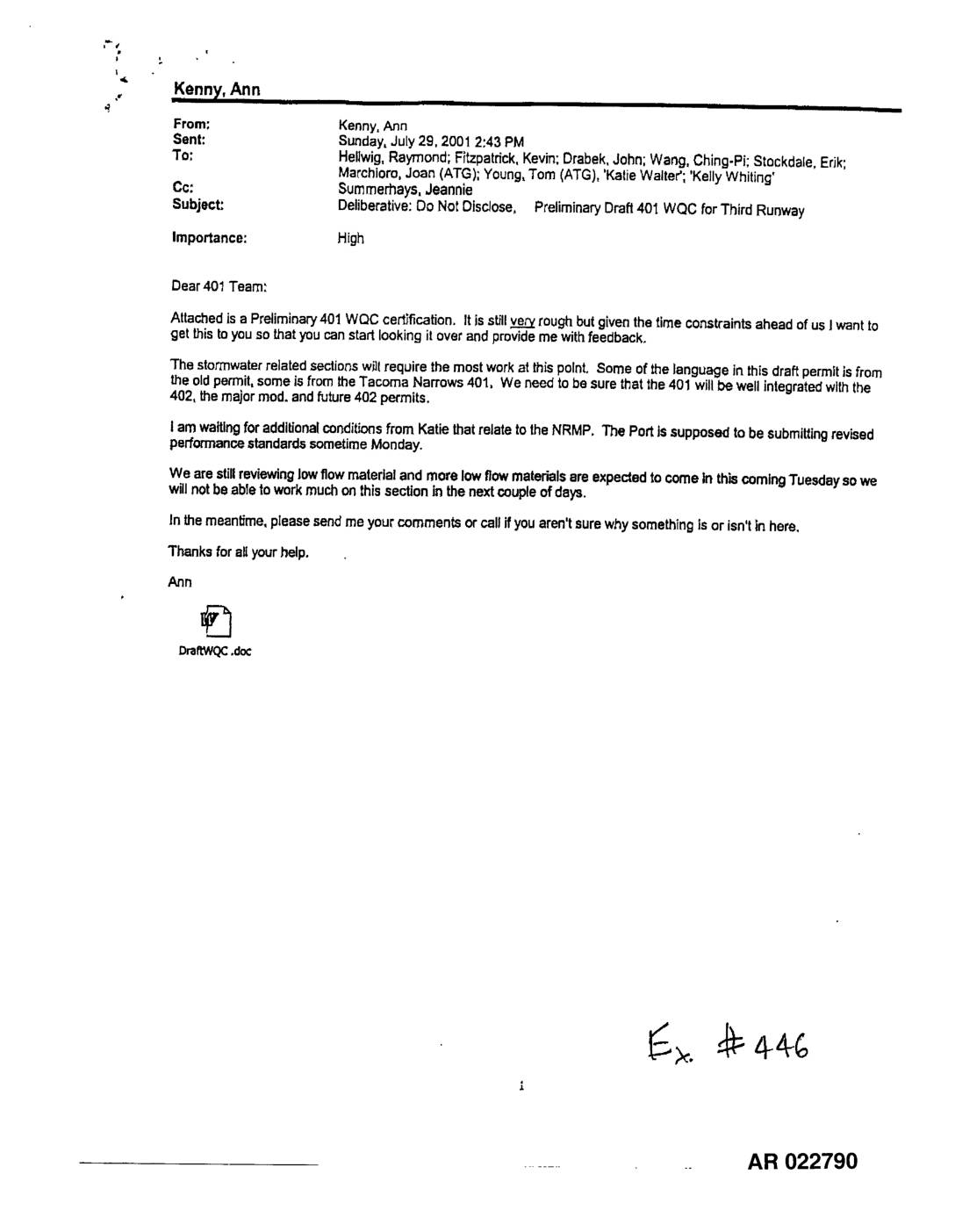
EXH 446: Prelim Draft 401 Water Quality Cert Third Runway — Internal Deliberative Email
In July 2001, Washington State Department of Ecology staff circulated a confidential preliminary draft of a Section 401 Water Quality Certification related to the construction of a third runway at Seattle-Tacoma International Airport. The draft certification, addressed to the Port of Seattle, confirmed that the proposed runway project complied with applicable provisions of the Clean Water Act and the Washington State Coastal Zone Management Program, subject to stormwater and other water quality conditions. The document was still under internal review, with sections on stormwater management and low-flow conditions pending further input before finalization. -
 2001-07-29
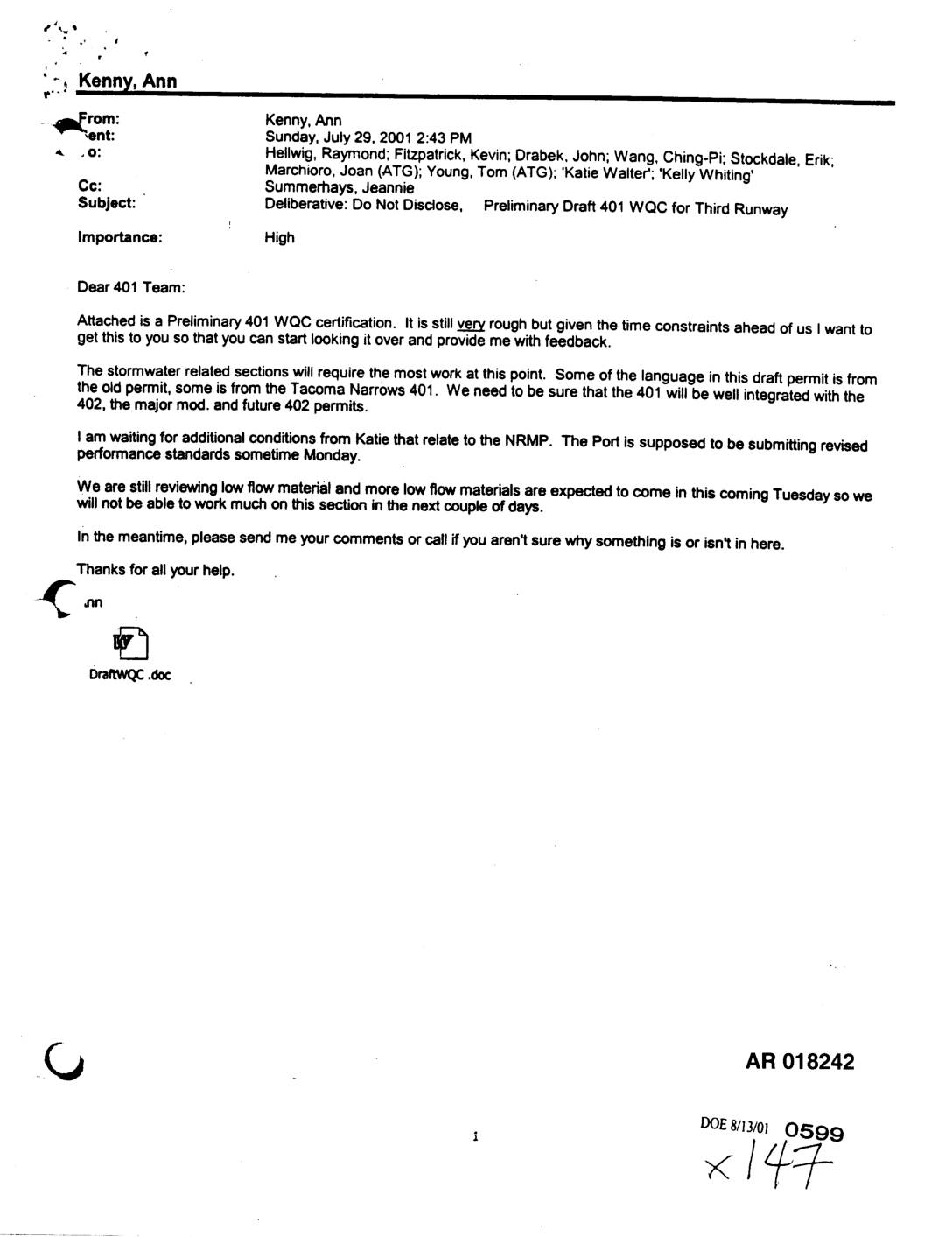
EXH AR018242: Ecology Preliminary Draft 401 Water Quality Certification for Third Runway, Seattle-Tacoma International Airport
Deliberative, do-not-disclose email from Ann Kenny (Washington State Department of Ecology) dated July 29, 2001, transmitting a preliminary draft 401 Water Quality Certification (WQC) for the Port of Seattle Third Runway construction at Seattle-Tacoma International Airport (STIA) in the Miller, Walker, and Des Moines Creek watersheds. The draft WQC references JARPA application dated October 25, -
 2001-07-24
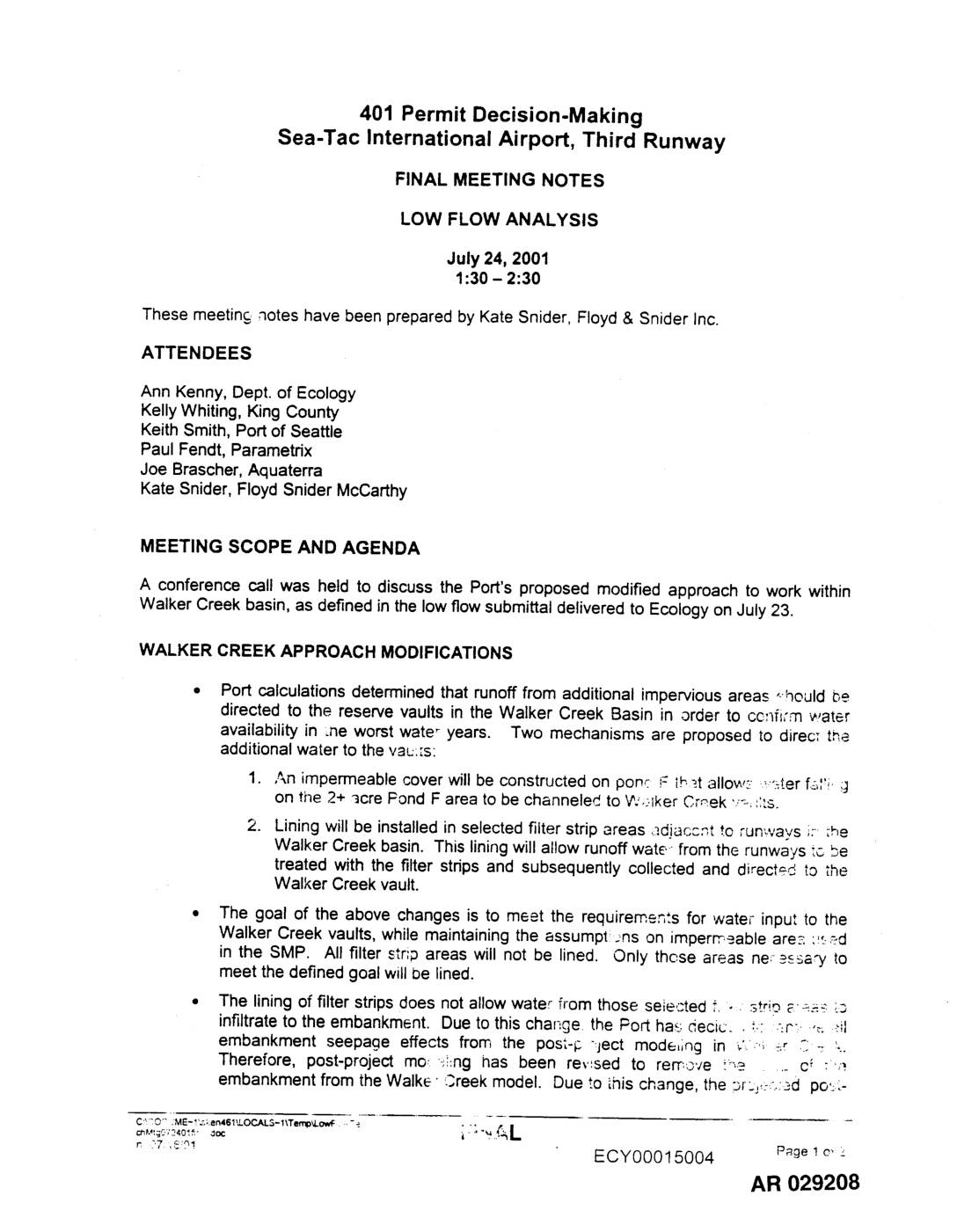
EXH AR029208: 401 Permit Decision-Making, Sea-Tac Airport Third Runway — Final Meeting Notes, Low Flow Analysis
Final meeting notes from July 24, 2001 conference call on 401 Permit Decision-Making for Sea-Tac International Airport Third Runway, Low Flow Analysis. Prepared by Kate Snider, Floyd & Snider Inc. Attendees included Ann Kenny (Dept. of Ecology), Kelly Whiting (King County), Keith Smith (Port of Seattle), Paul Fendt (Parametrix), Joe Brascher (Aquaterra). Discusses Port of -
 2001-07-18
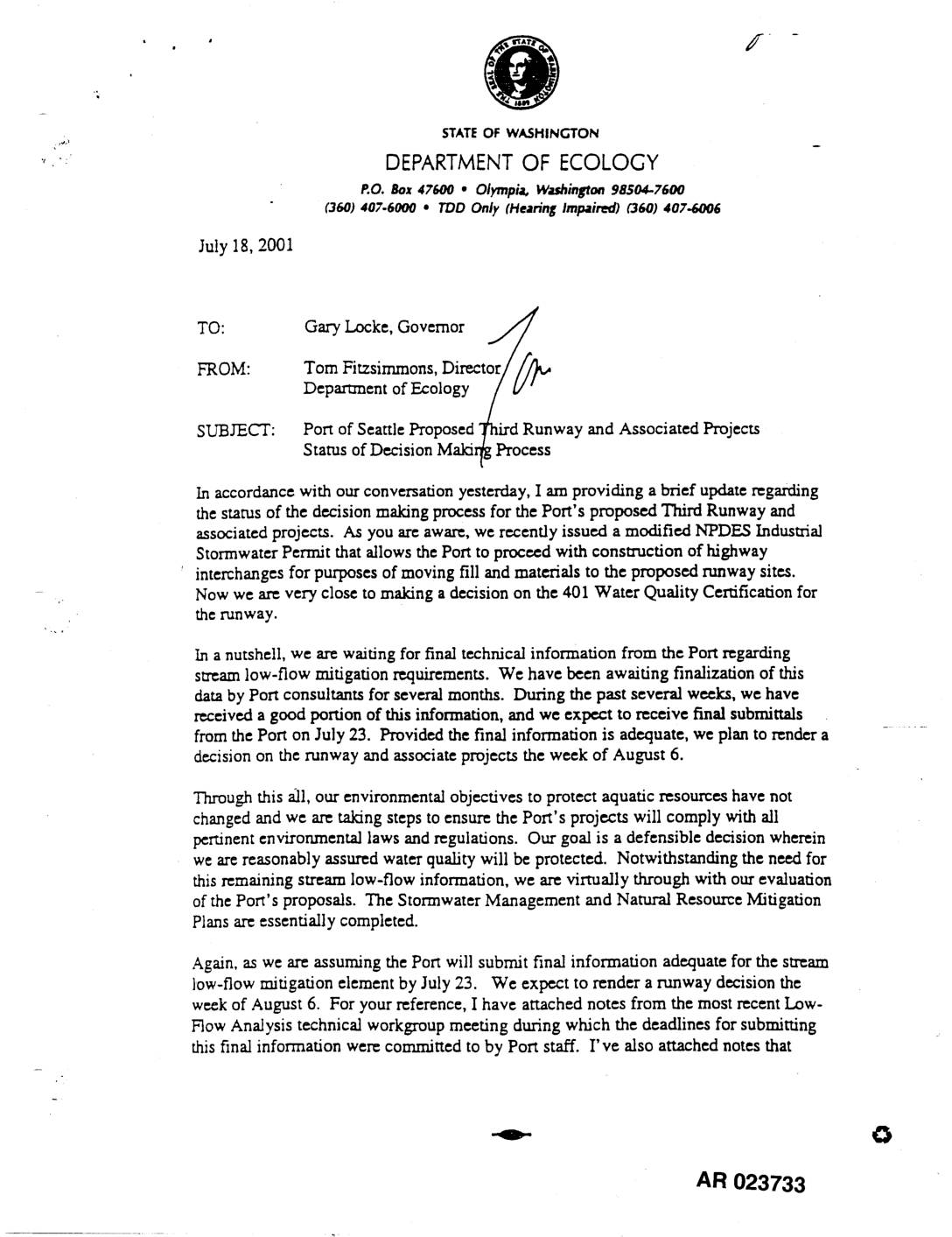
EXH AR023733: Ecology Memo to Gov. Locke – Third Runway 401 WQ Certification Status
In a July 18, 2001 memo to Governor Gary Locke, Washington State Department of Ecology Director Tom Fitzsimmons provided an update on the permitting process for the Port of Seattle's proposed Third Runway at Sea-Tac Airport. The department was awaiting final technical data from the Port on stream low-flow mitigation, expected by July 23, 2001, before issuing a 401 Water Quality Certification decision. Provided the information was satisfactory, Ecology planned to render a final decision on the runway project during the week of August 6, 2001. -
 2001-07-18
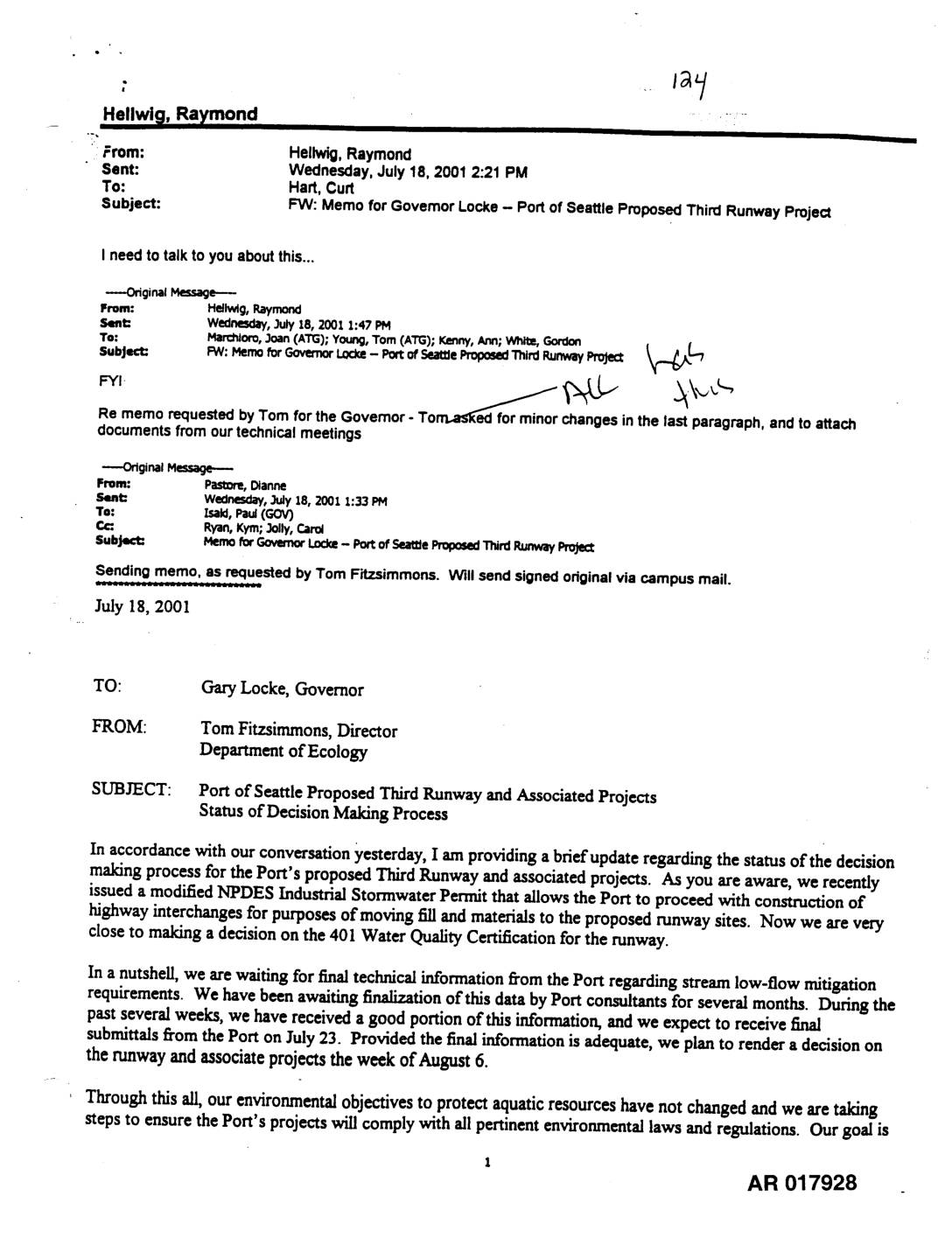
EXH AR017928: Memo to Governor Gary Locke — Port Of Seattle Proposed Third Runway and Associated Projects, Status of Decision Making Process
Memo dated July 18, 2001 from Tom Fitzsimmons, Director, Washington State Department of Ecology, to Governor Gary Locke regarding the status of the 401 Water Quality Certification decision for the Port Of Seattle proposed Third Runway and associated projects. Ecology is awaiting final technical information from Port consultants on stream low-flow mitigation requirements, expected by -
 2001-07-18
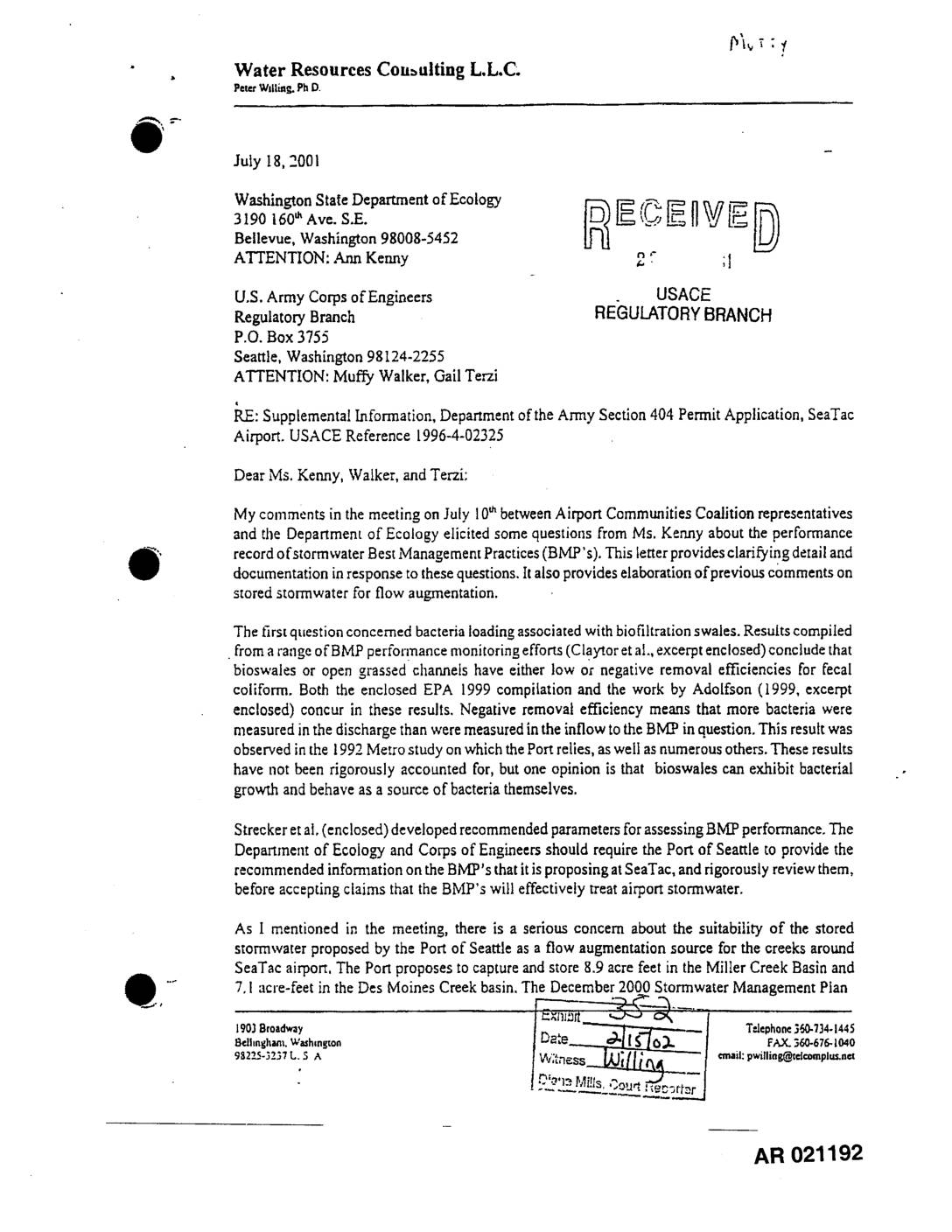
EXH AR021192: Supplemental Info Letter Stormwater BMP Performance Flow Augmentation STIA Sec 404 Permit App
A water resources consultant raised concerns in a July 2001 letter to the U.S. Army Corps of Engineers and Washington State Department of Ecology about the Port of Seattle's stormwater management plans for Sea-Tac Airport expansion. The letter challenged the effectiveness of proposed biofiltration swales, noting they can actually increase bacterial levels rather than reduce them, and warned that releasing stored stormwater from detention vaults into nearby Class AA streams could discharge pollutant-laden, oxygen-depleted water into already stressed waterways. The consultant concluded that the Port's plans fell short of providing reasonable assurance that water quality standards would be met. -
 2001-07-16
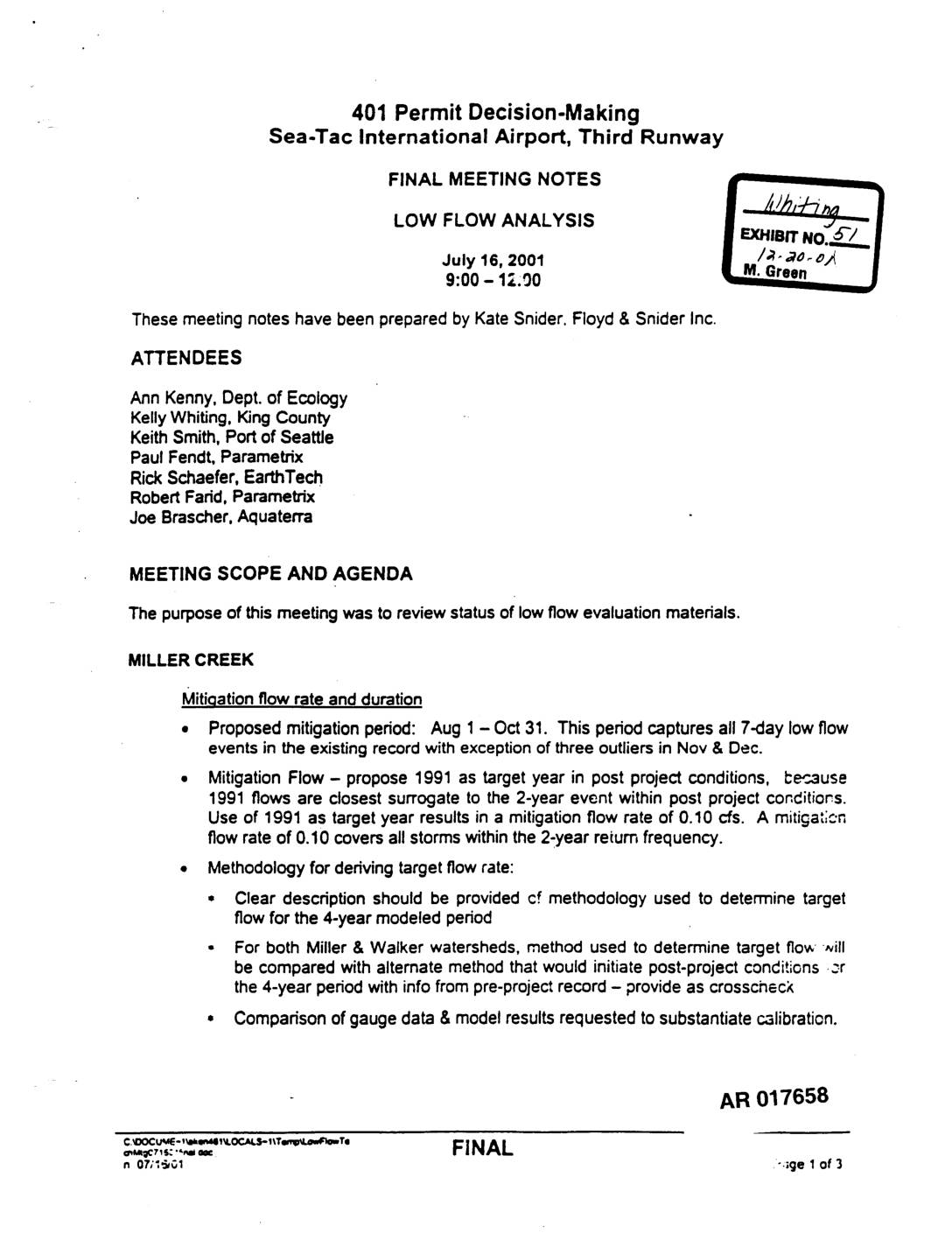
Exhibit 51: 401 Permit Decision-Making, Sea-Tac Airport Third Runway — Final Meeting Notes, Low Flow Analysis
Final meeting notes from July 16, 2001 for the 401 Permit Decision-Making process for Sea-Tac International Airport Third Runway, covering low flow analysis for Miller Creek and Walker Creek. Attendees included Ann Kenny (Dept. of Ecology), Kelly Whiting (King County), Keith Smith (Port of Seattle), Paul Fendt and Robert Farid (Parametrix), Rick Schaefer (EarthTech), and -
 2001-07-16
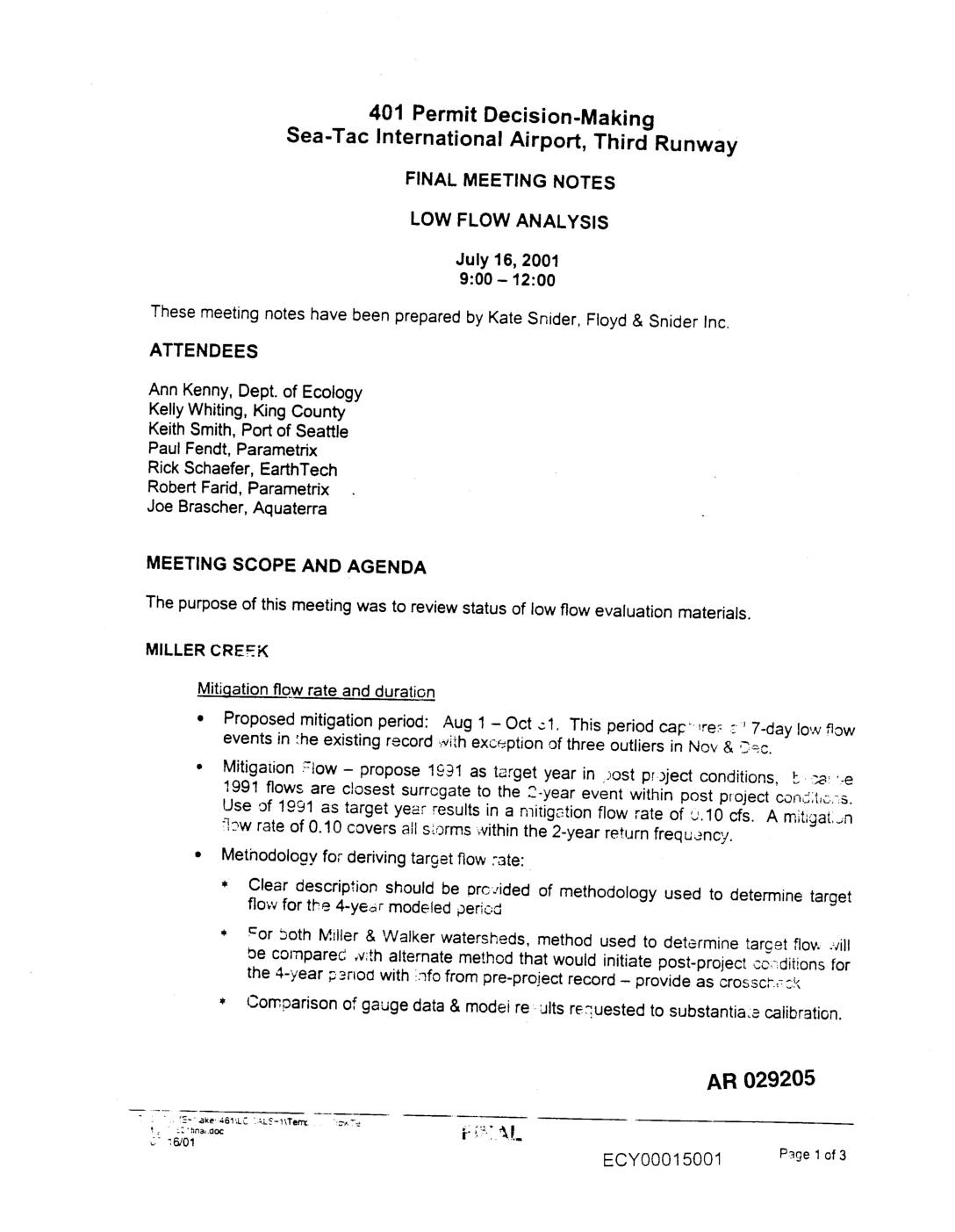
EXH AR029205: 401 Permit Decision-Making Sea-Tac International Airport Third Runway — Final Meeting Notes, Low Flow Analysis
Final meeting notes prepared by Kate Snider of Floyd & Snider Inc. for the 401 Permit Decision-Making process for the Sea-Tac International Airport Third Runway project, dated July 16, 2001. Attendees included representatives from Washington State Department of Ecology (Ann Kenny), King County (Kelly Whiting), Port of Seattle (Keith Smith), Parametrix, EarthTech, and Aquaterra. Document -
 2001-07-13
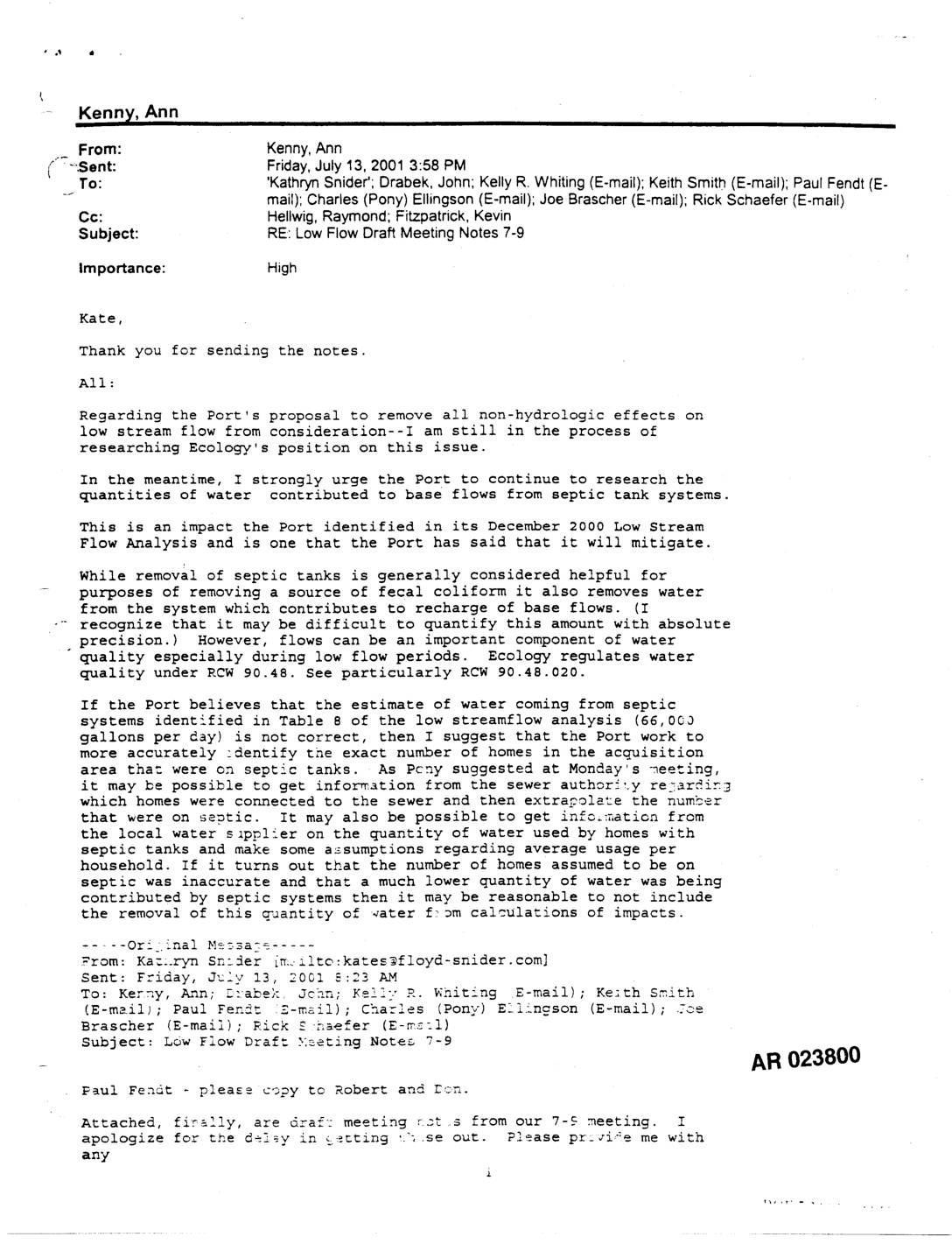
EXH AR023800: Email from Ann Kenny (Ecology) Re: Low Flow Draft Meeting Notes 7-9 — Septic Tank Impacts on Base Stream Flows
In a July 13, 2001 email, Ann Kenny of Washington State Department of Ecology urged the Port of Seattle to continue researching the water quantities contributed to base stream flows by septic tank systems slated for removal in the airport acquisition area. She noted that while eliminating septic tanks helps reduce fecal coliform contamination, it also removes water that recharges base flows — a water quality concern regulated under RCW 90.48. Kenny suggested the Port work to verify the accuracy of a 66,000-gallons-per-day estimate from its December 2000 Low Stream Flow Analysis by cross-referencing sewer authority and water supplier records. -
 2001-07-03
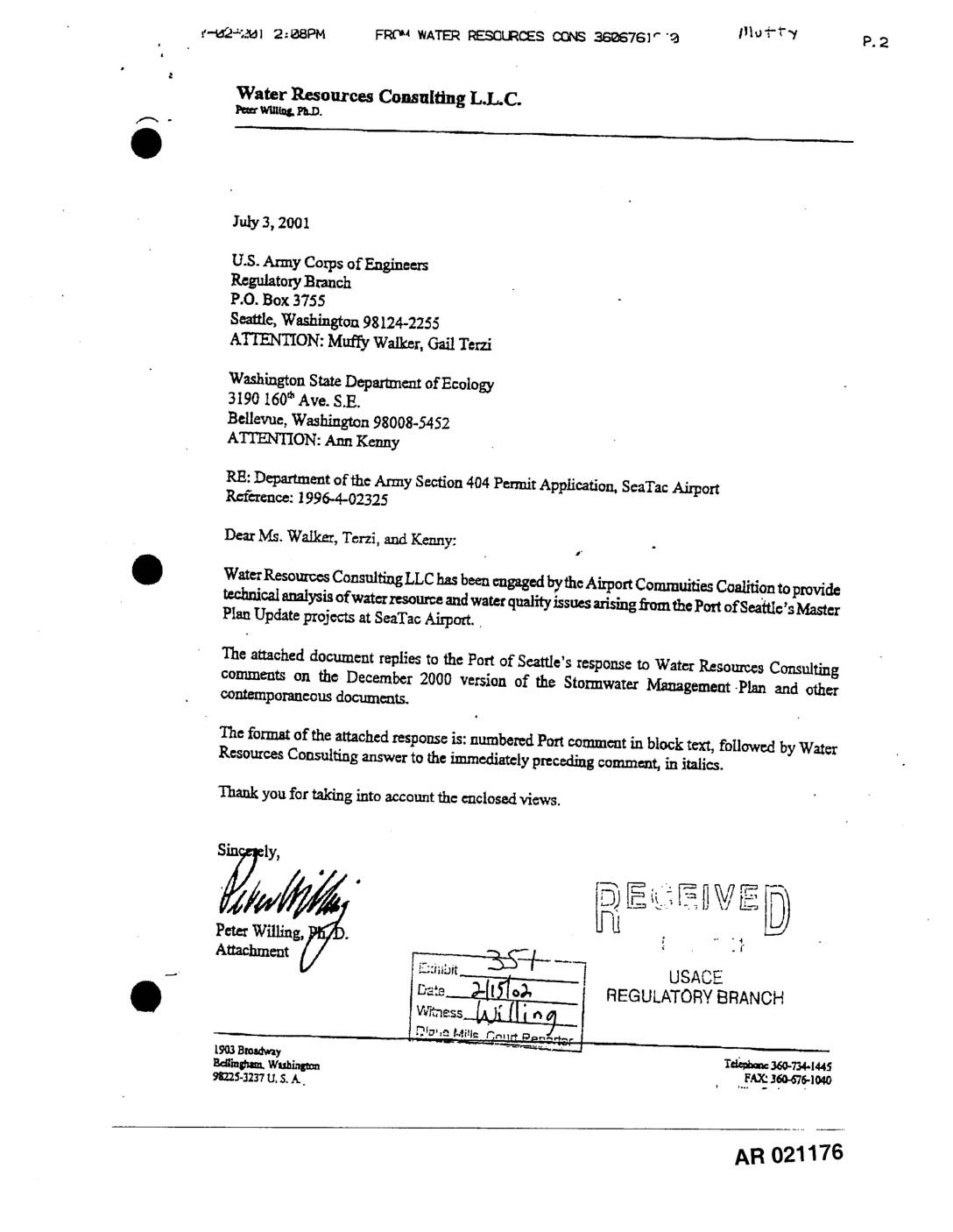
EXH AR021176: Water Resources Consulting LLC Follow-Up Response Section 404/401 Permit Comments STIA Master Plan Update
Water Resources Consulting LLC submitted technical comments in July 2001 on behalf of the Airport Communities Coalition, challenging the Port of Seattle's stormwater management plans for SeaTac Airport expansion. The document disputes Port claims about impervious surface increases, water diversions affecting Miller, Walker, and Des Moines creeks, and the effectiveness of bioswale filtration systems for removing pollutants such as metals from airport runoff.