TagThird Runway(1084)
-
 2001-03-20
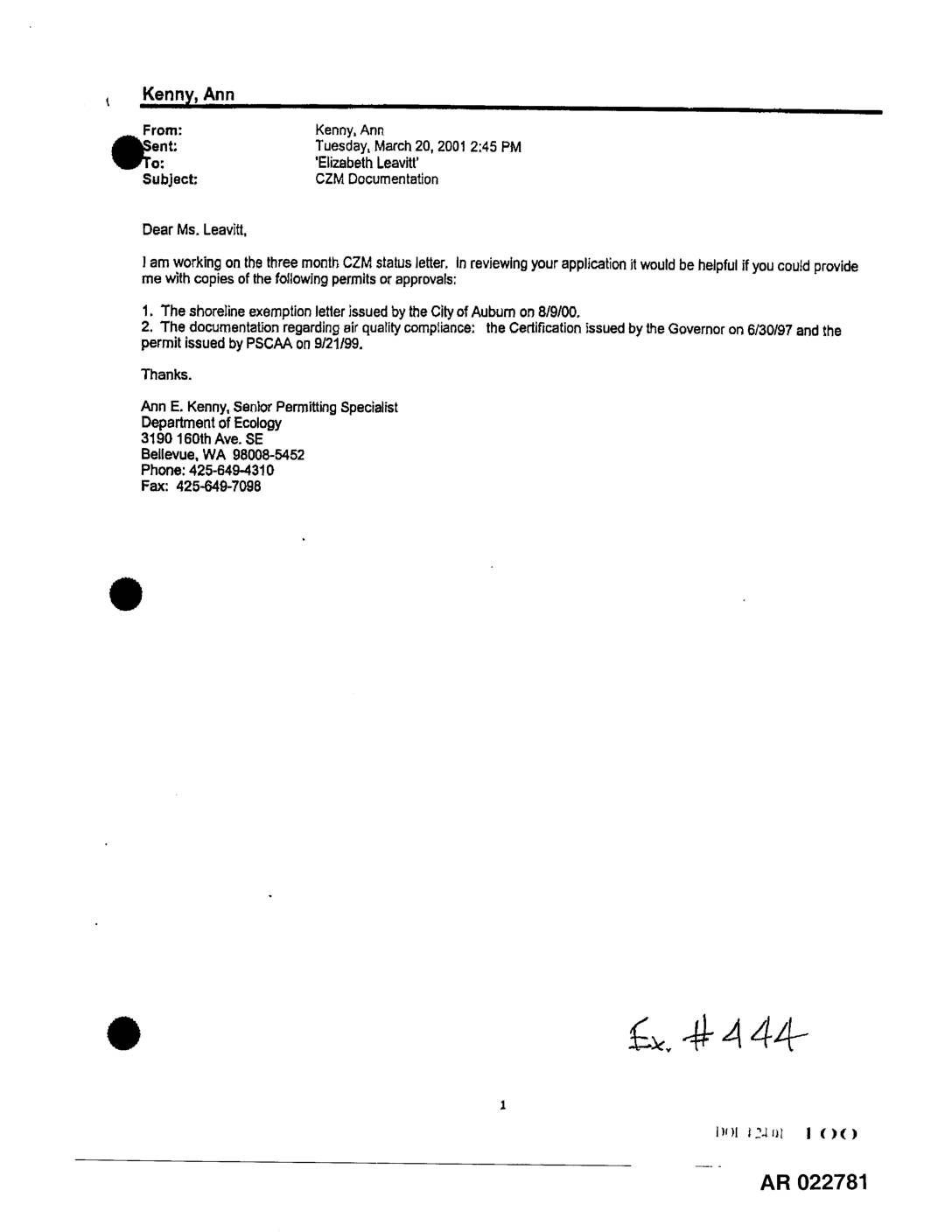
EXH 444: Email Ann Kenny (Ecology) to Elizabeth Leavitt Requesting CZM Documentation
In this March 20, 2001 email, Ann E. Kenny, a Senior Permitting Specialist at the Washington Department of Ecology, contacts Elizabeth Leavitt while working on a three-month Coastal Zone Management (CZM) status letter. Kenny requests copies of two key documents: a shoreline exemption letter issued by the City of Auburn on 8/9/00, and air quality compliance documentation including a Governor's Certification from 6/30/97 and a PSCAA permit from 9/21/99. -
 2001-03-19
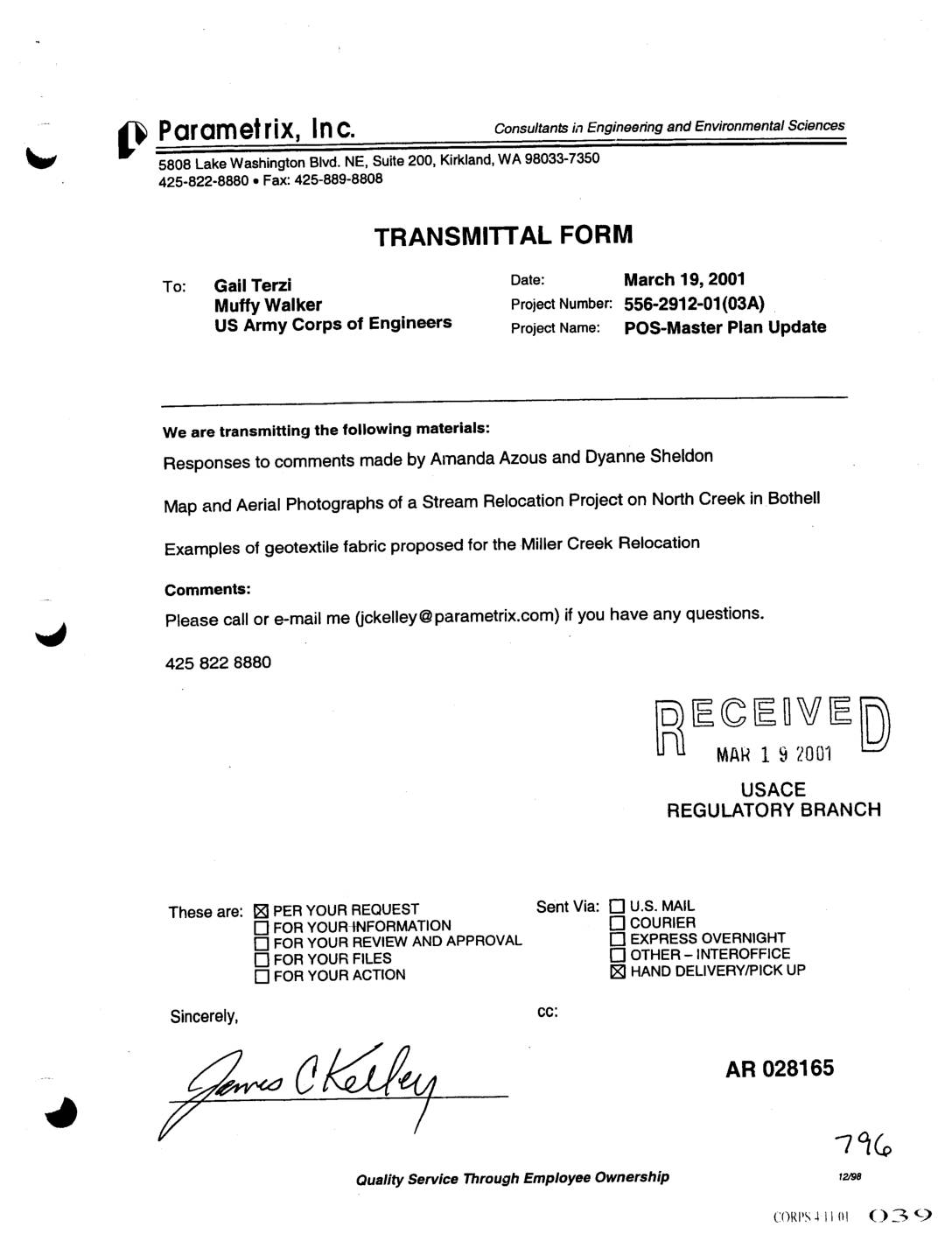
EXH AR028165: Transmittal Form and ACC Review — Miller Creek Relocation and Third Runway Wetland Impacts, Port Of Seattle STIA Master Plan Update
Transmittal form dated March 19, 2001 from Parametrix, Inc. (James C. Kelley) to Gail Terzi and Muffy Walker, US Army Corps of Engineers Regulatory Branch, for Port Of Seattle project number 556-2912-01(03A), POS-Master Plan Update. Transmits responses to comments by Amanda Azous and Dyanne Sheldon, map and aerial photographs of a stream relocation project on -
 2001-03-16
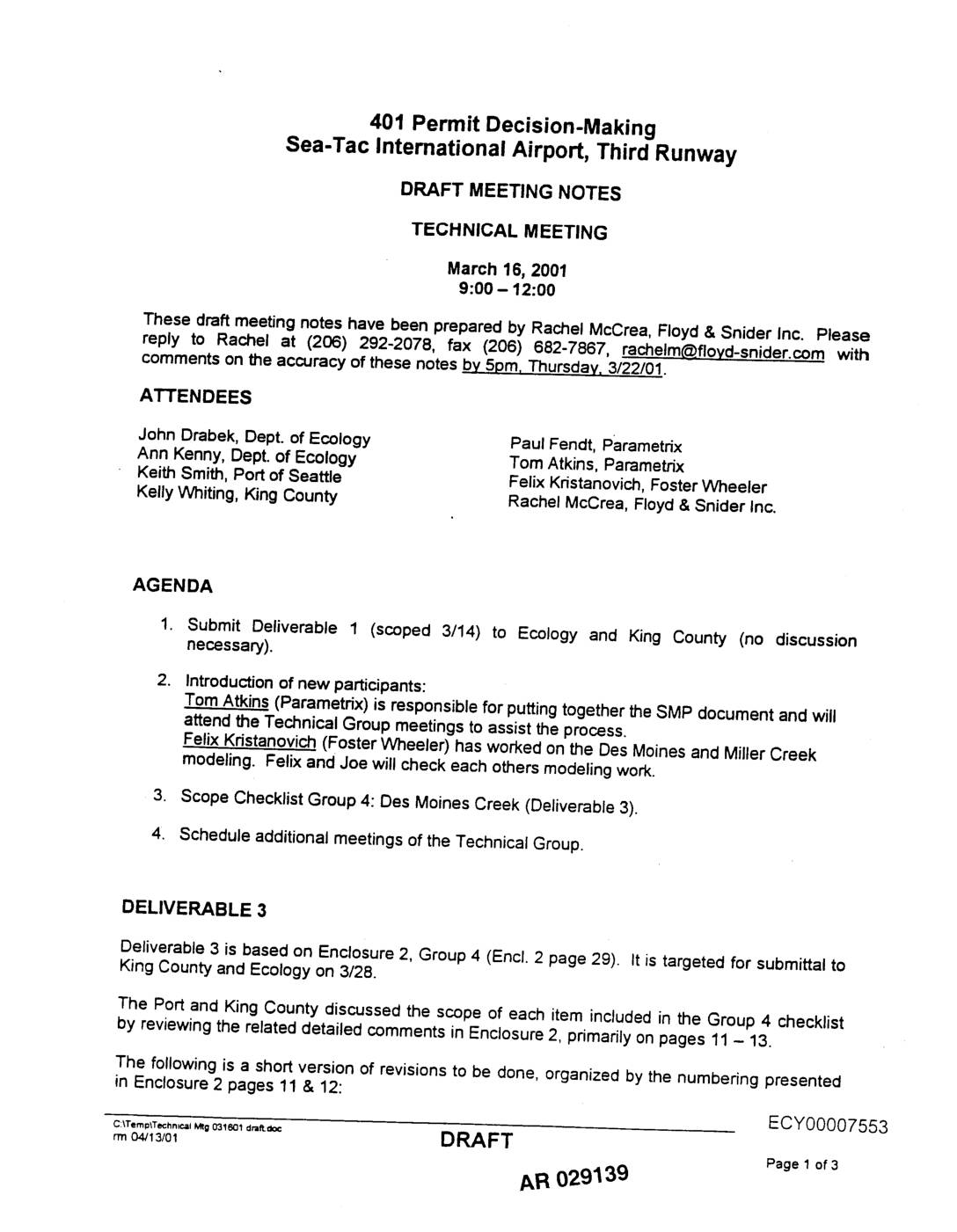
EXH AR029139: 401 Permit Decision-Making, Sea-Tac Airport Third Runway — Technical Meeting Draft Minutes, March 16, 2001
Draft meeting notes from March 16, 2001 Technical Meeting on 401 Permit Decision-Making for Sea-Tac Airport Third Runway, prepared by Rachel McCrea of Floyd & Snider Inc. Attendees included John Drabek and Ann Kenny (Dept. of Ecology), Keith Smith (Port Of Seattle), Kelly Whiting (King County), Paul Fendt and Tom Atkins (Parametrix), and Felix Kristanovich -
 2001-03-15
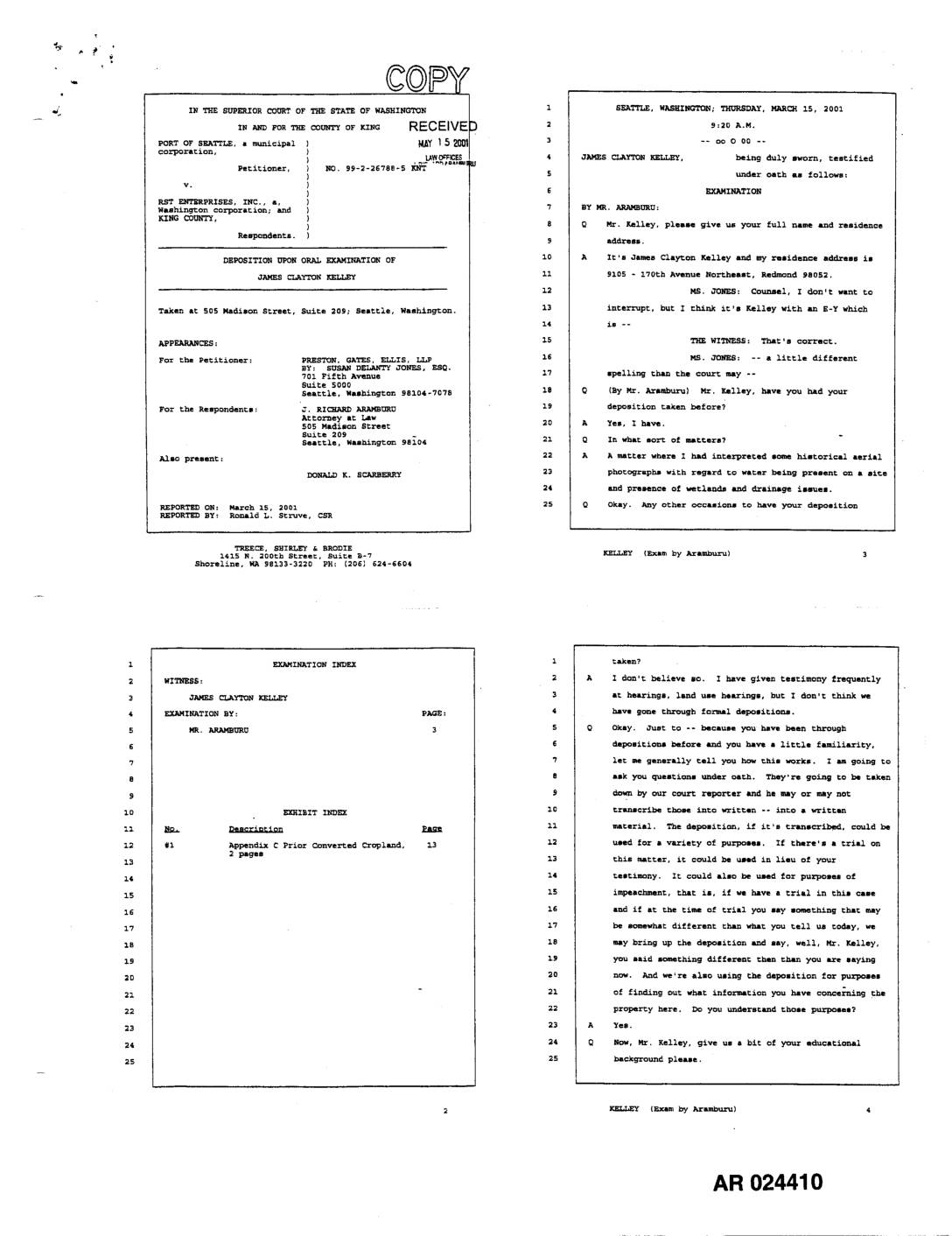
EXH AR024410: Deposition James Clayton Kelley — v. RST Enterprises & King County No. 99-2-26788-5 KNT
This is a March 15, 2001 deposition of James Clayton Kelley, a Senior Wetland Ecologist at Parametrix, taken in connection with a King County Superior Court case involving the Port of Seattle and the Sea-Tac Airport third runway project. Kelley, who holds a doctorate in plant ecology from Michigan State University, describes his role leading wetland delineation studies and 404 permit work for the project, including the identification and mapping of wetlands and prior converted croplands on properties such as the Vacca Farm. He testifies that wetland delineation reports prepared in August 1999 remained current with no significant changes, and that a 404 permit from the Army Corps of Engineers and Department of Ecology was still pending at the time of the deposition. -
 2001-03-15
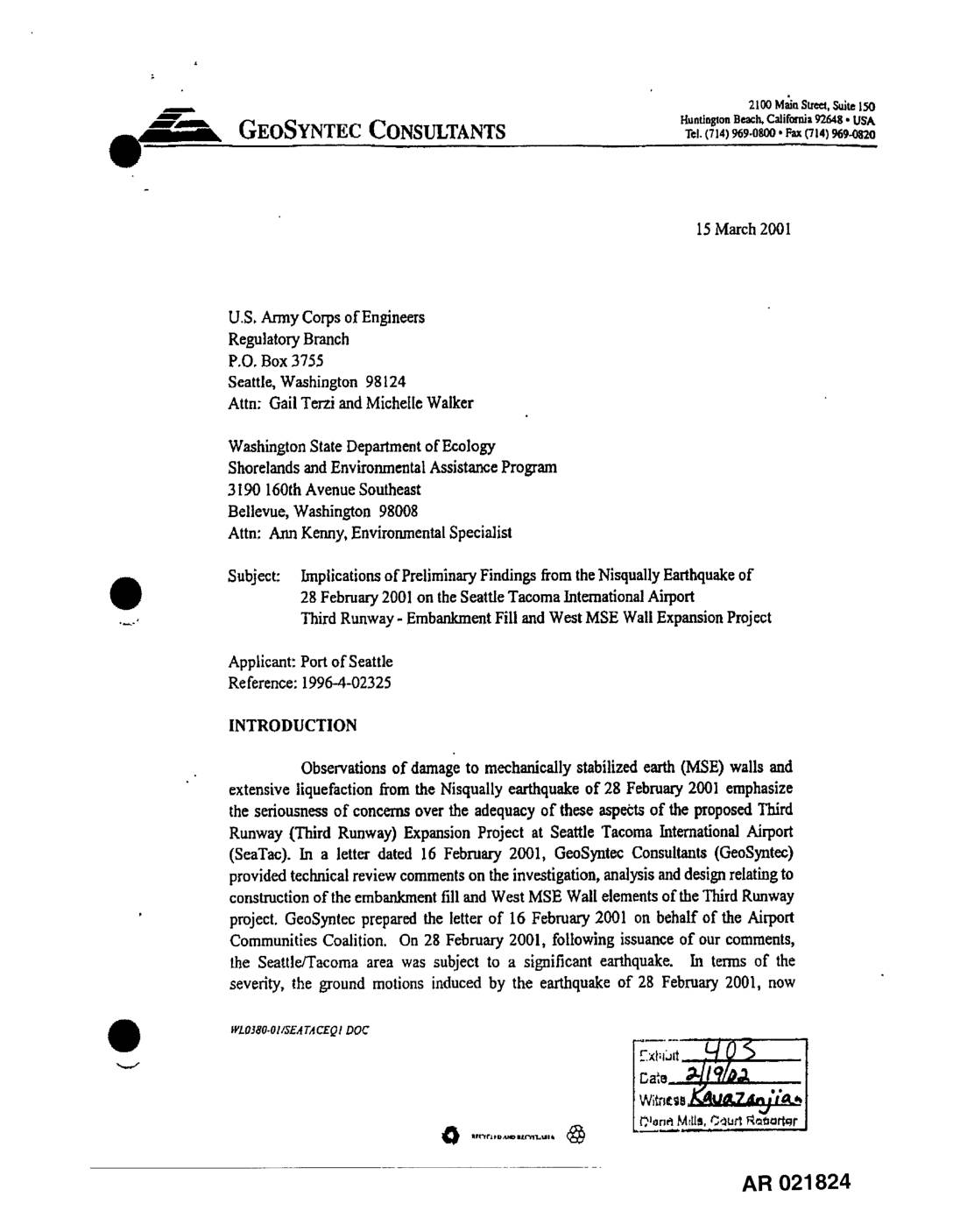
EXH 403: GeoSyntec Letter to Army Corps & WA Ecology — Nisqually Earthquake Implications STIA Third Runway MSE Wall & Embankment Fill
Following the Nisqually earthquake of February 28, 2001, GeoSyntec Consultants wrote to the U.S. Army Corps of Engineers and Washington State Department of Ecology raising serious concerns about the seismic safety of the proposed Third Runway expansion at Seattle-Tacoma International Airport. The letter highlighted that the earthquake caused damage to mechanically stabilized earth (MSE) walls and widespread liquefaction despite being only a moderate event, reinforcing earlier warnings about flaws in the project's seismic design criteria and ground motion analysis. GeoSyntec argued that the airport's role as a regional emergency lifeline demands higher safety standards than those applied to ordinary residential structures. -
 2001-03-15
EXH AR021642: Water Quality Monitoring RP 00-101B — Columbia Analytical Services to ACC
A March 15, 2001 laboratory report from Columbia Analytical Services sent to John Strand of the Airport Communities Coalition, summarizing water quality test results from samples submitted on February 28, 2001. The report, assigned service request number K2101434, confirms all analyses were conducted under the laboratory's quality assurance program. It includes reference sheets defining technical acronyms and data qualifiers used in interpreting inorganic, metals, and organic test results. -
 2001-03-14
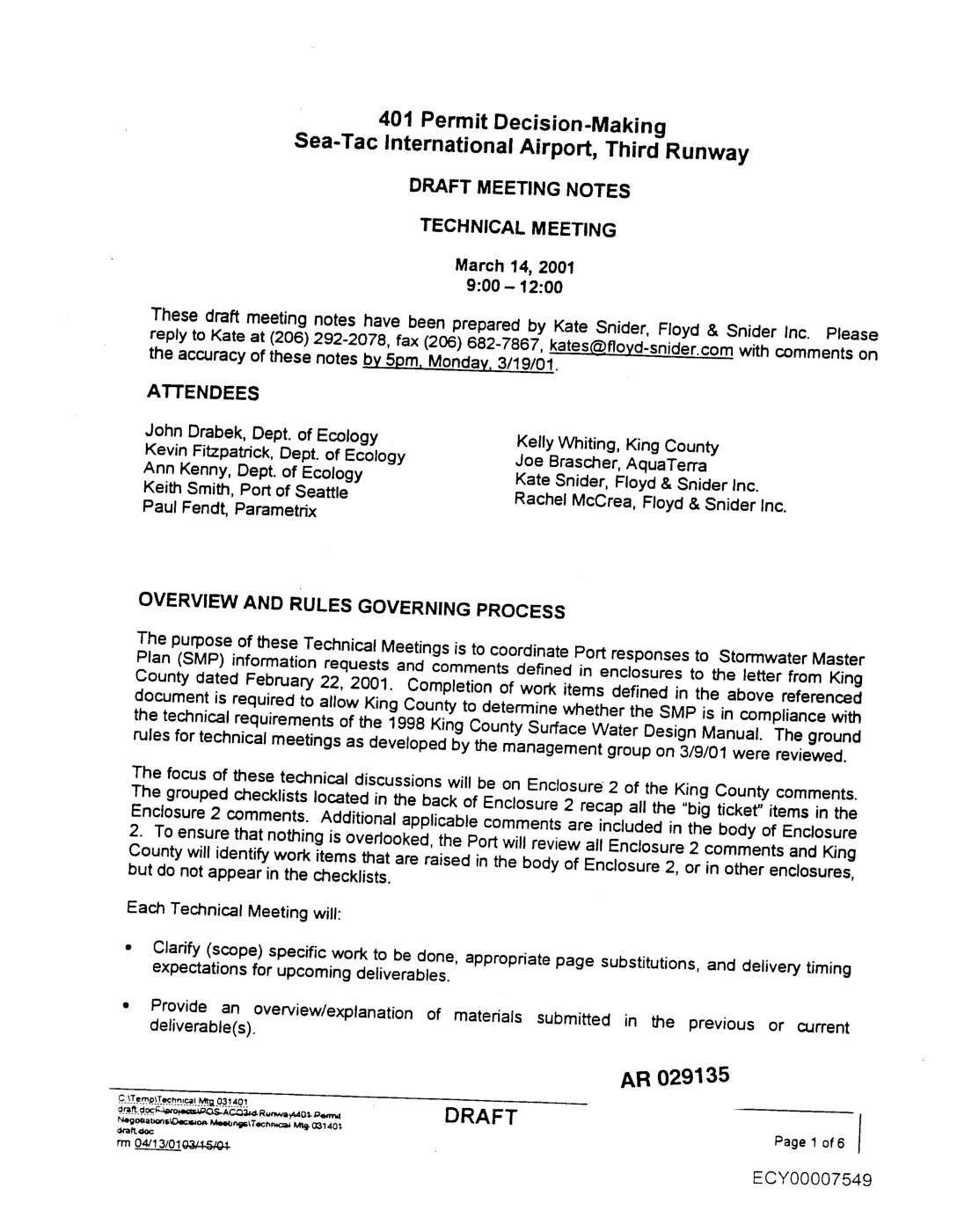
EXH AR029135: Draft Technical Meeting Notes — 401 Permit Decision-Making, Sea-Tac Airport Third Runway, March 14, 2001
Draft meeting notes prepared by Kate Snider of Floyd & Snider Inc. for a technical meeting held March 14, 2001 regarding 401 Permit Decision-Making for the Sea-Tac International Airport Third Runway. Attendees included representatives from the Washington State Department of Ecology (John Drabek, Kevin Fitzpatrick, Ann Kenny), Port of Seattle (Keith Smith), King County (Kelly -
 2001-03-14
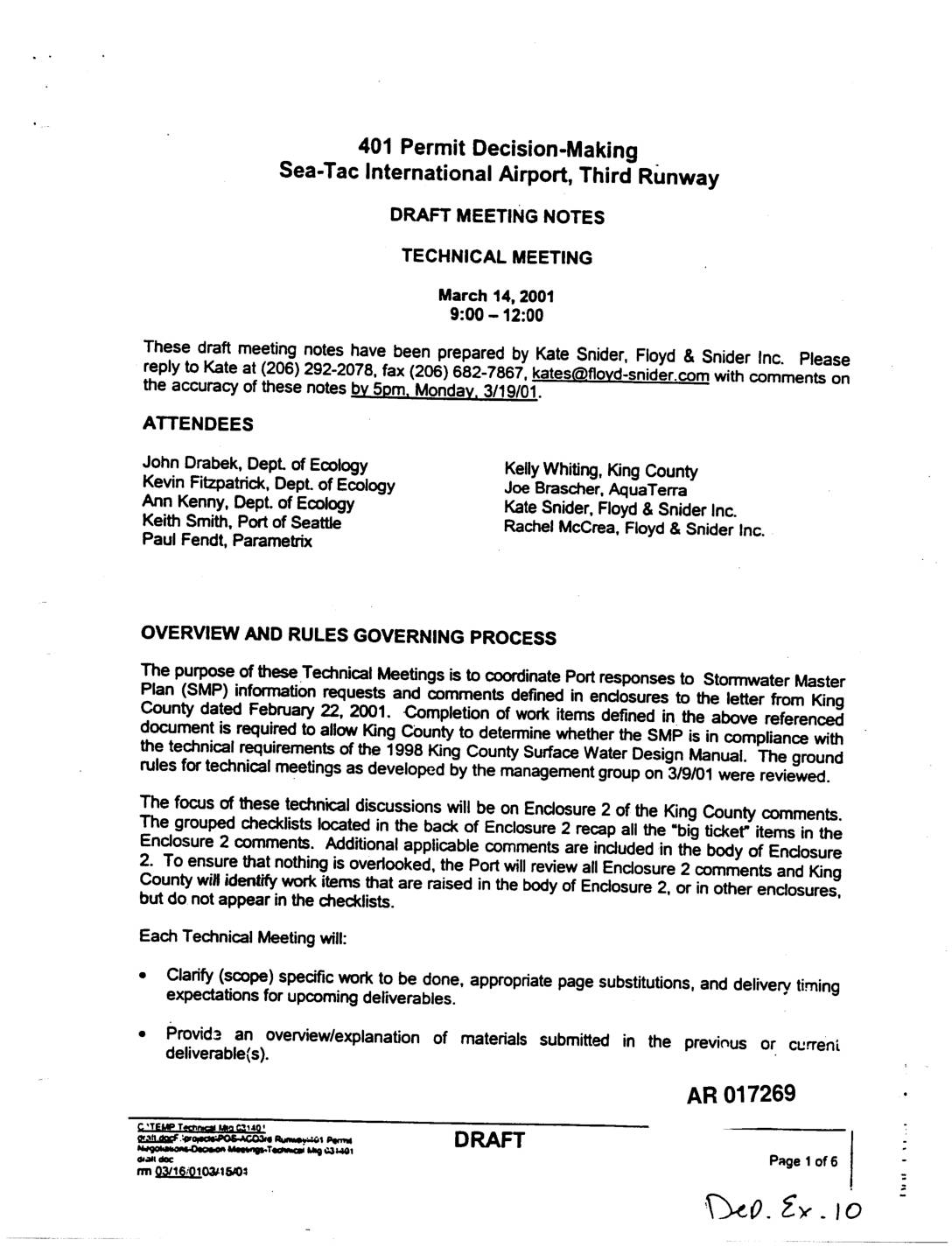
EXH AR017269: 401 Permit Decision-Making, Sea-Tac Airport Third Runway — Draft Technical Meeting Notes, March 14, 2001
Draft meeting notes prepared by Kate Snider of Floyd & Snider Inc. for a Technical Meeting held March 14, 2001 regarding 401 Permit Decision-Making for Sea-Tac International Airport Third Runway. Attendees included representatives from Washington State Department of Ecology (John Drabek, Kevin Fitzpatrick, Ann Kenny), Port of Seattle (Keith Smith), King County (Kelly Whiting), AquaTerra -
 2001-03-14
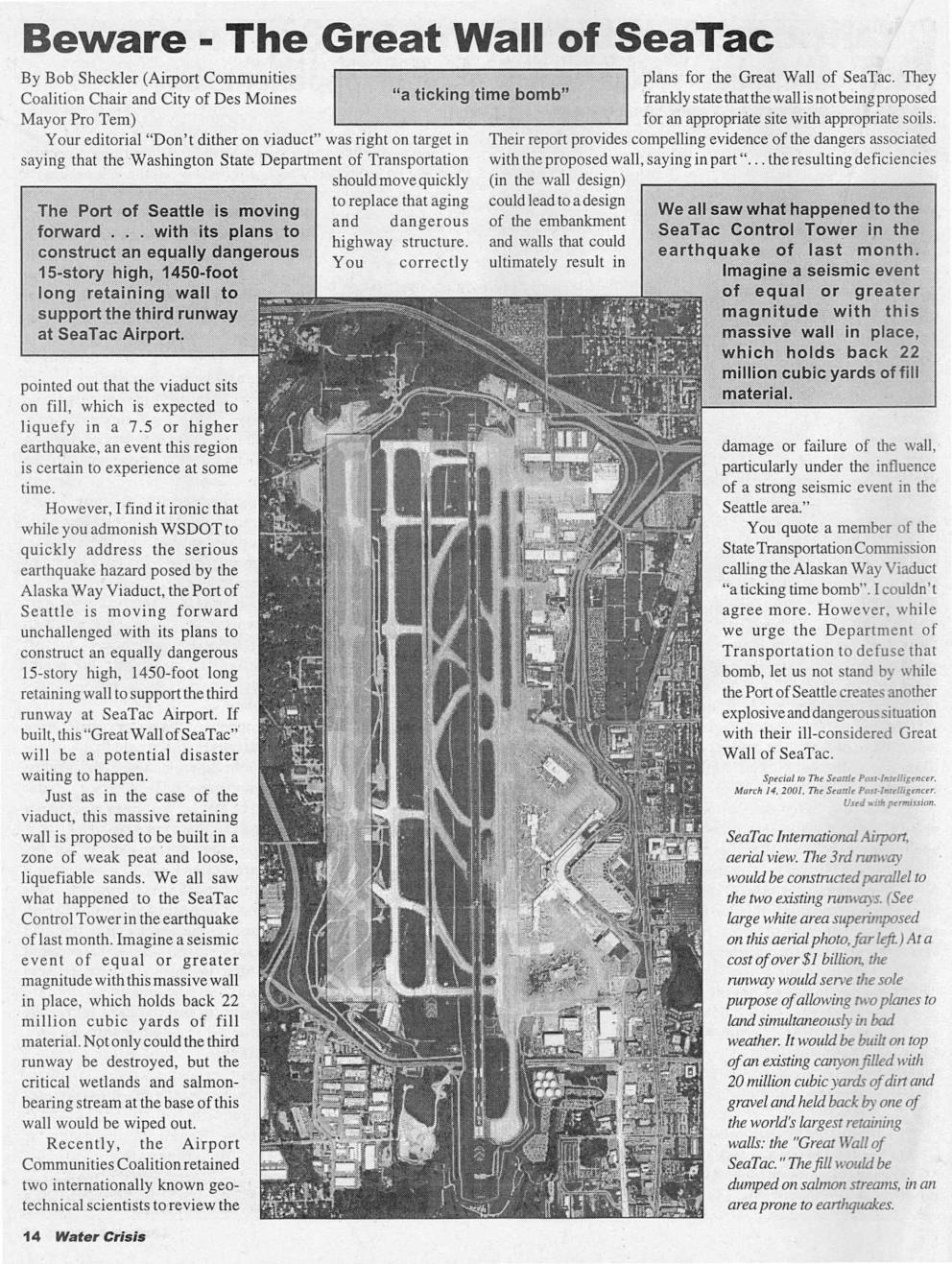
Beware – The Great Wall of Sea-Tac and Coalition appeals permit for 3rd runway
Two 2001 Seattle Post-Intelligencer articles raise safety and environmental concerns about SeaTac Airport's proposed third runway. The first warns that a planned 15-story, 1,450-foot retaining wall built on weak, earthquake-prone soils could catastrophically fail in a seismic event, threatening wetlands and salmon-bearing streams. The second reveals that state officials approved a key water-quality permit for the runway without following their own attorney's advice to secure a water right, prompting the Airport Communities Coalition to appeal the permit and allege political pressure was driving the project forward. -
 2001-03-12
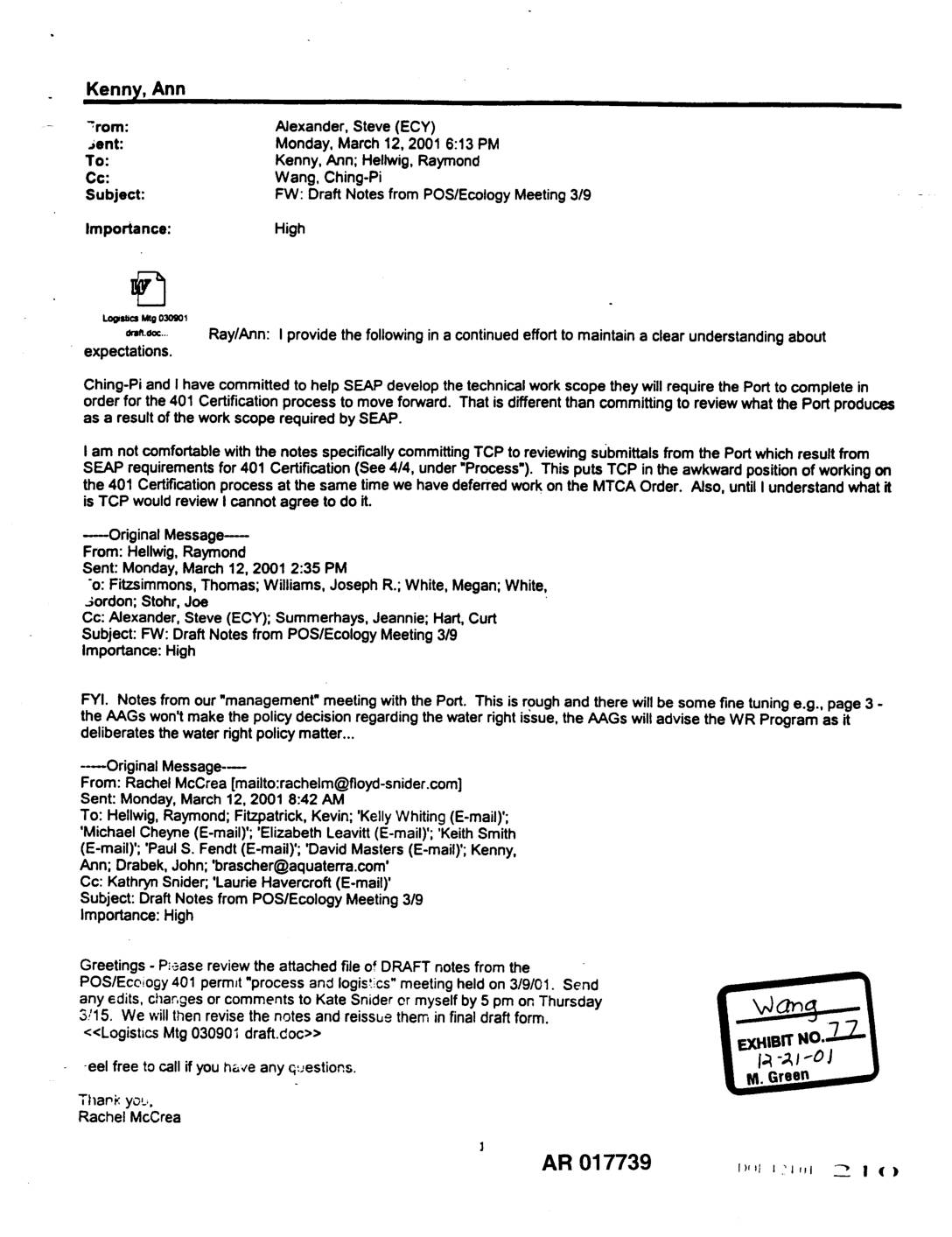
EXH AR17739: Draft Meeting Notes — 401 Permit Decision-Making, Port Of Seattle / Ecology Meeting, March 9, 2001
Email chain dated March 12, 2001 from Steve Alexander (ECY/Ecology) to Ann Kenny and Raymond Hellwig, forwarding draft meeting notes from a March 9, 2001 management meeting between the Department of Ecology and the Port Of Seattle regarding the 401 Certification process for Sea-Tac Airport Third Runway. Alexander clarifies that TCP (Toxics Cleanup Program) committed