TagSound Insulation(121)
-
 2016-10-11
Airport noise insulation project
This October 2016 Port of Seattle briefing presents the Airport Noise Insulation Project for Sea-Tac Airport, outlining how a federally guided noise study (known as a Part 150) is used to identify noise and land-use conflicts in surrounding communities. The project aims to provide sound insulation to eligible homeowners in high-noise areas, with approved mitigation measures qualifying for 80% federal Airport Improvement Program (AIP) grant funding. The briefing covers project elements, homeowner eligibility requirements, community benefits, and associated costs. -
 2016-10-11
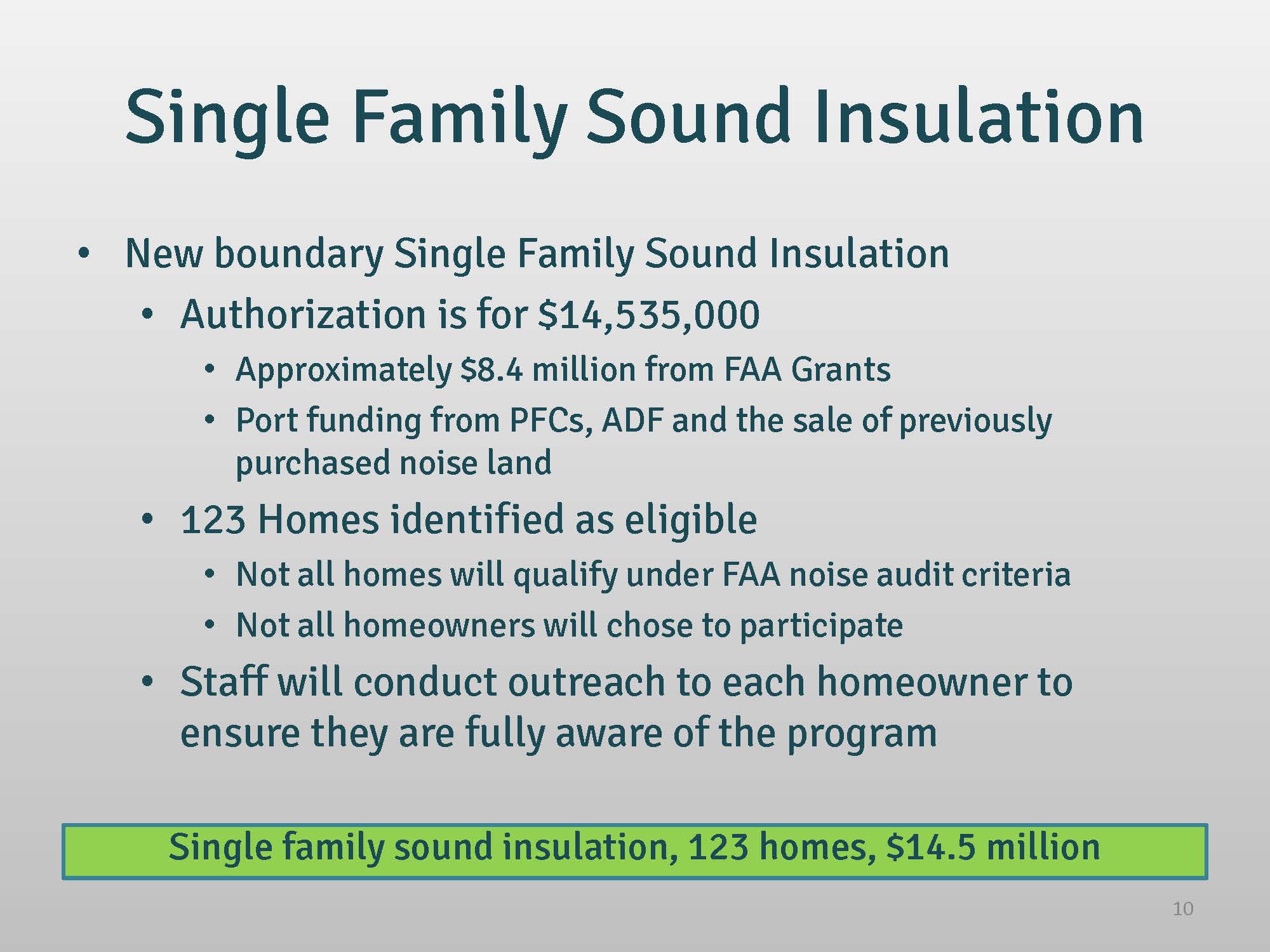
Single Family Sound Insulation Program Authorization — $14.5 Million for 123 Homes (October 2016)
Presentation slide describing a new boundary Single Family Sound Insulation program with authorization of $14,535,000, covering 123 eligible homes. Funding sources include approximately $8.4 million from FAA Grants plus Port funding from PFCs, ADF, and sale of previously purchased noise land. -
 2013-11-19
Seattle-Tacoma International Airport Noise Programs
Seattle-Tacoma International Airport operates several noise programs aimed at reducing the impact of aircraft noise on surrounding communities, including sound insulation, flight track monitoring, and community land-use planning. A key component is the Part 150 Noise Study, which makes the airport eligible for federal grants and focuses on areas within the 65 decibel Day Night Level (DNL) contour, without imposing flight restrictions or shifting noise to other neighborhoods. The program also includes an updated Noise Remedy Boundary that has been expanded beyond the previous boundary to better reflect projected future noise contours around the airport. -
 2013-09-24
Part 150 Noise Remedy Program — Sound Insulation Presentation to Port Of Seattle Commission (September 24, 2013) — Slide 3
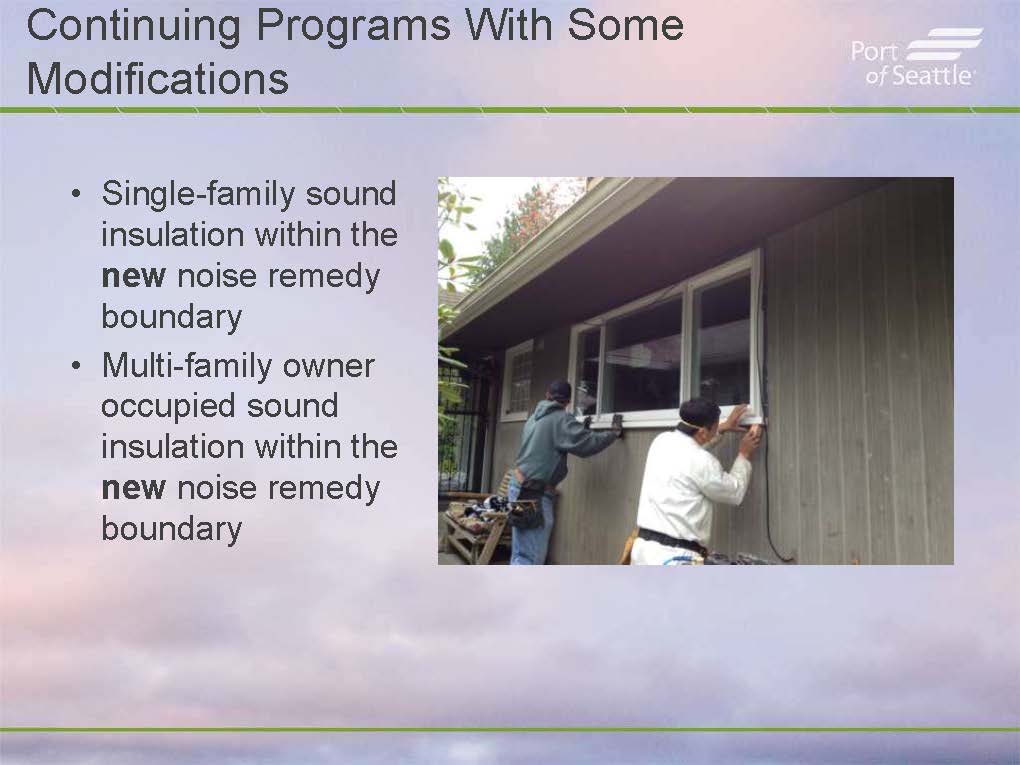
A Port of Seattle presentation slide describing continuing noise-remedy programs with modifications, specifically single-family and multi-family owner-occupied sound insulation within the new noise remedy boundary. The accompanying photo shows two workers installing or sealing windows on the exterior of a residential building, illustrating the sound insulation work being performed. -
 2013-09-24
Seattle-Tacoma International Airport Part 150 Update: Commission Presentation
The Port of Seattle is updating its Part 150 noise management plan for Seattle-Tacoma International Airport, which includes revising the official noise remedy boundary based on 2018 future noise contour projections. The updated boundary is generally smaller than the current one, reshaping which properties qualify for noise mitigation assistance. Continuing programs under the new boundary include sound insulation for both single-family homes and owner-occupied multi-family residences located within the affected area. -
 2013-01-01
Guidelines for airport sound insulation programs
This 2013 report from the National Academies provides updated guidelines for airport sound insulation programs (SIPs), helping airport sponsors manage the process of reducing aircraft noise in homes, schools, hospitals, and other noise-sensitive buildings. It covers key topics such as construction contracting, federal funding requirements, and best practices for working with homeowners and contractors on government-funded renovation projects. The guidelines are intended for use by airport staff, consultants, and FAA offices in developing compliant noise compatibility programs. -
 2012-09-01
King County International Airport Residential Aircraft Noise Remedy Improvements Program (RANRIP) Policies and Procedures Manual
The King County International Airport (Boeing Field) Residential Aircraft Noise Remedy Improvements Program (RANRIP) is a sound insulation program that provides home modifications to reduce aircraft noise for eligible residents living near the airport. The program, initially approved by the FAA in November 2006 and updated in September 2012, outlines policies and procedures covering homeowner eligibility, design assessments, construction processes, and post-construction inspections. Funding for sound insulation treatments is provided through the program, with the goal of measurably reducing interior noise levels for qualifying residences within the defined noise mitigation boundary. -
 2012-03-01
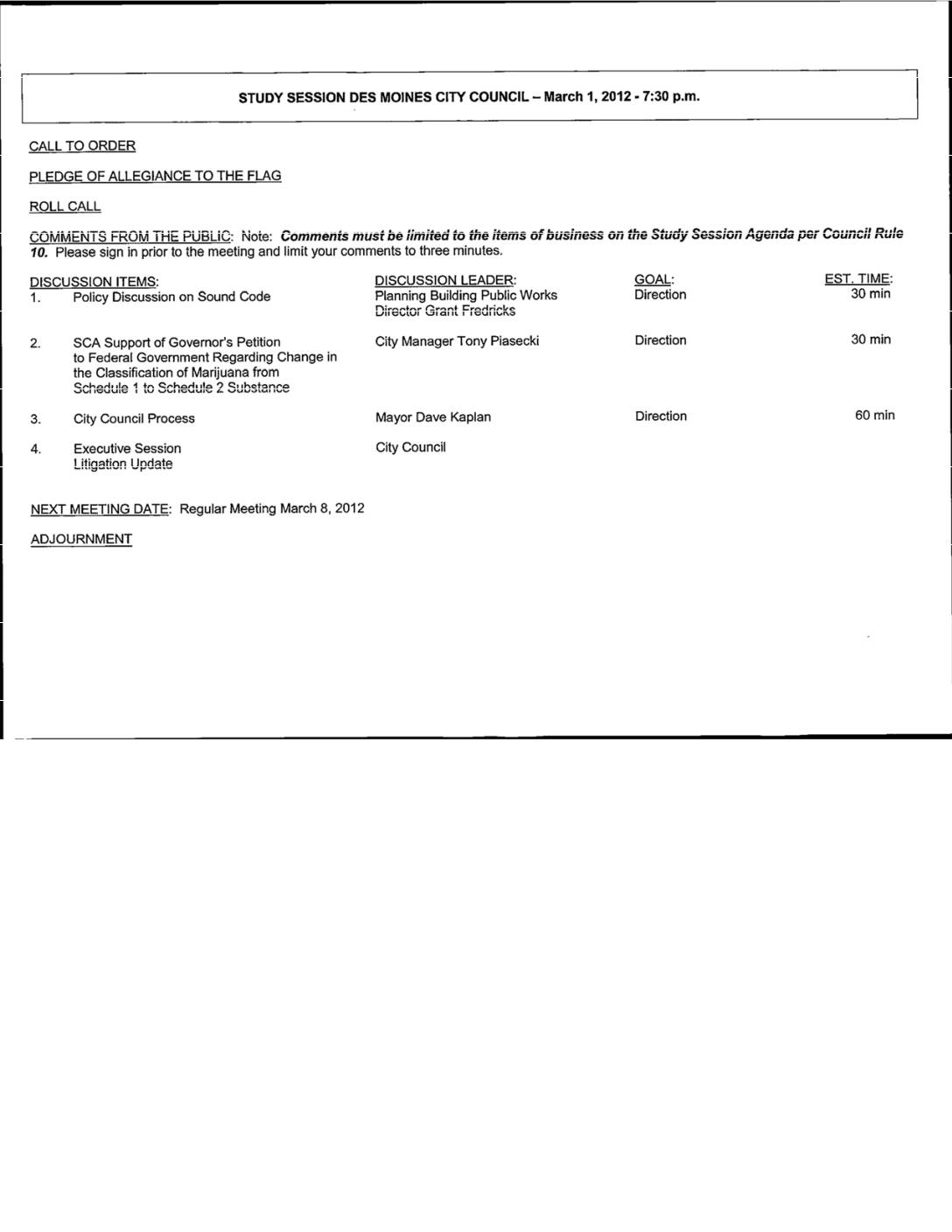
Study session Des Moines City Council – March 1, 2012 – 7:30 p.m.
At a March 1, 2012 Des Moines, WA City Council study session, staff presented a policy discussion on whether to update the city's Sound Transmission Control (Sound Code) requirements, which govern noise-reducing construction standards for buildings near Sea-Tac Airport. The existing code, last revised in 1996, was criticized by developers and homeowners as overly burdensome, while the Port of Seattle's official 'Part 150' noise contour study won't be finalized until 2016. The Council was asked to consider options ranging from immediate regulatory relief—such as reducing sound zones, limiting requirements to windows only, or making compliance voluntary—to waiting until the 2016 study is complete before making any changes. -
 2008-11-01
King County International Airport Sound Insulation Program Homeowner’s Handbook
The King County International Airport Sound Insulation Program, launched in 2005, offers free noise-reduction improvements to qualifying single-family homes (4-plex or smaller) located within the airport's noise mitigation area. Funded primarily by the FAA with a 5% match from King County, the program installs sound insulation upgrades to reduce the impact of aircraft noise inside residences. Homeowners who qualify must complete an eight-step participation process, including attending a briefing, signing a program contract, and granting an avigation easement. -
 2006-03-30
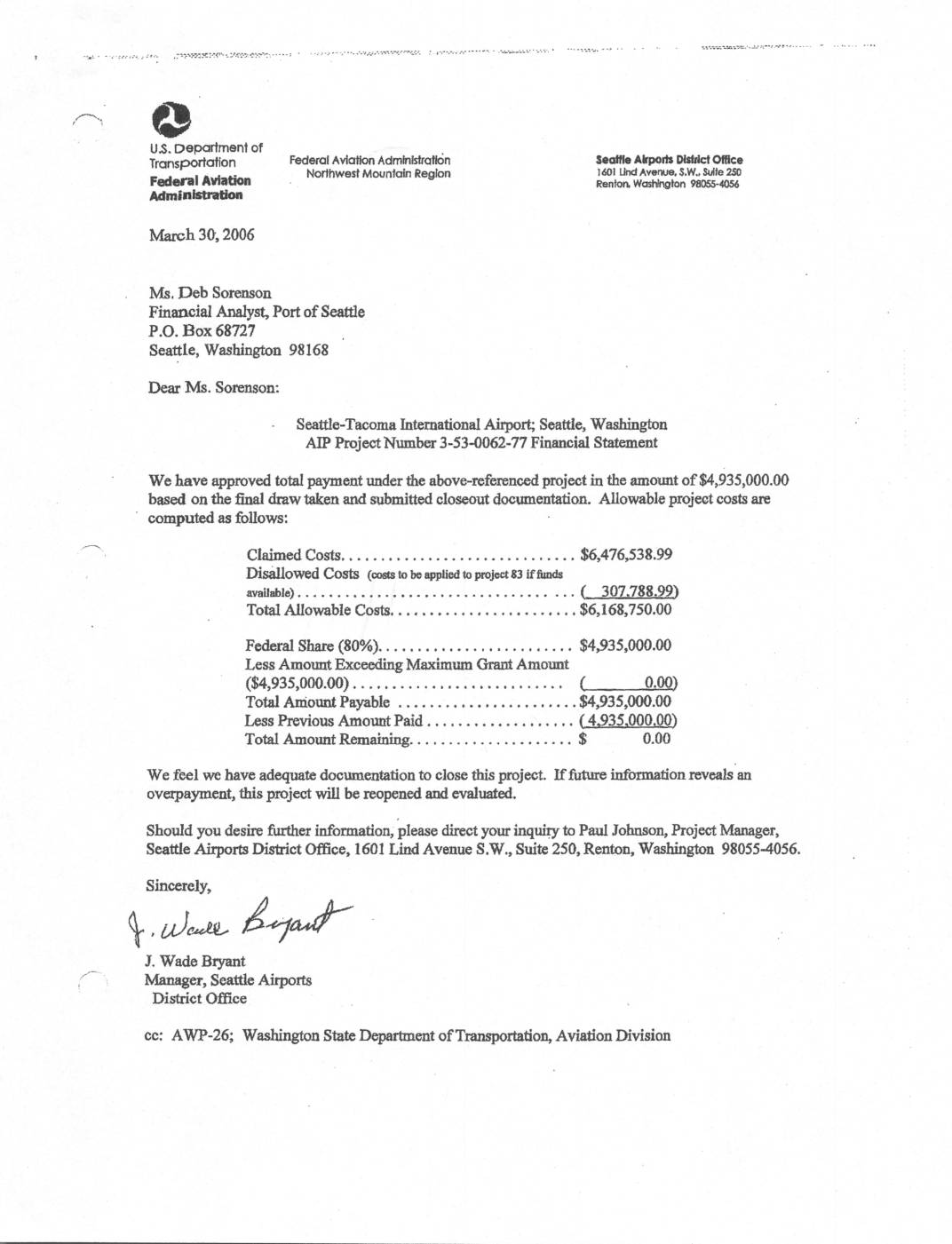
Sea-Tac International Airport acoustical insulation AIP project no. 3-53-0062-77 financial statement
The Federal Aviation Administration approved a total grant payment of $4,935,000 to the Port of Seattle for AIP Project Number 3-53-0062-77, covering acoustical insulation work at Seattle-Tacoma International Airport. Out of $6,476,538.99 in claimed costs, $6,168,750.00 was deemed allowable after disallowing $307,788.99, with the federal share set at 80%. The Port of Seattle submitted closeout documentation in March 2006, though a Circular A-133 audit by Deloitte & Touche and final acoustic test results for Seawind Condominiums were still pending completion at the time of closure.