Skip to content
  • STNI
  • Statistics
    • Ops and Passengers
      • King County International Airport (Boeing Field) Annual Operations
    • Financials
    • Aviation fuel uplift in the State of Washington 2018 – 2025
      • Aviation Fuel Uplift at Sea-Tac Airport
    • Air Quality Monitoring
    • Flight Tracking
      • Flow and Flight Tracks
      • Five Year Comparison
      • Busiest Hours and Days
    • SEL Noise Reports & Graphs
      • About The Permanent Noise Monitors
      • Minutes of Quiet by Noise Monitor
      • Noise Events mapped
      • Noise Events (SEL)
    • Runways
    • Employees
    • Real Estate
      • Port Properties and Trees mapped
    • Parking
  • Events
  • Protest
    • Regular Events
    • Legislation 2026
    • Complain about a particular flight
    • Advocacy Organizations
    • Media Outlets
    • People
    • The Port of Seattle
      • Commission Meetings
      • Public Records Requests
      • StART
      • Highline Forum
    • Contact Your Electeds
  • Resources
    • FAQs
      • FAA Occurrences/Accidents/Indents
    • The unSustainable Airport Master Plan
      • SAMP Public Comment Template
        • Two versions of Appendix K: NEPA/SEPA 2018 vs 2023
      • SAMP NTP: 31 projects by the numbers
      • SEPA Draft EIS (2026)
      • SAMP Record of Decision/FONSI (2025)
      • SAMP Draft EA (October 2024)
      • 2018 Scoping
    • Port Packages
      • Port Package Property Costs
      • Port Packages mapped
      • The Port Package Explainer
      • So you want a (first-time) Port Package? Start here
      • Port Package Looker Upper
      • How do I determine if I have a Port Package or Avigation Easement?
      • Progress on Port Package Update legislation
      • Having a Port Package Problem?
      • Port Package Site Visit Follow-Up
    • Document Library
    • Explainers
      • The Airport Law Cheat Sheet
      • The Grant Explainer
    • External Articles
    • History
      • Timeline
      • The Sea-Tac Communities Plan
        • Sea-Tac Communities Plan – Planning Maps
      • PSRC Third Runway Decision Process
    • Studies
    • Videos
  • Stories
  • Mission
  • Subscribe
  • Contact
Scroll down to content

Get InformedStay Informedx

I understand that you will never share my information with anyone, you will only use it to keep me updated on relevant events and that I may unsubscribe at any time.

STNI

STNISea-Tac Noise.Info

  • Solve for Sea-Tac. Solve for every airport.
  • Since 2016, working to obtain justice for everyone living under the flight path.
  • Less Noise. Cleaner Air. Better Public Health. Compensation.
  • Everything you think you know about the airport is wrong.

TagSound Insulation(132)

Advanced Search Options

  • Dates
  • Media
    • External Articles
    • Images
    • PDFs
    • Video
    • Audio
  • Order By
  • 2006-03-30

    Sea-Tac International Airport acoustical insulation AIP project no. 3-53-0062-77 financial statement

    The Federal Aviation Administration approved a total grant payment of $4,935,000 to the Port of Seattle for AIP Project Number 3-53-0062-77, covering acoustical insulation work at Seattle-Tacoma International Airport. Out of $6,476,538.99 in claimed costs, $6,168,750.00 was deemed allowable after disallowing $307,788.99, with the federal share set at 80%. The Port of Seattle submitted closeout documentation in March 2006, though a Circular A-133 audit by Deloitte & Touche and final acoustic test results for Seawind Condominiums were still pending completion at the time of closure.
    TagsAIP, FAA, Port Of Seattle, Sea-Tac Airport, Sound Insulation
  • 2003-08-26

    Request for authorization to implement sound insulation of 98 single family residences in the 2010 65 DNL noise contour

    In September 2003, the Port of Seattle Commission considered authorizing a $3.69 million program to sound-insulate 98 single-family homes near Sea-Tac Airport that fell within the projected 2010 65 DNL noise contour and were built before local noise codes took effect. The project, stemming from a 1997 Environmental Impact Statement related to the airport's third runway, aimed to reduce interior noise levels by at least 5 decibels in eligible homes in Des Moines and unincorporated King County. Funding was to come primarily from federal Airport Improvement Program grants (80%), with the remainder drawn from the Airport Development Fund, and homeowners were required to grant the Port an avigation easement in exchange for the insulation work.
    TagsAIP, Noise Remedy Program, Port Of Seattle, RCAA, Sound Insulation, Third Runway
  • 2002-01-22

    Resolution No. 3483: Port Of Seattle Commission Support for Highline School District Capital Facilities Improvement Ballot Measure

    In January 2002, the Port of Seattle Commission passed Resolution No. 3483 to formally support the Highline School District's $189.5 million Capital Facilities Improvement Bond, which was on the March 12, 2002 ballot. The resolution reaffirmed the Port's commitment to contribute $50 million as part of a $200 million partnership with Washington State and the FAA for noise insulation and ventilation improvements at the 15 Highline schools most impacted by Seattle-Tacoma Airport aircraft noise. The funding partnership was contingent on Highline District voters approving the bond measure, which would also finance broader facility and technology upgrades across the district's aging school buildings.
    TagsFAA, Highline Schools, Port Of Seattle Commission, Sea-Tac Airport, Sound Insulation
  • 1998-05-27

    Port of Seattle in violation of Federal Grant Assurance C.6 And State RCW 53.54.020

    This document compiles evidence alleging that the Port of Seattle violated Federal Grant Assurance C.6 and Washington State law RCW 53.54.020 in connection with its noise compatibility program at Sea-Tac Airport. It includes letters from elected officials, audit findings by Deloitte & Touche, and records showing the Port received over $100 million in federal funds for FAR Part 150 noise mitigation while allegedly failing to comply with the program's requirements. Supporting materials span 1990–1998 and involve Congress members, state legislators, the FAA, and the Washington State Auditor's Office.
    TagsAdam Smith, Federal Grant Assurance C.6, GAO, Minnie O Brasher, Port Of Seattle, RCW 53.54.020, Sound Insulation
  • 1998-03-02

    Port Of Seattle Sound Reduction Program: Home Owner’s Instruction Manual

    This Home Owner's Instruction Manual was produced under the Port of Seattle's Sound Reduction Program and covers vinyl window and door products installed by CARE-FREE Windows and contractor SKM Construction. It explains how to care for and operate the PVC windows, which are designed to reduce aircraft noise, improve weatherization, and resist drafts and condensation. All CARE-FREE Windows products are backed by a 10-year guarantee covering defects in materials and workmanship from the date of purchase.
    TagsNoise Remedy Program, Port Of Seattle, Port Packages, Sound Insulation, Windows
  • 1998-01-01

    MAC Part 150 Residential Sound Insulation Program: 1992–1997 Completion & Funding Summary

    The MAC Part 150 Residential Sound Insulation Program completed sound insulation work on 3,673 homes near Minneapolis-St. Paul International Airport between 1992 and 1997, at a total cost of $76.6 million. Funding came from two sources: $28.7 million in FAA Airport Improvement Program (AIP) grants and $48.6 million in MSP Passenger Facility Charges (PFC). The program grew significantly over its six-year run, peaking in 1996 with 1,002 homes insulated at a cost of $20.7 million.
    TagsAIP, Noise Mitigation, Part 150, Passenger Facility Charges, Sound Insulation
  • 1994-05-18

    Seattle-Tacoma International Airport FAR Part 150 Noise Compatibility Program: 1993 Amendments

    This document presents the Seattle-Tacoma International Airport FAR Part 150 Noise Compatibility Program: 1993 Amendments, submitted by the Port of Seattle and approved by the Federal Aviation Administration on May 18, 1994. It outlines a series of noise mitigation measures—including sound insulation programs for homes and public buildings, a transaction assistance program for affected property owners, and an expanded noise monitoring system—aimed at reducing noncompatible land uses around Sea-Tac Airport. Three new measures were also recommended, covering funding for land use planning, a community planners forum, and ongoing operations review and noise exposure map updates.
    TagsFAA, Noise Mitigation, Part 150, Port Of Seattle, Sound Insulation
  • 1994-05-18

    Seattle-Tacoma International Airport FAR Part 150 Noise Compatibility Program: 1993 Amendments

    This document presents the Seattle-Tacoma International Airport FAR Part 150 Noise Compatibility Program: 1993 Amendments, submitted by the Port of Seattle and approved by the Federal Aviation Administration on May 18, 1994. It outlines updates to existing noise-reduction measures—including sound insulation for homes and public buildings, a transaction assistance program, and an expanded noise monitoring system—as well as newly recommended measures such as community planning forums and operational reviews. The program aims to reduce noncompatible land uses around Sea-Tac Airport and prevent the introduction of new ones.
    TagsFAA, Noise Mitigation, Part 150, Port Of Seattle, Sound Insulation
  • 1992-03-01

    Port Package Air Filter Label

    A circular multilingual instruction card (date-coded 92.03, document number 008004) providing filter replacement instructions in Danish (DK), Swedish (S), Finnish (SF), German (D), and English (GB). Instructions read: 'Open the ventilator. Push, turn right, pull,' with a diagram illustrating the procedure.
    Tagsair filtration, Port Packages, Sound Insulation
  • 1990-01-08

    SeaTac noise projects

    Since 1982, Seattle-Tacoma Airport (Sea-Tac) has received 13 federal AIP grants totaling over $50 million to acquire approximately 750 noise-impacted land parcels near the airport. In addition, four federal grants totaling over $7 million have funded a noise insulation program that has treated 323 homes, with further funding of $3.2 million per year requested to insulate roughly 175 additional houses annually over the next four years.
    TagsAIP, Airport Improvement Program, FAA, FAA Northwest Mountain Region, Port Packages, Sound Insulation

Posts pagination

Page 1 … Page 11 Page 12 Page 13 Page 14
Sidebar On/Off

Upcoming Events

  • StART SEA Stakeholder Advisory Round Table
    Add to CalendarMWednesday Aug 26, 5:00pm - 7:00pm
    Zoom (Virtual Meeting)
    START meetingagenda 2026826 final 0 pdf

    Meeting Objectives Introduce the primary feedback themes identified by StART members regarding StART’s Operating Procedures and determine areas that may warrant future discussion. 5:00 PM – Welcome Meeting Management Welcome Lead: Andrés Mantilla, Facilitator, Uncommon Bridges; Wendy Reiter, Airport Managing Director, POS 5:15 PM – Dinner: All participants eat. 5:30 PM – StART Operating Procedures

    [...]
  • Commercial Aviation Work Group
    Add to CalendarMThursday Sep 3, 10:00am - 1:30pm
    Virtual Meeting (Zoom)
    Cawg agenda sep 3 26 virtual pdf

    Meeting Agenda 10:00 a.m. – 10:15 a.m. | Welcome – Evan Nordby, Chair a. Introductions and Agenda Reviewb. Status of appointments and non-voting member invitationsc. Other updates as necessary 10:15 a.m. – 11:00 a.m. | Is it practical and legal to operate the western Washington [Puget Sound] airports as a single airport system? – Consultant

    [...]

[See all...]


Help study childhood asthma. Get free HEPA filter!

read more...

Issues

Sea-Tac Airport is currently undergoing the largest and longest expansion in its history, collectively known as the Sustainable Airport Master Plan (SAMP). Some of it you can already hear, but you’re probably not aware of what it all means. Here’s what you need to know.
read more...

Read This!

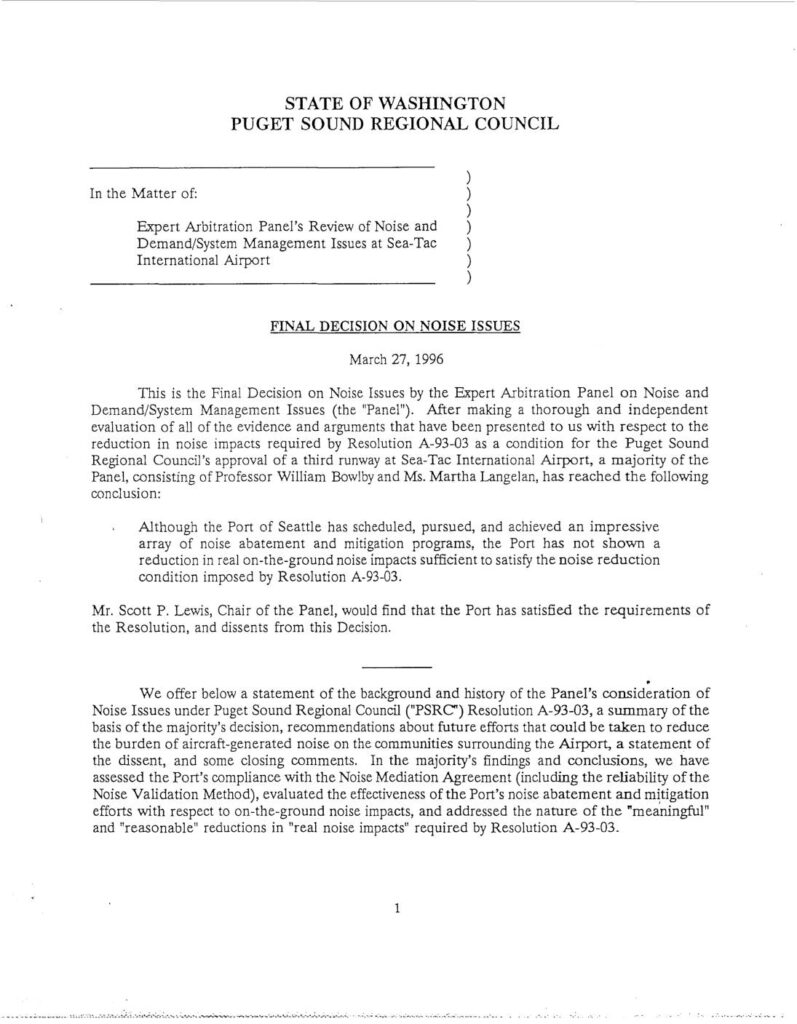
As the source for federal transportation grants, the Puget Sound Regional Council was charged with developing a system to meet the growing need for commercial aviation. When the search for a second airport failed, they authorized the Port of Seattle to build the Third Runway, with a mandate to develop a noise abatement and mitigation program. In their effort to stop the Third Runway, the ACC argued over every detail of the Port's efforts--including property buyouts and sound insulation. The dispute was meant to be settled by a three member Expert Arbitration Panel. This is their final report. It finds 2-1, that the Port's program was insufficient in several respects. Despite that, funding for the Third Runway was approved by the PSRC, and the 'Port Package' program, proceeded largely unchanged. Expert Arbitration Panel's final decision finding that the Port of Seattle had not shown sufficient reduction in real on-the-ground noise impacts to satisfy noise reduction conditions required for approval of a third runway at Sea-Tac International Airport. The majority decision concluded the Port's noise abatement programs were insufficient despite being impressive in scope.
continue...
The Podcast!

Subscribe to the only podcast devoted to policies, politics, history, impacts for people living under the flight path everywhere. It’s definitely not just about noise!
  • Sea-Tac Noise.Info
  • Connect with STNI

    • Subscribe
    • Port Package Problem?
    • Donate
    • Podcast
    • Socials
      • Facebook
      • X (Twitter)
      • Bluesky
      • Instagram

    "GE90 Engine Undergoing Pre- or Post-Test Processing at a GE Aviation Facility" — , 2023

  • Learn

    • Frequently Asked Questions
    • Explainers
    • Youtube
    • Research Requests
    • Make a complaint
  • Goals

    Fulfill the promises of 1976:
    • Compensation
    • Reduced noise
    • Improved air quality
    • Environmental remediation
Login/Register
©2026•Data Privacy

Message

We use cookies to provide basic functionality. We also provide access to search engines in order to provide site analytics. We do not sell or share your data.
V V