TagSea-Tac Airport Master Plan(37)
-
 1996-09-19
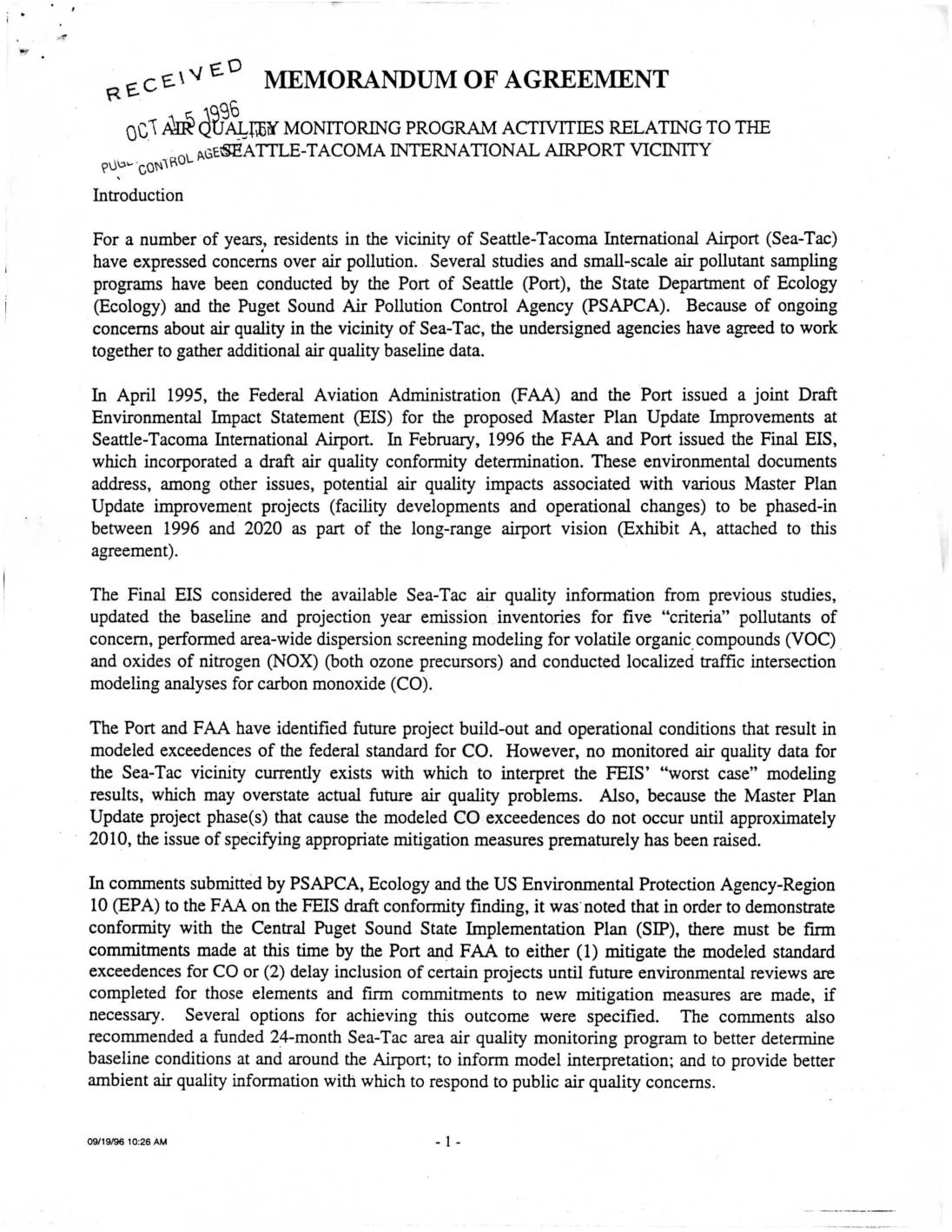
Memorandum of Agreement: Air Quality Monitoring Program Activities Relating to the Seattle-Tacoma International Airport Vicinity
A 1996 Memorandum of Agreement between the Port of Seattle, FAA, EPA, Washington State Department of Ecology, and the Puget Sound Air Pollution Control Agency established a 24-month air quality monitoring program near Seattle-Tacoma International Airport. The $195,000 program was designed to measure carbon monoxide, nitrogen oxides, and aircraft fuel particle residue in order to establish baseline pollution data and assess the accuracy of earlier 'worst case' air quality models from the airport's Final Environmental Impact Statement. The Port agreed not to proceed with Master Plan expansion projects projected to cause CO standard exceedances until monitoring was complete and, if necessary, appropriate mitigation measures were identified. -
 1996-06-05
Air Quality Conformity Review for Sea-Tac Master Plan Update
A 1996 air quality review commissioned by the Airport Communities Coalition challenges the FAA's finding that Sea-Tac Airport's Master Plan Update would not worsen air pollution. Envirometrics, Inc. found that if the proposed third runway increased airport operations—by up to 33% annually and 50% during peak hours—carbon monoxide (CO) and nitrogen dioxide (NO₂) levels would exceed federal air quality standards at multiple locations near the airport. The report concludes that these increased emissions from greater aircraft and vehicle traffic would delay attainment of ambient air quality standards in the surrounding communities. -
 1996-03-27
Appendix E: Comments Concerning the Final Environmental Impact Statement — Sea-Tac Airport Master Plan Update
Appendix E contains public comments submitted in response to the Final Environmental Impact Statement (FEIS) for the Seattle-Tacoma International Airport Master Plan Update. Commenters include the Highline Water District, the Washington State Department of Ecology, the U.S. Public Health Service, and the Washington State Department of Natural Resources, raising concerns about groundwater contamination, the handling of aircraft de-icing glycols, storm water runoff, and surface mining permit requirements for borrow sites on Port of Seattle property. The agencies generally called for stronger mitigation measures and clearer answers to environmental questions before approving the proposed airport expansion. -
 1996-02-01
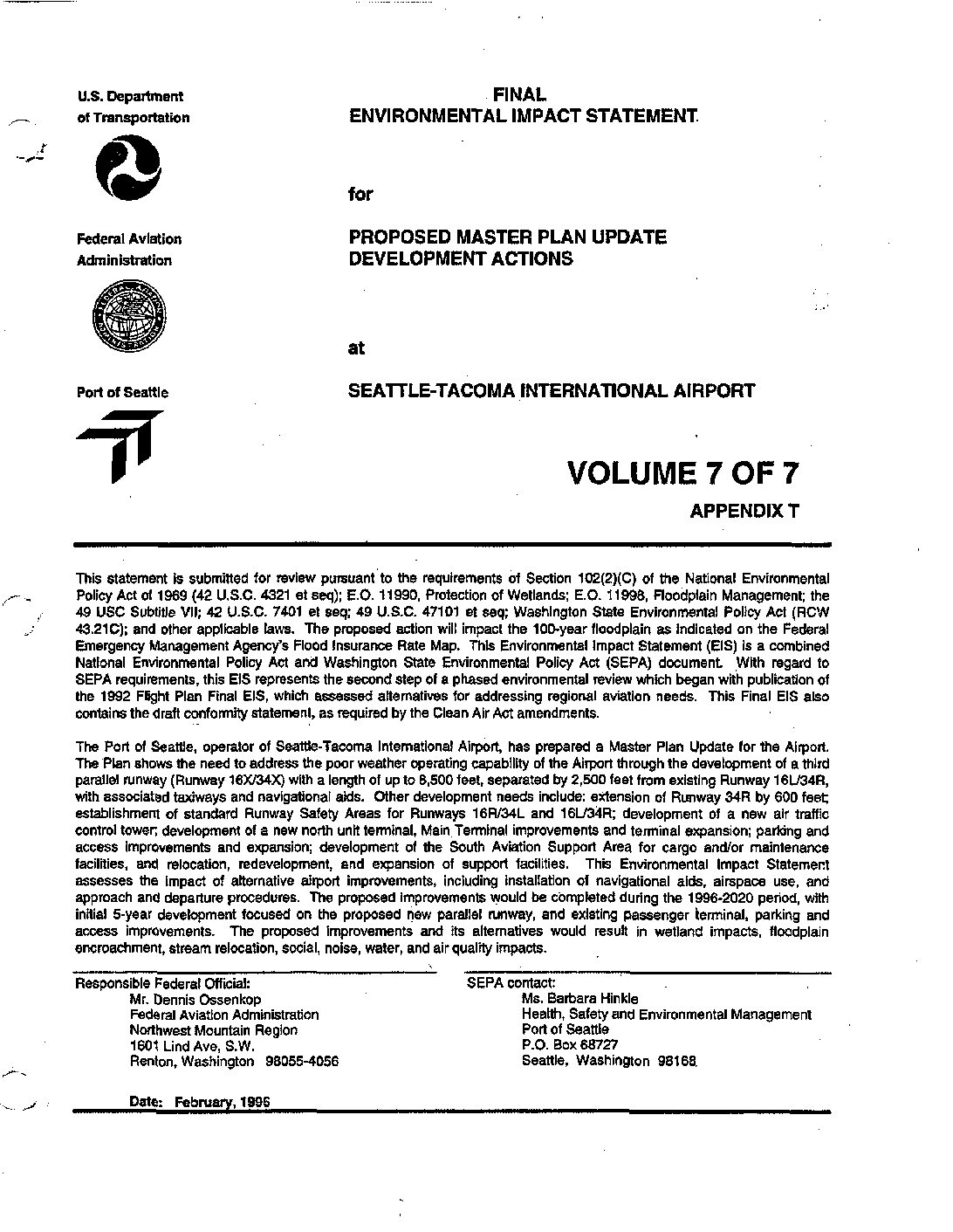
Final Environmental Impact Statement for proposed Master Plan Update development actions at Seattle-Tacoma International Airport, Volume 7 of 7, Appendix T
This 1996 Final Environmental Impact Statement (EIS), prepared by the FAA and Port of Seattle, evaluates the environmental effects of proposed expansion plans at Seattle-Tacoma International Airport, including construction of a third parallel runway, terminal upgrades, and parking improvements planned through 2020. The document addresses key community concerns such as aircraft noise, air quality, surface traffic, and impacts on wetlands and floodplains. It includes transcripts and written comments from two public hearings held in June 1995, attended by community members and agencies who raised significant concerns about noise, health, and environmental impacts. -
 1996-02-01
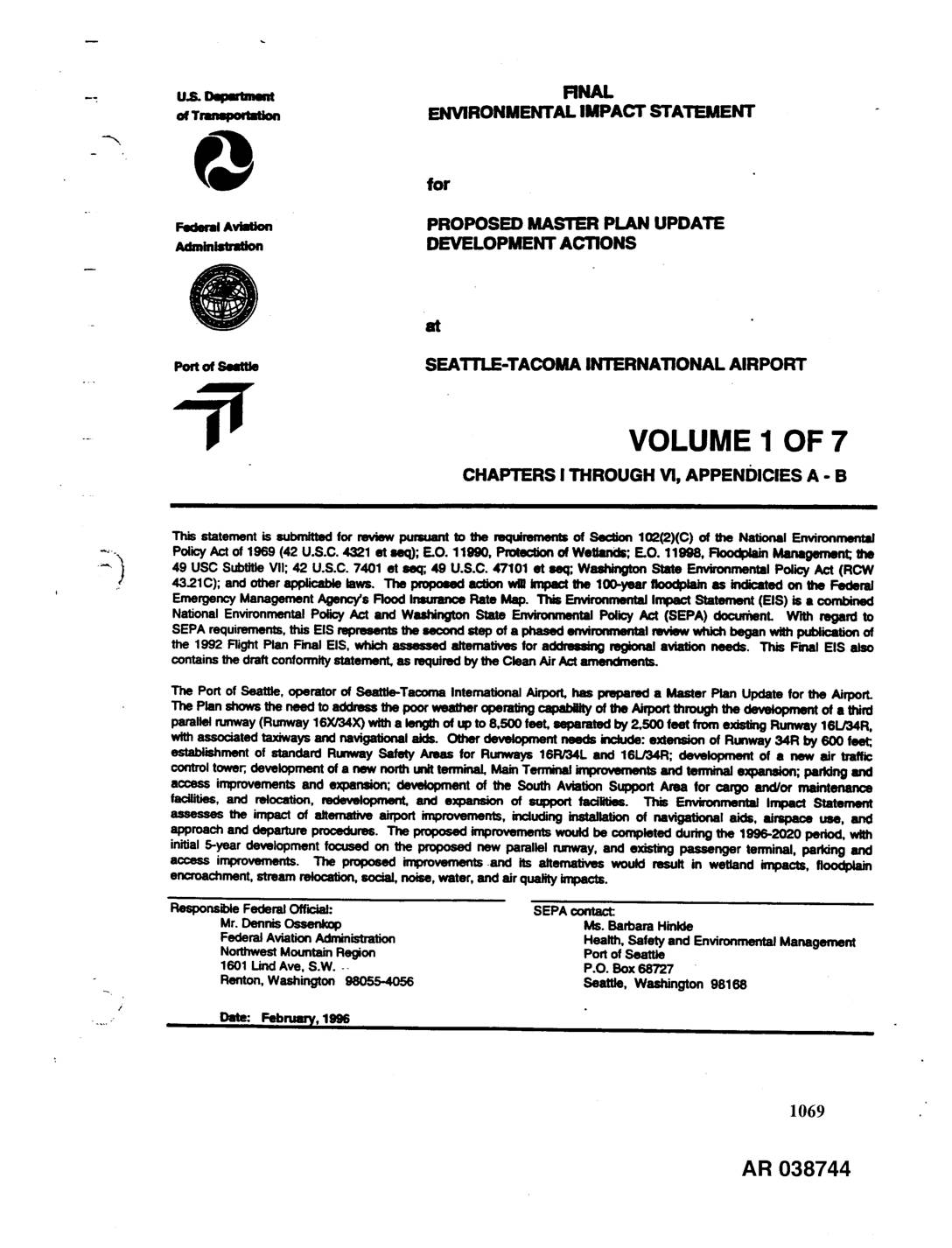
EXH AR038744: Final Environmental Impact Statement for Proposed Master Plan Update Development Actions at Seattle-Tacoma International Airport, Volume 1 of 7
Final Environmental Impact Statement (EIS) prepared jointly by the Federal Aviation Administration (FAA) Northwest Mountain Region and the Port of Seattle for the Seattle-Tacoma International Airport (Sea-Tac) Master Plan Update, dated February 1996, AR038744. Covers proposed development actions 1996-2020 including a new third parallel runway (Runway 16X/34X) up to 8,500 feet long separated 2,500 feet -
 1994-09-19
Technical Report No. 6: Airside Options Evaluation — Airport Master Plan Update for Seattle-Tacoma International Airport
This 1994 technical report, prepared by P&D Aviation for the Port of Seattle, evaluates airside development options for Seattle-Tacoma International Airport as part of a broader Airport Master Plan Update. It examines potential improvements to the existing airfield, analyzes options for adding a third runway, and assesses the operational, cost, and environmental implications of each scenario. The findings cover runway length requirements, projected airfield delays, estimated construction costs, and preliminary environmental screening results. -
 1985-09-01
Master plan update for Sea-Tac International Airport: Final report
This 1985 Master Plan Update, prepared by Peat Marwick/TRA for the Port of Seattle, outlines the long-term development strategy for Sea-Tac International Airport to handle projected growth in air traffic through the early 2000s. The plan rules out construction of new runways due to existing capacity, prior investment, and environmental concerns, while recommending expansion of the passenger terminal complex to accommodate up to 55 air carrier gates and 25 commuter airline gates. Planning activity levels projected total annual passengers growing from 12.5 million in the short term to 21 million in the long term.