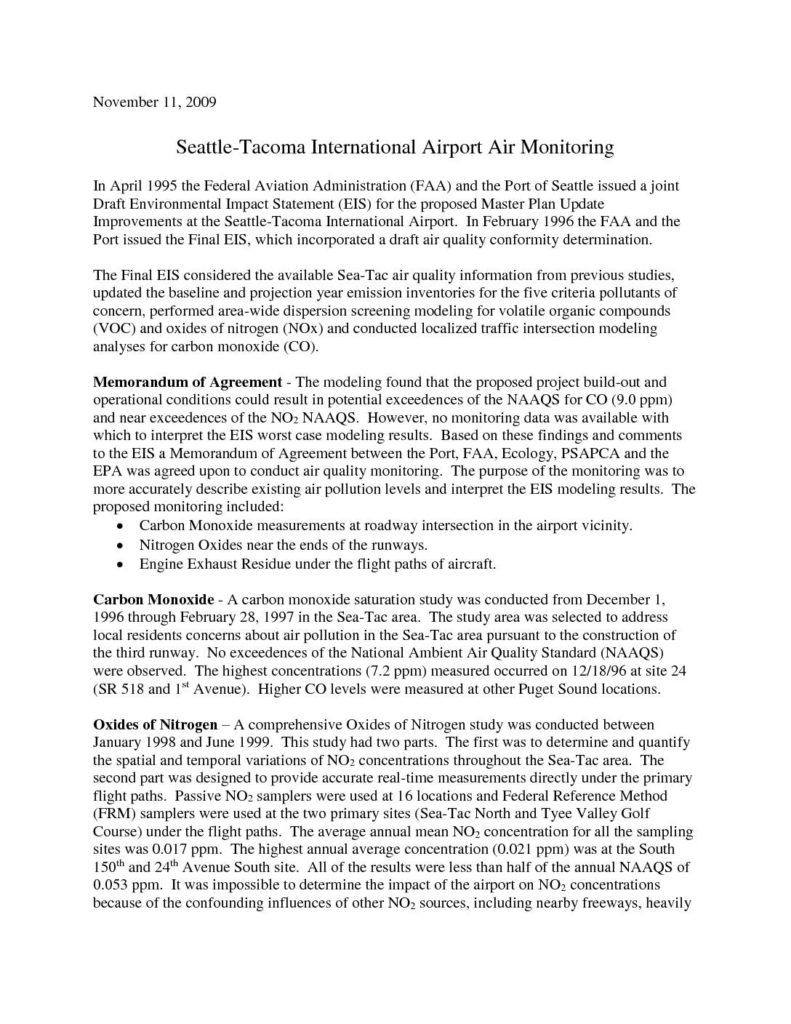
This 2009 report summarizes air quality monitoring studies conducted near Seattle-Tacoma International Airport between 1996 and 2002, following concerns raised during the airport's expansion planning. Measurements of carbon monoxide, nitrogen dioxide, particulate matter, and air toxics were taken at multiple sites around the airport, and none of the pollutants exceeded federal air quality standards. While some elevated levels of metals like chromium were detected at the Sea-Tac monitoring site, overall cancer risk from air toxics was lower than the regional average for the Seattle area.Open full document
Notes
This document summarizes air quality monitoring studies conducted at Seattle-Tacoma International Airport following a 1996 Memorandum of Agreement between the Port of Seattle, FAA, Ecology, PSAPCA, and EPA. Studies measured carbon monoxide, oxides of nitrogen, particulate matter, and air toxics in the Sea-Tac area, finding no exceedances of NAAQS standards for CO, NO2, or PM10. Air toxics sampling found elevated chromium, manganese, and nickel at the Sea-Tac North site, with only chromium exceeding EPA’s lifetime risk-based value.