TagNoise Mitigation(259)
-
 1997-07-01
PSRC Property Acquisition Financial Feasibility Study
A study commissioned by the Puget Sound Regional Council to assess the financial feasibility of establishing a funding mechanism for acquiring and redeveloping properties adversely impacted by regionally significant essential public facilities. The study examines case study areas near the Auburn Rail Yard, Sea-Tac International Airport, and the proposed Everett 112th Street SE HOV Lanes -
 1997-07-01
Property Acquisition Financial Feasibility Study
This 1997 Puget Sound Regional Council study examines the financial feasibility of acquiring and redeveloping properties negatively affected by major regional transportation facilities, including Sea-Tac International Airport, the Auburn Rail Yard, and a proposed Everett HOV facility. It evaluates potential funding mechanisms—such as a state-financed revolving fund or public/private partnerships—to convert noise-impacted land within the 65–75 DNL noise contours to compatible non-residential uses. The study covers roughly 100 acres across three case-study areas and was initiated under Regional Council Resolution A-96-02 adopted in July 1996. -
1997-07-01
Property Acquisition Financial Feasibility Study
Puget Sound Regional Council (PSRC) Property Acquisition Financial Feasibility Study, July 1997, prepared pursuant to Resolution A-96-02 adopted July 11, 1996. Evaluates state-financed revolving fund and public/private financing mechanisms for acquisition and redevelopment of land with incompatible uses adjacent to regional transportation facilities. Case study areas cover approximately 100 acres near three facilities: Auburn Rail -
 1995-01-20
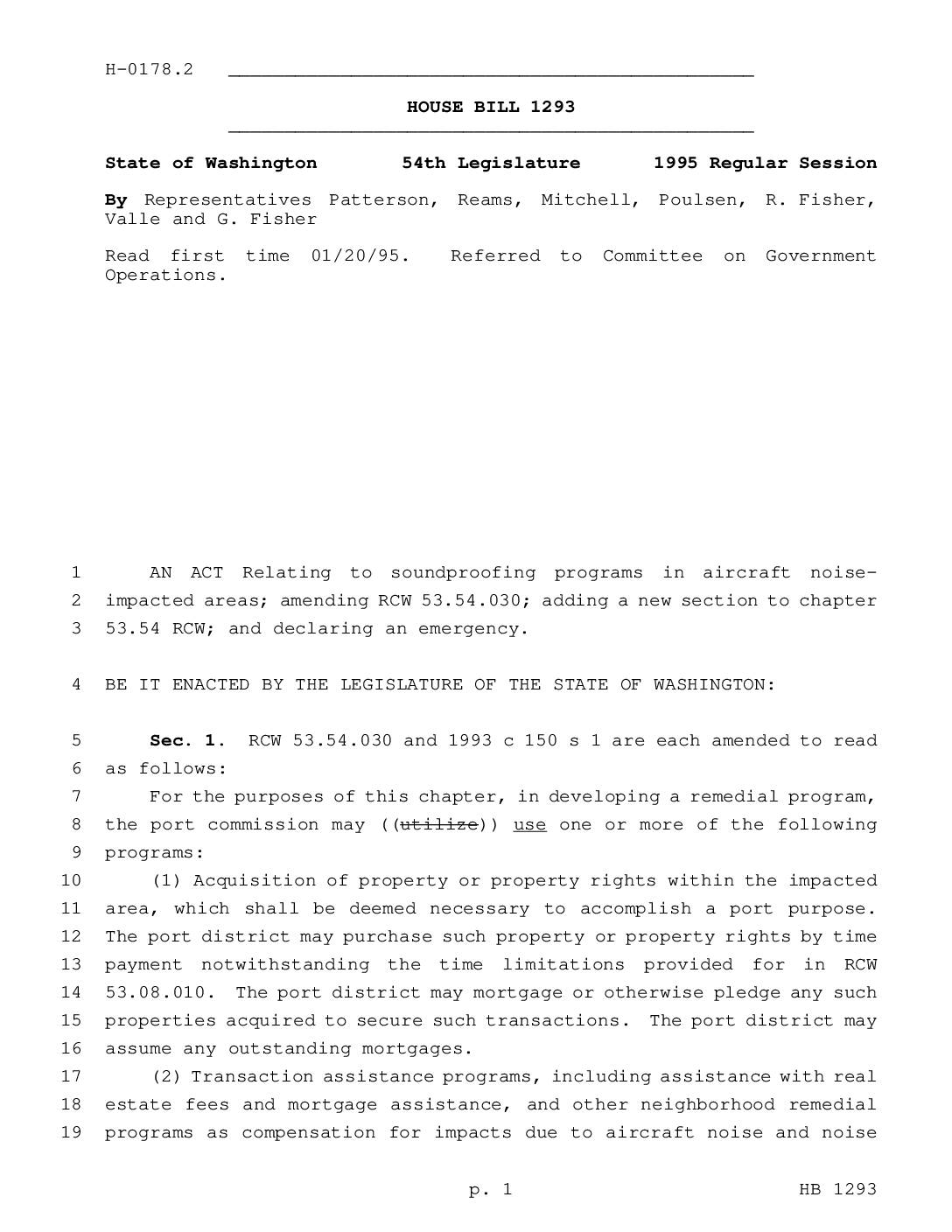
House Bill 1293: Soundproofing programs in aircraft noise-impacted areas
Washington House Bill 1293 (1995) amended state law governing how port districts can address aircraft noise impacts on nearby properties, expanding soundproofing programs and removing a prior requirement that property owners waive damages and convey easements in exchange for noise mitigation. The bill declared such damage-waiver agreements void as against public policy, meaning residents near airports like Sea-Tac could receive soundproofing benefits without giving up their legal rights. The act was designated an emergency measure, intended to take effect immediately upon passage. -
 1994-05-18
Seattle-Tacoma International Airport FAR Part 150 Noise Compatibility Program: 1993 Amendments
This document presents the Seattle-Tacoma International Airport FAR Part 150 Noise Compatibility Program: 1993 Amendments, submitted by the Port of Seattle and approved by the Federal Aviation Administration on May 18, 1994. It outlines updates to existing noise-reduction measures—including sound insulation for homes and public buildings, a transaction assistance program, and an expanded noise monitoring system—as well as newly recommended measures such as community planning forums and operational reviews. The program aims to reduce noncompatible land uses around Sea-Tac Airport and prevent the introduction of new ones. -
 1994-05-18
Seattle-Tacoma International Airport FAR Part 150 Noise Compatibility Program: 1993 Amendments
This document presents the Seattle-Tacoma International Airport FAR Part 150 Noise Compatibility Program: 1993 Amendments, submitted by the Port of Seattle and approved by the Federal Aviation Administration on May 18, 1994. It outlines a series of noise mitigation measures—including sound insulation programs for homes and public buildings, a transaction assistance program for affected property owners, and an expanded noise monitoring system—aimed at reducing noncompatible land uses around Sea-Tac Airport. Three new measures were also recommended, covering funding for land use planning, a community planners forum, and ongoing operations review and noise exposure map updates. -
 1993-07-25
Substitute House Bill 1915: Aircraft noise abatement–assistance to individual properties
Washington State's Substitute House Bill 1915, signed into law on April 30, 1993, expanded the tools available to port districts for addressing aircraft noise impacts on nearby properties. The law allows ports to offer affected property owners a range of remedies, including property acquisition, transaction assistance, soundproofing programs, and mortgage insurance. A key update permits individual properties to receive benefits more than once if they experience increased or changed aircraft noise levels that would have warranted a different level of mitigation. -
 1992-09-01
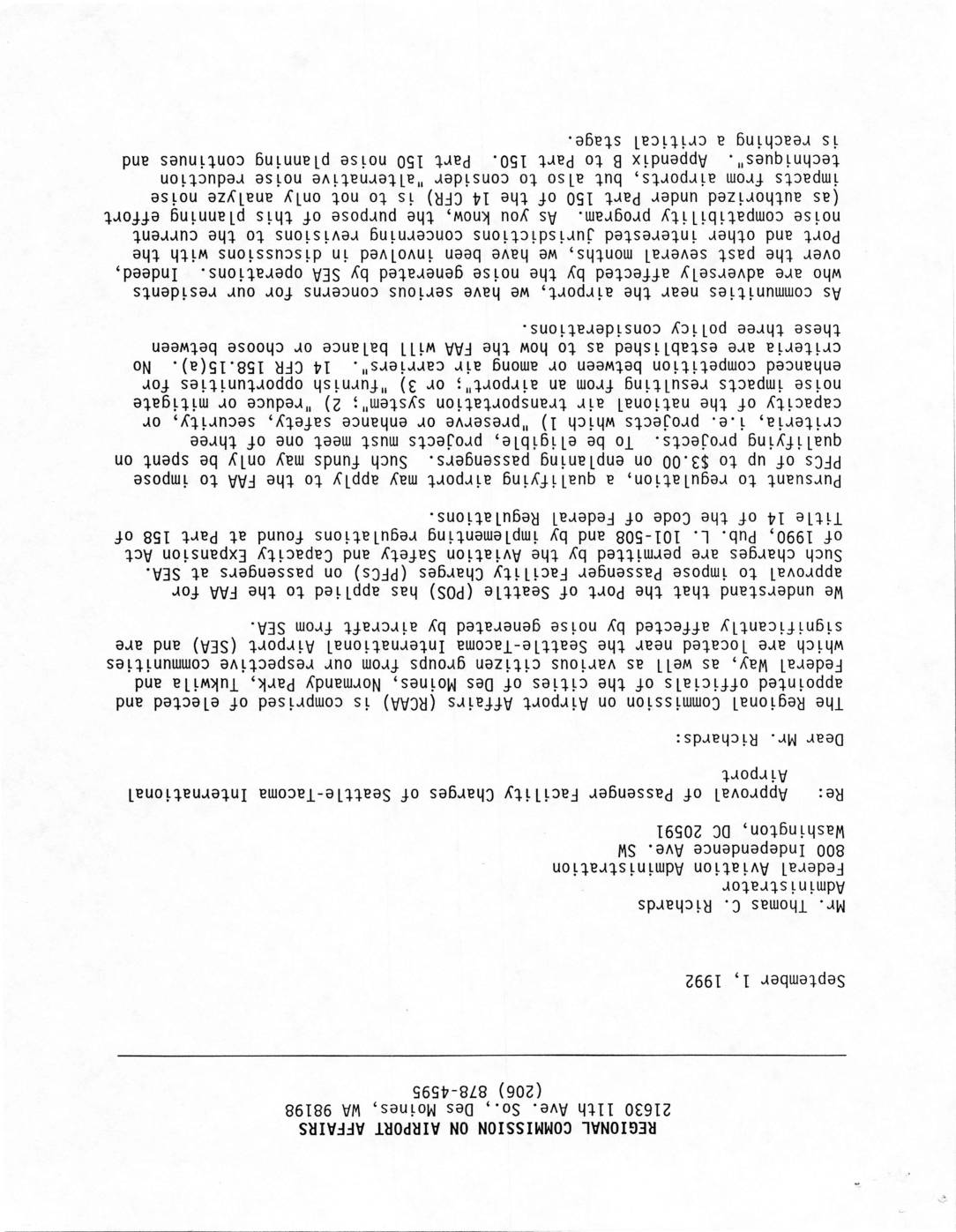
Approval of passenger facility charges of Seattle-Tacoma International Airport
In a September 1, 1992 letter to the FAA Administrator, the Regional Commission on Airport Affairs formally requests reconsideration of the FAA's August 14, 1992 decision approving Passenger Facility Charges (PFCs) at Seattle-Tacoma International Airport. The Commission, representing communities near Sea-Tac severely impacted by aircraft noise, argues that PFC funds should be redirected toward noise mitigation efforts rather than security improvements and preliminary studies, and that local governments were not properly notified or consulted during the PFC application process. The letter calls for increased funding levels for noise mitigation, cancellation of certain approved expenditures deemed inappropriate or excessive, and greater consideration of local government views in future PFC allocation decisions. -
 1990-03-31
Final package of mediated noise abatement actions for Seattle-Tacoma International Airport
This document outlines the Final Package of Mediated Noise Abatement Actions for Seattle-Tacoma International Airport, agreed upon by the Mediation Committee on March 31, 1990. It covers a wide range of noise reduction measures, including nighttime flight restrictions, a noise remedy and insulation program for affected communities, improved flight corridor procedures, and a comprehensive noise management and monitoring system. According to technical consultants, full implementation of these agreements could reduce noise levels by approximately 50% in the communities surrounding the airport. -
 1985-02-01
Sea-Tac International Airport Part 150: Airport noise compatibility program
This 1985 document, prepared by the Port of Seattle, outlines the Part 150 Airport Noise Compatibility Program for Seattle-Tacoma (Sea-Tac) International Airport. It combines two phases: Phase I, Noise Exposure Maps (officially submitted to the FAA in October 1984), and Phase II, a Noise Compatibility Program adopted by the Port Commission in January 1985. Together, these phases identify noise exposure around the airport and propose measures to address compatibility between aircraft noise and surrounding land uses.