Skip to content
  • STNI
  • Statistics
    • Ops and Passengers
      • King County International Airport (Boeing Field) Annual Operations
    • Financials
    • Aviation fuel uplift in the State of Washington 2018 – 2025
      • Aviation Fuel Uplift at Sea-Tac Airport
    • Air Quality Monitoring
    • Flight Tracking
      • Flow and Flight Tracks
      • Five Year Comparison
      • Busiest Hours and Days
    • SEL Noise Reports & Graphs
      • About The Permanent Noise Monitors
      • Minutes of Quiet by Noise Monitor
      • Noise Events mapped
      • Noise Events (SEL)
    • Runways
    • Employees
    • Real Estate
      • Port Properties and Trees mapped
    • Parking
  • Events
  • Protest
    • Regular Events
    • Legislation 2026
    • Complain about a particular flight
    • Advocacy Organizations
    • Media Outlets
    • People
    • The Port of Seattle
      • Commission Meetings
      • Public Records Requests
      • StART
      • Highline Forum
    • Contact Your Electeds
  • Resources
    • FAQs
      • FAA Occurrences/Accidents/Indents
    • The unSustainable Airport Master Plan
      • SAMP Public Comment Template
        • Two versions of Appendix K: NEPA/SEPA 2018 vs 2023
      • SAMP NTP: 31 projects by the numbers
      • SEPA Draft EIS (2026)
      • SAMP Record of Decision/FONSI (2025)
      • SAMP Draft EA (October 2024)
      • 2018 Scoping
    • Port Packages
      • Port Package Property Costs
      • Port Packages mapped
      • The Port Package Explainer
      • So you want a (first-time) Port Package? Start here
      • Port Package Looker Upper
      • How do I determine if I have a Port Package or Avigation Easement?
      • Progress on Port Package Update legislation
      • Having a Port Package Problem?
      • Port Package Site Visit Follow-Up
    • Document Library
    • Explainers
      • The Airport Law Cheat Sheet
      • The Grant Explainer
    • External Articles
    • History
      • Timeline
      • The Sea-Tac Communities Plan
        • Sea-Tac Communities Plan – Planning Maps
      • PSRC Third Runway Decision Process
    • Studies
    • Videos
  • Stories
  • Mission
  • Subscribe
  • Contact
Scroll down to content

Get InformedStay Informedx

I understand that you will never share my information with anyone, you will only use it to keep me updated on relevant events and that I may unsubscribe at any time.

STNI

STNISea-Tac Noise.Info

  • Solve for Sea-Tac. Solve for every airport.
  • Since 2016, working to obtain justice for everyone living under the flight path.
  • Less Noise. Cleaner Air. Better Public Health. Compensation.
  • Everything you think you know about the airport is wrong.

TagModel Toxics Control Act(35)

Advanced Search Options

  • Dates
  • Media
    • External Articles
    • Images
    • PDFs
    • Video
    • Audio
  • Order By
  • 2001-05-01

    Model Toxics Control Act Cleanup Regulation: Process for Cleanup of Hazardous Waste Sites

    This Washington State Department of Ecology fact sheet explains how the Model Toxics Control Act (Initiative 97, 1989) governs the cleanup of hazardous waste sites in Washington, outlining who is liable, how sites are identified, and the options available for conducting cleanups. Potentially liable parties — including past and present owners, operators, and those who transported or disposed of hazardous substances — may clean up sites independently or work cooperatively with Ecology through formal agreements such as consent decrees. Note: this document concerns hazardous waste site cleanup regulation and does not contain information related to Sea-Tac Airport noise policy.
    TagsEcology, Model Toxics Control Act, MTCA, RCW, WAC
  • 2001-04-11

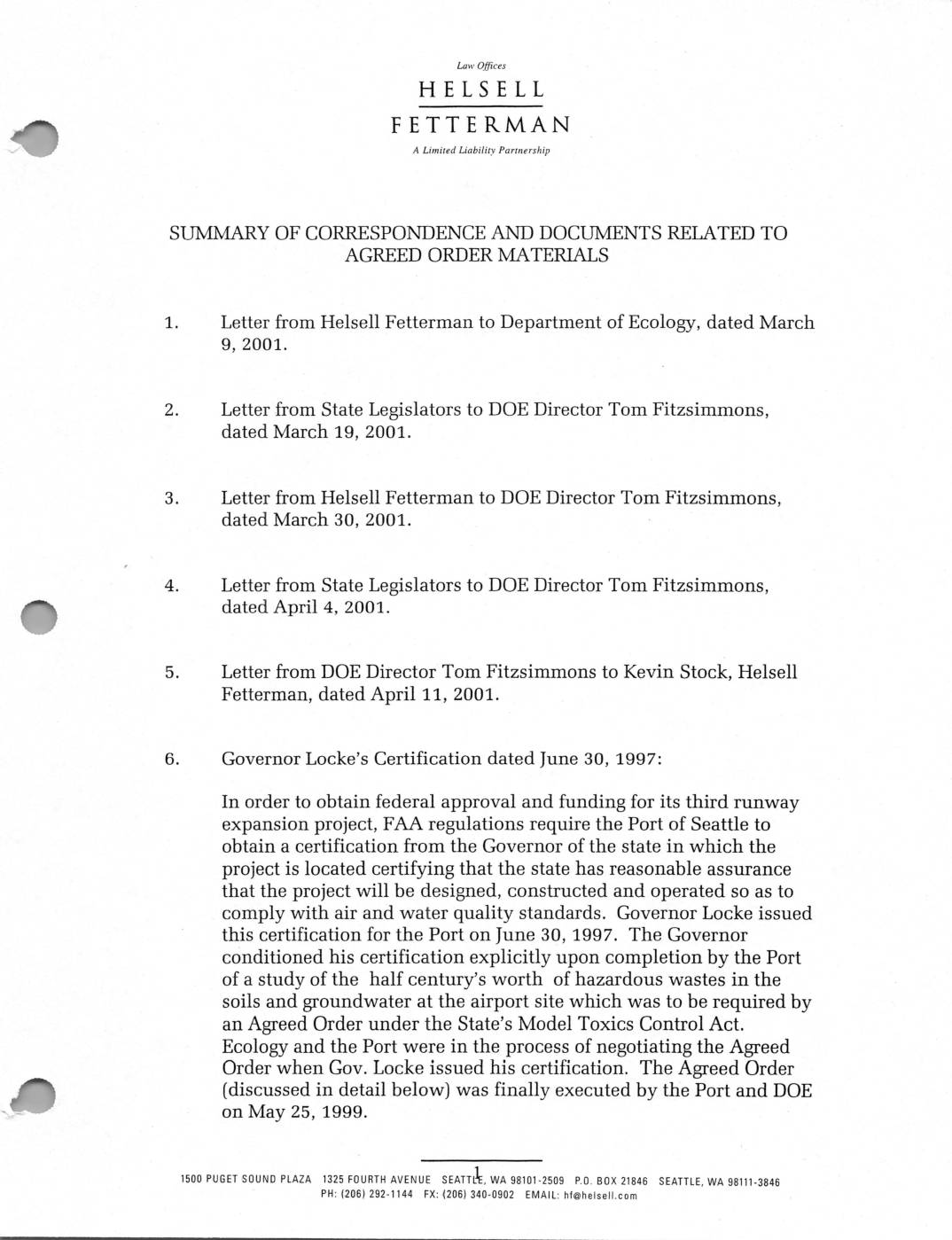
    Summary of Correspondence and Documents Related to Agreed Order Materials, Department of Ecology and Port Of Seattle, 2001

    This document summarizes correspondence and records related to environmental cleanup efforts at Seattle-Tacoma International Airport, covering the period from 1997 to 2001. It details how Governor Locke conditioned his 1997 certification for the airport's third runway expansion on the Port of Seattle completing a study of decades-worth of hazardous waste contamination in the soil and groundwater at the site. The records also trace the lengthy negotiations between the Port and the Washington State Department of Ecology to establish an Agreed Order under the Model Toxics Control Act, which was ultimately signed in May 1999.
    TagsEcology, Model Toxics Control Act, Port Of Seattle, Sea-Tac Airport, Third Runway
  • 2001-02-12

    EXH AR017506: WAC 173-340-740 MTCA Cleanup Regulation — Unrestricted Land Use Soil Cleanup Standards

    WAC 173-340-740 from the Model Toxics Control Act (MTCA) Cleanup Regulation, published February 12, 2001, establishing unrestricted land use soil cleanup standards. Covers Method A, Method B (standard and modified), and petroleum mixture cleanup levels including Equations 740-1 through 740-3 for noncarcinogens and carcinogens. Specifies default exposure parameters: soil ingestion rate 200 mg/day, average body
    TagsACC, Ecology, Model Toxics Control Act, MTCA, Pollution Control Hearings Board, soil, WAC
  • 2001-02-12

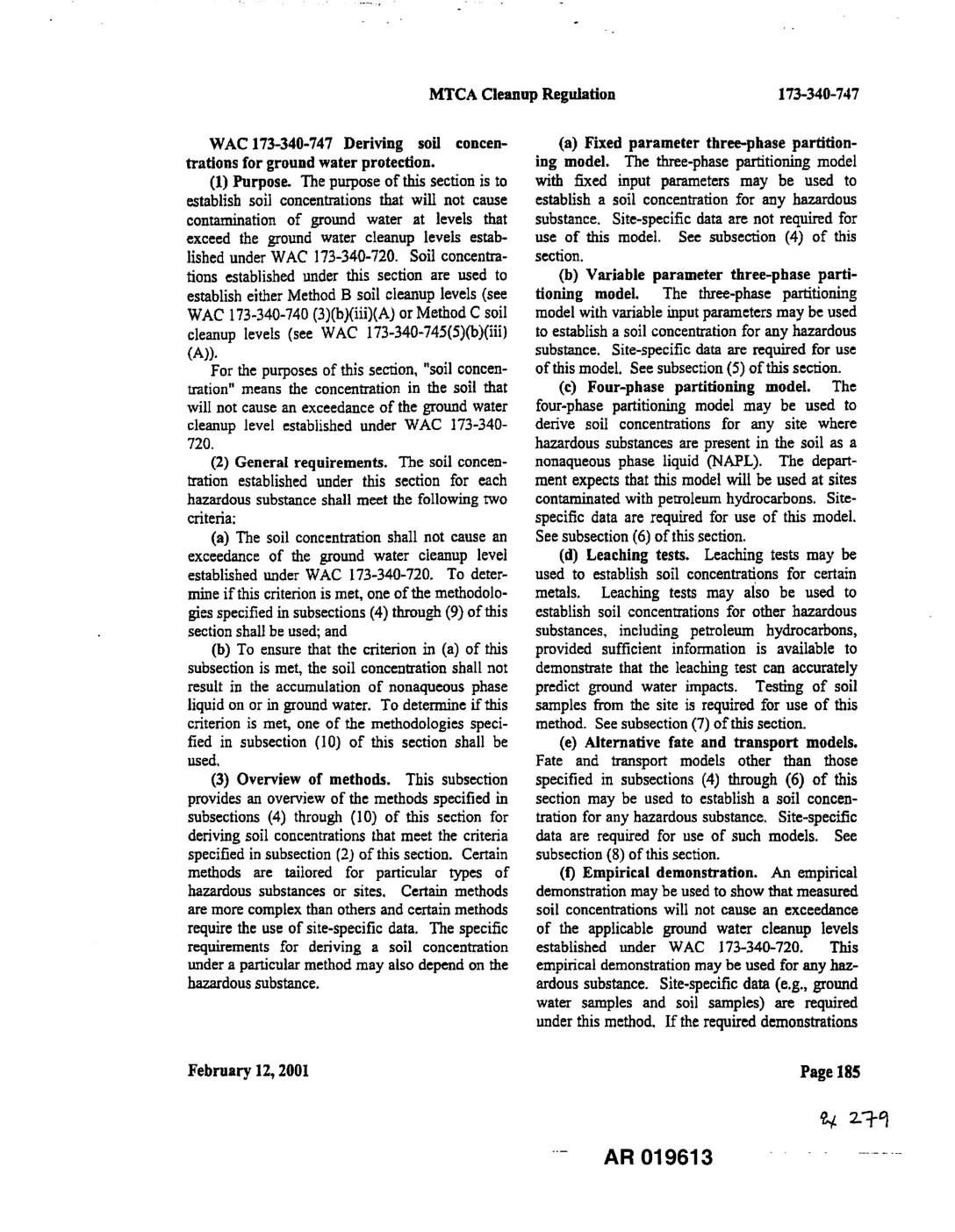
    EXH AR019613: WAC 173-340-747 Deriving Soil Concentrations Groundwater Protection MTCA

    This Washington State regulation (WAC 173-340-747) establishes methods for determining safe soil contamination levels that protect groundwater quality at cleanup sites. It outlines several scientific approaches, including three-phase and four-phase partitioning models, leaching tests, and empirical demonstrations, to calculate the maximum allowable concentration of hazardous substances in soil before they risk contaminating groundwater. The regulation requires that soil concentrations not cause groundwater cleanup level exceedances and not result in the buildup of nonaqueous phase liquids in or on groundwater.
    TagsACC, Ecology, Model Toxics Control Act, MTCA, Pollution Control Hearings Board, soil, WAC
  • 2001-02-12

    EXH AR017360: Part IX Tables — MTCA WAC 173-340-900 Method A Cleanup Levels for Ground Water

    Exhibit AR017360, Part IX Tables from MTCA Cleanup Regulation WAC 173-340-900, dated February 12, 2001. Contains Table 720-1, Method A Cleanup Levels for Ground Water, listing hazardous substances including arsenic, benzene, benzo(a)pyrene, cadmium, chromium, DDT, 1,2-dichloroethane (EDC), ethylbenzene, ethylene dibromide (EDB), lead, lindane, methylene chloride, mercury, MTBE, naphthalenes, PCB mixtures, radium 226, tetrachloroethylene, toluene, trichloroethylene,
    TagsACC, Ecology, Model Toxics Control Act, MTCA, Pollution Control Hearings Board, WAC, Water Quality
  • 2001-01-24

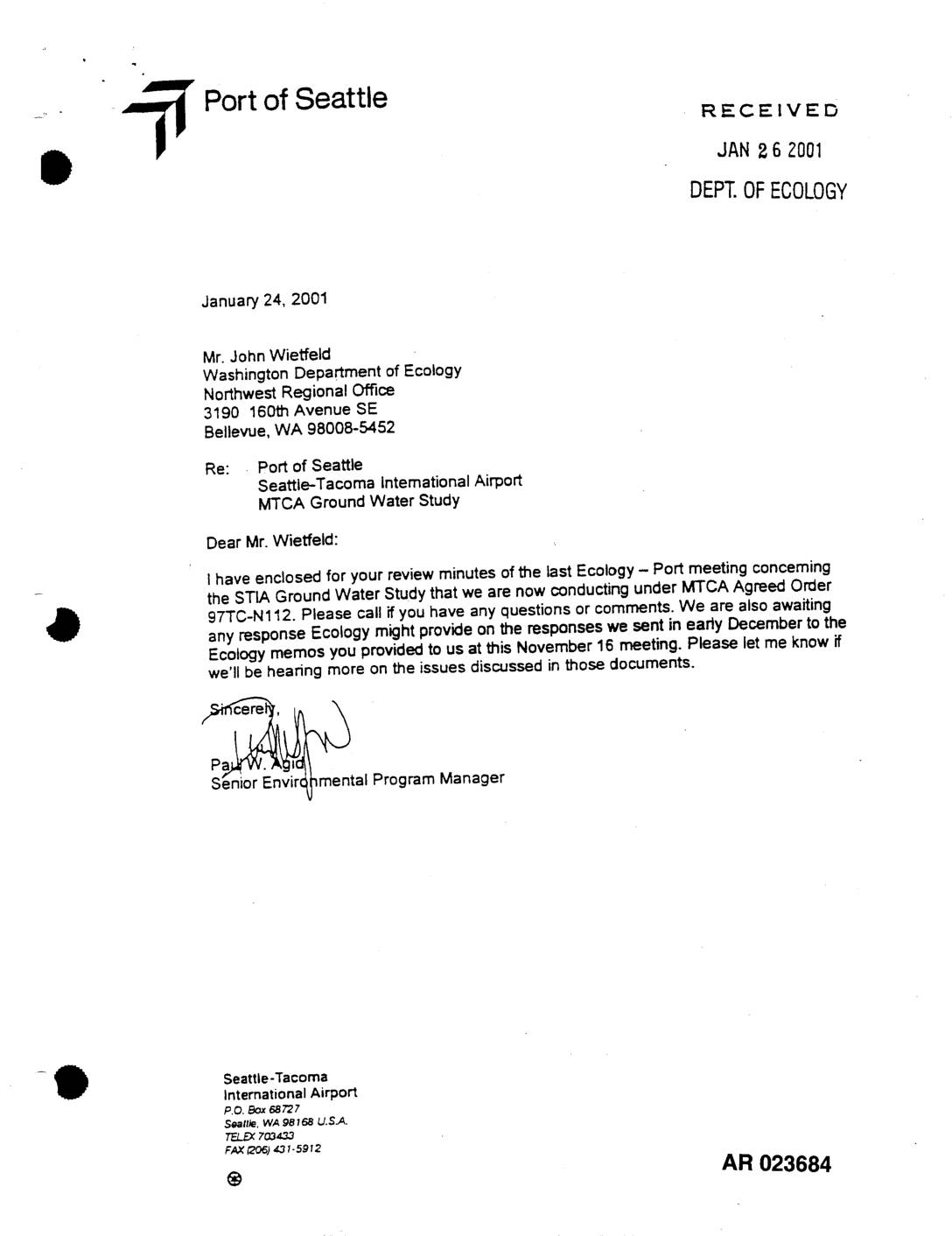
    EXH AR023684: Letter to Ecology re MTCA Ground Water Study STIA w/ Meeting Notes Agreed Order Status 11/16/00

    A January 2001 letter and accompanying meeting notes document communications between the Port of Seattle and the Washington Department of Ecology regarding a groundwater contamination study at Seattle-Tacoma International Airport, conducted under the Model Toxics Control Act (MTCA) Agreed Order 97TC-N112. The records outline the scope of the study, which focuses on hydrogeologic investigation and a review of the Fuel Operations Area, and clarify that any necessary cleanup would be handled separately after the study's completion. Both parties discussed concerns about scope expansion and the process for addressing contaminated sites identified through the study.
    TagsACC, Ecology, Model Toxics Control Act, MTCA, Pollution Control Hearings Board, Port Of Seattle, Third Runway
  • 2000-12-19

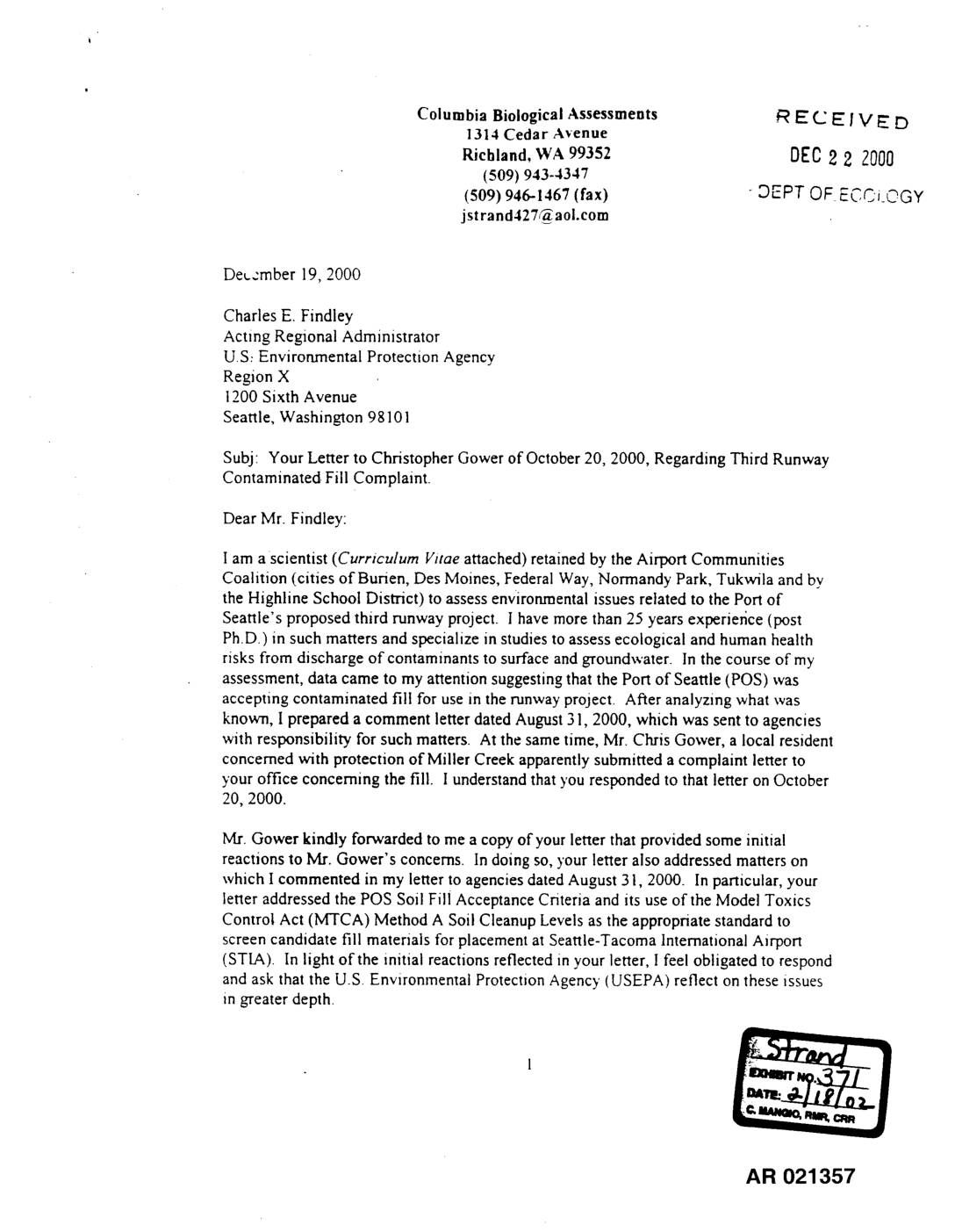
    EXH 371: Columbia Biological Assessments Letter to EPA Region X – Contaminated Fill, MTCA Method A Standards, Third Runway

    A scientist retained by the Airport Communities Coalition wrote to the EPA in December 2000, raising serious concerns about the Port of Seattle accepting contaminated fill materials for the proposed Third Runway project at Seattle-Tacoma International Airport. The letter argues that the Port improperly used Washington State's Model Toxics Control Act (MTCA) cleanup standards as fill acceptance criteria, when those standards were designed to clean up existing contaminated sites, not to permit introducing pollution onto previously clean land. The scientist also criticizes the Port's soil testing methods as statistically inadequate to detect the true extent of contamination, warning that chemicals in the fill could leach into groundwater, wetlands, and surface water including Miller Creek.
    TagsACC, Airport Communities Coalition, Environmental Protection Agency, Fill Dirt, Model Toxics Control Act, Pollution Control Hearings Board, Third Runway
  • 2000-09-11

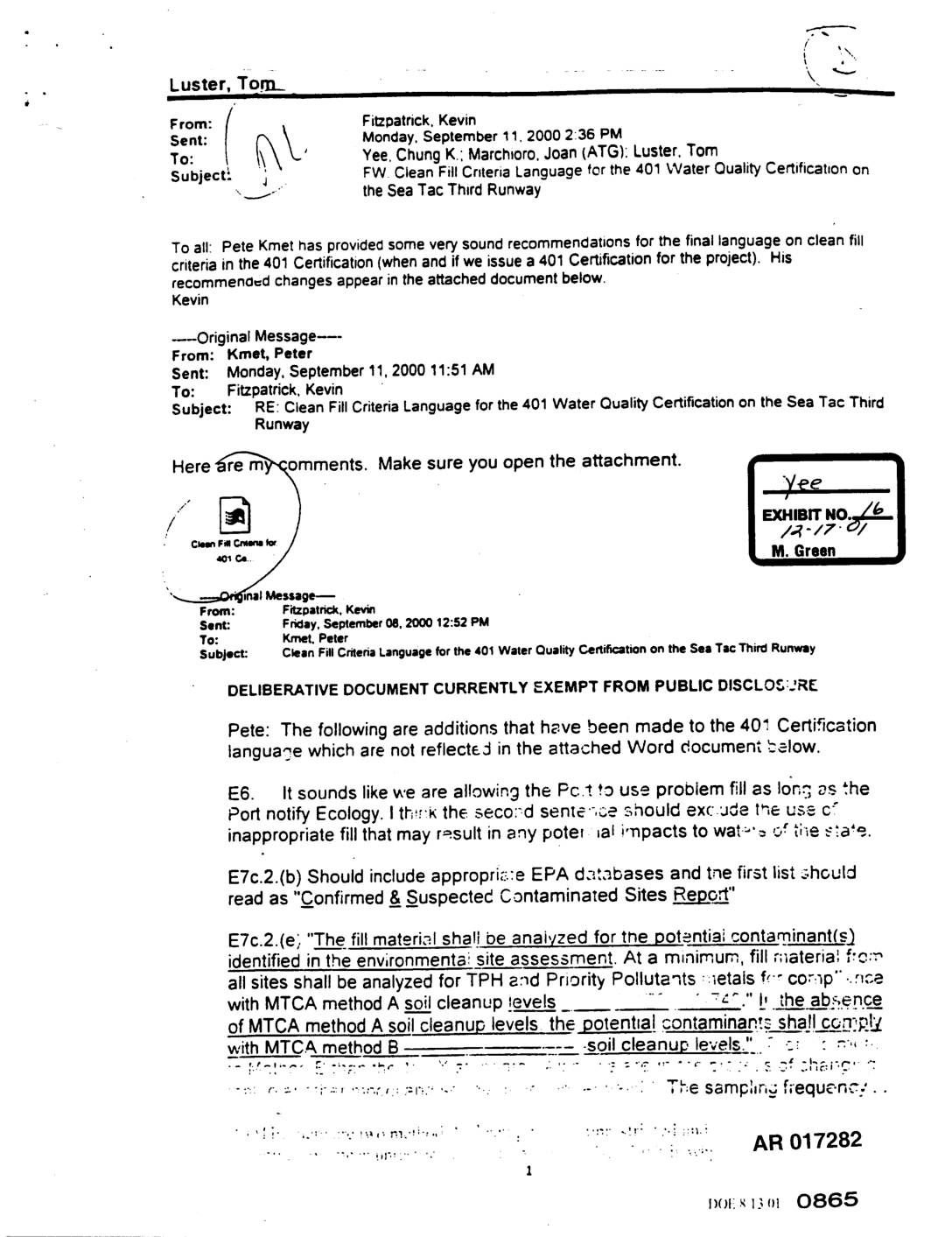
    EXH AR017282: Email Chain on Clean Fill Criteria Language for the 401 Water Quality Certification on the Sea-Tac Third Runway

    Email chain dated September 11, 2000 among Kevin Fitzpatrick, Peter Kmet, Chung K. Yee, Joan Marchioro, and Tom Luster of Washington State Department of Ecology (Water Quality Program, NWRO) regarding clean fill criteria language for the 401 Water Quality Certification on the Sea-Tac Third Runway project. Document marked ‘Deliberative Document Currently Exempt From Public Disclosure.’
    TagsACC, Ecology, Fill Dirt, Model Toxics Control Act, Pollution Control Hearings Board, Third Runway, Water Quality
  • 2000-09-11

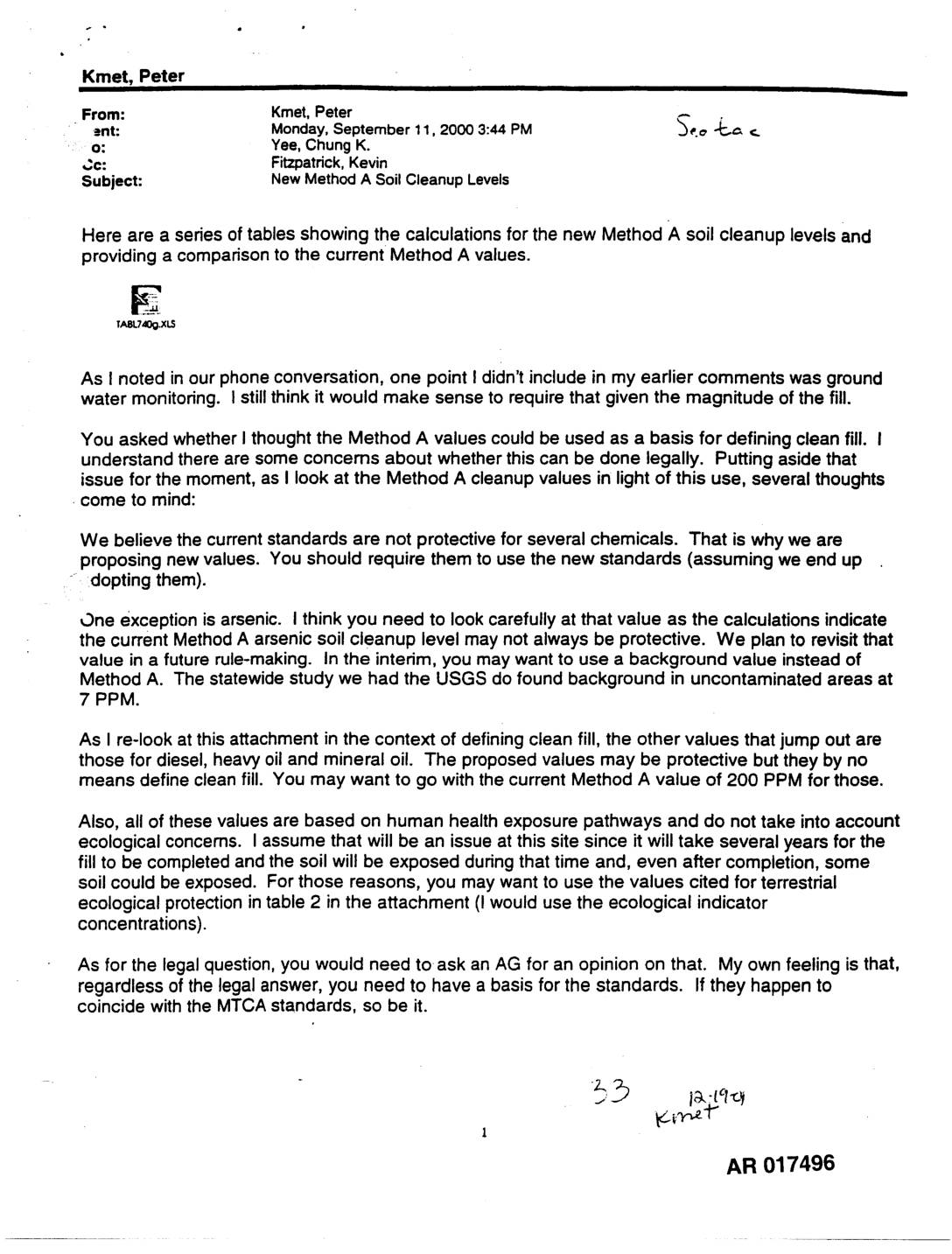
    EXH AR017496: Email from Peter Kmet to Chung K. Yee Regarding New Method A Soil Cleanup Levels

    Internal email dated September 11, 2000 from Peter Kmet to Chung K. Yee (cc: Kevin Fitzpatrick) discussing new Method A soil cleanup levels under MTCA (Model Toxics Control Act) and their use as a basis for defining clean fill. Kmet addresses specific chemicals including arsenic (recommends 7 PPM background value from USGS statewide study instead
    TagsACC, Ecology, Fill Dirt, Model Toxics Control Act, MTCA, Pollution Control Hearings Board, soil
  • 2000-03-07

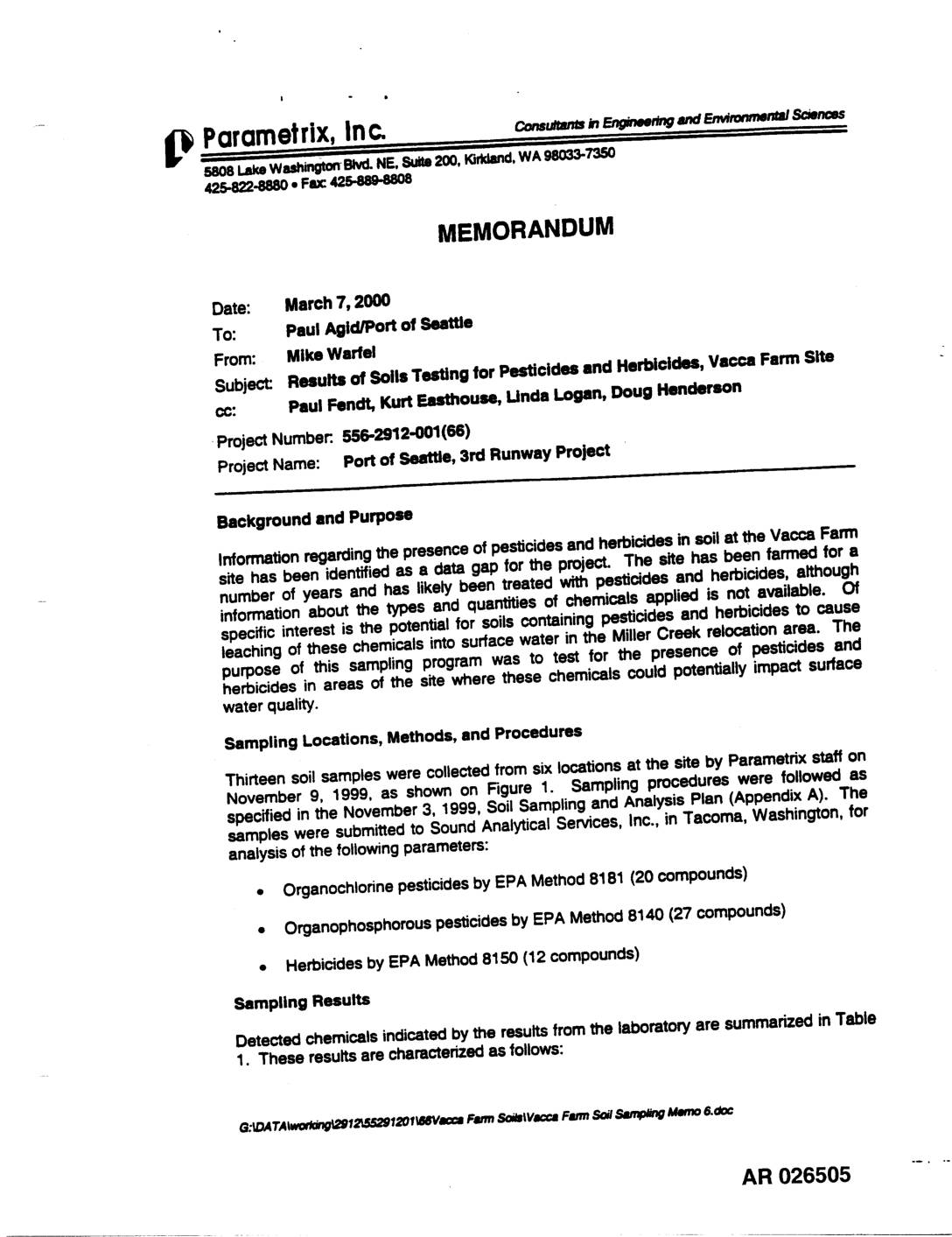
    EXH AR026505: Memo — Soils Testing Results, Pesticides & Herbicides, Vacca Farm Site

    A March 2000 Parametrix memorandum reports the results of pesticide and herbicide soil testing at the Vacca Farm site, part of the Port of Seattle's Third Runway Project. Of 59 compounds tested, only 12 were detected, primarily organochlorine pesticides, with Dieldrin slightly exceeding cleanup levels in shallow soil samples at two locations in the proposed floodplain area. The memo recommends removing the upper six inches of soil from the floodplain area for offsite disposal, while concluding that the proposed Miller Creek relocation corridor does not pose unacceptable risks to human health.
    TagsACC, Miller Creek, Model Toxics Control Act, Pollution Control Hearings Board, Port Of Seattle, soil, Third Runway

Posts pagination

Page 1 Page 2 Page 3 Page 4
Sidebar On/Off

Upcoming Events

  • StART SEA Stakeholder Advisory Round Table
    Add to CalendarMWednesday Aug 26, 5:00pm - 7:00pm
    Zoom (Virtual Meeting)
    START meetingagenda 2026826 final 0 pdf

    Meeting Objectives Introduce the primary feedback themes identified by StART members regarding StART’s Operating Procedures and determine areas that may warrant future discussion. 5:00 PM – Welcome Meeting Management Welcome Lead: Andrés Mantilla, Facilitator, Uncommon Bridges; Wendy Reiter, Airport Managing Director, POS 5:15 PM – Dinner: All participants eat. 5:30 PM – StART Operating Procedures

    [...]
  • Commercial Aviation Work Group
    Add to CalendarMThursday Sep 3, 10:00am - 1:30pm
    Virtual Meeting (Zoom)
    Cawg agenda sep 3 26 virtual pdf

    Meeting Agenda 10:00 a.m. – 10:15 a.m. | Welcome – Evan Nordby, Chair a. Introductions and Agenda Reviewb. Status of appointments and non-voting member invitationsc. Other updates as necessary 10:15 a.m. – 11:00 a.m. | Is it practical and legal to operate the western Washington [Puget Sound] airports as a single airport system? – Consultant

    [...]

[See all...]


Help study childhood asthma. Get free HEPA filter!

read more...

Issues

Sea-Tac Airport is currently undergoing the largest and longest expansion in its history, collectively known as the Sustainable Airport Master Plan (SAMP). Some of it you can already hear, but you’re probably not aware of what it all means. Here’s what you need to know.
read more...

Read This!

As the source for federal transportation grants, the Puget Sound Regional Council was charged with developing a system to meet the growing need for commercial aviation. When the search for a second airport failed, they authorized the Port of Seattle to build the Third Runway, with a mandate to develop a noise abatement and mitigation program. In their effort to stop the Third Runway, the ACC argued over every detail of the Port's efforts--including property buyouts and sound insulation. The dispute was meant to be settled by a three member Expert Arbitration Panel. This is their final report. It finds 2-1, that the Port's program was insufficient in several respects. Despite that, funding for the Third Runway was approved by the PSRC, and the 'Port Package' program, proceeded largely unchanged. Expert Arbitration Panel's final decision finding that the Port of Seattle had not shown sufficient reduction in real on-the-ground noise impacts to satisfy noise reduction conditions required for approval of a third runway at Sea-Tac International Airport. The majority decision concluded the Port's noise abatement programs were insufficient despite being impressive in scope.
continue...

The Podcast!

Subscribe to the only podcast devoted to policies, politics, history, impacts for people living under the flight path everywhere. It’s definitely not just about noise!
  • Sea-Tac Noise.Info
  • Connect with STNI

    • Subscribe
    • Port Package Problem?
    • Donate
    • Podcast
    • Socials
      • Facebook
      • X (Twitter)
      • Bluesky
      • Instagram

    "FAA Approval of Noise Compatibility Program Update, Naples Municipal Airport (APF), Naples, Florida" — , 2024

  • Learn

    • Frequently Asked Questions
    • Explainers
    • Youtube
    • Research Requests
    • Make a complaint
  • Goals

    Fulfill the promises of 1976:
    • Compensation
    • Reduced noise
    • Improved air quality
    • Environmental remediation
Login/Register
©2026•Data Privacy

Message

We use cookies to provide basic functionality. We also provide access to search engines in order to provide site analytics. We do not sell or share your data.
V V