TagMiller Creek(252)
-
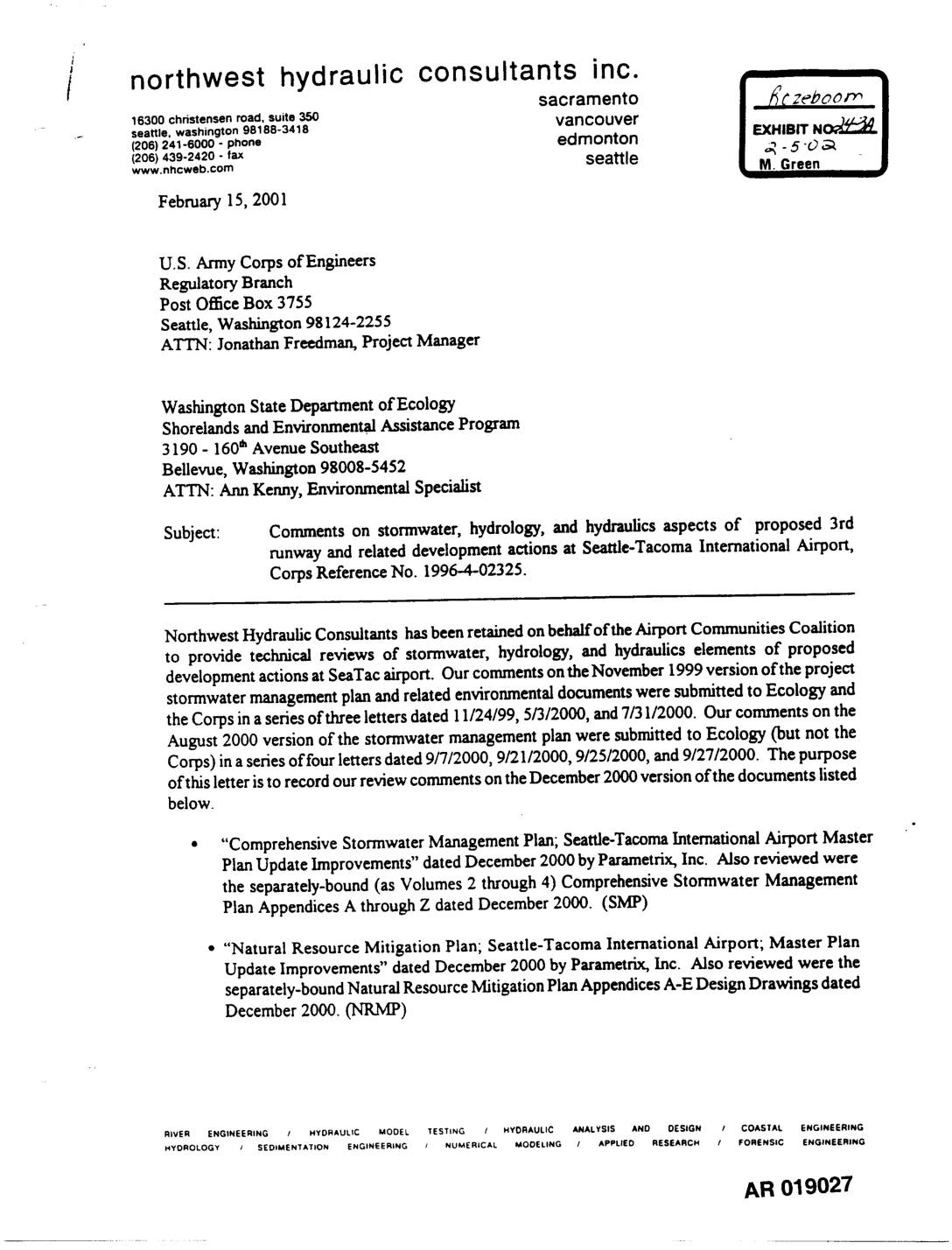 2001-02-15
EXH AR019027: ACC Technical Review Letter — Stormwater Hydrology Hydraulics Comments STIA Third Runway SMP Dec 2000
A February 2001 technical review letter from Northwest Hydraulic Consultants, submitted on behalf of the Airport Communities Coalition, raises serious concerns about the stormwater management plans for Seattle-Tacoma International Airport's proposed third runway expansion. The review identifies multiple technical deficiencies in the project's hydrology and drainage designs, warning that they could cause significant adverse impacts to local streams and wetlands, particularly Miller Creek and Des Moines Creek. The letter also criticizes the lack of clearly defined stormwater control standards, absence of independent design review processes, and failure to provide financial guarantees for implementing the stormwater management plan. -
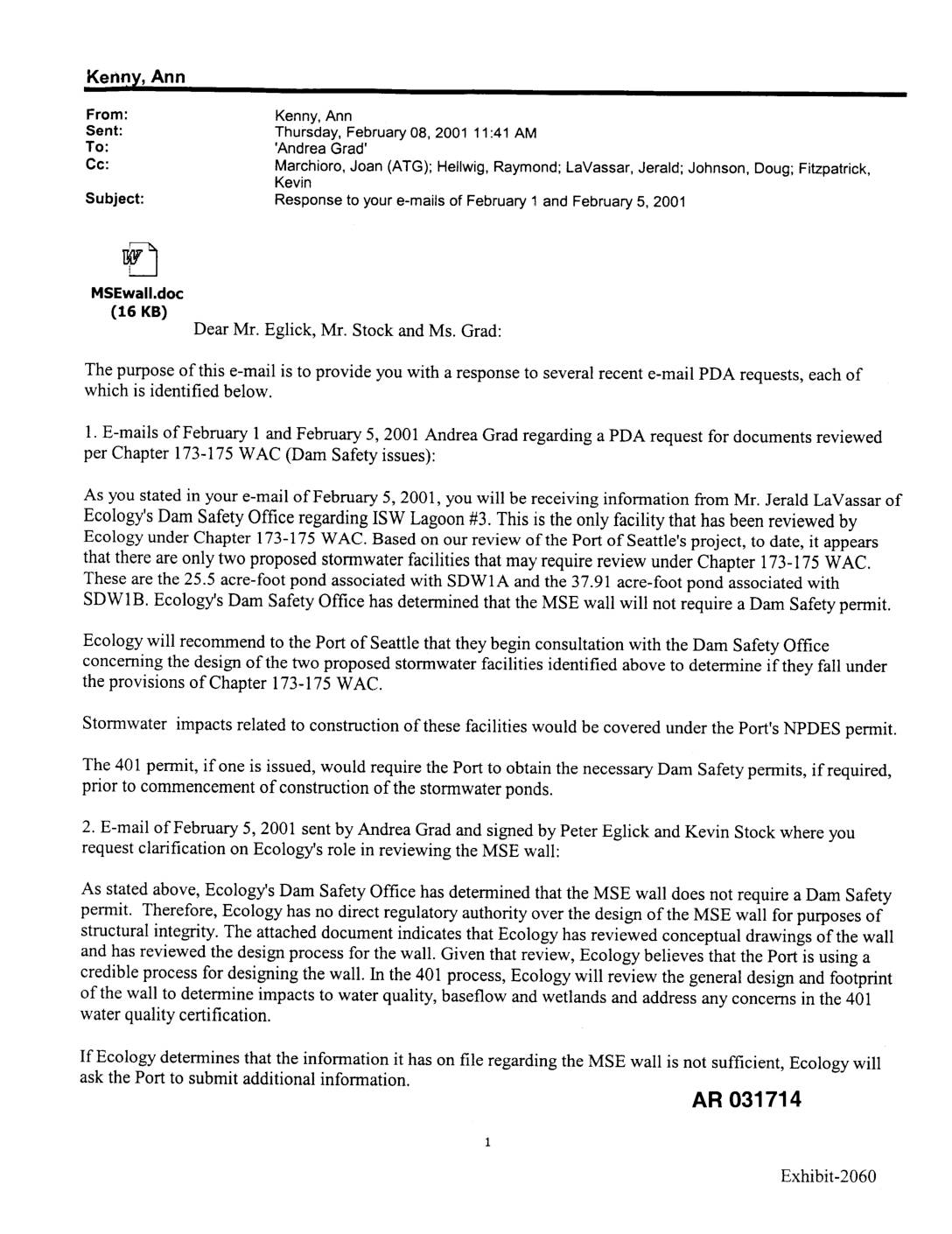 2001-02-08
Exhibit 2060: Ecology Response to PDA Requests on Dam Safety and MSE Wall Review, Plus Memorandum on Retaining Wall Alternatives for Miller Creek
Email dated February 8, 2001 from Ann Kenny (Ecology Senior Environmental Specialist) to Andrea Grad, Peter Eglick, and Kevin Stock responding to PDA requests regarding Chapter 173-175 WAC Dam Safety review of Port Of Seattle Third Runway stormwater facilities. Covers ISW Lagoon #3, 25.5 acre-foot pond (SDW1A), 37.91 acre-foot pond (SDW1B), MSE wall Dam Safety -
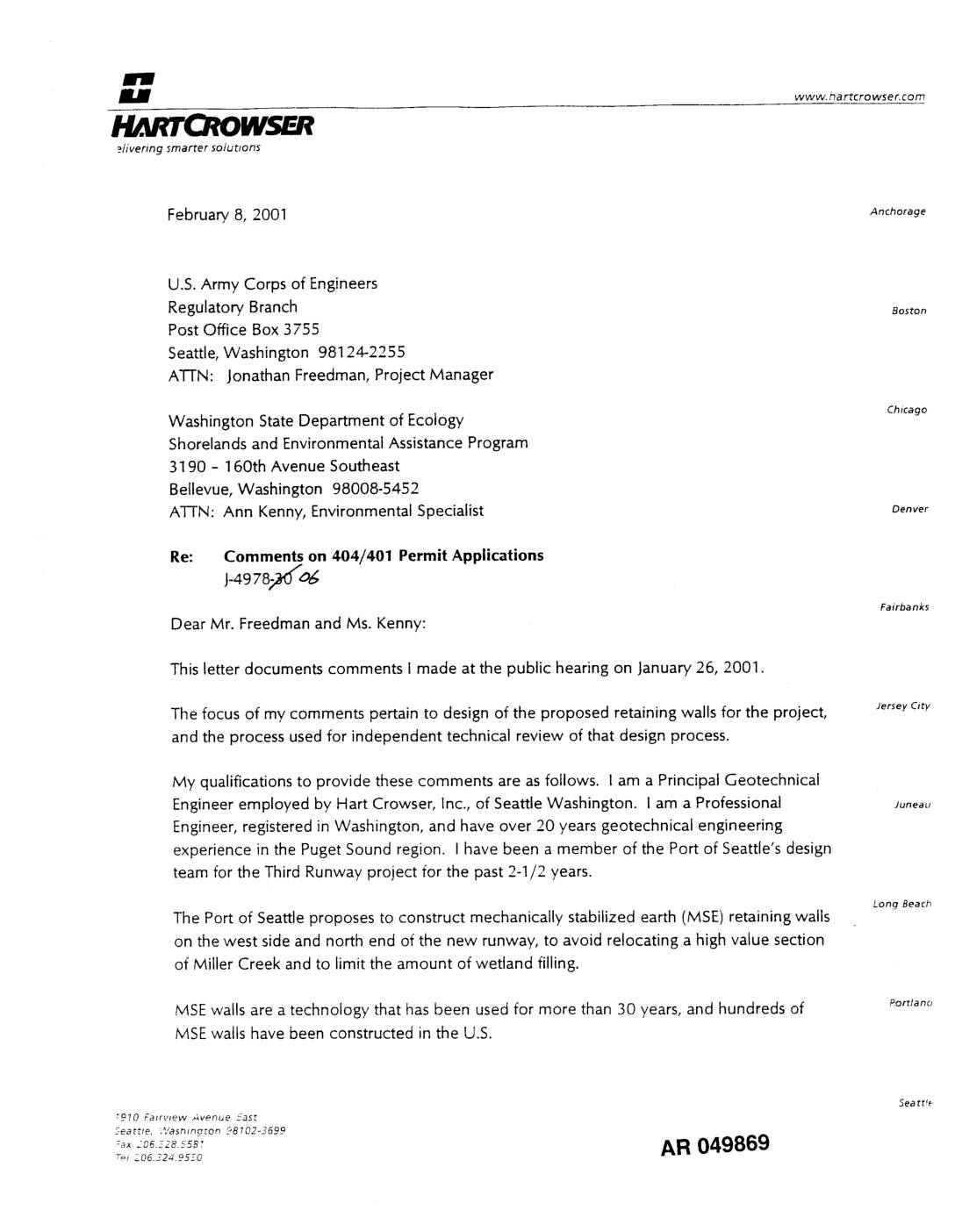 2001-02-08
EXH AR049869: Hart Crowser Letter — Comments on 404/401 Permit Applications for Port Of Seattle Third Runway MSE Retaining Walls
Letter dated February 8, 2001 from Hart Crowser Principal Geotechnical Engineer to U.S. Army Corps of Engineers (Jonathan Freedman) and Washington State Department of Ecology (Ann Kenny), documenting comments made at the January 26, 2001 public hearing on 404/401 permit applications J-4978-30-06. Comments focus on the design and independent technical review of mechanically stabilized earth -
 2001-02-07
Exhibit 2059: Email and Memorandum on Retaining Wall/Slope Alternatives to Reduce Impacts to Miller Creek, Third Runway at Sea-Tac Airport
Exhibit 2059 (AR 031711–031713, ECY00010776–10778). Email from Gus Ordonez to Ann Kenny dated February 7, 2001, transmitting a memorandum from Jerald LaVassar, M.S., P.E. to Tom Luster reviewing the report ‘Evaluation of Retaining Wall/Slope Alternatives to Reduce Impacts to Miller Creek, Embankment Station 174+00 to 186+00’ for the Third Runway project at Sea-Tac International Airport. -
 2001-01-17
EXH AR034299: Amendment and Erratum to Second Revised Public Notice — Port Of Seattle Permit Application 1996-4-02325
U.S. Army Corps of Engineers Public Notice (Reference 1996-4-02325, dated 17 January 2001) amending the second revised public notice dated 27 December 2000 for a Department of the Army Section 404 Clean Water Act permit application by Port Of Seattle. Project located in Miller Creek, Walker Creek, and Des Moines Creek watersheds and wetlands at -
 2000-12-27
EXH AR034248: Second Revised Public Notice of Application for Permit — Port Of Seattle Third Runway, STIA Wetland Fill
US Army Corps of Engineers Seattle District Second Revised Public Notice (Reference 1996-4-02325, dated 27 December 2000, expiration 16 February 2001) for Department of the Army permit under Section 404 of the Clean Water Act. Port Of Seattle applicant (contact Elizabeth Leavitt) proposes to fill 50 wetlands totaling 18.37 acres and temporarily impact 12 wetlands -
 2000-12-20
EXH 242: Northwest Hydraulic Consultants Summary IWS Issues — STIA Third Lagoon Expansion
This December 2000 email from Northwest Hydraulic Consultants summarizes technical concerns about Seattle-Tacoma International Airport's Industrial Wastewater System (IWS) and its effects on local waterways. The consultants warn that diverting large areas of stormwater runoff to the IWS is reducing natural water flows to Walker Creek and Des Moines Creek, and that lining the IWS storage lagoons may further diminish groundwater base flows to those streams. Additional concerns include undersized detention facilities, lack of continuous simulation modeling, and unresolved conflicts with FAA wildlife guidelines related to the proposed Third Lagoon expansion. -
 2000-12-08
EXH 370: Letter Columbia Biological Assessments to WDFW Reviewing JARPA Miller Creek Project
A fisheries biologist hired by the Airport Communities Coalition reviewed the Port of Seattle's permit application for the Miller Creek Relocation Project, raising serious scientific concerns about the proposed construction near Sea-Tac Airport. The review found that the project design lacked supporting scientific citations and calculations, and concluded that summer water temperatures would likely exceed safe levels for cutthroat trout for several years until riparian vegetation matured. Additional concerns were raised about inadequate water flow depths and the risk of the stream running dry due to highly porous spawning gravels used in the channel design. -
 2000-12-01
EXH AR049528: Port Of Seattle Seattle-Tacoma Airport Master Plan Update Low Streamflow Analysis
Low Streamflow Analysis prepared by Earth Tech, Inc. for Port Of Seattle as part of the Seattle-Tacoma Airport Master Plan Update, dated December 2000. Report covers existing streamflow conditions, watershed modeling of current and proposed conditions, hydrologic behavior of runway fill, non-hydrologic flows, secondary recharge effects, reserved stormwater release, and summary of low streamflow effects -
 2000-12-01
EXH AR049788: Supplement Biological Assessment — Master Plan Update Improvements, Seattle-Tacoma International Airport
Supplement Biological Assessment prepared by Parametrix, Inc. (December 2000) for the Federal Aviation Administration and Port Of Seattle for reinitiation and initiation of ESA Section 7 consultation on STIA Master Plan Update Improvements. AR 049788. Document covers hydrologic impacts and mitigation for Miller Creek, Walker Creek, and Des Moines Creek watersheds, including stormwater detention facility