TagCEQ(27)
-
 2024-06-06
Council on Environmental Quality Substantially Rewrites NEPA Regulations
Holland & Knight alert by Rafe Petersen, Alexandra E. Ward, and Jason A. Hill analyzing the Council on Environmental Quality (CEQ) Phase II regulations published May 1, 2024 under the National Environmental Policy Act (NEPA). Covers amendments to 40 C.F.R. Parts 1500-1508, including changes to Environmental Impact Statement (EIS), Environmental Assessment (EA), Categorical Exclusion (CatEx), -
 2015-07-16
Environmental impacts: Policies and procedures (Order 1050.1F)
FAA Order 1050.1F, effective July 16, 2015, establishes the Federal Aviation Administration's policies and procedures for complying with the National Environmental Policy Act (NEPA), covering actions such as grants, construction, rulemaking, and NextGen airspace improvements. The order outlines when environmental reviews, assessments, or full impact statements are required, and defines responsibilities for the FAA, applicants, and contractors. It is relevant to noise and environmental impact considerations at airports like Sea-Tac, as it governs how the FAA evaluates and documents the environmental effects of aviation-related actions. -
 2002-10-23
EXH AR037425: Memorandum of Agreement Between the Department of the Army and the Environmental Protection Agency Concerning the Determination of Mitigation Under the Clean Water Act Section 404(b)(1) Guidelines
Memorandum of Agreement (MOA) between the U.S. Department of the Army and the U.S. Environmental Protection Agency (EPA) articulating policy and procedures for determining type and level of mitigation required under Clean Water Act (CWA) Section 404(b)(1) Guidelines. AR037425. Covers three mitigation types: avoidance, minimization, and compensatory mitigation; establishes no net loss of wetlands goal; -
 1997-04-21
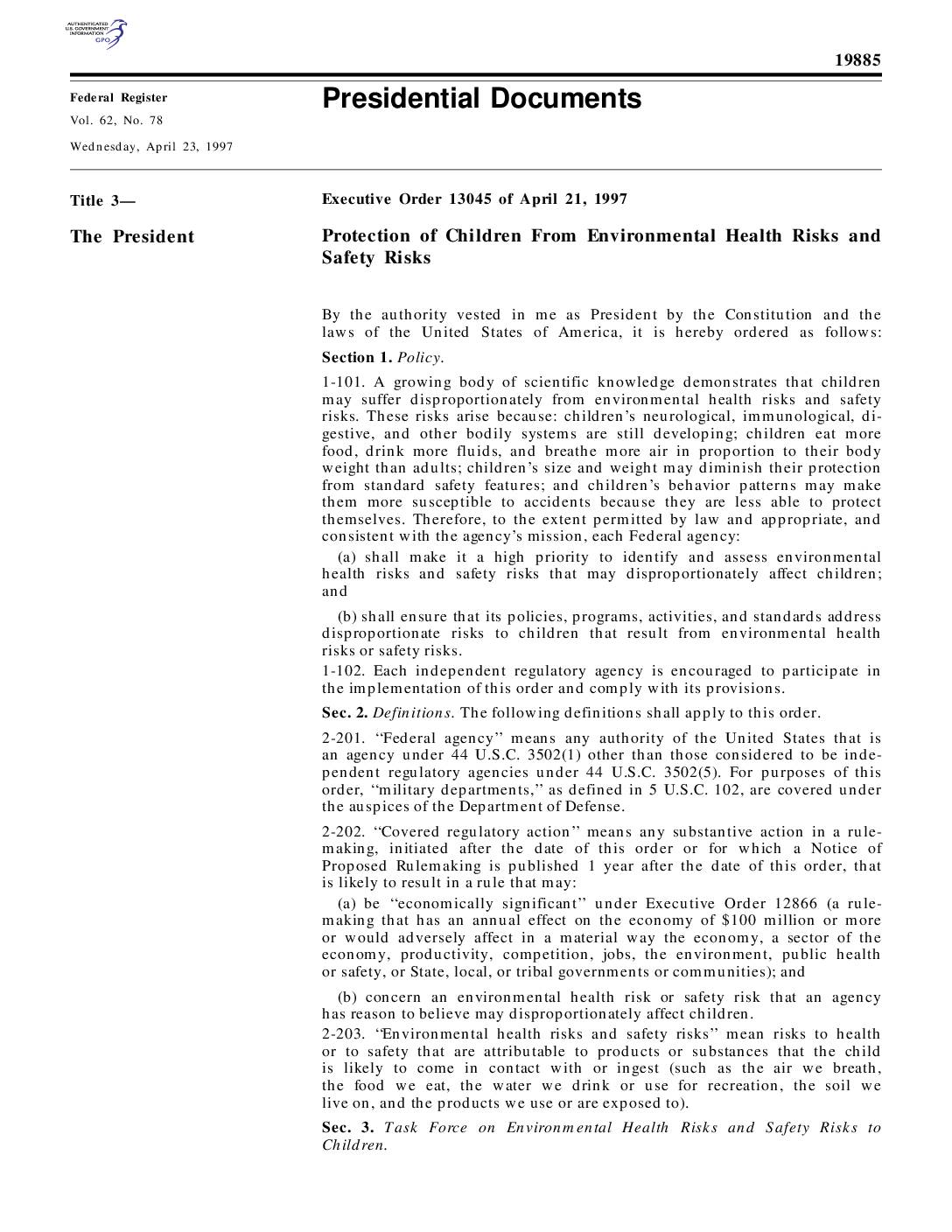
Executive order 13045 protection of children from environmental health risks and safety risks
Executive Order 13045, signed by President Clinton in April 1997, directs federal agencies to identify and address environmental health and safety risks that disproportionately affect children, recognizing that children are more vulnerable due to their developing bodies and behaviors. The order establishes a Task Force co-chaired by the Secretary of Health and Human Services and the EPA Administrator to coordinate federal research and recommend protective strategies. It also requires agencies to evaluate the effects of significant regulations on children's health and safety before those rules take effect. -
 1997-04-21
Executive order 13045 protection of children from environmental health risks and safety risks
Executive Order 13045, signed by President Clinton in April 1997, directs federal agencies to identify and address environmental health and safety risks that disproportionately affect children, recognizing that children are more vulnerable due to their developing bodies and behaviors. The order establishes a Task Force co-chaired by the Secretary of Health and Human Services and the EPA Administrator to coordinate federal research and recommend protective strategies. It also requires agencies to evaluate the effects of significant regulations on children's health and safety before those rules take effect. -
 1997-01-01
Considering Cumulative Effects Under the National Environmental Policy Act
A handbook published by the Council on Environmental Quality providing guidance on analyzing cumulative effects under NEPA. The document covers scoping, describing affected environments, determining environmental consequences, and addressing cumulative impacts in environmental assessments. -
 1980-06-01
Guidelines for considering noise in land use planning and control
Published in June 1980 by the Federal Interagency Committee on Urban Noise, this document provides guidelines for incorporating noise considerations into land use planning and control decisions. It was produced jointly by the U.S. Department of Transportation, Department of Defense, Environmental Protection Agency, and Department of Housing and Urban Development. The guidelines are intended to help planners and policymakers manage the impact of noise—such as that generated by airports like Sea-Tac—on surrounding communities through zoning and land use strategies.