TagAir Traffic Control(102)
-
 2004-05-03
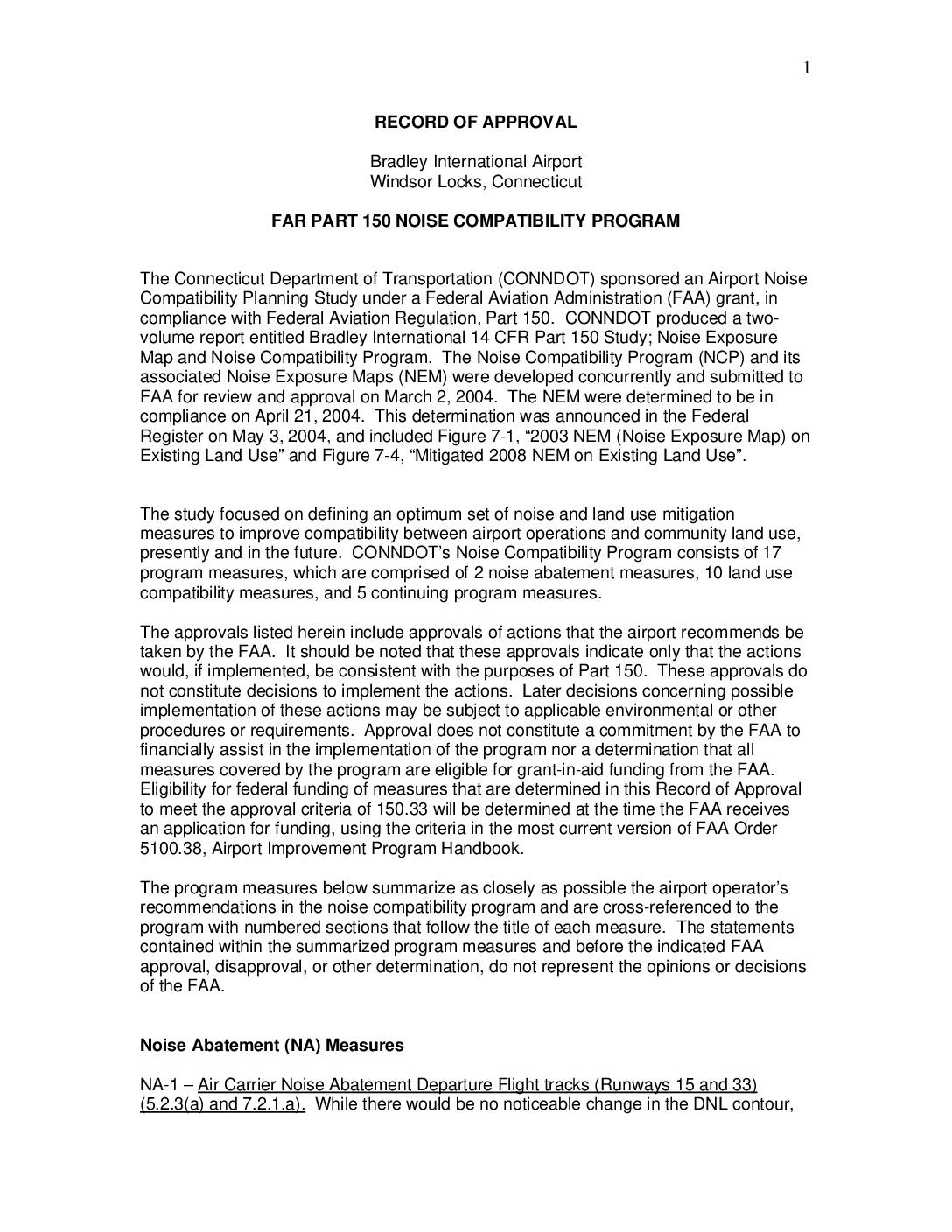
Record of Approval – Bradley International Airport FAR Part 150 Noise Compatibility Program
FAA Record of Approval for Bradley International Airport’s Part 150 Noise Compatibility Program, detailing approved and disapproved noise abatement and land use compatibility measures. The program includes 17 measures comprising 2 noise abatement measures, 10 land use compatibility measures, and 5 continuing program measures. -
 2001-06-22
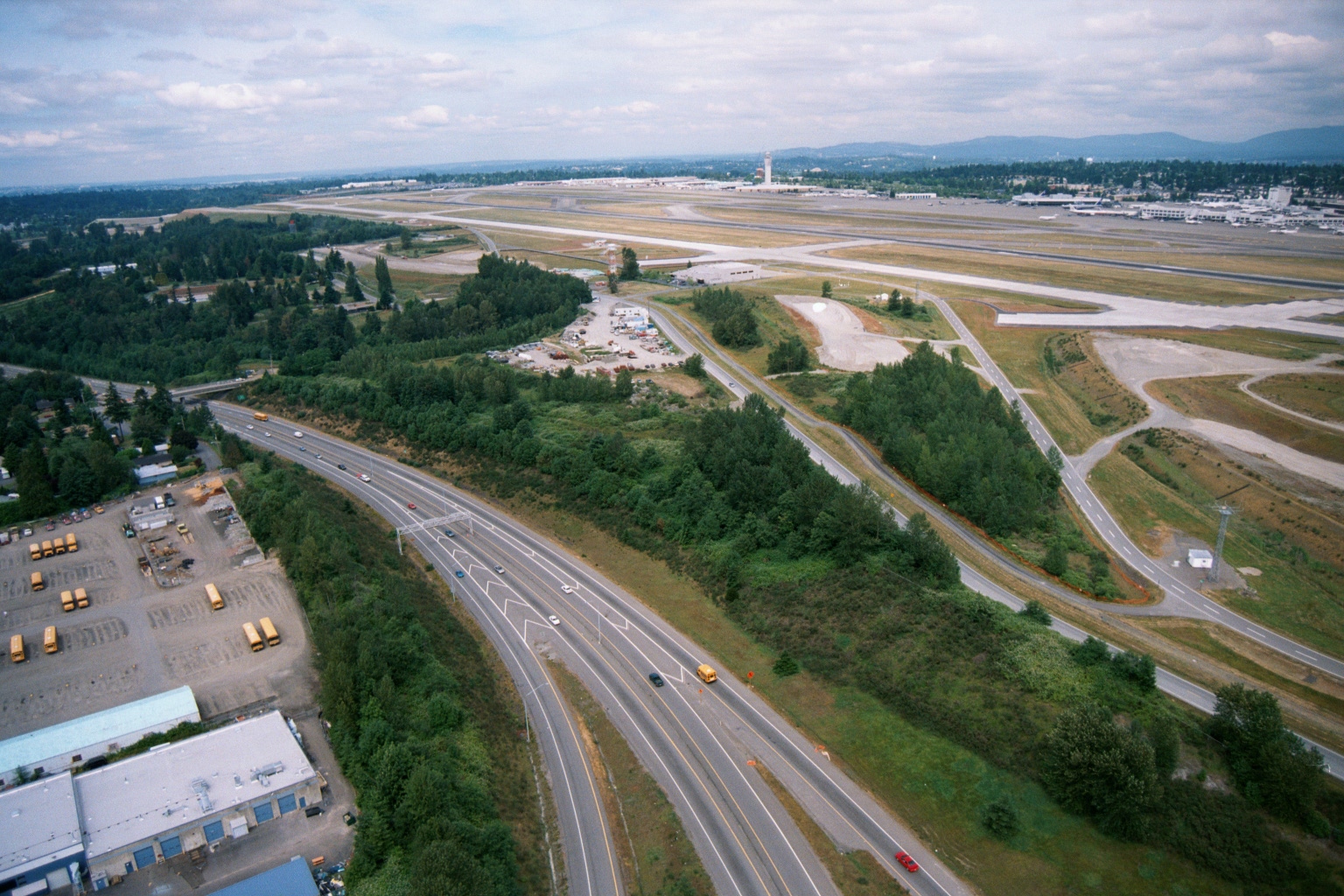
Aerial View of Highway Approaching Sea-Tac Airport with Runways and Control Tower
Aerial photograph showing a multi-lane divided highway curving past a wooded area toward Seattle-Tacoma International Airport, with runway infrastructure, taxiways, and a control tower visible in the background. A school bus yard and industrial facility are visible in the lower left, and mountains are seen on the horizon. -
 1998-07-01
Glossary of Commonly Used Acoustic and Air Traffic Control Terms
This Port of Seattle glossary defines key acoustic and air traffic control terms used in airport noise policy discussions. It explains measurements like decibels (dB), A-weighted decibels (dBA), and the Day-Night Noise Level (DNL), which is a 24-hour average used to map noise exposure around Sea-Tac Airport. It also covers Federal Aviation Regulations (Parts 36, 91, and 161) that govern aircraft noise standards, phase-out schedules for older noisy aircraft, and the process for airports to adopt new noise rules. -
 1998-06-01
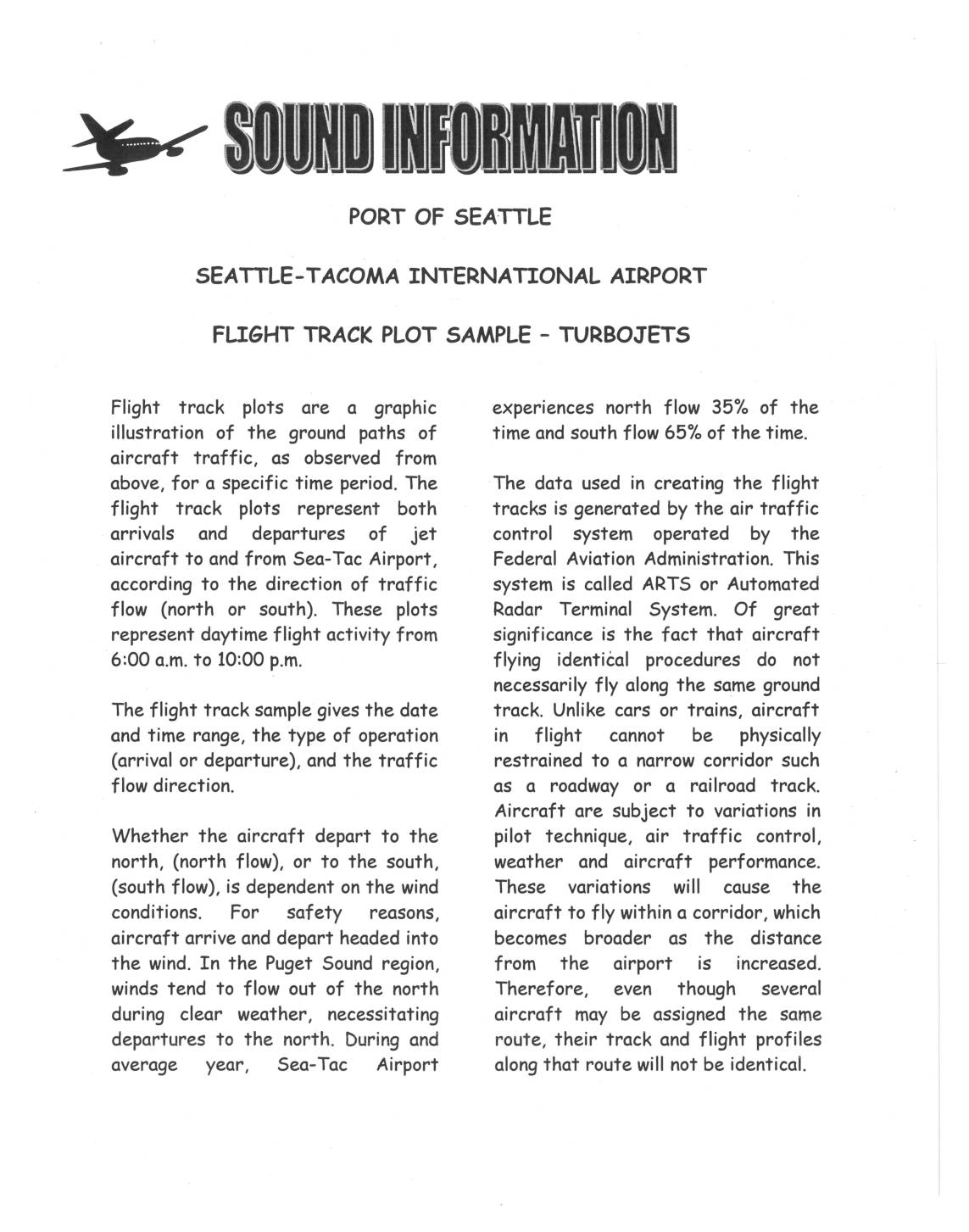
Port Of Seattle Sea-Tac Jet Aircraft Flight Track Patterns: North Flow and South Flow, Summer 1998
This Port of Seattle document explains flight track plots for Seattle-Tacoma International Airport, which map the ground paths of jet aircraft arrivals and departures during daytime hours (6am–10pm). It describes how wind conditions determine whether aircraft fly in a north or south flow pattern, with south flow occurring about 65% of the year. The document also notes that even aircraft following identical routes will not fly the exact same path, due to variations in pilot technique, weather, air traffic control, and aircraft performance. -
 1995-12-04
Seattle 4-Post Decision and Order
This 1995 FAA Decision and Order addresses longstanding air traffic congestion and inefficiency problems at Seattle-Tacoma International Airport (Sea-Tac), stemming from outdated flight route procedures established in the 1970s. The document explains that existing arrival and departure routes caused safety concerns, reduced airport capacity, and increased controller workload, particularly when runway directions changed multiple times daily. It also notes that the so-called 'noise abatement' procedures from 1974 were not based on any coherent noise reduction plan, but were largely the result of moving flight paths away from communities that had complained. -
 1990-04-02
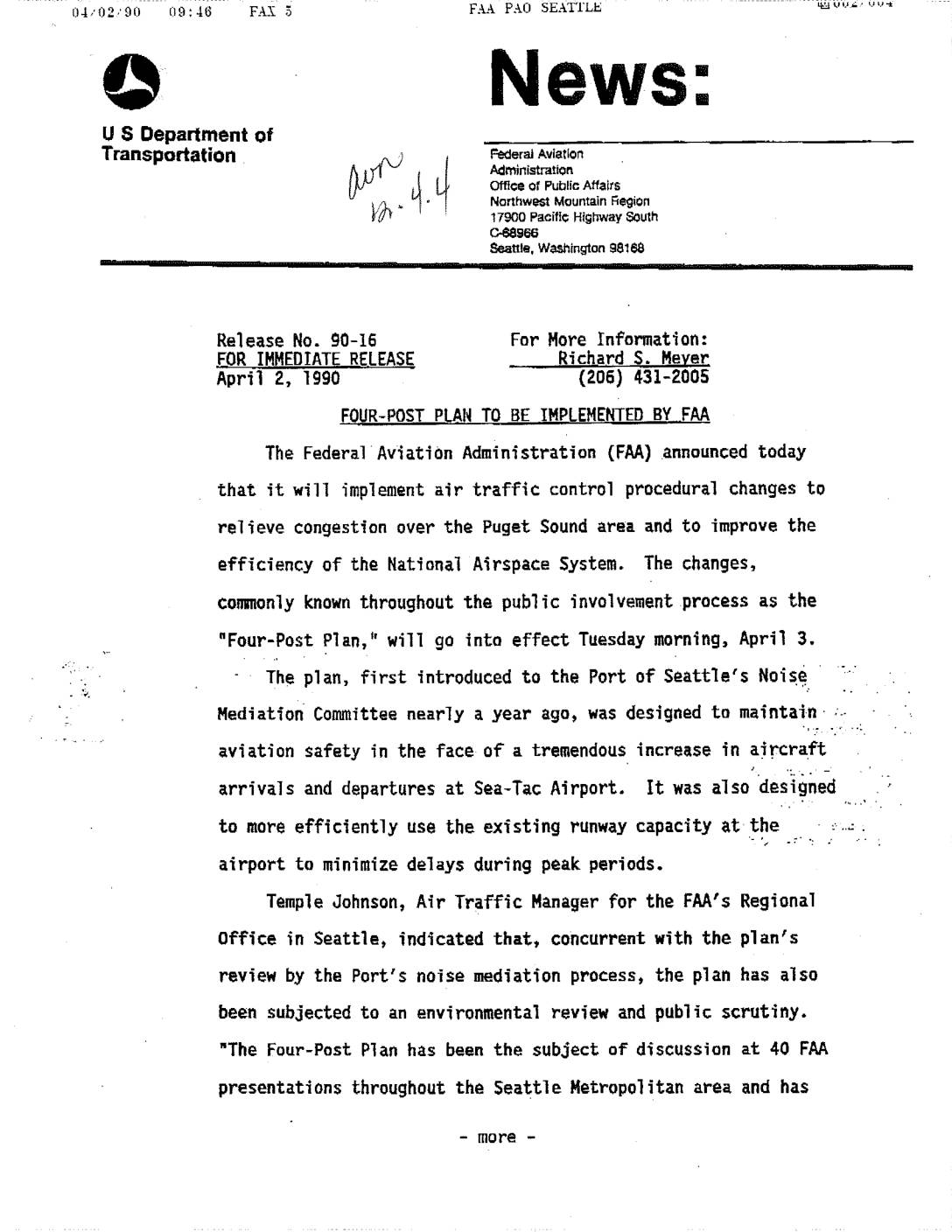
Four-Post Plan to Be Implemented by FAA
On April 2, 1990, the FAA announced it would implement the 'Four-Post Plan,' a set of air traffic control procedural changes at Seattle-Tacoma International Airport designed to reduce congestion, improve efficiency, and address worsening arrival delays. The plan, developed after nearly a year of public meetings, environmental review, and computer simulation of 13 alternatives, was determined to produce no significant noise impact on surrounding communities. The FAA cited a 30,000 increase in annual landings and takeoffs since 1988 and the failure of mediation talks to produce an agreed-upon flight path solution as key reasons for moving forward with the changes. -
 1990-03-27
Final environmental assessment for proposed changes to air traffic arrival and departure routes at Seattle-Tacoma International Airport
This 1990 Final Environmental Assessment, prepared by the FAA's Air Traffic Division in Seattle, evaluates proposed changes to arrival and departure flight routes at Seattle-Tacoma International Airport. The document was signed by Air Traffic Division Manager Temple H. Johnson, Jr. on March 27, 1990, and examines the potential environmental impacts of rerouting aircraft traffic in and out of Sea-Tac. It serves as an official federal record relevant to noise and environmental policy affecting communities around the airport. -
 1990-01-01
Final environmental assessment: Proposed changes to air traffic arrival and departure routes at Seattle-Tacoma International Airport, Volume II
This 1990 Final Environmental Assessment, published by the U.S. Department of Transportation's Federal Aviation Administration, examines proposed changes to air traffic arrival and departure routes at Seattle-Tacoma International Airport. Volume II of the document compiles public comments received in response to the Draft Environmental Assessment, reflecting community input on how the proposed route changes could affect noise and other environmental conditions in the Seattle, Washington area. -
 1989-12-01
Draft Environmental Assessment for Proposed Changes to Air Traffic Arrival and Departure Routes at Seattle-Tacoma International Airport
This 1989 draft Environmental Assessment, prepared by the FAA's Air Traffic Division, evaluates proposed changes to arrival and departure flight routes at Seattle-Tacoma International Airport. The changes aimed to reduce air traffic congestion and improve airspace efficiency, particularly during peak demand periods when south-arrival capacity (42 aircraft/hour) lagged significantly behind north-arrival capacity (56 aircraft/hour). The inefficiency was linked to a requirement routing turbojet aircraft through Elliott Bay, a legacy of noise abatement agreements with local governments and the Port of Seattle dating back to 1970. -
 1989-12-01
Draft environmental assessment for proposed changes to air traffic arrival and departure routes at Seattle-Tacoma International Airport
This 1989 FAA draft Environmental Assessment examines proposed changes to arrival and departure flight routes at Seattle-Tacoma International Airport, aimed at reducing air traffic congestion and improving airspace efficiency. The document identifies a key inefficiency: during good weather and peak demand, south-landing capacity (42 aircraft/hour) was significantly lower than north-landing capacity (56 aircraft/hour), largely due to a requirement routing turbojet aircraft through Elliott Bay. The assessment traces the issue back to noise abatement procedures established since 1970 that prioritized limiting jet overflights in certain Seattle metropolitan areas over operational efficiency.