TagACC(1548)
-
 2001-02-15
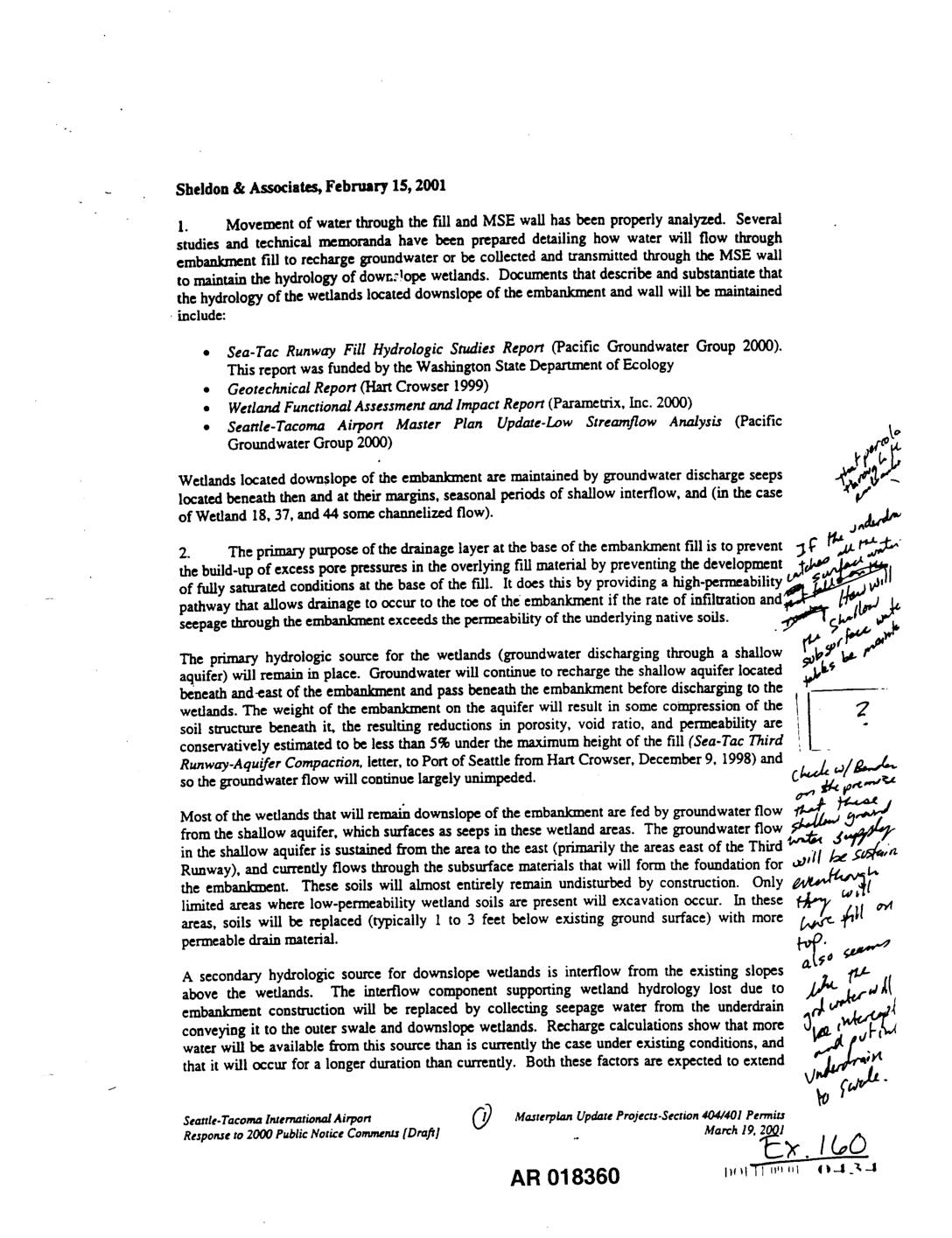
EXH AR018360: Sheldon & Associates Response to 2000 Public Notice Comments — Water Movement Through Fill and MSE Wall
Sheldon & Associates letter dated February 15, 2001, responding to public notice comments regarding the Seattle-Tacoma International Airport Masterplan Update Projects Section 404/401 Permits. Addresses movement of water through embankment fill and Mechanically Stabilized Earth (MSE) wall, drainage layer design to prevent excess pore pressures, rock underdrain clogging prevention using Group 1A filter material, shallow -
 2001-02-15
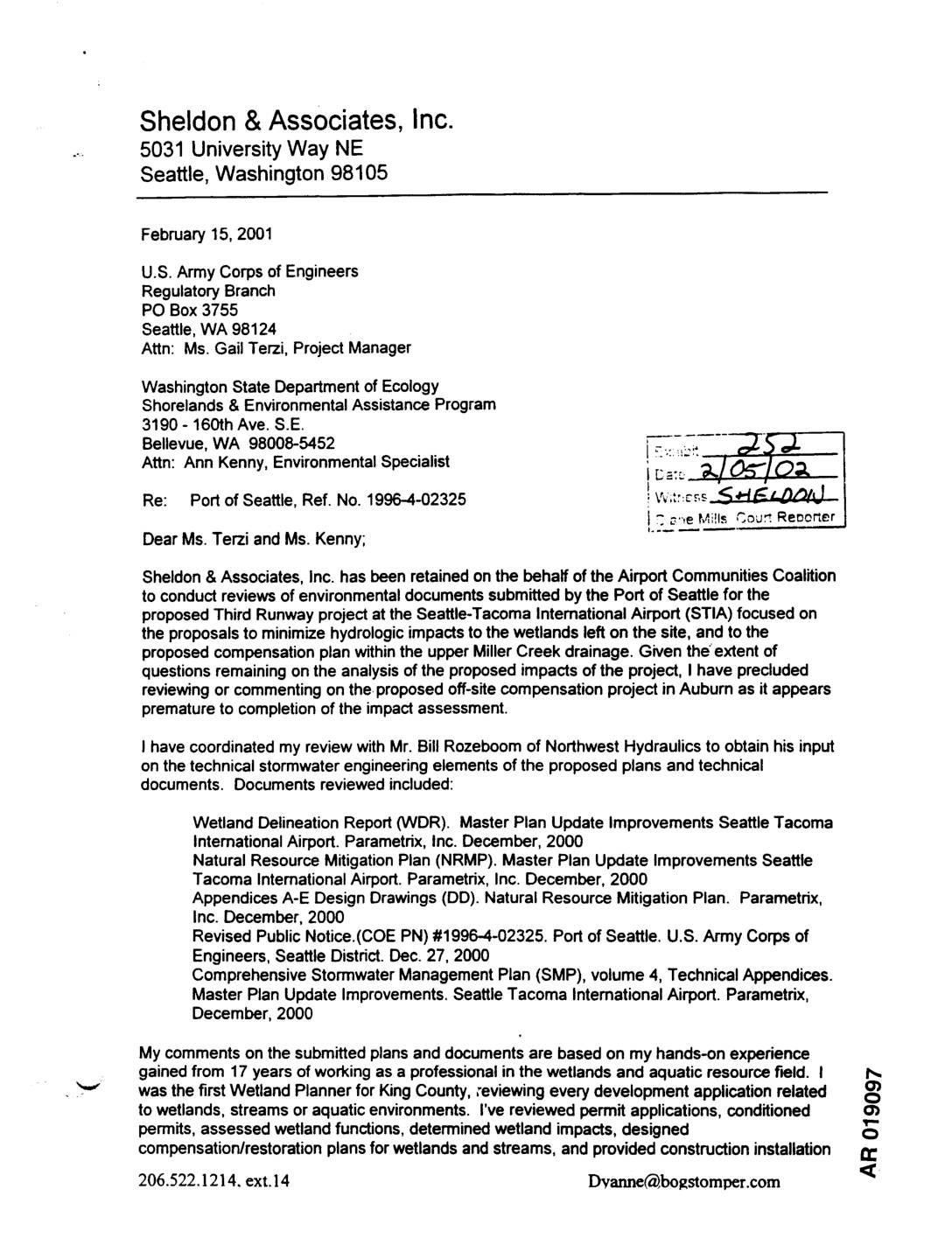
EXH AR019097: Sheldon & Associates to Army Corps & Ecology — STIA Third Runway Natural Resource Mitigation Plan Review
A 2001 environmental review letter from Sheldon & Associates, commissioned by the Airport Communities Coalition, challenges the Port of Seattle's technical documents for the proposed Third Runway at Seattle-Tacoma International Airport. The review finds that the Port has not adequately demonstrated that massive fill placement and engineered retaining walls would avoid long-term damage to downslope wetlands, groundwater flows, and Miller Creek. Key unresolved concerns include the reliability of the proposed underdrain system, incomplete baseline data, and the lack of independent construction oversight. -
 2001-02-14
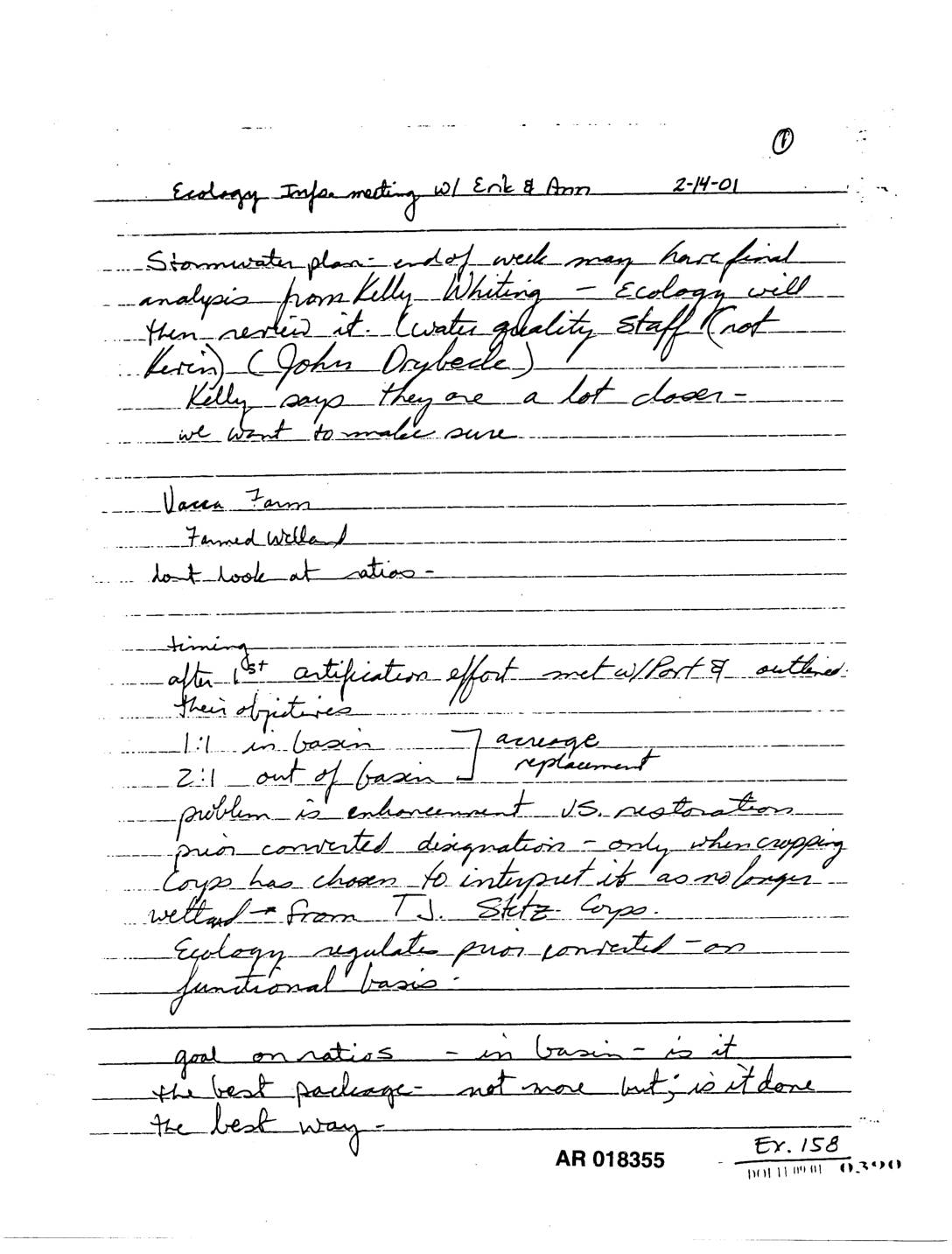
Exhibit 158: Ecology Informational Meeting Notes with Erik and Ann, 2-14-01
Handwritten notes from an Ecology informational meeting with Erik and Ann dated February 14, 2001 (AR 018355-018357). Topics include stormwater plan analysis from Kelly Whiting and John Drybeck (water quality staff), Vasen Farm farmed wetland ratios (1:1 in-basin acreage, 2:1 out-of-basin replacement), enforcement vs. restoration, prior converted designation, Corps of Engineers wetland determinations, 509 overpass, -
 2001-02-13
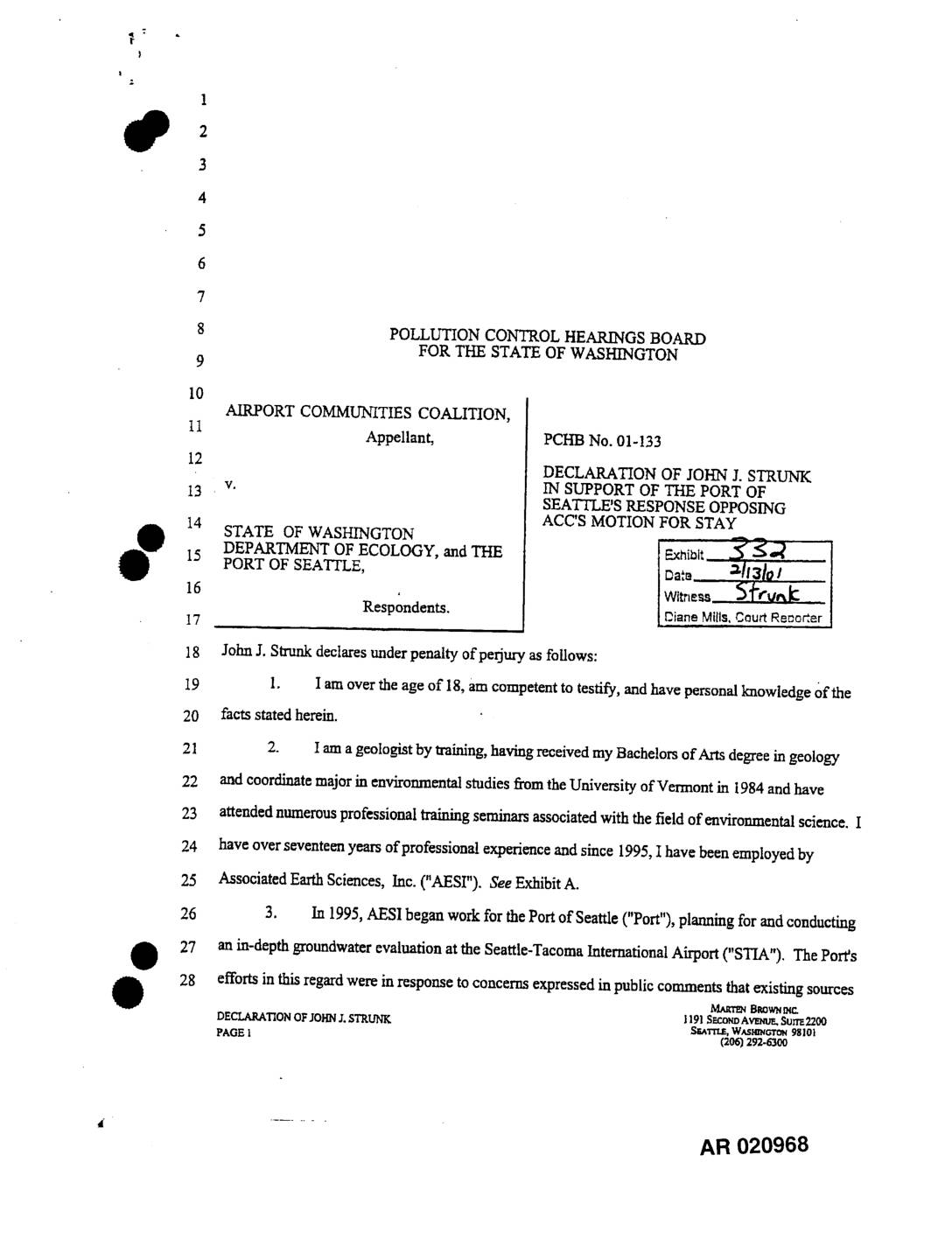
EXH 332: Declaration John J. Strunk Supporting Response Opposing ACC Motion for Stay
A declaration by geologist John J. Strunk of Associated Earth Sciences, Inc. (AESI) submitted to Washington State's Pollution Control Hearings Board describes groundwater contamination studies conducted at Seattle-Tacoma International Airport (Sea-Tac) in connection with the proposed Third Runway project. The studies found that while contamination exists in shallow groundwater zones within the Airport's Aircraft Operations and Maintenance Area (AOMA), it is isolated and located approximately 2,800 feet from the Third Runway site, with water flow predominantly directed away from that area. AESI concluded that subsurface utility lines do not appear to be a significant pathway for contaminant migration toward the Third Runway construction zone. -
 2001-02-13
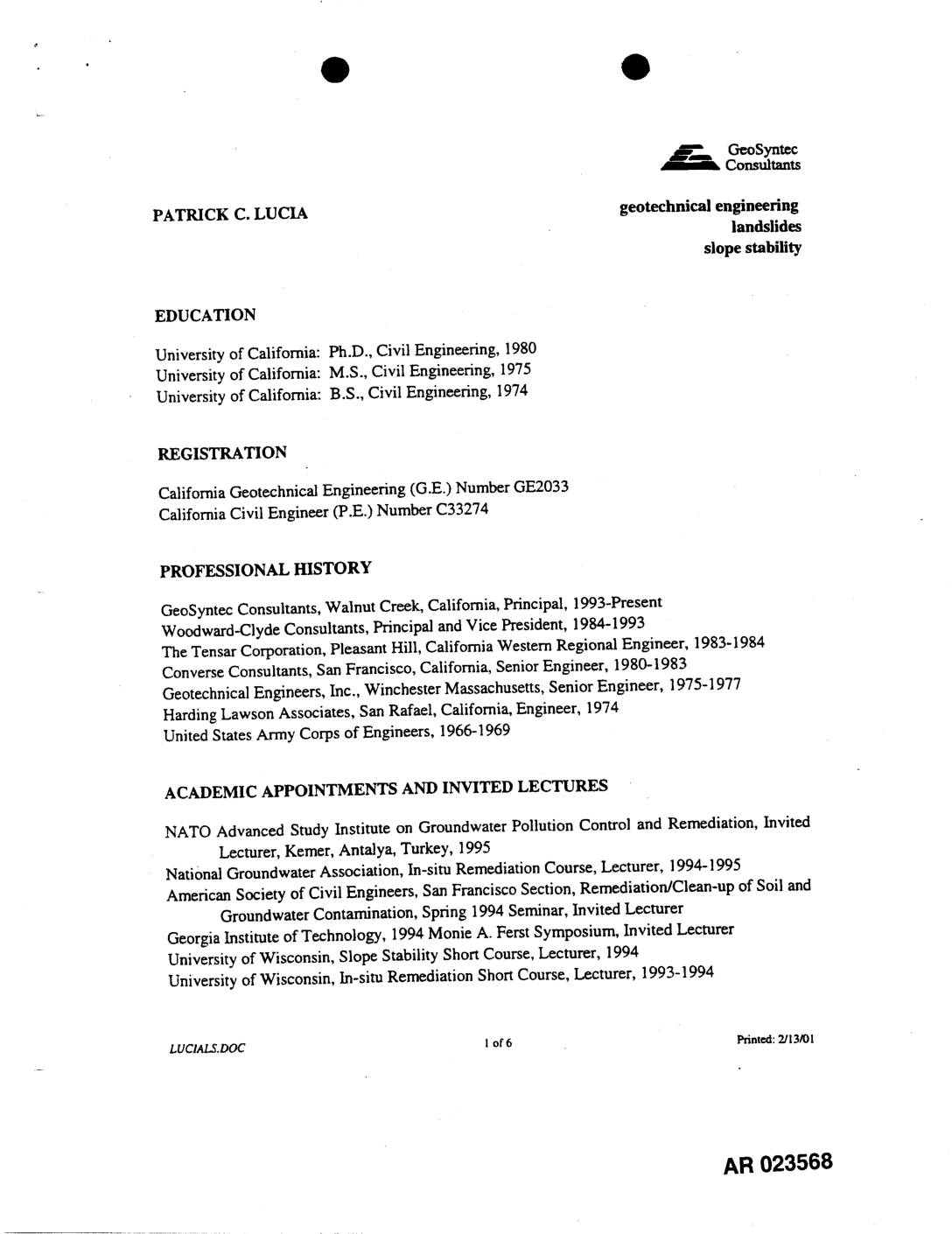
EXH AR023568: CV Patrick C. Lucia, GeoSyntec Consultants
This document is a professional curriculum vitae for Patrick C. Lucia, a civil engineer and Principal at GeoSyntec Consultants specializing in geotechnical engineering, landslides, and slope stability. It details his education, professional registrations, career history, and representative project experience, including bridge seismic reviews, landslide repairs, and reservoir stability evaluations in California. Note: This document does not appear to contain content related to Sea-Tac Airport noise policy. -
 2001-02-12
EXH AR017360: Part IX Tables — MTCA WAC 173-340-900 Method A Cleanup Levels for Ground Water
Exhibit AR017360, Part IX Tables from MTCA Cleanup Regulation WAC 173-340-900, dated February 12, 2001. Contains Table 720-1, Method A Cleanup Levels for Ground Water, listing hazardous substances including arsenic, benzene, benzo(a)pyrene, cadmium, chromium, DDT, 1,2-dichloroethane (EDC), ethylbenzene, ethylene dibromide (EDB), lead, lindane, methylene chloride, mercury, MTBE, naphthalenes, PCB mixtures, radium 226, tetrachloroethylene, toluene, trichloroethylene, -
 2001-02-12
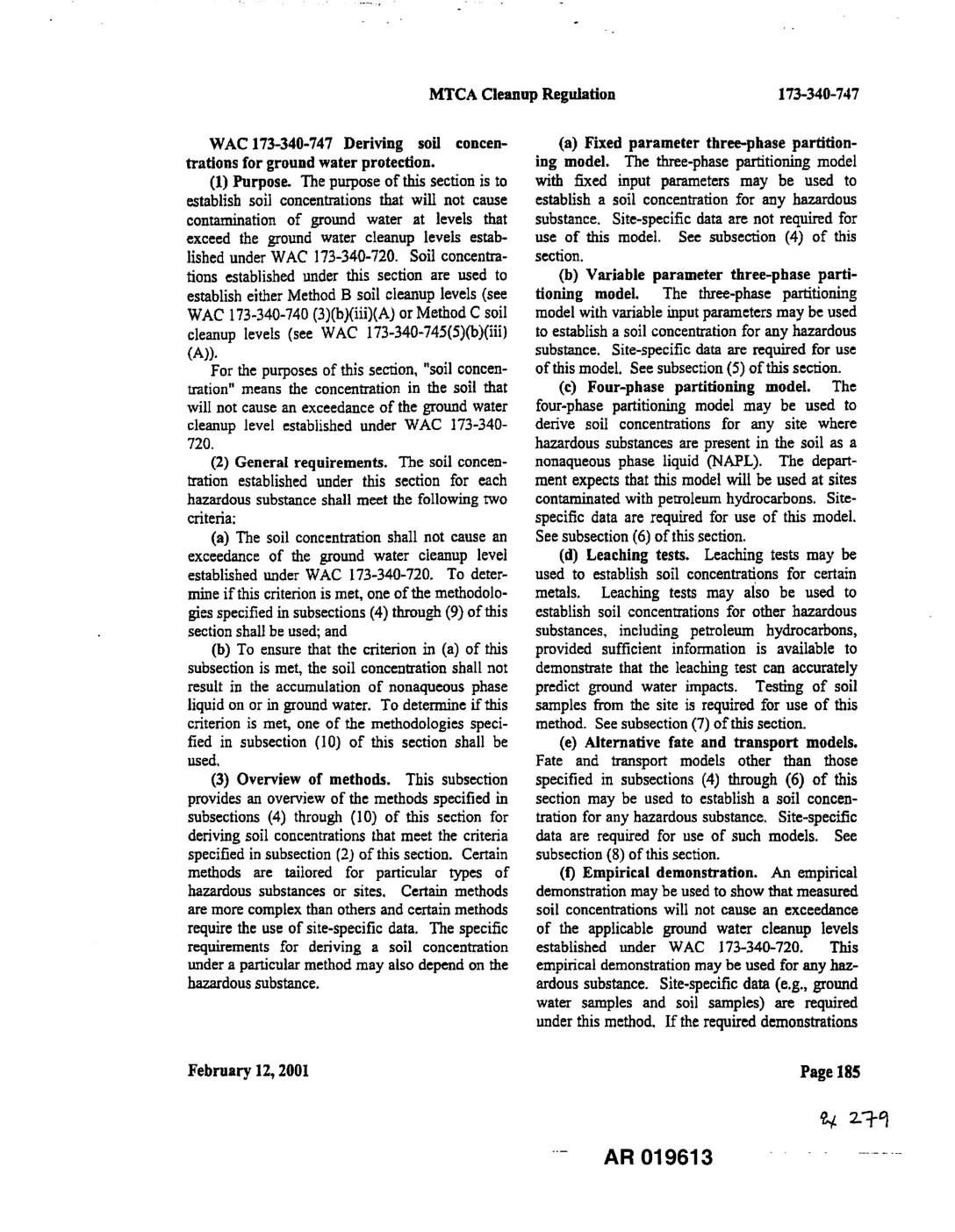
EXH AR019613: WAC 173-340-747 Deriving Soil Concentrations Groundwater Protection MTCA
This Washington State regulation (WAC 173-340-747) establishes methods for determining safe soil contamination levels that protect groundwater quality at cleanup sites. It outlines several scientific approaches, including three-phase and four-phase partitioning models, leaching tests, and empirical demonstrations, to calculate the maximum allowable concentration of hazardous substances in soil before they risk contaminating groundwater. The regulation requires that soil concentrations not cause groundwater cleanup level exceedances and not result in the buildup of nonaqueous phase liquids in or on groundwater. -
 2001-02-12
EXH AR017506: WAC 173-340-740 MTCA Cleanup Regulation — Unrestricted Land Use Soil Cleanup Standards
WAC 173-340-740 from the Model Toxics Control Act (MTCA) Cleanup Regulation, published February 12, 2001, establishing unrestricted land use soil cleanup standards. Covers Method A, Method B (standard and modified), and petroleum mixture cleanup levels including Equations 740-1 through 740-3 for noncarcinogens and carcinogens. Specifies default exposure parameters: soil ingestion rate 200 mg/day, average body -
 2001-02-08
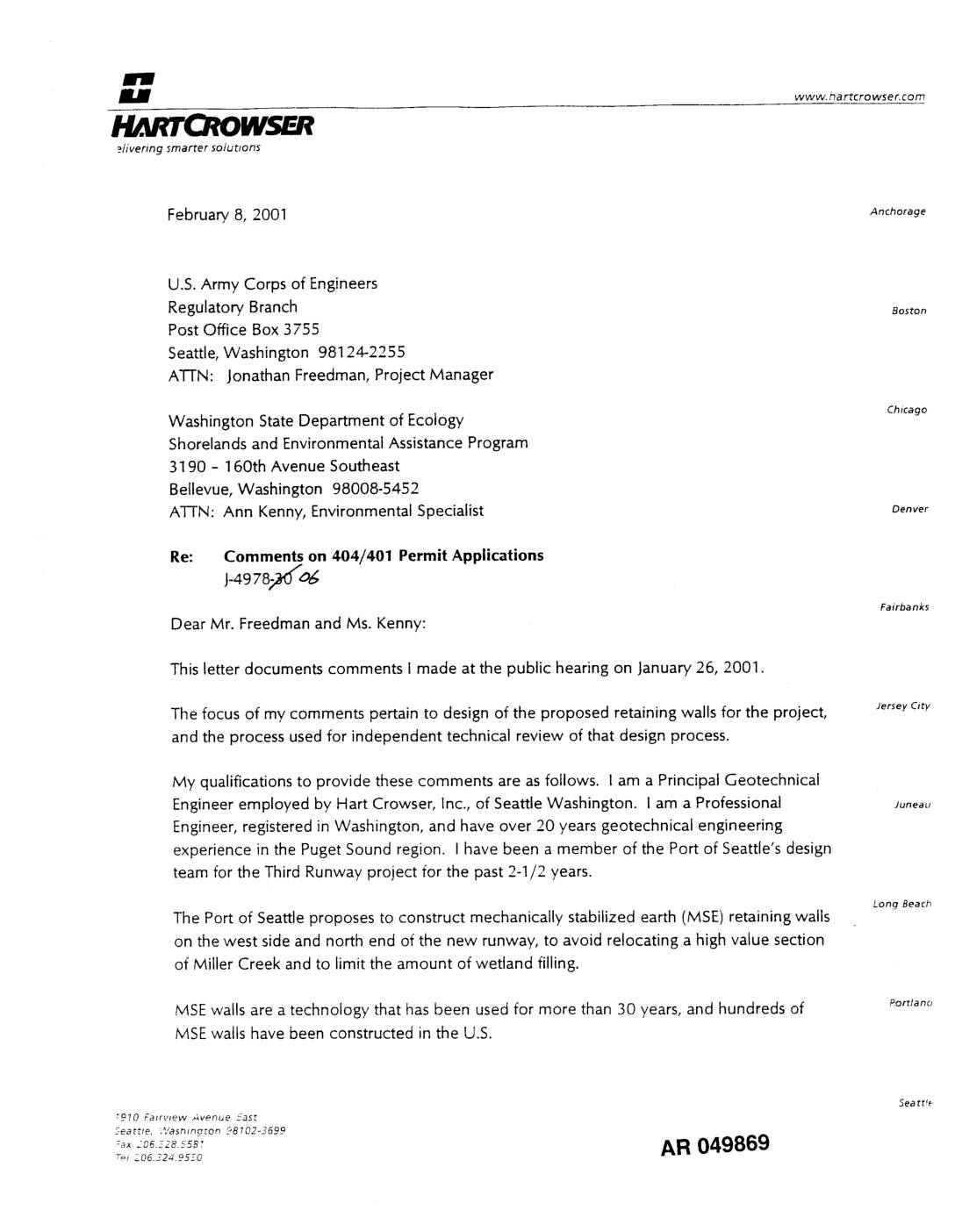
EXH AR049869: Hart Crowser Letter — Comments on 404/401 Permit Applications for Port Of Seattle Third Runway MSE Retaining Walls
Letter dated February 8, 2001 from Hart Crowser Principal Geotechnical Engineer to U.S. Army Corps of Engineers (Jonathan Freedman) and Washington State Department of Ecology (Ann Kenny), documenting comments made at the January 26, 2001 public hearing on 404/401 permit applications J-4978-30-06. Comments focus on the design and independent technical review of mechanically stabilized earth -
 2001-02-08
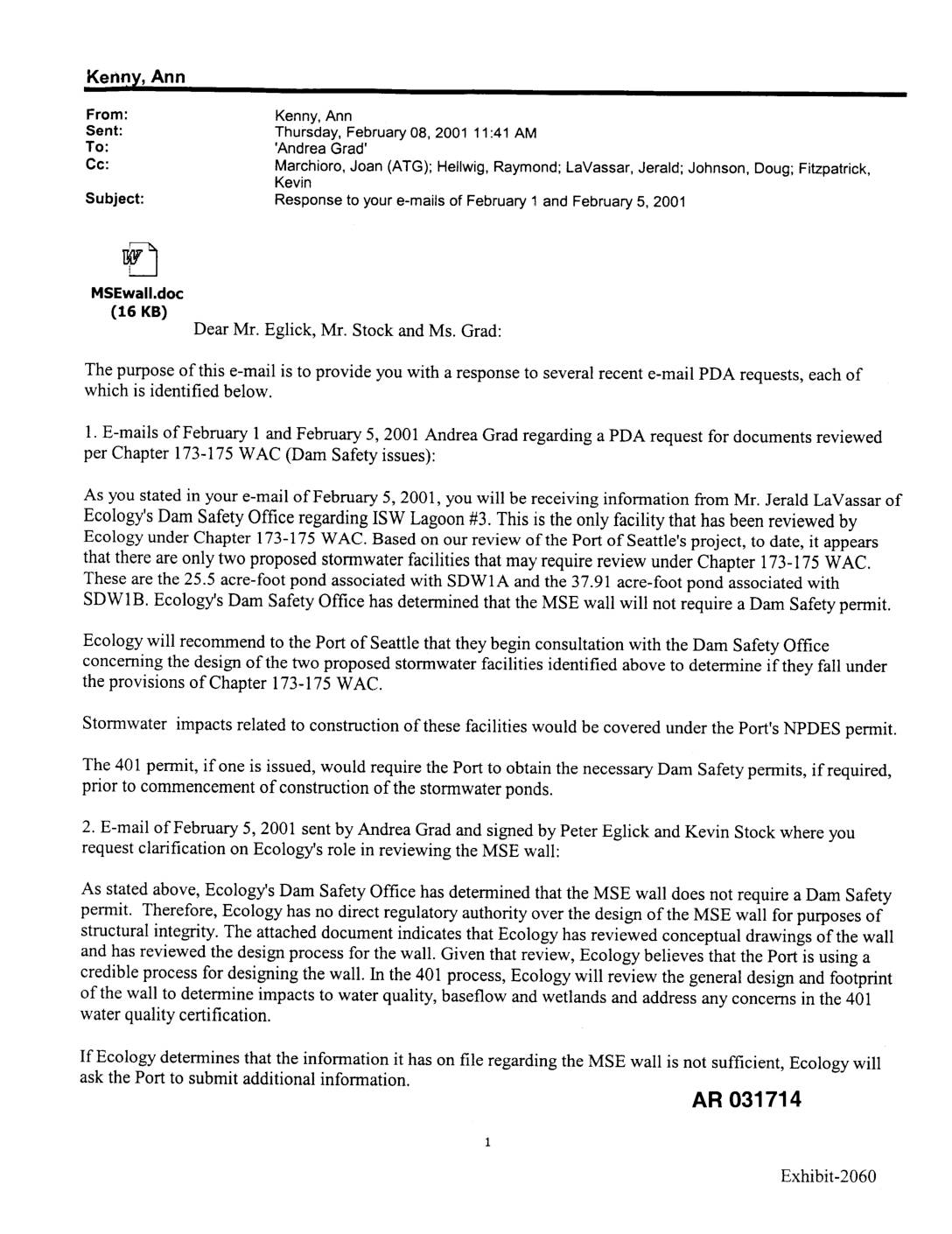
Exhibit 2060: Ecology Response to PDA Requests on Dam Safety and MSE Wall Review, Plus Memorandum on Retaining Wall Alternatives for Miller Creek
Email dated February 8, 2001 from Ann Kenny (Ecology Senior Environmental Specialist) to Andrea Grad, Peter Eglick, and Kevin Stock responding to PDA requests regarding Chapter 173-175 WAC Dam Safety review of Port Of Seattle Third Runway stormwater facilities. Covers ISW Lagoon #3, 25.5 acre-foot pond (SDW1A), 37.91 acre-foot pond (SDW1B), MSE wall Dam Safety