TagWater Quality(475)
-
 2001-08-10
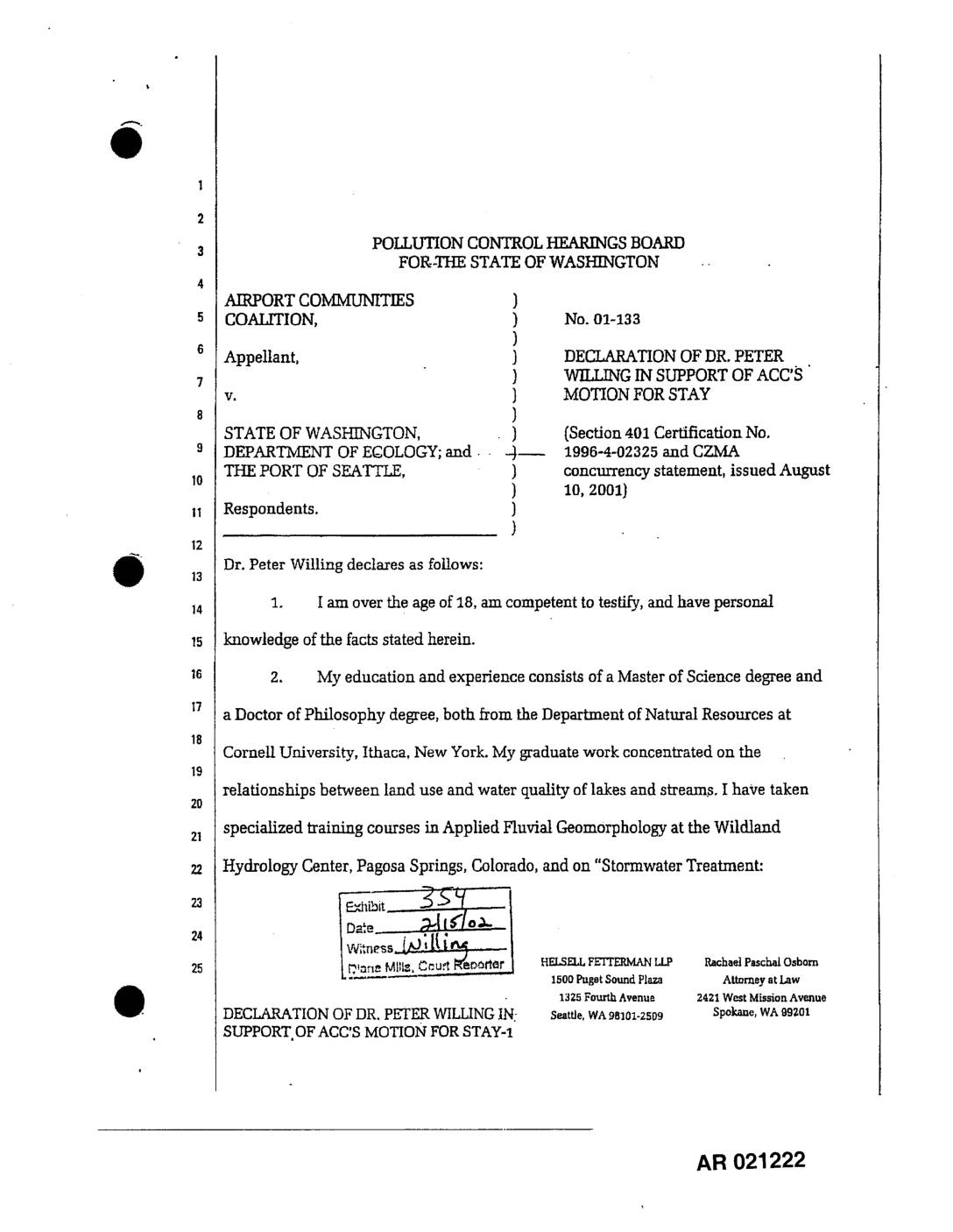
EXH 354: Decl. Dr. Peter Willing Support ACC Motion for Stay PCHB No. 01-133
Dr. Peter Willing, a water resources expert, submitted this declaration opposing the Department of Ecology's water quality certification for Sea-Tac Airport's proposed third runway construction. He argues that the certification relies on vague future performance expectations and unresolved contingency plans that fail to provide reasonable assurance that water quality standards will be met. His key concerns include the Port of Seattle's flawed low streamflow analysis and inadequate stormwater management plans that could perpetuate ongoing water quality violations in nearby Class AA streams. -
 2001-08-10
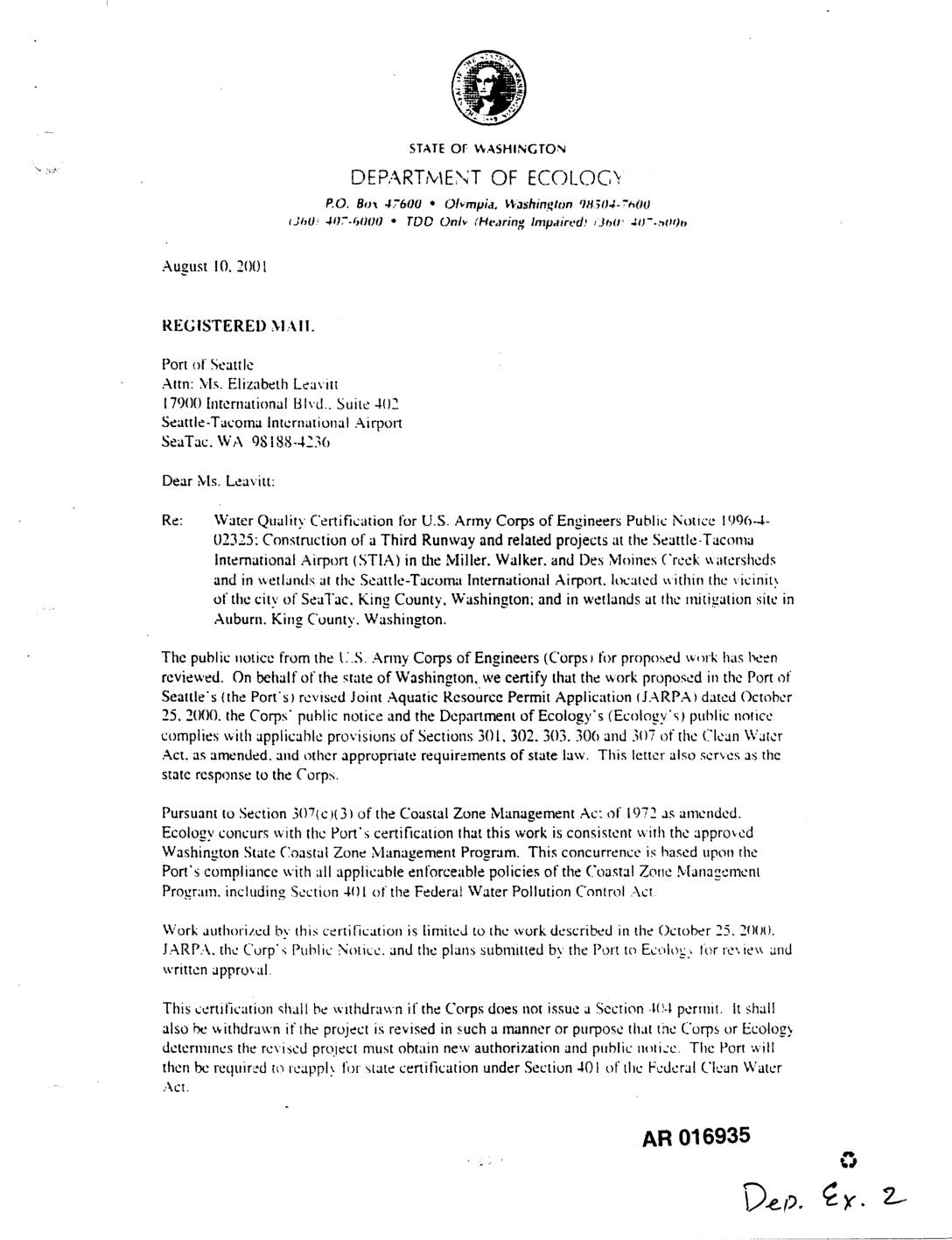
EXH AR016935: Ecology Water Quality Certification — STIA Third Runway Construction, Order #1996-4-02325
Washington State Department of Ecology (Ecology) Water Quality Certification letter dated August 10, 2001, addressed to Port Of Seattle, Attn: Elizabeth Leavitt, for U.S. Army Corps of Engineers Public Notice 1996-4-02325. Certifies that construction of a Third Runway and related projects at Seattle-Tacoma International Airport (STIA) in the Miller, Walker, and Des Moines Creek watersheds -
 2001-08-10
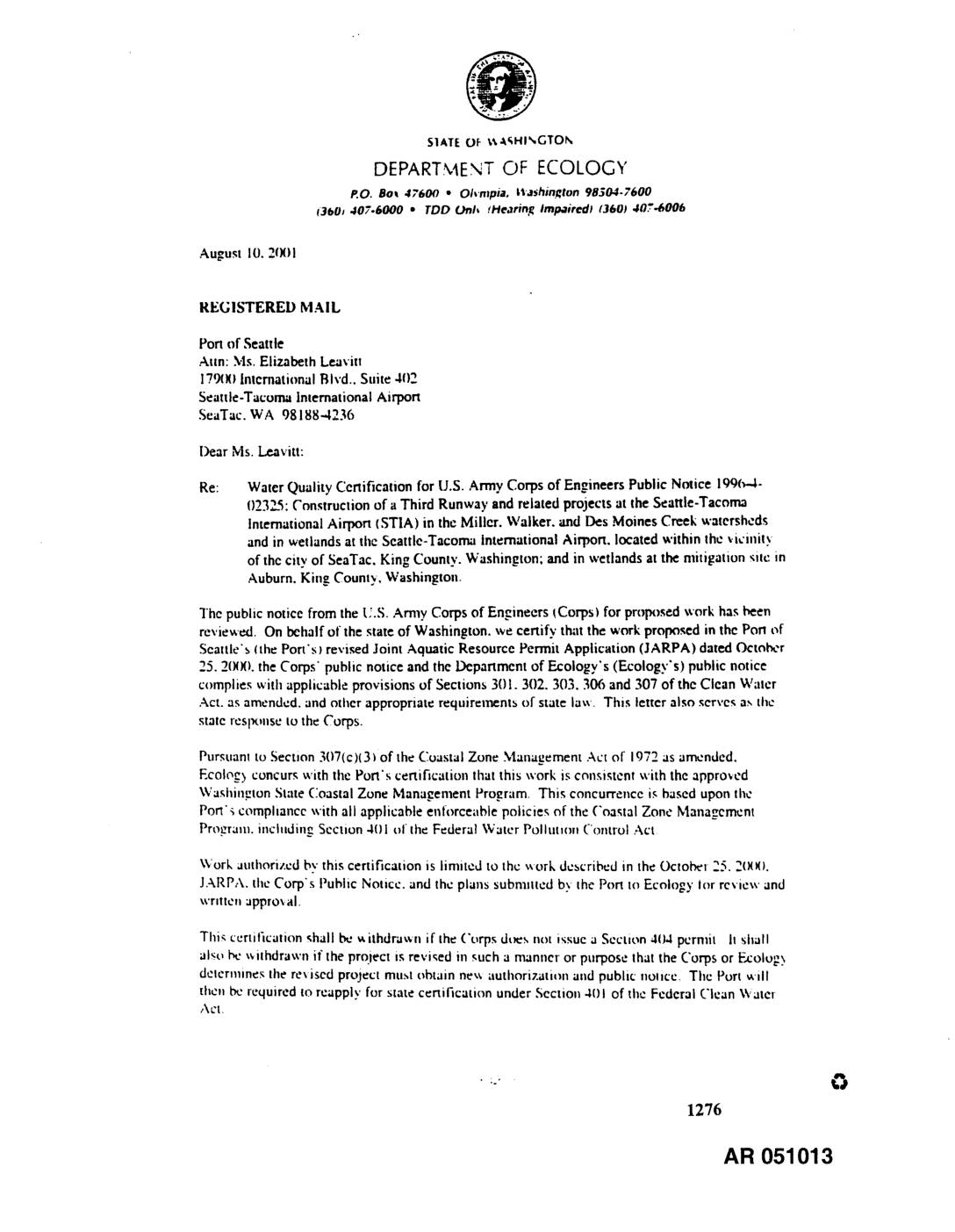
EXH AR051013: Water Quality Certification Order #1996-4-02325 — Ecology to Port Of Seattle for Third Runway Construction at STIA
Washington State Department of Ecology Water Quality Certification (Order #1996-4-02325) issued August 10, 2001, to Port Of Seattle for construction of a 8,500-foot third parallel runway and related projects at Seattle-Tacoma International Airport (STIA) in the Miller, Walker, and Des Moines Creek watersheds and wetlands in SeaTac and Auburn, King County. Certifies compliance with Clean -
 2001-08-10
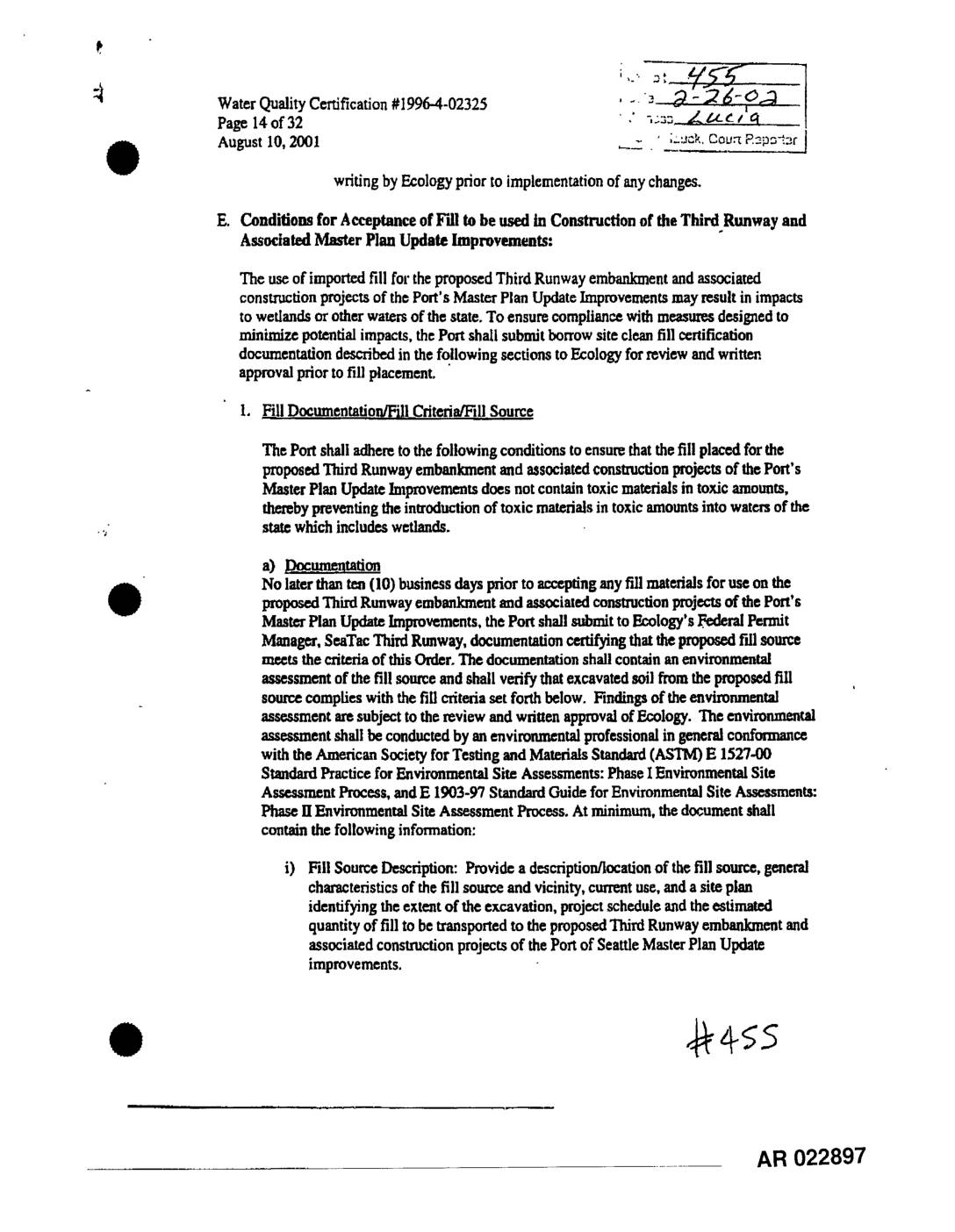
EXH 455: Water Quality Cert #1996-4-02325 Fill Acceptance Conditions Third Runway Embankment pp.14–16
This document outlines Washington State Department of Ecology conditions for accepting imported fill material used in construction of Sea-Tac Airport's Third Runway and associated Master Plan improvements. It requires the Port of Seattle to submit environmental assessments of fill sources — including records reviews, site reconnaissance, and soil sampling for hazardous substances such as arsenic, lead, and mercury — at least ten business days before placing any fill. Specific contamination limits (e.g., arsenic at 20 mg/kg, lead at 220/250 mg/kg) and minimum sampling schedules based on fill volume are established to prevent toxic materials from entering state waters and wetlands. -
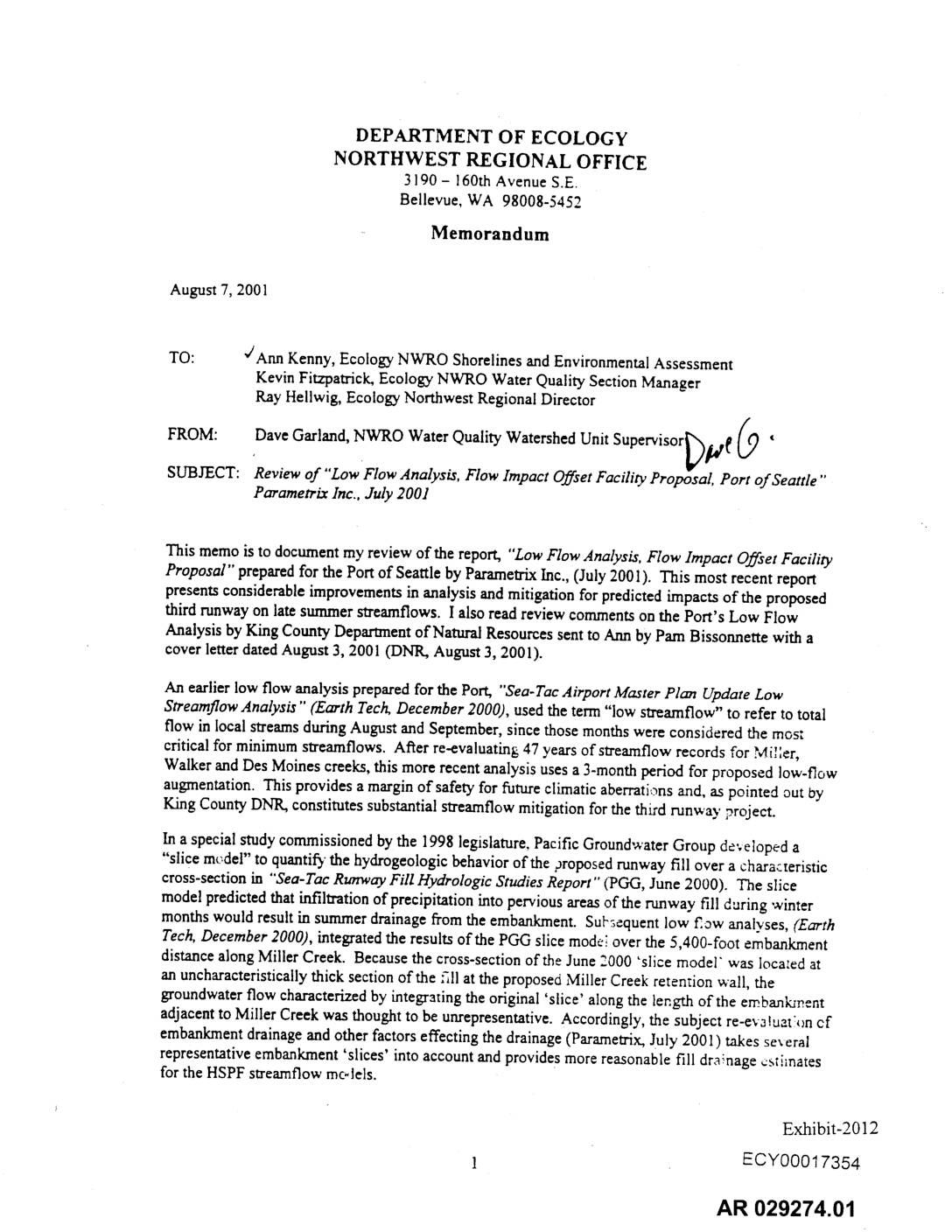 2001-08-07
Exhibit 2012: Ecology Memorandum — Review of “Low Flow Analysis, Flow Impact Offset Facility Proposal, Port Of Seattle” by Parametrix Inc., July 2001
Memorandum dated August 7, 2001 from Dave Garland, NWRO Water Quality Watershed Unit Supervisor, Washington State Department of Ecology, to Ann Kenny, Kevin Fitzpatrick, and Ray Hellwig, reviewing Parametrix Inc.’s July 2001 “Low Flow Analysis, Flow Impact Offset Facility Proposal” prepared for the Port Of Seattle regarding the proposed third runway at Sea-Tac Airport. Reviews -
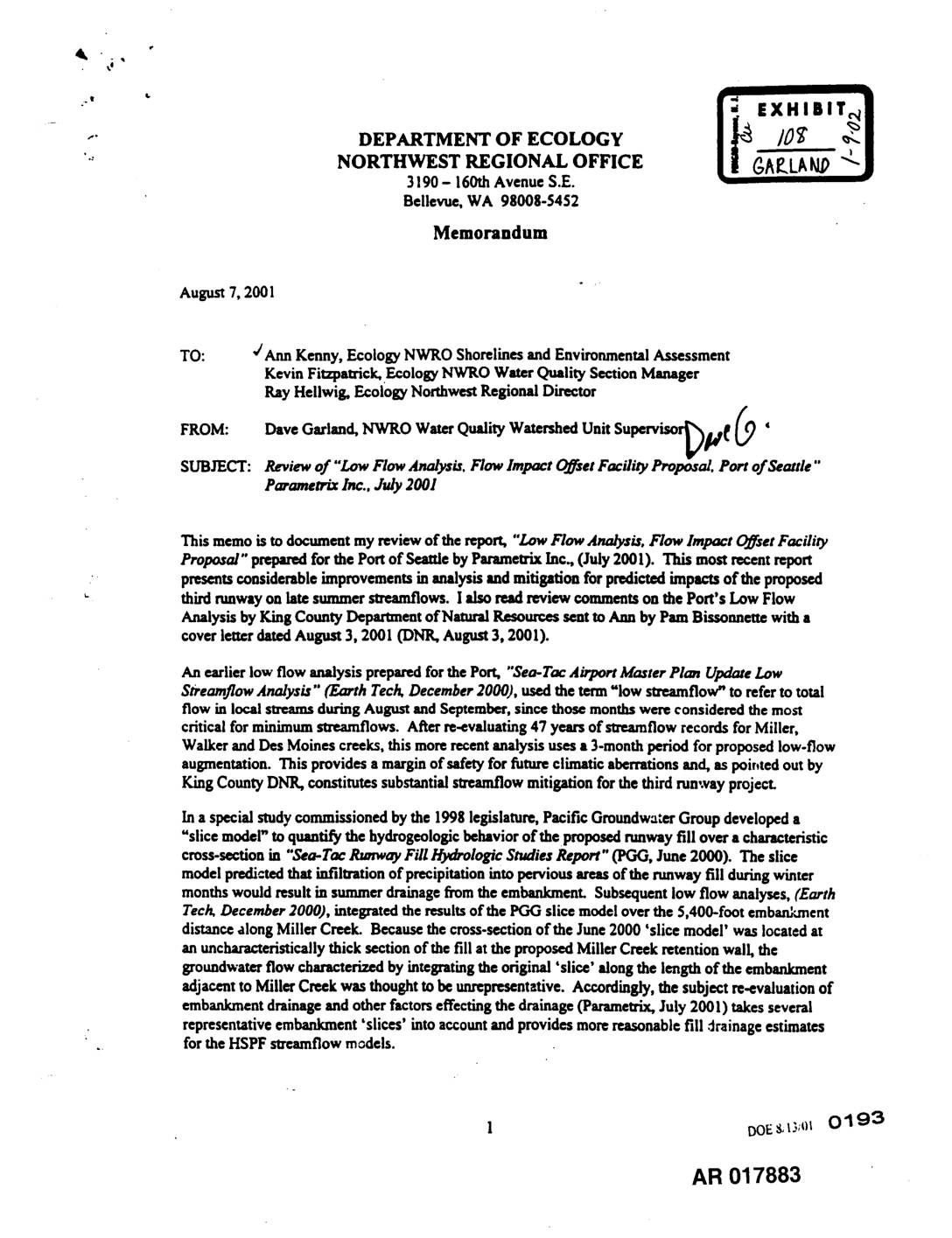 2001-08-07
Exhibit 108: Ecology NWRO Memorandum — Review of Low Flow Analysis, Flow Impact Offset Facility Proposal, Port Of Seattle (Parametrix Inc., July 2001)
Memorandum dated August 7, 2001 from Dave Garland, NWRO Water Quality Watershed Unit Supervisor, to Ann Kenny, Kevin Fitzpatrick, and Ray Hellwig of the Washington State Department of Ecology Northwest Regional Office. Reviews the Parametrix Inc. July 2001 report ‘Low Flow Analysis, Flow Impact Offset Facility Proposal’ prepared for Port Of Seattle regarding predicted impacts -
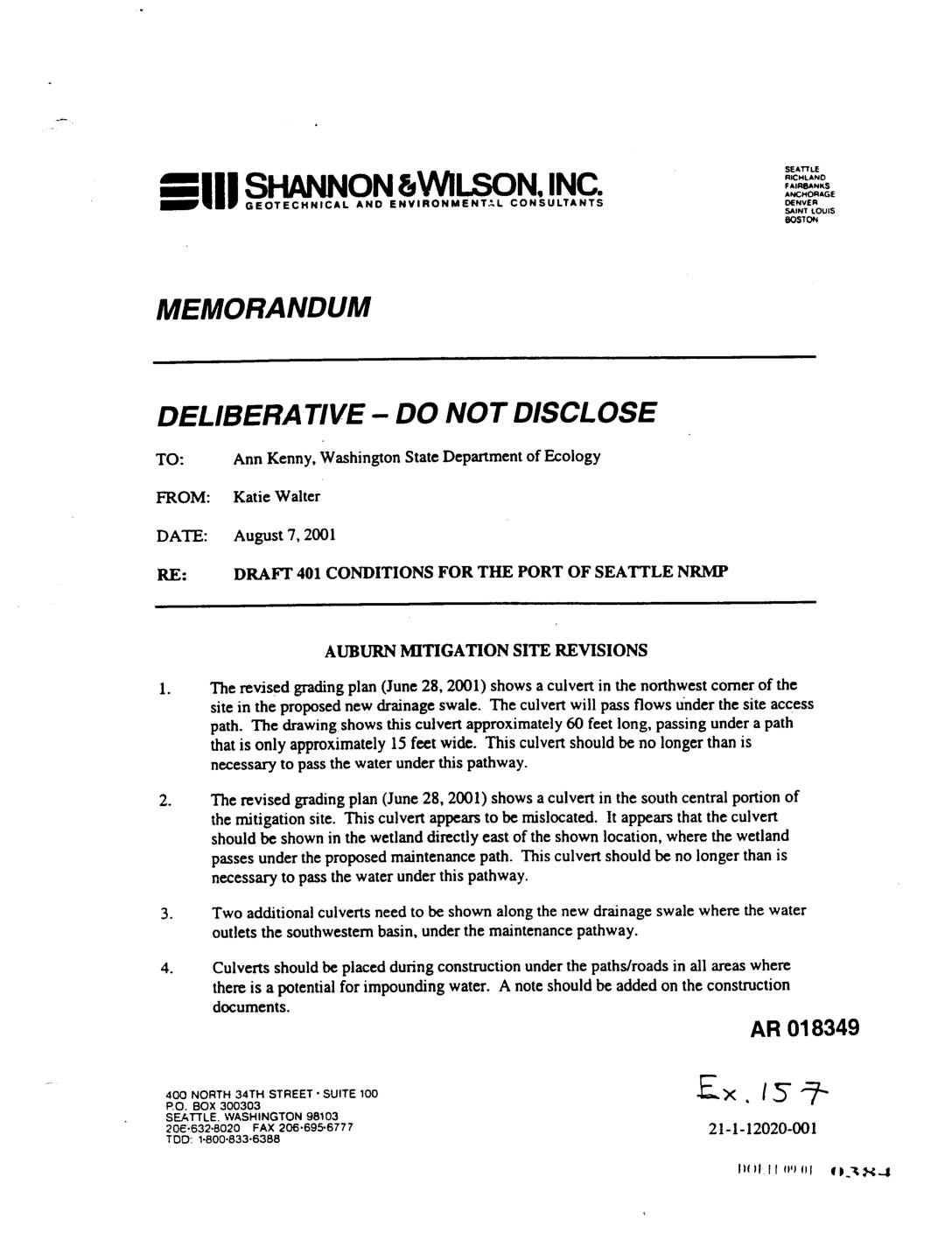 2001-08-07
Exhibit 157: Draft 401 Conditions for Port Of Seattle NRMP — Auburn Mitigation Site Revisions and Performance Standards
Memorandum dated August 7, 2001, from Katie Walter (Shannon & Wilson, Inc.) to Ann Kenny (Washington State Department of Ecology) regarding draft 401 conditions for the Port Of Seattle Natural Resource Mitigation Plan (NRMP), marked Deliberative — Do Not Disclose. Covers Auburn mitigation site culvert placement issues from the June 28, 2001 revised grading plan, -
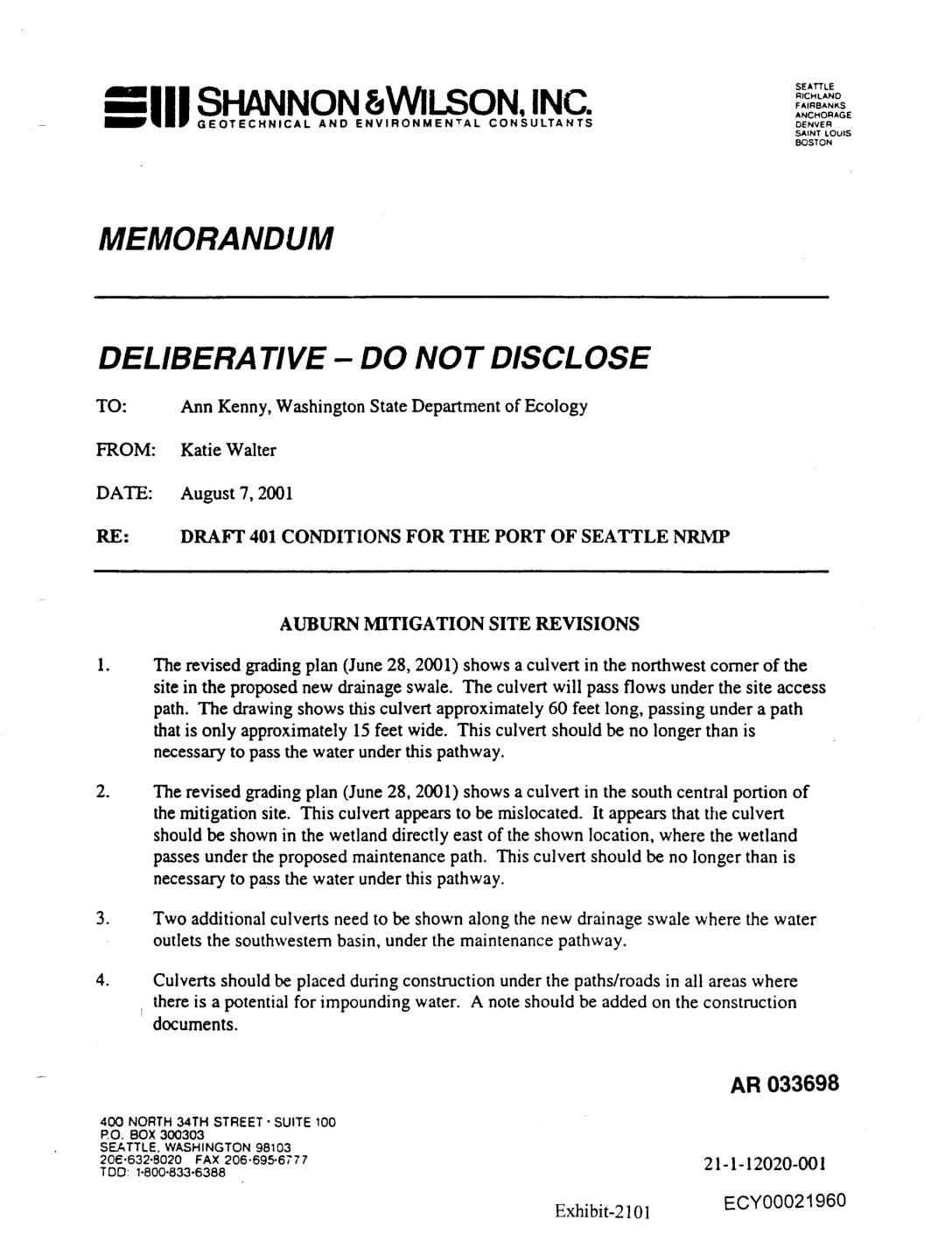 2001-08-07
Exhibit 2101 (AR 033698): Draft 401 Conditions for the Port Of Seattle NRMP — Auburn Mitigation Site Revisions and Performance Standards
Memorandum dated August 7, 2001, from Katie Walter (Shannon & Wilson, Inc.) to Ann Kenny (Washington State Department of Ecology), marked ‘Deliberative – Do Not Disclose,’ regarding draft 401 conditions for the Port Of Seattle Natural Resources Mitigation Plan (NRMP), Auburn Mitigation Site. Document addresses culvert placement issues in the revised grading plan (June 28, -
 2001-08-06
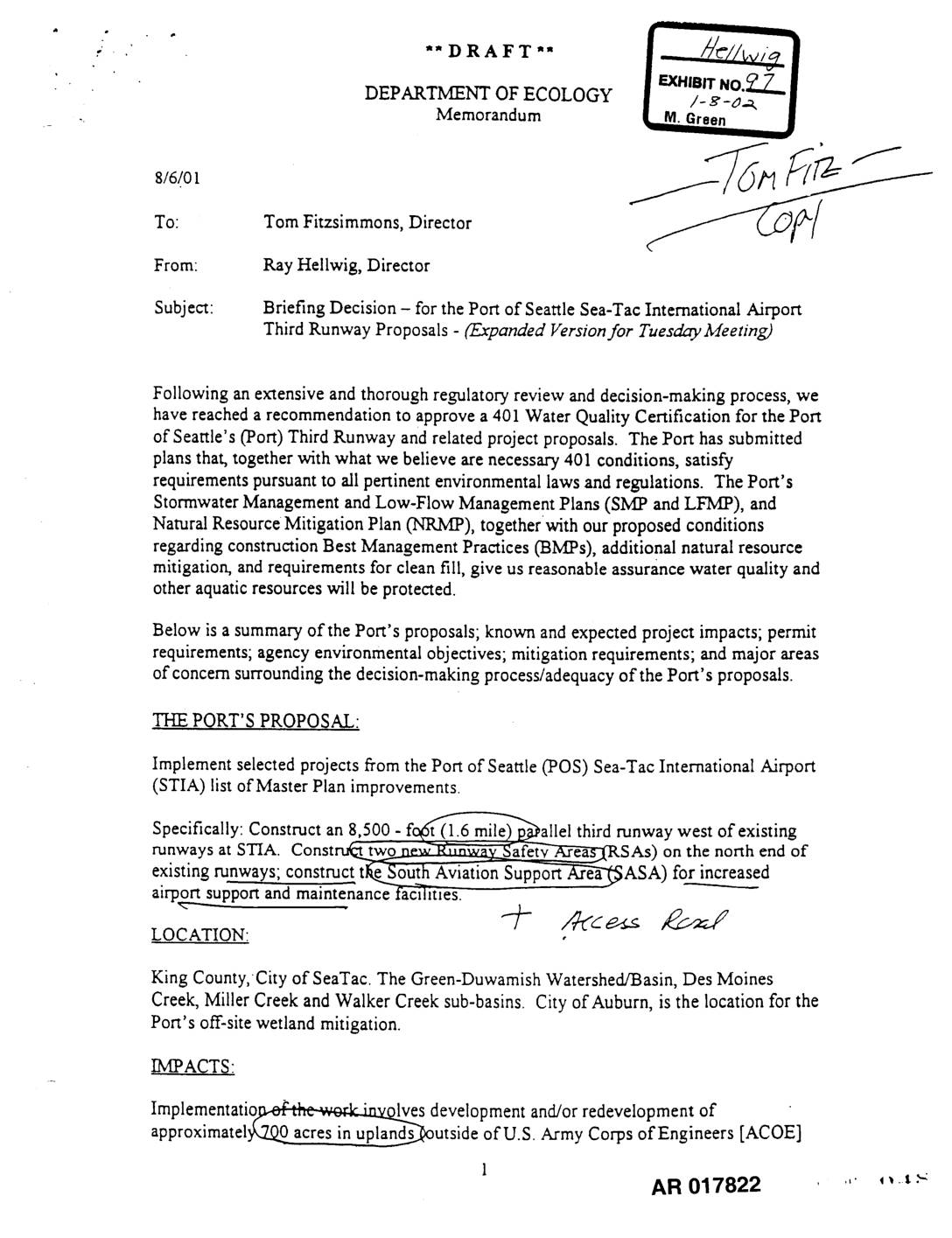
EXH AR017822: Ecology Draft Memorandum — Briefing Decision on Port Of Seattle Sea-Tac Third Runway 401 Water Quality Certification
Draft memorandum dated 8/6/01 from Ray Hellwig, Director, Washington State Department of Ecology, to Tom Fitzsimmons, Director, recommending approval of a 401 Water Quality Certification for the Port Of Seattle’s Sea-Tac International Airport Third Runway project. Document covers 8,500-foot parallel third runway, Runway Safety Areas (RSAs), South Aviation Support Area (SASA), impacts to approximately 700 -
 2001-08-06
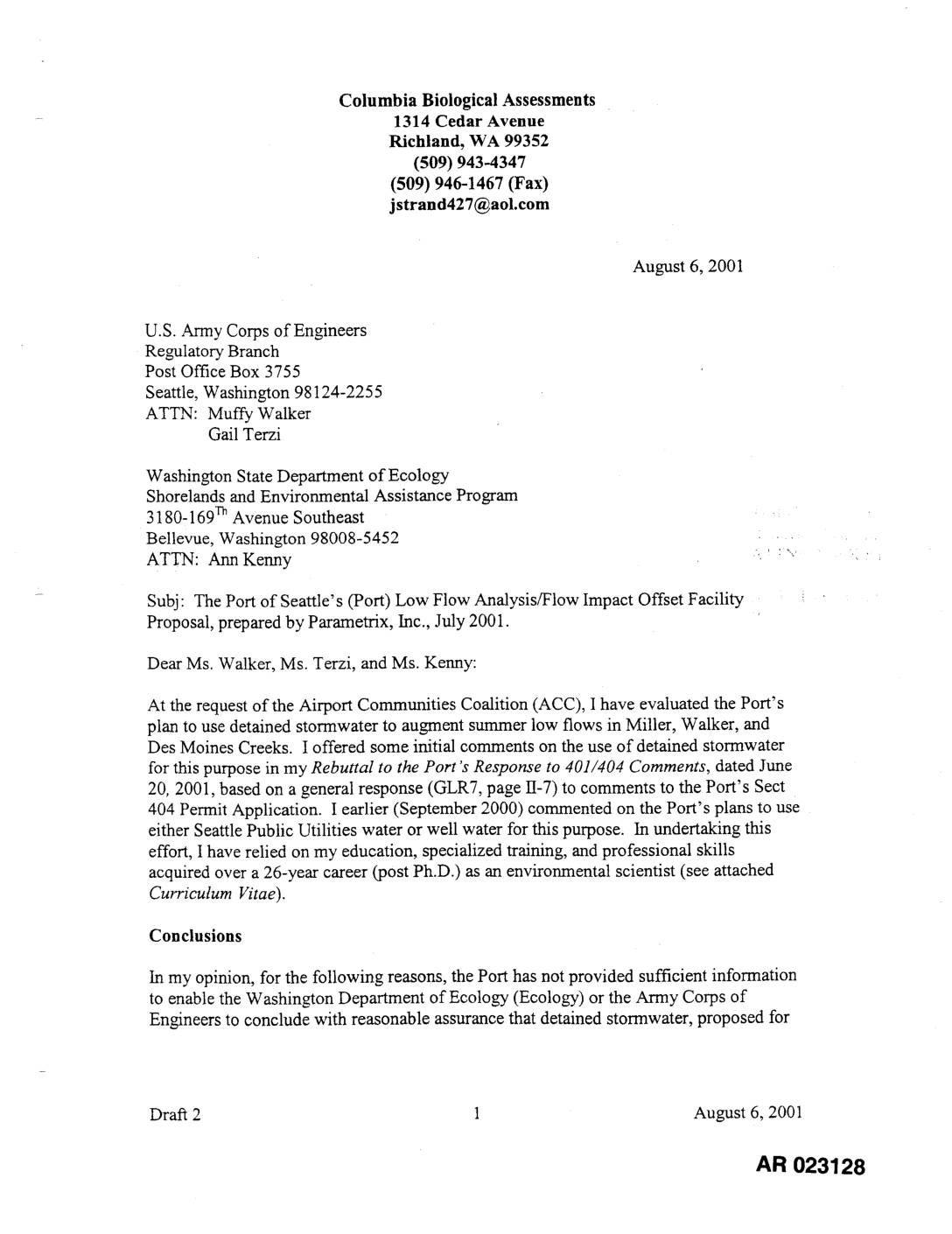
EXH AR023128: Letter from Columbia Biological Assessments to Army Corps of Engineers and Ecology re Port Of Seattle Low Flow Analysis/Flow Impact Offset Facility Proposal
A biological scientist hired by the Airport Communities Coalition reviewed the Port of Seattle's plan to store airport stormwater in detention vaults and release it into Miller, Walker, and Des Moines Creeks during summer low-flow periods. The review found that the plan could worsen water quality in those creeks, because stored sediments may release toxic levels of copper and zinc, and potentially harbor human pathogens from airplane wastewater. The scientist concluded that regulators lacked sufficient information to approve the proposal without further testing, modeling, and independent scientific review.