Skip to content
  • STNI
  • Statistics
    • Ops and Passengers
      • King County International Airport (Boeing Field) Annual Operations
    • Financials
    • Aviation fuel uplift in the State of Washington 2018 – 2025
      • Aviation Fuel Uplift at Sea-Tac Airport
    • Air Quality Monitoring
    • Flight Tracking
      • Flow and Flight Tracks
      • Five Year Comparison
      • Busiest Hours and Days
    • SEL Noise Reports & Graphs
      • About The Permanent Noise Monitors
      • Minutes of Quiet by Noise Monitor
      • Noise Events mapped
      • Noise Events (SEL)
    • Runways
    • Employees
    • Real Estate
      • Port Properties and Trees mapped
    • Parking
  • Events
  • Protest
    • Regular Events
    • Legislation 2026
    • Complain about a particular flight
    • Advocacy Organizations
    • Media Outlets
    • People
    • The Port of Seattle
      • Commission Meetings
      • Public Records Requests
      • StART
      • Highline Forum
    • Contact Your Electeds
  • Resources
    • FAQs
      • FAA Occurrences/Accidents/Indents
    • The unSustainable Airport Master Plan
      • SAMP Public Comment Template
        • Two versions of Appendix K: NEPA/SEPA 2018 vs 2023
      • SAMP NTP: 31 projects by the numbers
      • SEPA Draft EIS (2026)
      • SAMP Record of Decision/FONSI (2025)
      • SAMP Draft EA (October 2024)
      • 2018 Scoping
    • Port Packages
      • Port Package Property Costs
      • Port Packages mapped
      • The Port Package Explainer
      • So you want a (first-time) Port Package? Start here
      • Port Package Looker Upper
      • How do I determine if I have a Port Package or Avigation Easement?
      • Progress on Port Package Update legislation
      • Having a Port Package Problem?
      • Port Package Site Visit Follow-Up
    • Document Library
    • Explainers
      • The Airport Law Cheat Sheet
      • The Grant Explainer
    • External Articles
    • History
      • Timeline
      • The Sea-Tac Communities Plan
        • Sea-Tac Communities Plan – Planning Maps
      • PSRC Third Runway Decision Process
    • Studies
    • Videos
  • Stories
  • Mission
  • Subscribe
  • Contact
Scroll down to content

Get InformedStay Informedx

I understand that you will never share my information with anyone, you will only use it to keep me updated on relevant events and that I may unsubscribe at any time.

STNI

STNISea-Tac Noise.Info

  • Solve for Sea-Tac. Solve for every airport.
  • Since 2016, working to obtain justice for everyone living under the flight path.
  • Less Noise. Cleaner Air. Better Public Health. Compensation.
  • Everything you think you know about the airport is wrong.

TagWater Quality(478)

Advanced Search Options

  • Dates
  • Media
    • External Articles
    • Images
    • PDFs
    • Video
    • Audio
  • Order By
  • 2002-02-13

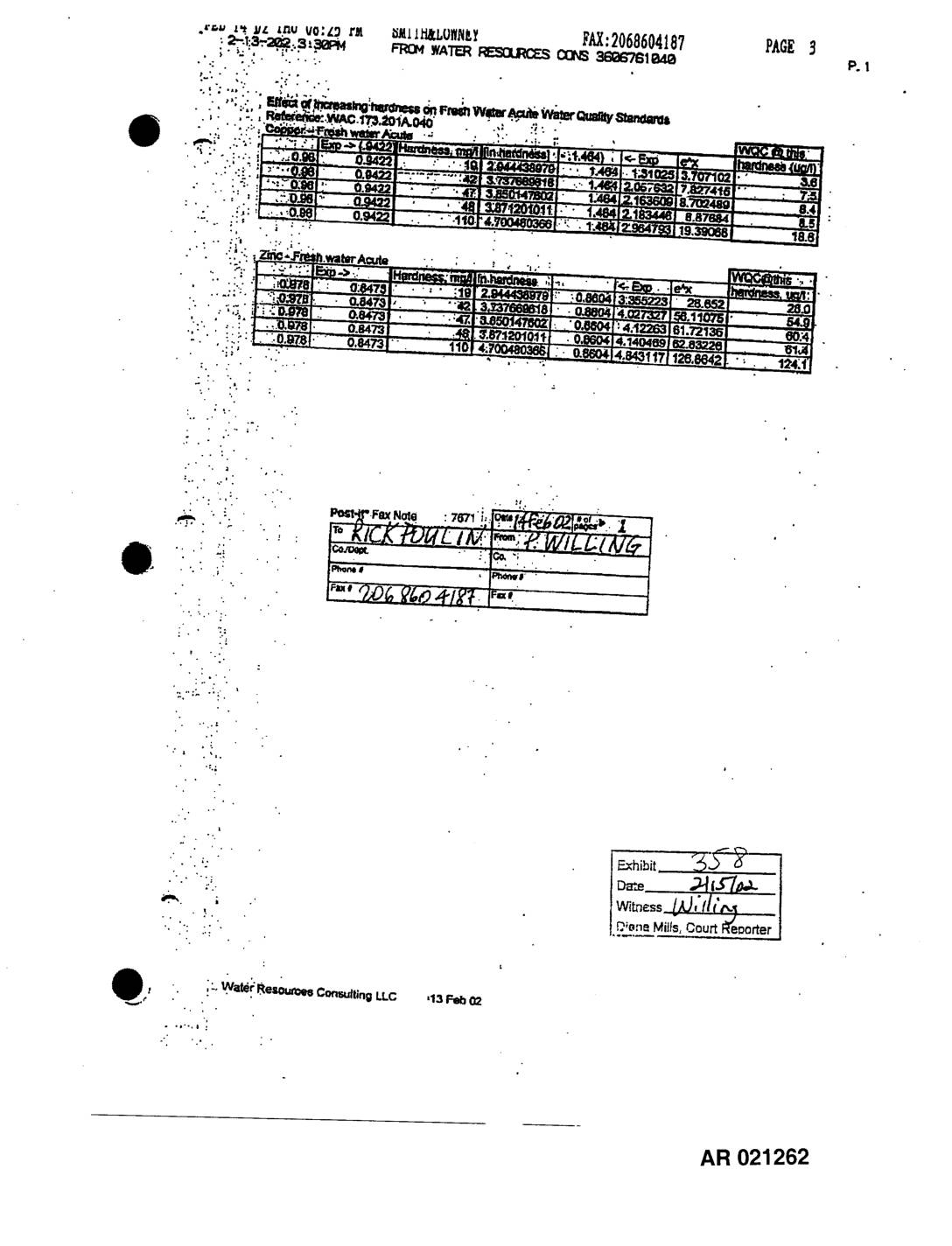
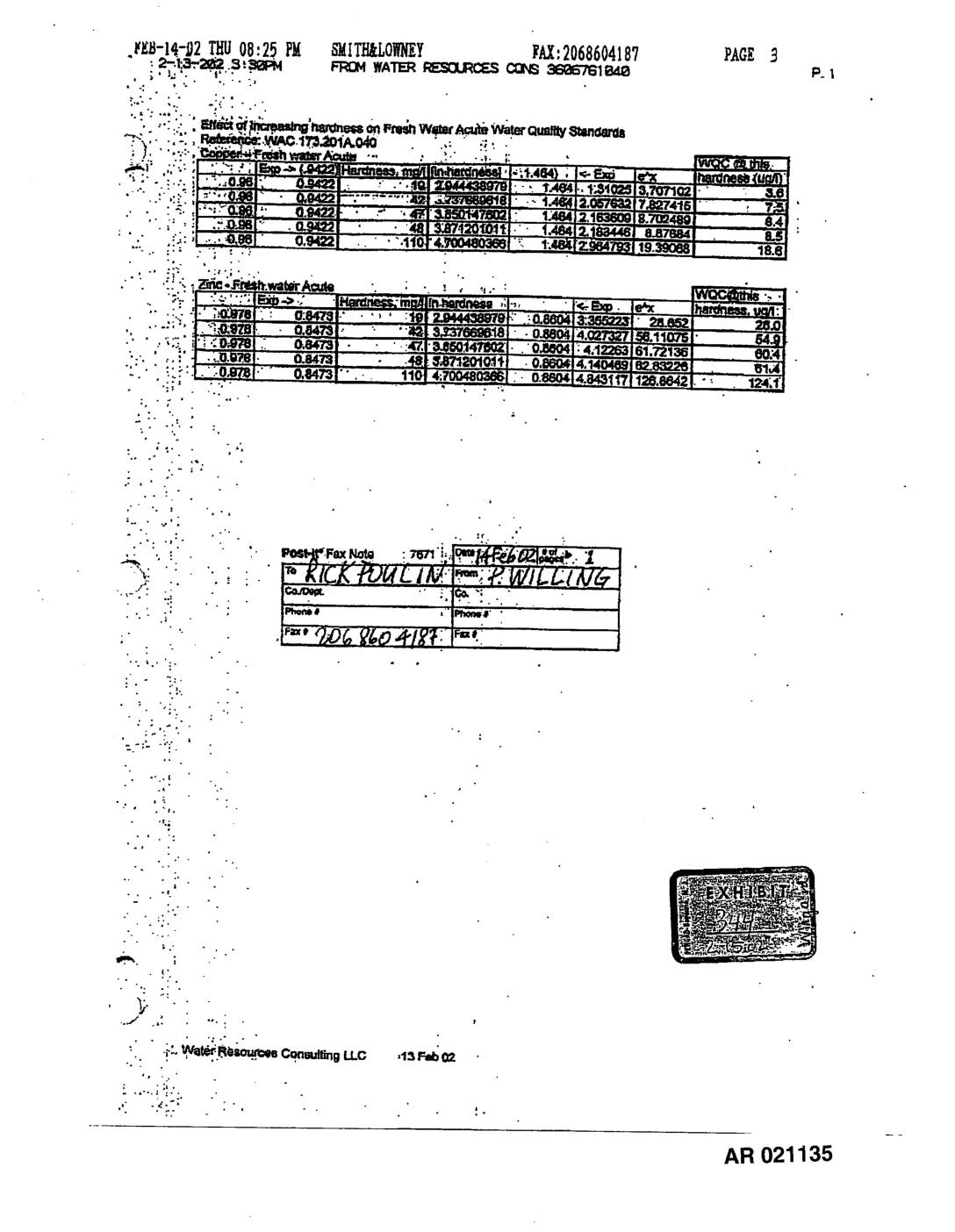
    EXH 358: Increasing Hardness Effect on Freshwater Acute WQ Standards — Copper & Zinc, WAC 173.201A.040

    This document is a February 2002 fax from Water Resources Consulting LLC addressing the effect of increasing water hardness on fresh water acute water quality standards, referencing WAC 173.201A.040. It contains tables calculating acute water quality standards for copper and zinc at varying hardness levels in fresh water. The document appears to be part of an administrative record (AR 021262) and was transmitted between consultants, though its connection to Sea-Tac Airport noise policy is not evident from the content.
    TagsACC, PCHB, Pollution Control Hearings Board, Third Runway, WAC, Water Quality
  • 2002-02-11

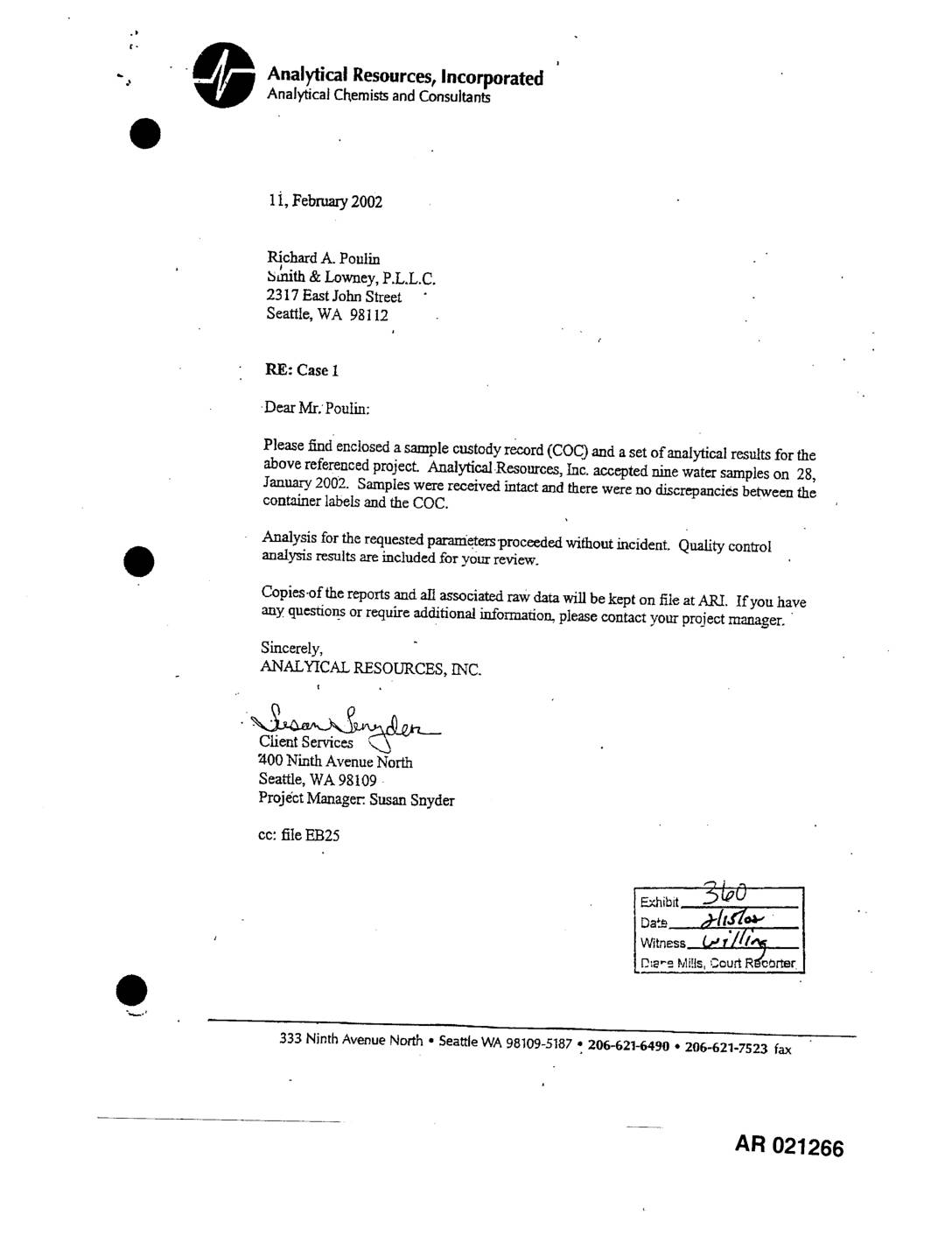
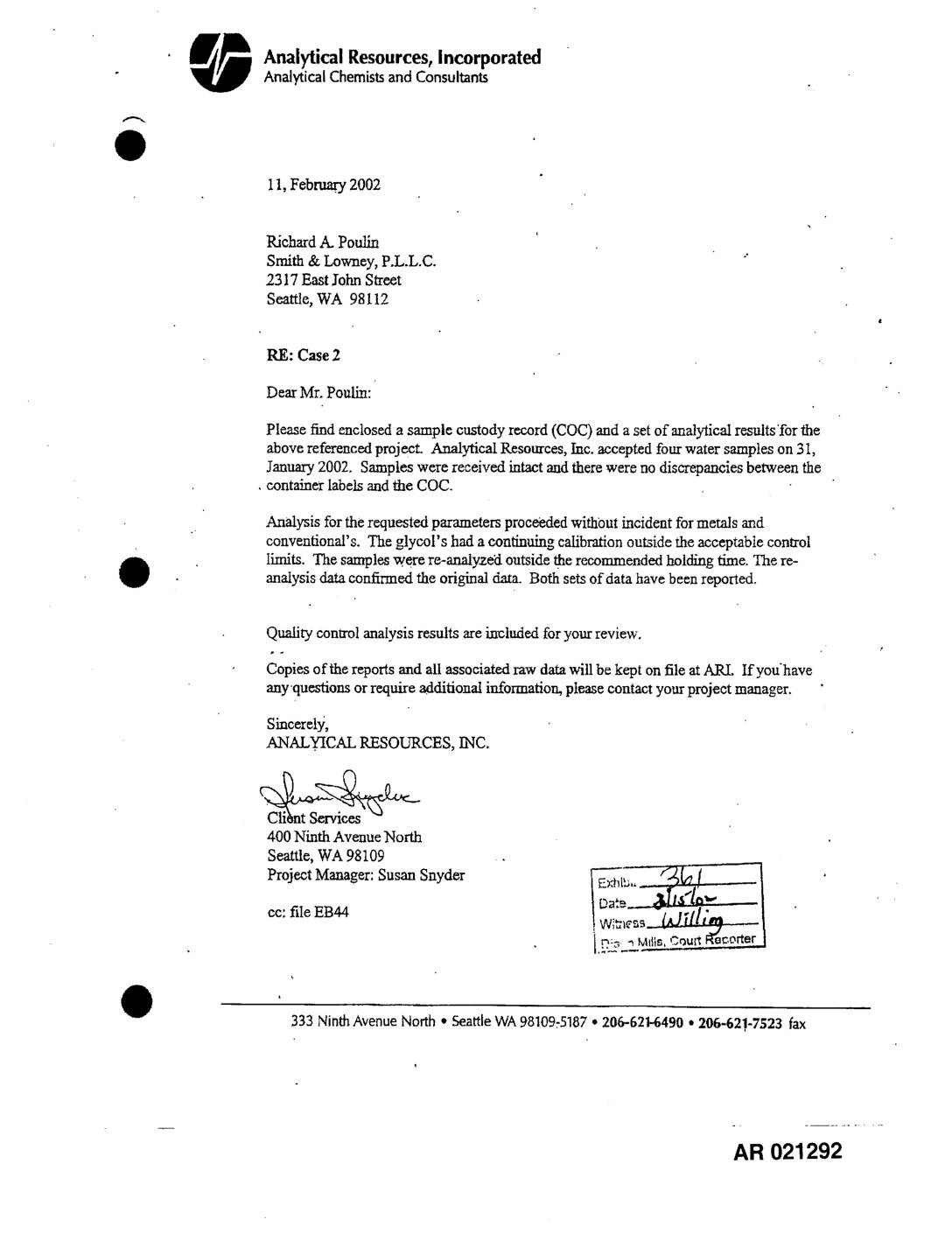
    EXH 360: Analytical Resources Inc. Chain of Custody & Glycols Analysis CASE 1 Water Samples Jan–Feb 2002

    Analytical Resources, Inc. submitted water sample analysis results to attorney Richard Poulin of Smith & Lowney law firm in February 2002 for a matter identified as Case 1. Nine water samples were collected on January 28, 2002 and tested for ethylene glycol and propylene glycol, with neither compound detected above the 5.0 mg/L detection limit. The chain of custody record shows samples were collected by Greg Wingard of CASE and received by ARI laboratory staff for quality-controlled analysis.
    TagsACC, CASE, Ethylene Gycol, PCHB, Pollution Control Hearings Board, Third Runway, Water Quality
  • 2002-02-11

    EXH AR021292: Analytical Resources Inc. Letter to Smith & Lowney — CASE Water Sample Analysis Results, EB44

    A February 2002 analytical laboratory report from Analytical Resources, Inc. to Seattle law firm Smith & Lowney, documenting water sample testing results for a project referenced as Case 2. Four water samples were collected on January 31, 2002, and analyzed for metals, conventional parameters, and glycols, with the glycol analysis requiring re-testing due to calibration issues outside acceptable control limits. The results showed no detectable levels of ethylene glycol or propylene glycol above the 5.0 mg/L detection limit.
    TagsACC, CASE, Ethylene Gycol, Pollution Control Hearings Board, Water Quality
  • 2002-02-11

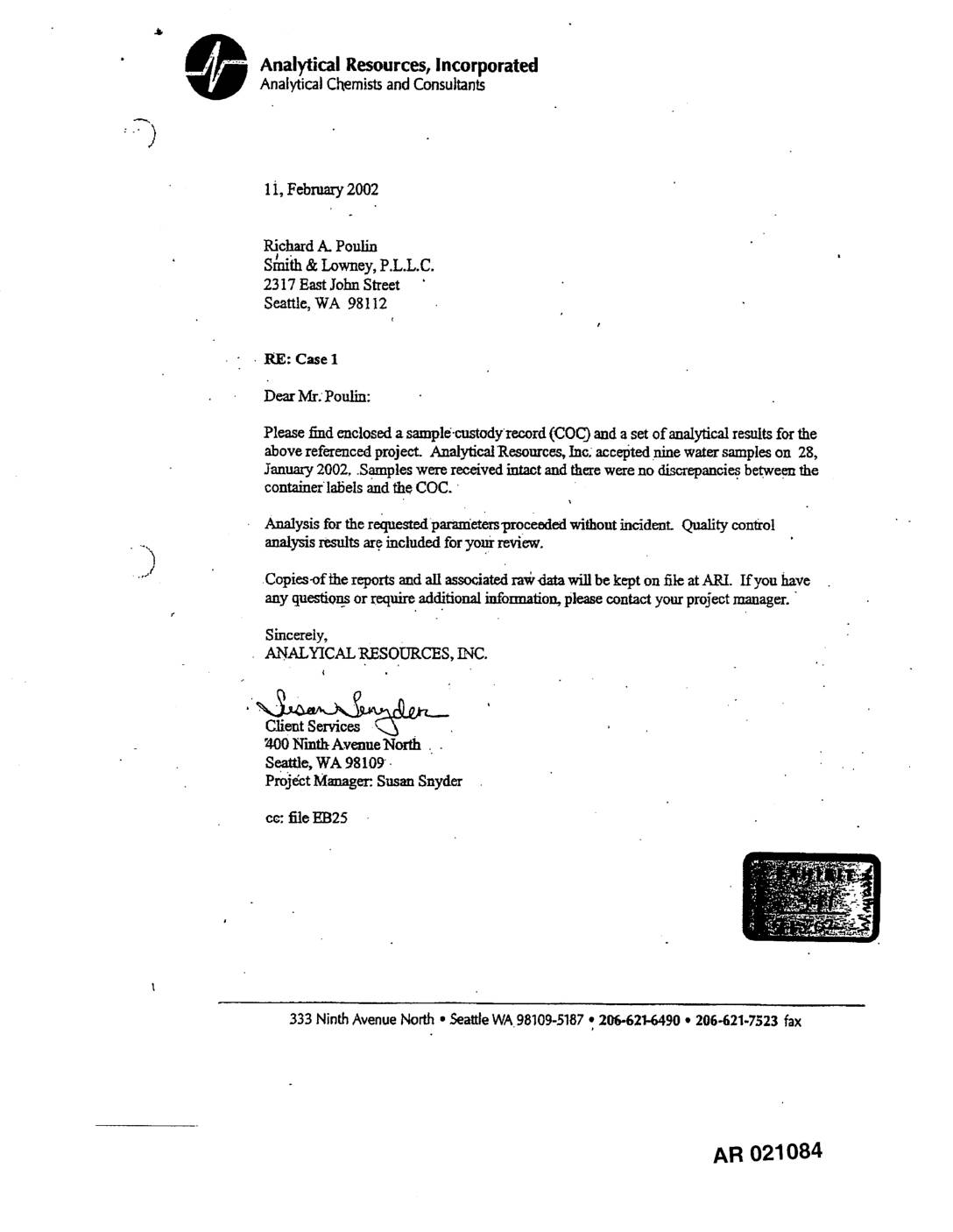
    EXH AR021084: Analytical Resources Inc. Cover Letter & Chain of Custody — CASE 1 Water Sample (Glycols, Metals, TSS)

    A February 2002 letter from Analytical Resources, Inc. to attorney Richard Poulin of Smith & Lowney, P.L.L.C. transmits laboratory analytical results for nine water samples accepted on January 28, 2002, under Case 1. The samples were received intact with no discrepancies noted on the chain of custody record, and analysis for requested parameters including glycols, TSS, copper, zinc, and hardness proceeded without incident. Quality control results, including a method blank showing no detected ethylene or propylene glycol above 5.0 mg/L, are included in the report.
    TagsACC, CASE, Ethylene Gycol, PCHB, Pollution Control Hearings Board, Third Runway, Water Quality
  • 2002-02-11

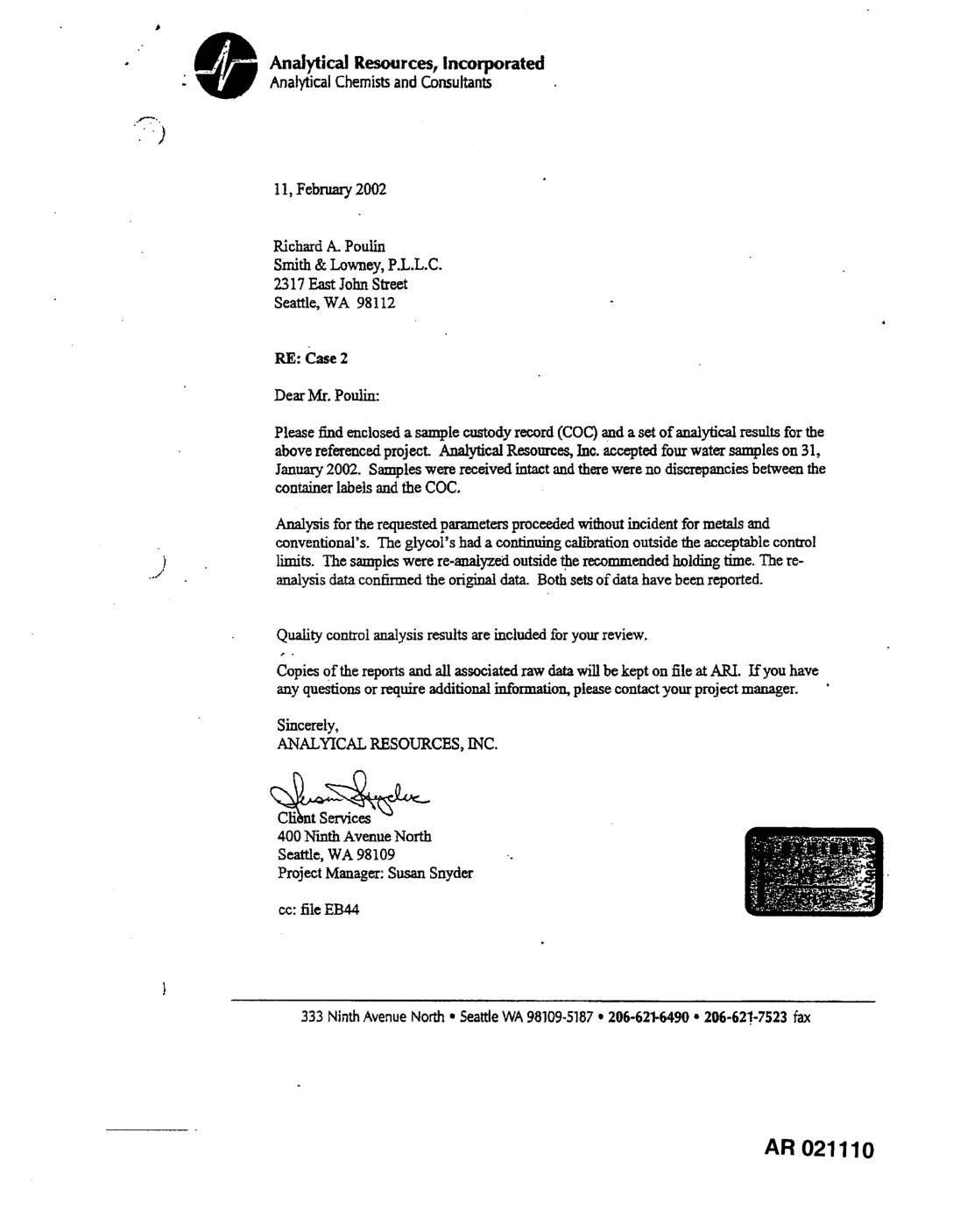
    EXH AR021110: Analytical Resources Inc. Cover Letter & Glycols Analysis Data, CASE Project EB44

    A February 2002 laboratory report from Analytical Resources, Inc. documents the analysis of four water samples submitted by the law firm Smith & Lowney, P.L.L.C. for a project identified as Case 2. The samples were tested for metals, conventional parameters, and glycols, with results showing no ethylene or propylene glycol detected above the 5.0 mg/L detection limit. A calibration issue with the glycol analysis required re-testing outside the standard holding time, though re-analysis confirmed the original findings.
    TagsACC, CASE, Ethylene Gycol, Pollution Control Hearings Board, Water Quality
  • 2002-02-08

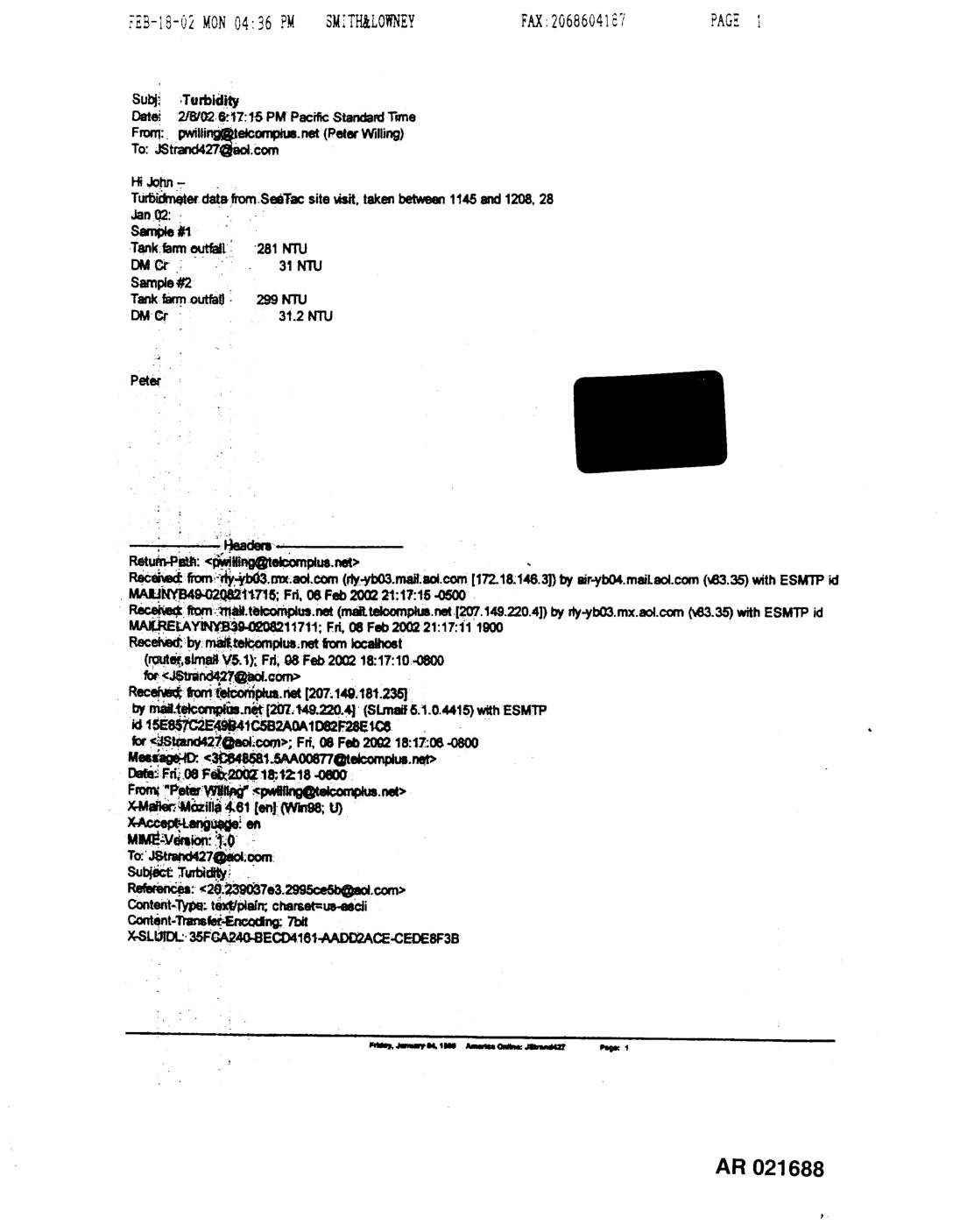
    EXH AR021688: Turbidity Data Email — Sea-Tac Tank Farm Outfall vs. DM Creek, Jan 28, 2002

    An email dated February 8, 2002, from Peter Willing to John Strand reports turbidity measurements taken during a site visit at Sea-Tac on January 28, 2002, between 11:45 and 12:08. Two samples were recorded: Sample #1 showed tank farm outfall at 281 NTU and DM Creek at 31 NTU, while Sample #2 showed tank farm outfall at 299 NTU and DM Creek at 31.2 NTU. The data indicates significantly elevated turbidity levels at the tank farm outfall compared to the creek reference point.
    TagsACC, Des Moines Creek, PCHB, Pollution Control Hearings Board, Sea-Tac Airport, Third Runway, Water Quality
  • 2002-02-07

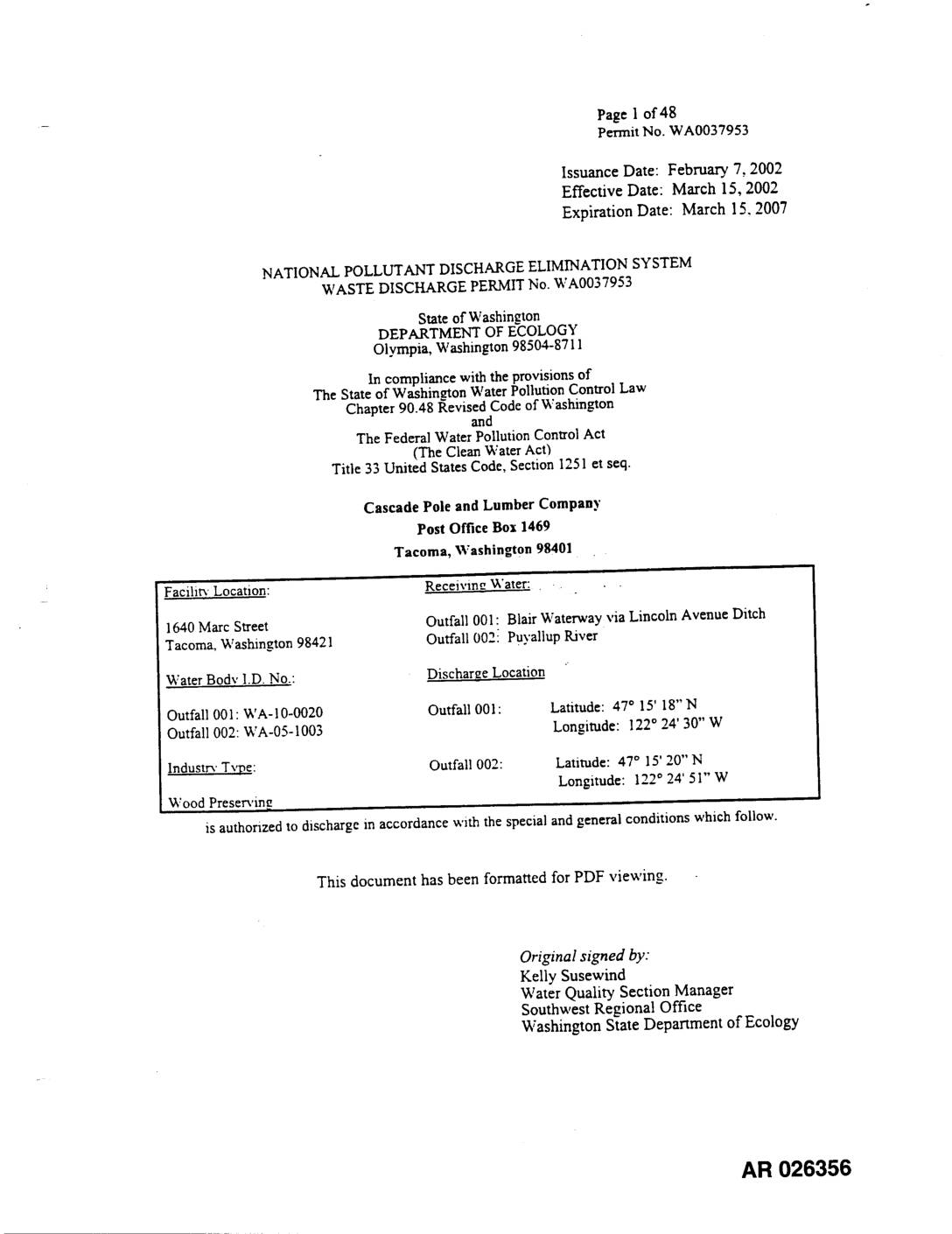
    EXH AR026356: NPDES Waste Discharge Permit WA0037953 — Cascade Pole & Lumber Co., Tacoma

    This is a National Pollutant Discharge Elimination System (NPDES) waste discharge permit issued by the Washington State Department of Ecology to Cascade Pole and Lumber Company, a wood preserving facility in Tacoma, Washington. The permit, valid from March 2002 to March 2007, authorizes the company to discharge treated stormwater and process wastewater into the Blair Waterway and Puyallup River, subject to strict discharge limits, monitoring requirements, and pollution prevention measures. Note: this document pertains to water quality regulation and does not contain information related to Sea-Tac Airport noise policy.
    TagsACC, City of Tacoma, Clean Water Act, Ecology, NPDES, PCHB, Pollution Control Hearings Board, Water Quality
  • 2002-02-06

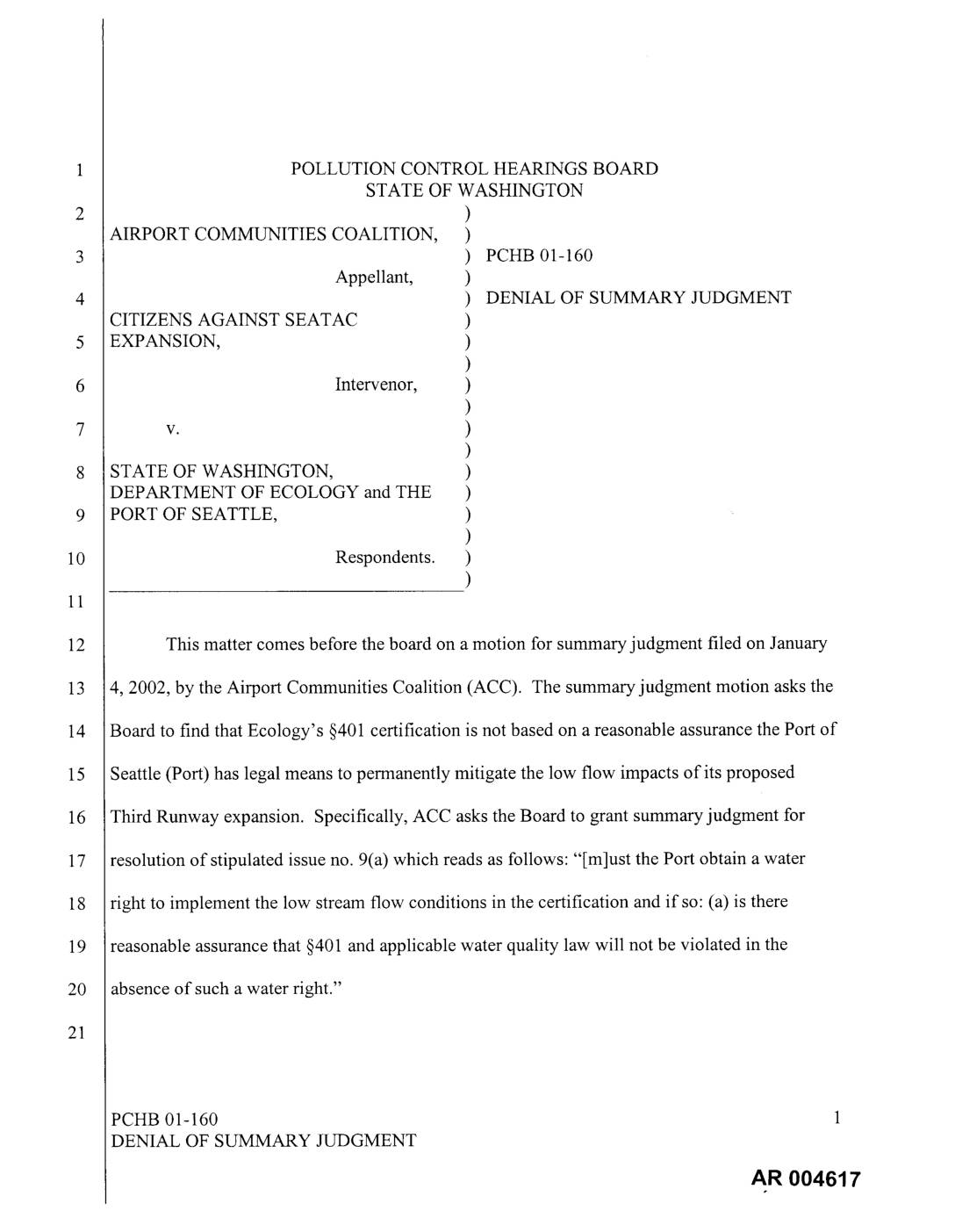
    PCHB Doc 01-160: Denial of Summary Judgment — ACC v. Ecology and Port Of Seattle (Water Right for Third Runway §401 Certification)

    Pollution Control Hearings Board (PCHB) case 01-160 denial of summary judgment filed by Airport Communities Coalition (ACC) against Washington State Department of Ecology and Port Of Seattle. ACC sought a ruling that Ecology’s §401 certification lacked reasonable assurance that Port Of Seattle had legal means to permanently mitigate low stream flow impacts of the Third
    TagsACC, Airport Communities Coalition, CASE, PCHB, Pollution Control Hearings Board, Third Runway, Water Quality
  • 2002-02-05

    EXH: AR019096 ACC First Supplemental Response to Request for Production No. 2 and Interrogatory No. 5

    This legal document is part of a Pollution Control Hearings Board case in which the Airport Communities Coalition (ACC) challenged the Port of Seattle and the Washington State Department of Ecology over environmental concerns related to Seattle-Tacoma International Airport. The document lists scientific references and studies relied upon by ACC's expert witnesses, covering topics such as the effects of airport deicing chemicals on water quality, dissolved oxygen levels in receiving streams, toxicity to aquatic life including salmon and trout, and fluoride impacts on fish. The referenced research was used to support ACC's claims about the environmental impact of airport operations on surrounding waterways and ecosystems.
    TagsACC, Airport Communities Coalition, Pollution Control Hearings Board, Port Of Seattle, Third Runway, Water Quality
  • 2002-02-05

    EXH AR027881: Ecology Letter to Port Of Seattle Denying Administrative Order for Lagoon #3 Bypass at STIA

    Letter dated February 5, 2002 from Hamid ‘Ed’ Abbasi, Environmental Engineer, Washington State Department of Ecology (NWRO) to Michael Feldman, Director of Aviation Facilities & Environmental Programs, Seattle-Tacoma International Airport. Ecology denies the Port Of Seattle’s request for an Administrative Order to bypass the industrial waste treatment system at Lagoon #3 under NPDES Permit WA-002465-1,
    TagsACC, Ecology, NPDES, Pollution Control Hearings Board, Port Of Seattle, Sea-Tac Airport, Water Quality

Posts pagination

Page 1 … Page 10 Page 11 Page 12 Page 13 Page 14 … Page 48
Sidebar On/Off

Upcoming Events

  • StART SEA Stakeholder Advisory Round Table
    Add to CalendarMWednesday Aug 26, 5:00pm - 7:00pm
    Zoom (Virtual Meeting)
    START meetingagenda 2026826 final 0 pdf

    Meeting Objectives Introduce the primary feedback themes identified by StART members regarding StART’s Operating Procedures and determine areas that may warrant future discussion. 5:00 PM – Welcome Meeting Management Welcome Lead: Andrés Mantilla, Facilitator, Uncommon Bridges; Wendy Reiter, Airport Managing Director, POS 5:15 PM – Dinner: All participants eat. 5:30 PM – StART Operating Procedures

    [...]
  • Commercial Aviation Work Group
    Add to CalendarMThursday Sep 3, 10:00am - 1:30pm
    Virtual Meeting (Zoom)
    Cawg agenda sep 3 26 virtual pdf

    Meeting Agenda 10:00 a.m. – 10:15 a.m. | Welcome – Evan Nordby, Chair a. Introductions and Agenda Reviewb. Status of appointments and non-voting member invitationsc. Other updates as necessary 10:15 a.m. – 11:00 a.m. | Is it practical and legal to operate the western Washington [Puget Sound] airports as a single airport system? – Consultant

    [...]

[See all...]


Help study childhood asthma. Get free HEPA filter!

read more...

Issues

Sea-Tac Airport is currently undergoing the largest and longest expansion in its history, collectively known as the Sustainable Airport Master Plan (SAMP). Some of it you can already hear, but you’re probably not aware of what it all means. Here’s what you need to know.
read more...

Read This!

As the source for federal transportation grants, the Puget Sound Regional Council was charged with developing a system to meet the growing need for commercial aviation. When the search for a second airport failed, they authorized the Port of Seattle to build the Third Runway, with a mandate to develop a noise abatement and mitigation program. In their effort to stop the Third Runway, the ACC argued over every detail of the Port's efforts--including property buyouts and sound insulation. The dispute was meant to be settled by a three member Expert Arbitration Panel. This is their final report. It finds 2-1, that the Port's program was insufficient in several respects. Despite that, funding for the Third Runway was approved by the PSRC, and the 'Port Package' program, proceeded largely unchanged. Expert Arbitration Panel's final decision finding that the Port of Seattle had not shown sufficient reduction in real on-the-ground noise impacts to satisfy noise reduction conditions required for approval of a third runway at Sea-Tac International Airport. The majority decision concluded the Port's noise abatement programs were insufficient despite being impressive in scope.
continue...

The Podcast!

Subscribe to the only podcast devoted to policies, politics, history, impacts for people living under the flight path everywhere. It’s definitely not just about noise!
  • Sea-Tac Noise.Info
  • Connect with STNI

    • Subscribe
    • Port Package Problem?
    • Donate
    • Podcast
    • Socials
      • Facebook
      • X (Twitter)
      • Bluesky
      • Instagram

    "Greater Highline Community Parks Board: Purpose, Plan for Park Development, and History of North Sea-Tac Park" — , 2022

  • Learn

    • Frequently Asked Questions
    • Explainers
    • Youtube
    • Research Requests
    • Make a complaint
  • Goals

    Fulfill the promises of 1976:
    • Compensation
    • Reduced noise
    • Improved air quality
    • Environmental remediation
Login/Register
©2026•Data Privacy

Message

We use cookies to provide basic functionality. We also provide access to search engines in order to provide site analytics. We do not sell or share your data.
V V