TagStART(508)
-
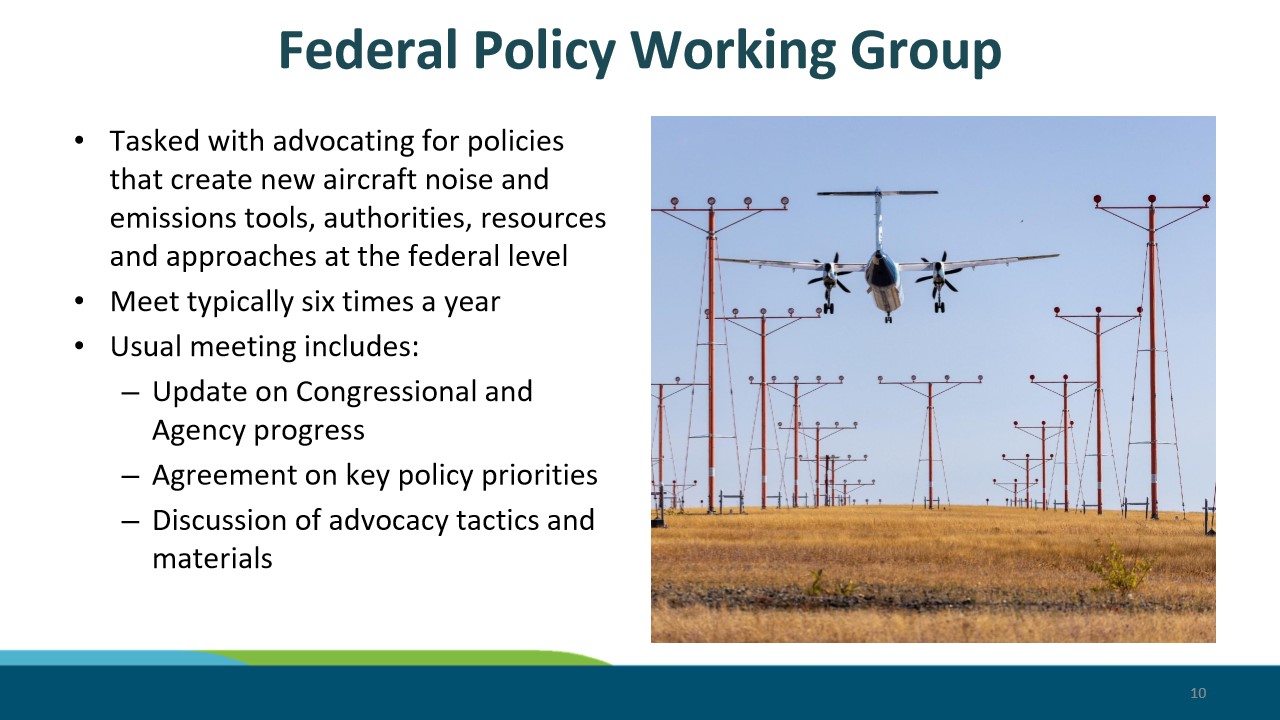
StART Overview — Federal Policy Working Group — Slide 10
Presentation slide titled 'Federal Policy Working Group' describing a group tasked with advocating for federal policies on aircraft noise and emissions tools. The slide details that the group meets six times per year and covers Congressional/Agency updates, key policy priorities, and advocacy tactics; accompanied by a photo of a twin-turboprop aircraft on approach over instrument landing system antenna arrays. -
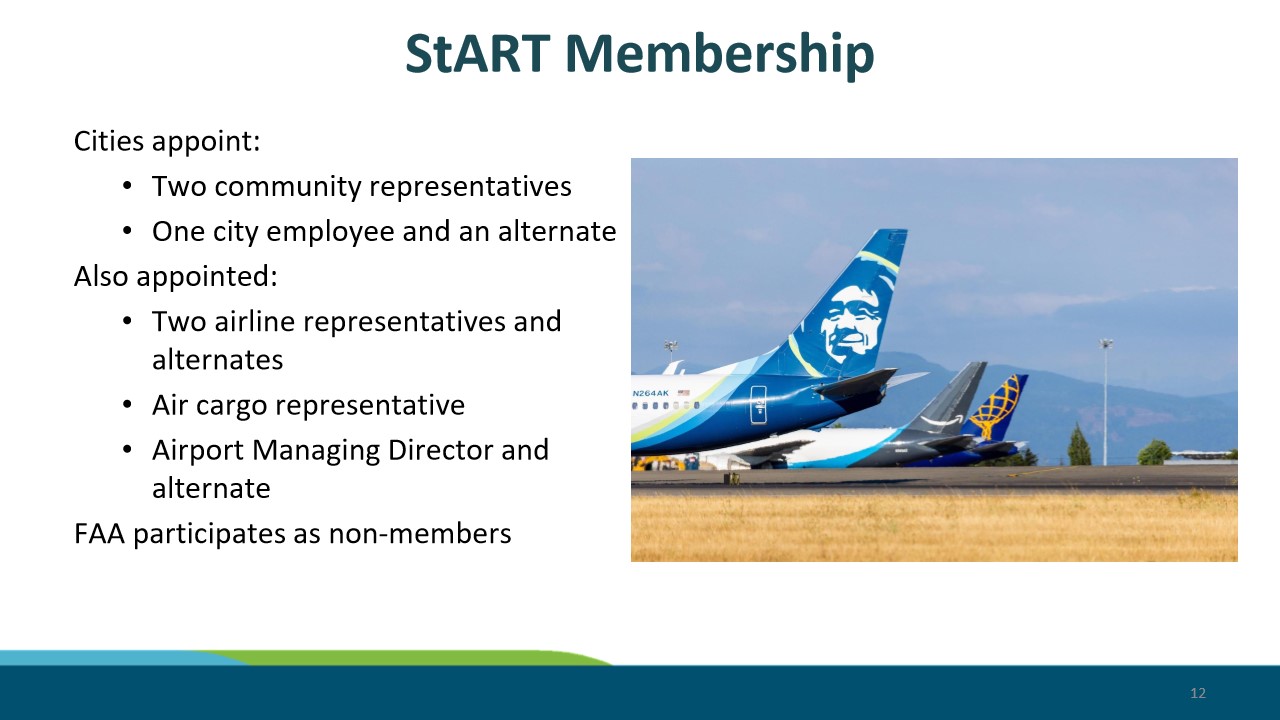
2-28 StART Meeting – StART Overview PowerPoint 12
Slide 12 of a presentation on StART (Stakeholder Advisory Round Table) membership, detailing that cities appoint two community representatives and one city employee plus alternate, while airlines, air cargo, and the Airport Managing Director also hold seats. The FAA participates as a non-member; the photo shows an Alaska Airlines aircraft (tail number N264AK) and an Amazon Air aircraft on the tarmac, consistent with Sea-Tac Airport operations. -
StART Overview — Full StART Meeting Format and Procedures (Slide 11)
This presentation slide describes the format of Full StART (Sea-Tac Airport Roundtable) meetings, noting they convene approximately six times per year, are not governed by the Open Public Meetings Act, allow public observation and comment, and reserve all interactions and questions for StART members. No official audio or video recordings are made, but meeting summaries are made available. -
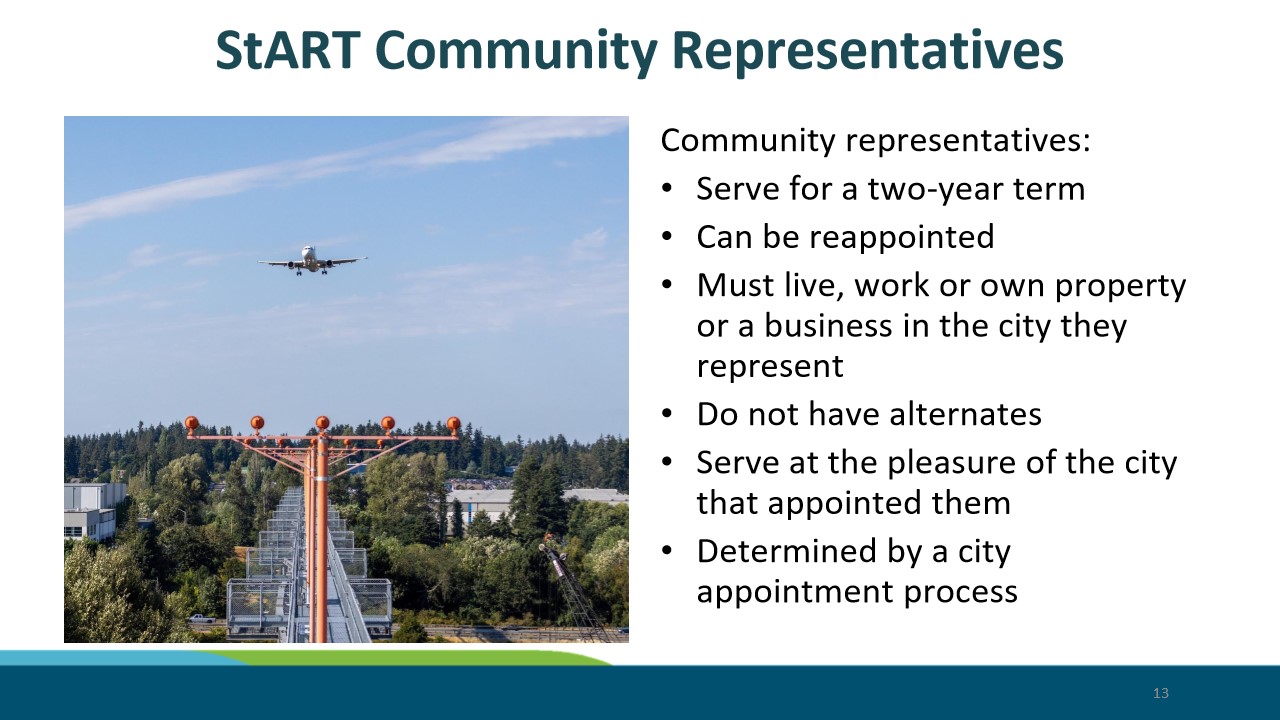
StART Overview Presentation — Community Representatives Eligibility and Appointment Rules (Slide 13)
Presentation slide titled 'StART Community Representatives' outlining eligibility and appointment rules for community representatives on the Sea-Tac Airport Round Table (StART): two-year terms, reappointment allowed, must live/work/own property or business in the represented city, no alternates, serve at the city's pleasure, and selected via city appointment process. The slide includes a photograph of an aircraft on approach over Sea-Tac Airport's approach lighting system structure. -
StART Overview PowerPoint — Facilitator Role and Responsibilities (Slide 14)
This presentation slide describes the role of the StART (Sea-Tac Airport Roundtable) Facilitator, noting they are selected by the Port and evaluated by the Steering Committee. Key responsibilities include presiding over all StART meetings, ensuring fair and balanced discussion, remaining neutral (not advocating for any individual or issue), enforcing the Code of Conduct, and serving as the lead disseminator of all information. -
StART Overview Presentation — Member Responsibilities (Slide 15)
A presentation slide titled 'Member Responsibilities' listing six bullet points: preparing for and participating in full meetings and working group meetings, coordinating with and representing one's appointing body/constituency, respecting diversity of views, focusing on the subject at hand, and abiding by the Code of Conduct. The slide is numbered 15 and uses a teal and green color scheme consistent with a formal advisory or policy body orientation deck. -
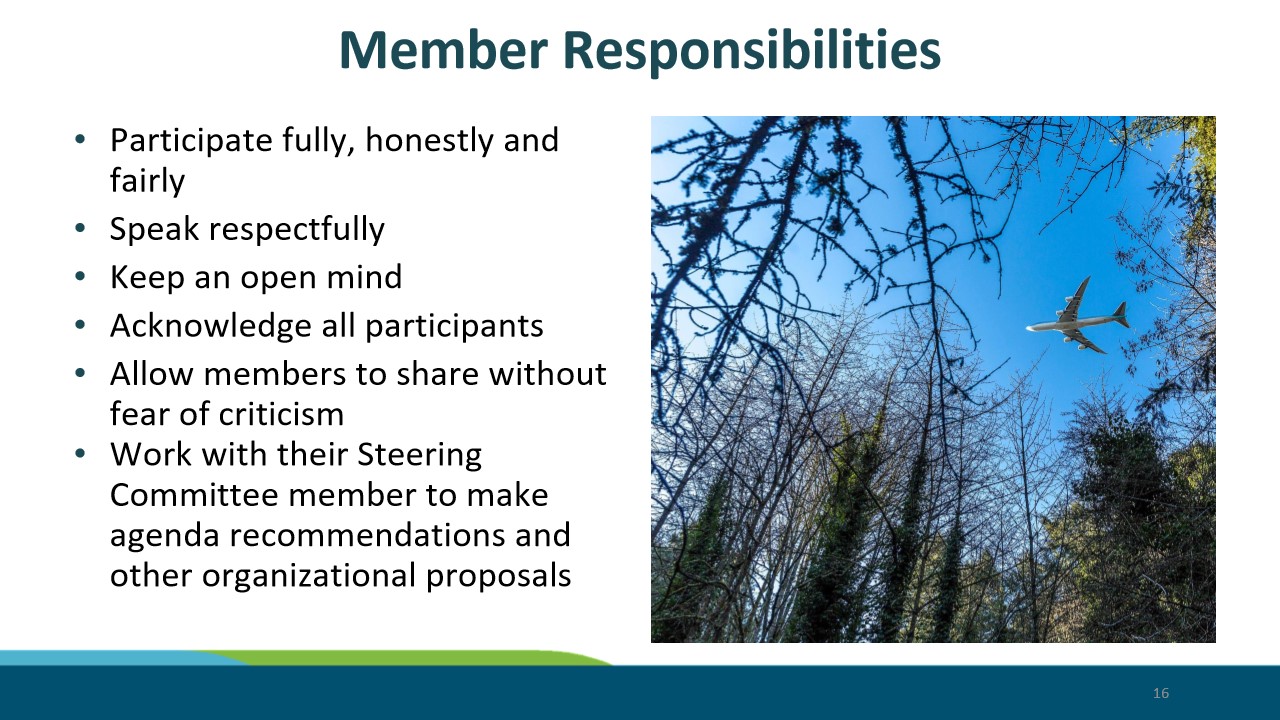
StART Overview — Member Responsibilities (Slide 16)
Slide 16 from a Sea-Tac Airport noise-policy presentation listing member responsibilities, including participating fully and honestly, speaking respectfully, keeping an open mind, and working with Steering Committee members on agenda recommendations. The slide is illustrated with a photograph taken from ground level through bare tree branches showing a commercial aircraft flying overhead against a blue sky, consistent with an airport noise community engagement context. -
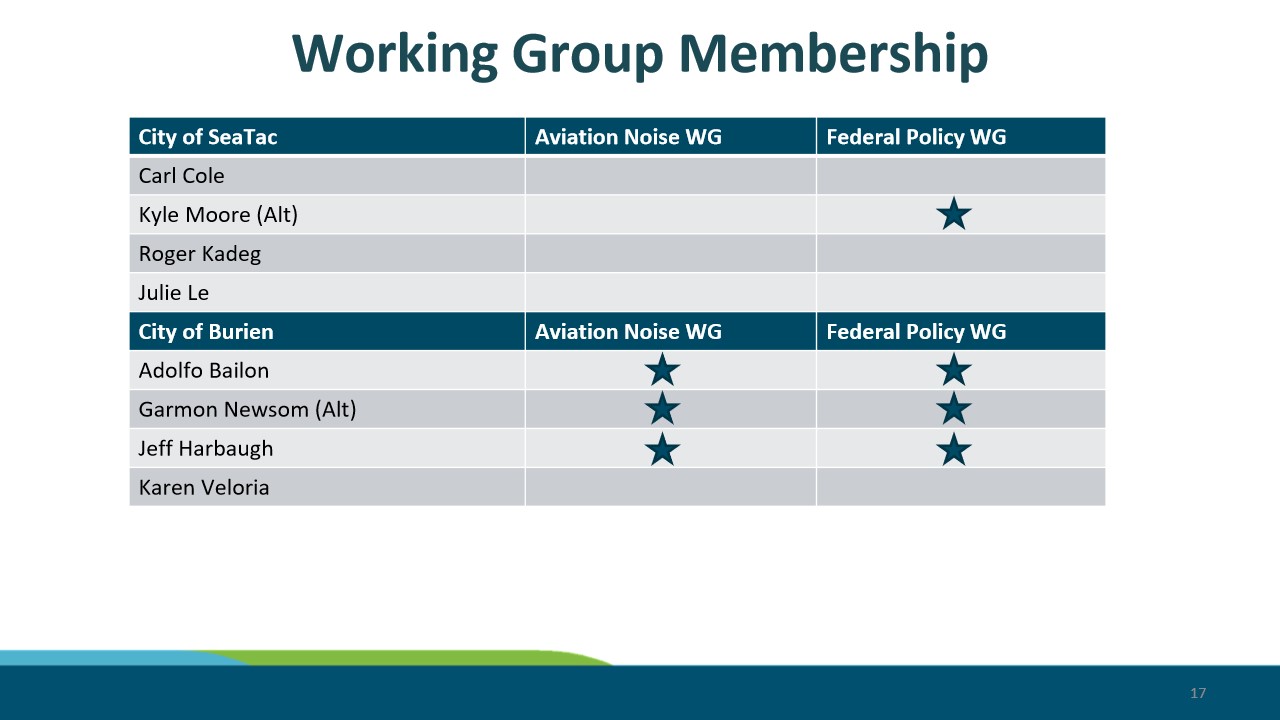
2-28 StART Meeting – StART Overview PowerPoint 17
Slide 17 lists members of the Aviation Noise and Federal Policy Working Groups for two cities. City of SeaTac representatives include Carl Cole, Kyle Moore (Alt), Roger Kadeg, and Julie Le; City of Burien representatives include Adolfo Bailon, Garmon Newsom (Alt), Jeff Harbaugh, and Karen Veloria, with stars indicating working group assignments. -
 2025-01-01
Overview flight go-arounds
This presentation from Seattle-Tacoma International Airport (SEA) explains what flight go-arounds are and how often they occur. A go-around happens when a pilot or air traffic controller decides it is not safe to land, due to factors like bad weather or aircraft spacing issues, and the plane must circle back for another attempt. SEA's go-around rate averages about 0.4% of all arrivals, closely matching the 0.39% national average reported by the FAA across 30 major U.S. airports. -
 2025-01-01
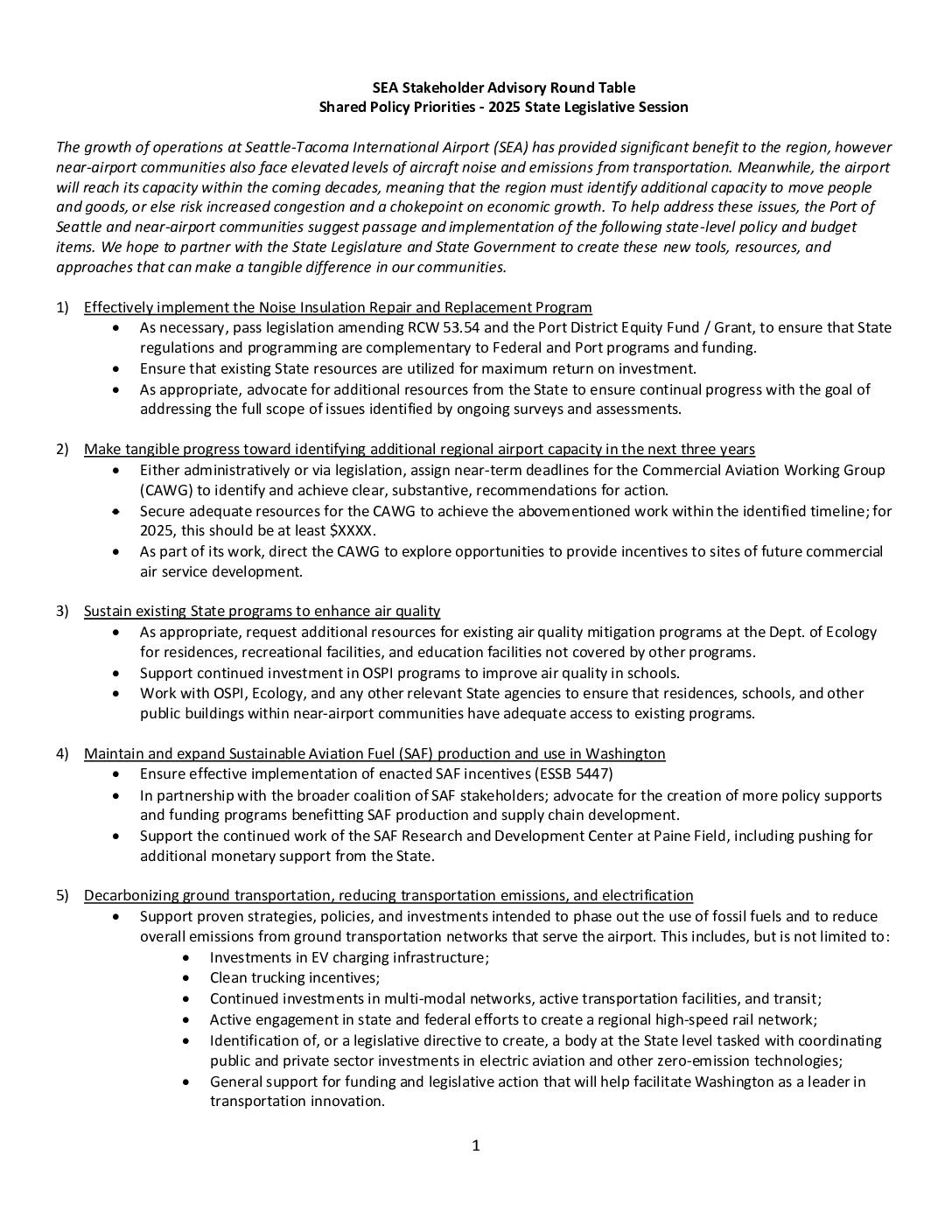
SEA Stakeholder Advisory Round Table shared policy priorities – 2025 state legislative session
The Port of Seattle and communities near Seattle-Tacoma International Airport have outlined five shared policy priorities for the 2025 state legislative session, addressing aircraft noise, air quality, and regional growth. Key proposals include repairing noise insulation in homes, identifying new regional airport capacity within three years, improving air quality programs, expanding sustainable aviation fuel production, and reducing emissions from ground transportation. The document calls on the Washington State Legislature to pass new laws, allocate funding, and coordinate with state agencies to make these changes a reality.