TagStART(508)
-
 2025-01-01
StART Noise Working Group year end recap
The StART (Sea-Tac Airport Roundtable) Noise Working Group, a collaborative body of roughly 20 members representing various community and aviation stakeholders, was formed to identify and pursue achievable noise reduction efforts at Seattle-Tacoma International Airport. This presentation serves as a year-end recap of the group's work and progress. Members include representatives from local communities, airlines, and the Port of Seattle. -
 2025-01-01
StART Aviation Noise Working Group: 34R glideslope analysis
The Port of Seattle's StART Aviation Noise Working Group analyzed glideslope options for Runway 34R at Seattle-Tacoma International Airport. The presentation covers the existing Instrument Landing System, which uses a 2.75-degree glideslope rather than the standard 3-degree angle, along with alternative navigation systems and path indicators. The group evaluated alternatives and developed a recommendation aimed at addressing community noise concerns associated with arriving aircraft. -
 2025-01-01
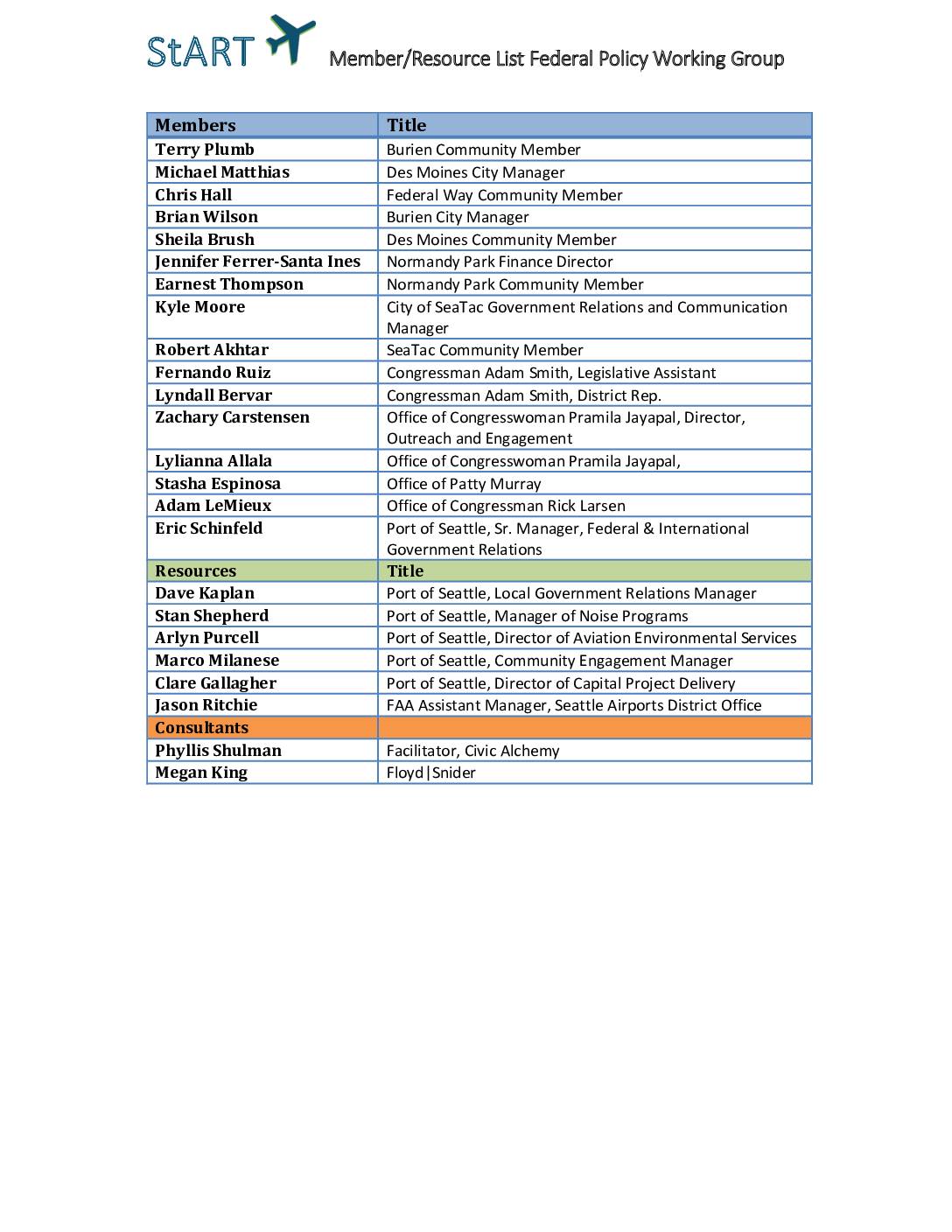
StART member/resource list Federal Policy Working Group
This document lists the members, resources, and consultants of the StART (Sea-Tac Airport Roundtable) Federal Policy Working Group, a collaborative body focused on aviation noise and policy issues around Seattle-Tacoma International Airport. The group includes community members and city officials from Burien, Des Moines, Federal Way, Normandy Park, and SeaTac, alongside representatives from the offices of several federal legislators. Port of Seattle staff, an FAA district office manager, and two outside consultants round out the working group's roster. -
 2025-01-01
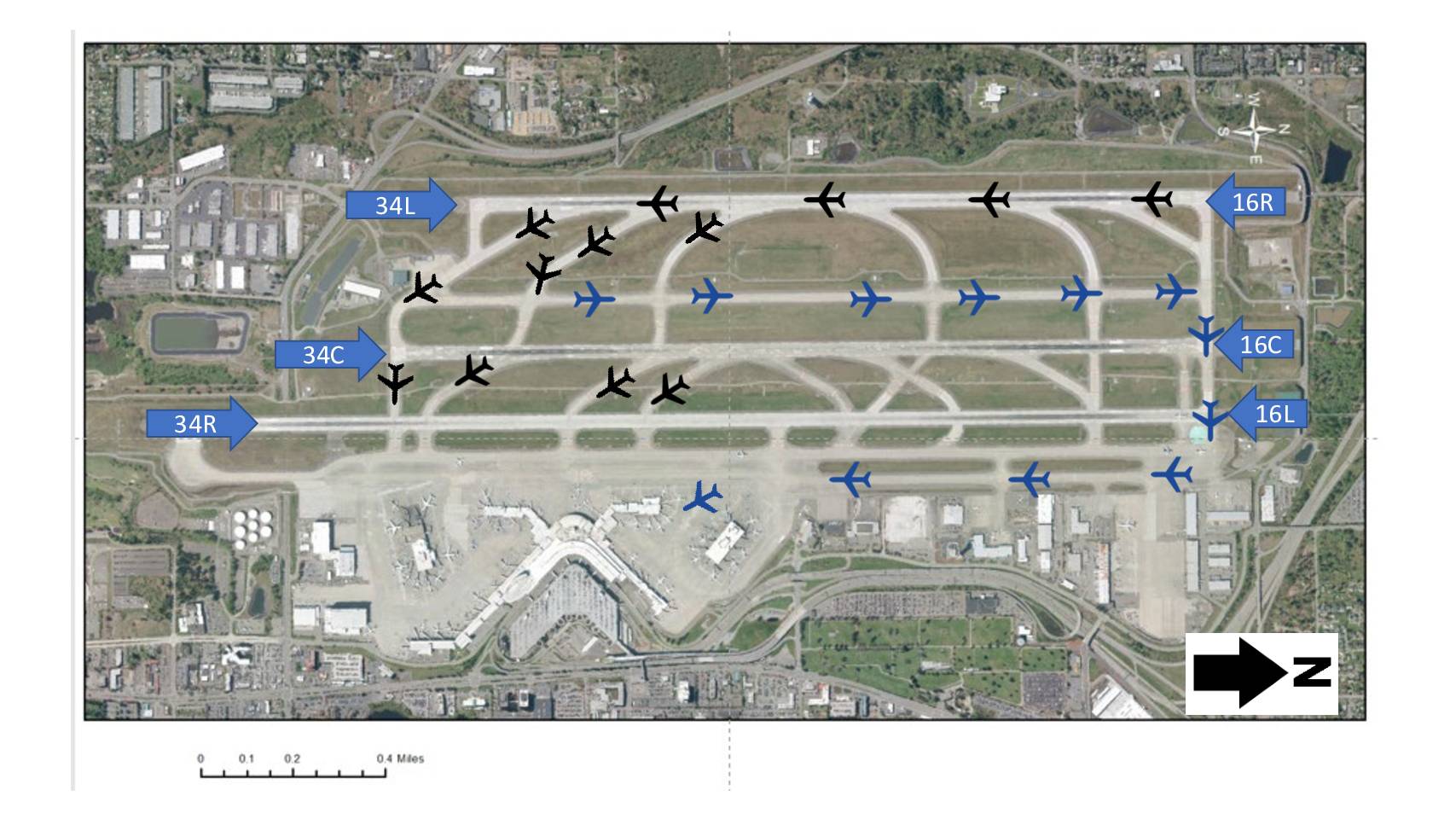
Sea-Tac Airport runway configuration map
This diagram shows the runway layout at Seattle-Tacoma International Airport (Sea-Tac), illustrating three parallel runway pairs oriented roughly north-south: 34L/16R, 34C/16C, and 34R/16L. Black aircraft icons represent arriving or departing flights on the northern runways, while blue icons indicate traffic on the central and southern runways, reflecting how flight operations are distributed across the airfield. The map is relevant to noise policy discussions as it visually documents the flight paths and runway usage patterns that affect surrounding communities. -
 2025-01-01
Late Night Noise Limitation Program overview
The Port of Seattle's Late Night Noise Limitation Program monitors aircraft noise levels at Sea-Tac Airport between midnight and 5am, using SEL noise thresholds measured at four monitor locations for both arrivals and departures. Airlines whose flights exceed these thresholds are notified and face penalties to their Fly Quiet Award scores. All airlines are encouraged to reduce late-night operations or switch to quieter aircraft, with results reported publicly on a regular basis. -
 2025-01-01
SEA-TAC Stakeholder Advisory Round Table: Airport flight pattern general briefing
This briefing from the Port of Seattle's SEA-TAC Stakeholder Advisory Round Table explains how air traffic control works at Seattle-Tacoma International Airport, covering flight arrival and departure patterns, standard terminal routes, and the three layers of air traffic control — Tower, TRACON, and Center — that manage aircraft from landing through long-distance travel. The document was prepared to help community stakeholders understand the factors that influence where and how aircraft fly around the airport. It is intended as an educational resource for those interested in airport flight patterns and related noise impacts. -
 2025-01-01
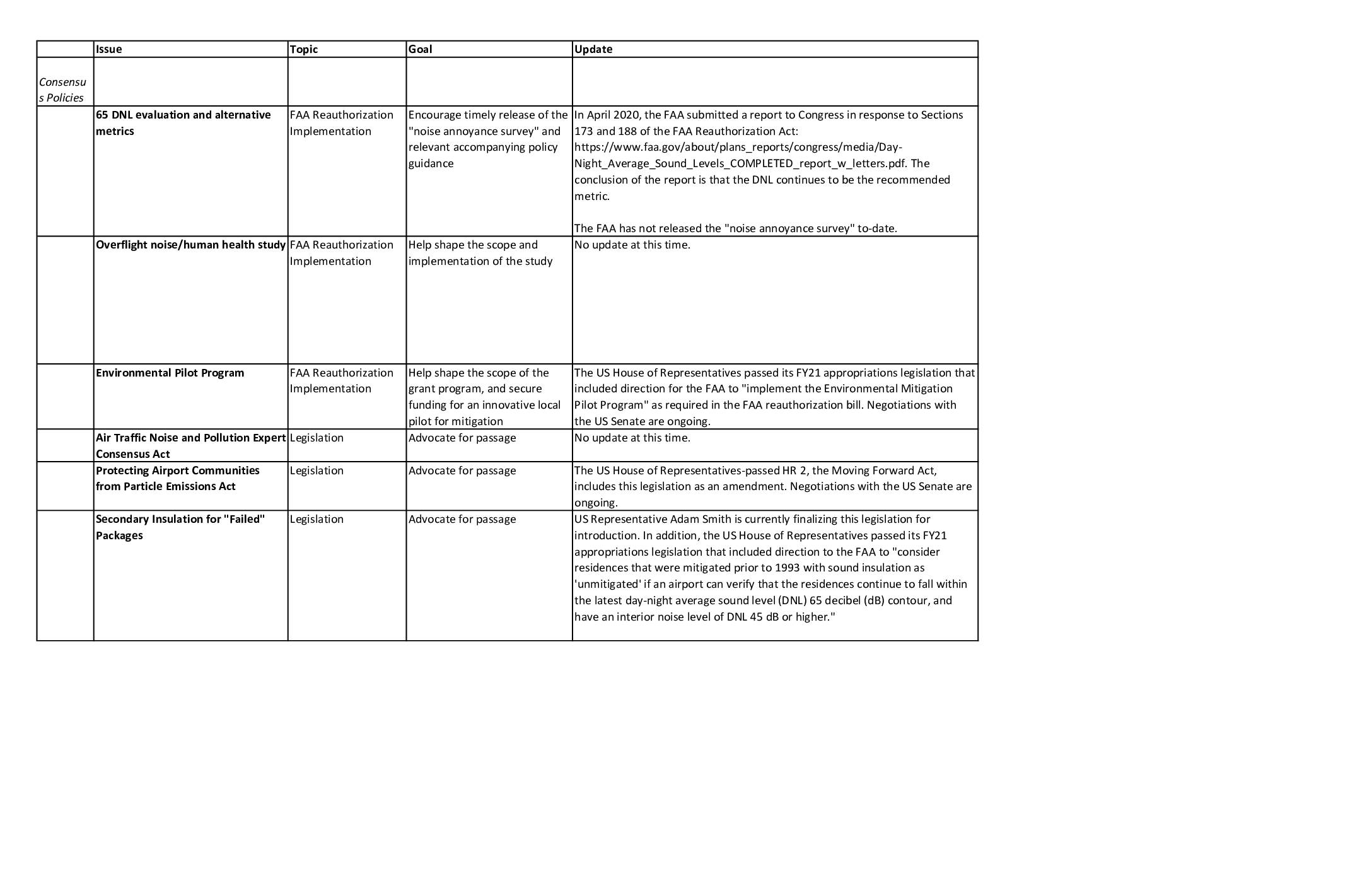
Legislative and policy priorities issue tracker
This document tracks the status of Sea-Tac Airport (SEA) noise policy issues, covering federal legislation, FAA Reauthorization Act implementation, and local StART Noise Working Group initiatives. It provides updates on efforts such as DNL noise metric evaluation, community noise insulation funding, sustainable aviation fuel, and supersonic aircraft noise standards. Several items show active progress in the U.S. House of Representatives, while others remain ongoing or awaiting further action from the FAA or U.S. Senate. -
 2025-01-01
Seattle Airport end-around taxi procedure proposal
This proposal outlines an End-Around Taxi Procedure for Seattle-Tacoma International Airport, designed for use when Runway 16C is restricted due to weather conditions. The procedure routes arriving aircraft heading to gates north of Box 77 behind departing aircraft using an intersection departure from Runway 16L at Echo, reducing the number of active runway crossings. The goal is to improve ground movement efficiency during low-visibility or adverse weather operations. -
 2025-01-01
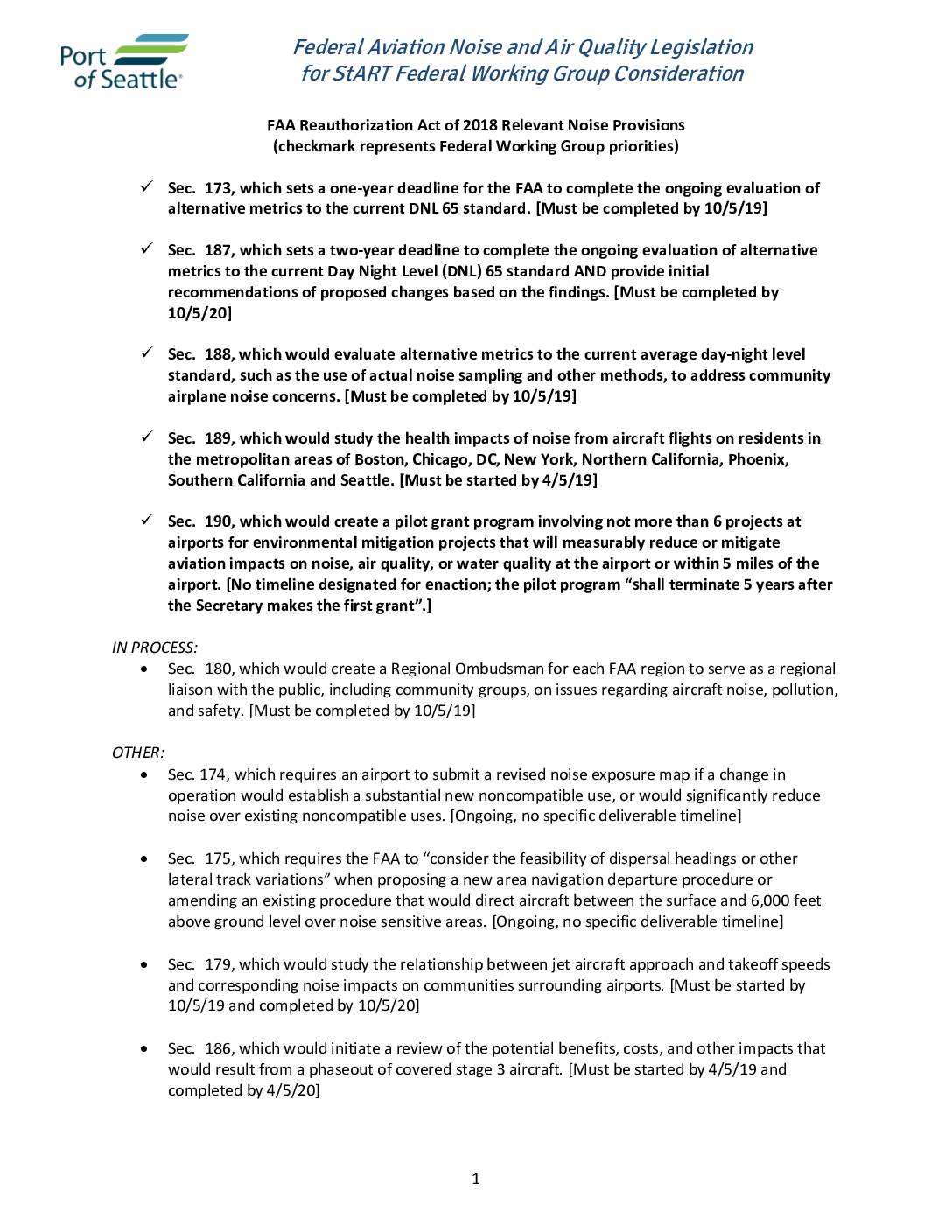
Federal aviation noise and air quality legislation for StART Federal Working Group consideration
This Port of Seattle document outlines key federal aviation noise and air quality legislation relevant to the StART (Sea-Tac Airport Roundtable) Federal Working Group, including provisions from the FAA Reauthorization Act of 2018 and proposed 2019 legislation. It highlights priority measures such as evaluating alternatives to the current DNL 65 noise standard, studying health impacts of aircraft noise in major metro areas including Seattle, and creating environmental mitigation grant programs for airports. Additional issues under consideration include noise insulation packages, funding for federal noise programs, and greater flexibility for local communities to address aviation impacts. -
 2025-01-01
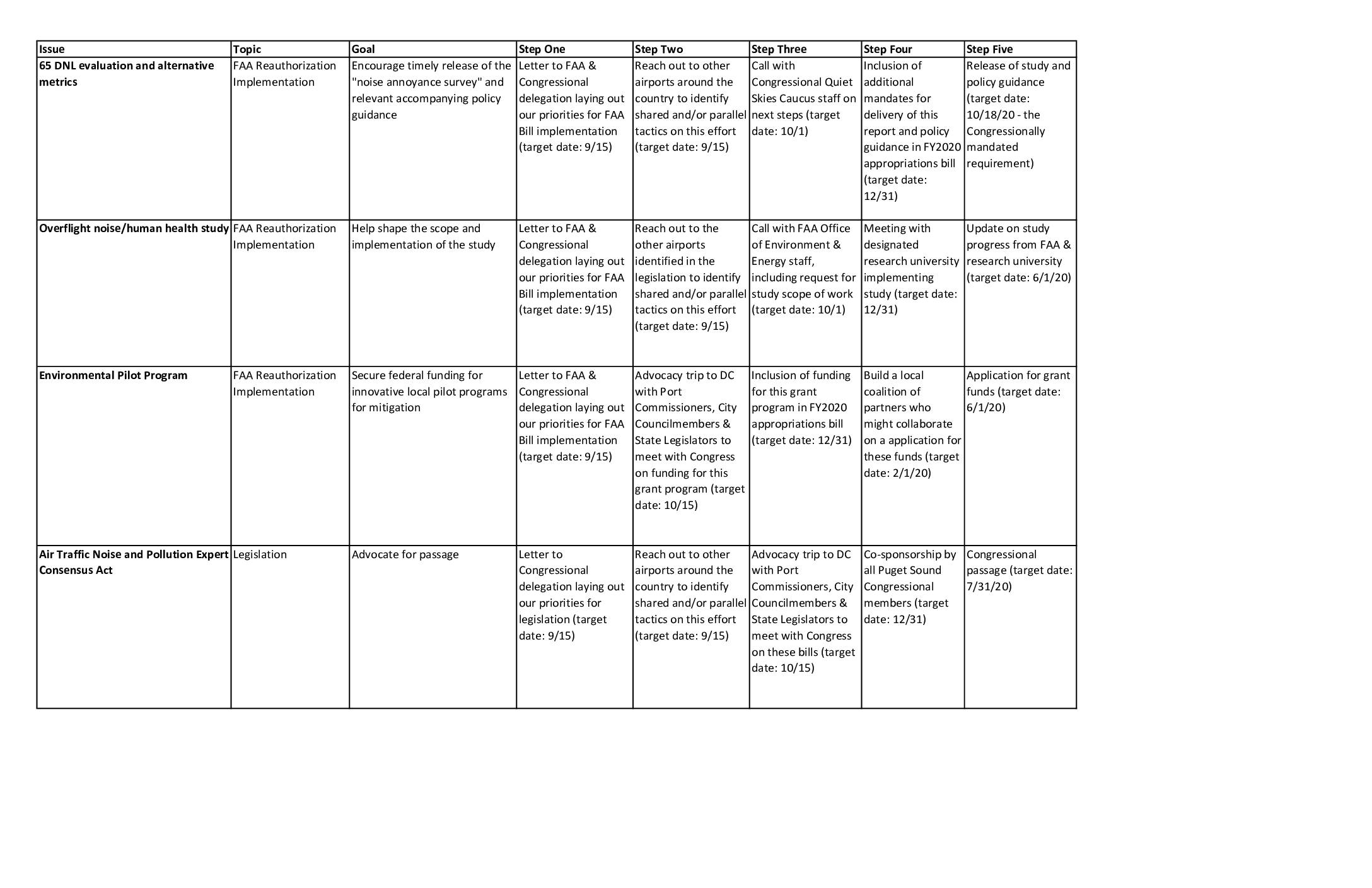
Sea-Tac Airport noise advocacy work plan
This document outlines a strategic action plan addressing aircraft noise and environmental concerns related to Sea-Tac Airport, covering issues such as DNL noise metrics, overflight health studies, particle emissions legislation, and late-night noise limitations. Each issue is assigned a topic category, a goal, and a sequence of up to five concrete steps with target dates ranging from September 2019 through mid-2020. Key tactics include letters to the FAA and Congressional delegations, advocacy trips to Washington D.C., coalition-building with other airports, and pursuing funding through federal appropriations bills.