TagRegional Commission On Airport Affairs(43)
-
 2000-01-01
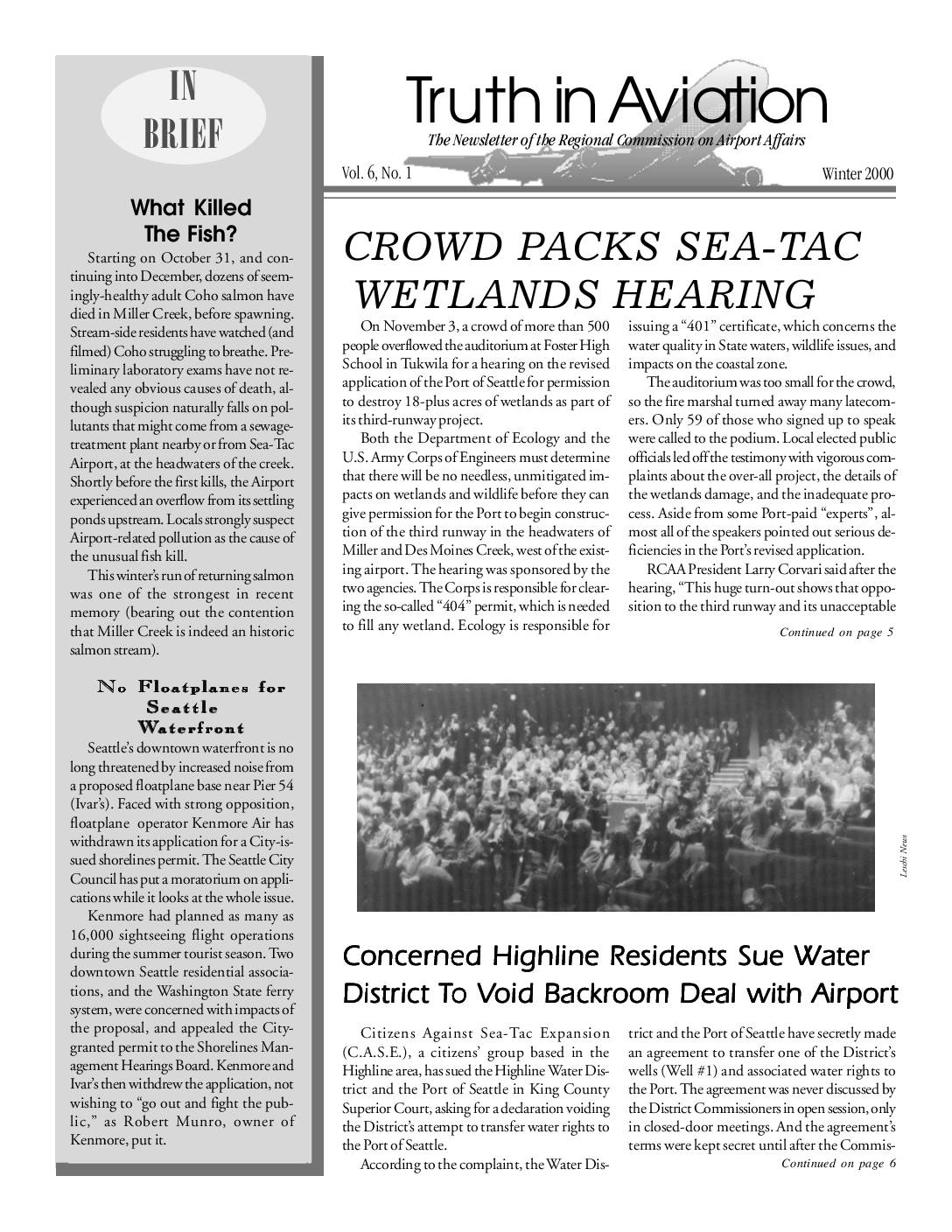
Truth in Aviation: The newsletter of the Regional Commission on Airport Affairs, Vol. 6, No. 1, Winter 2000
This Winter 2000 newsletter from the Regional Commission on Airport Affairs covers community opposition to Sea-Tac Airport's third runway expansion, including a packed public hearing on wetlands destruction, debates over proposed changes to flight corridors to reduce noise impacts, and a major study finding that retrofitting Highline School District classrooms to acceptable noise levels would cost $178 million — far exceeding the Port of Seattle's $50 million mitigation budget. The newsletter highlights growing tensions between the Port, local residents, and government agencies over the environmental, financial, and quality-of-life impacts of airport expansion. -
 1999-07-01
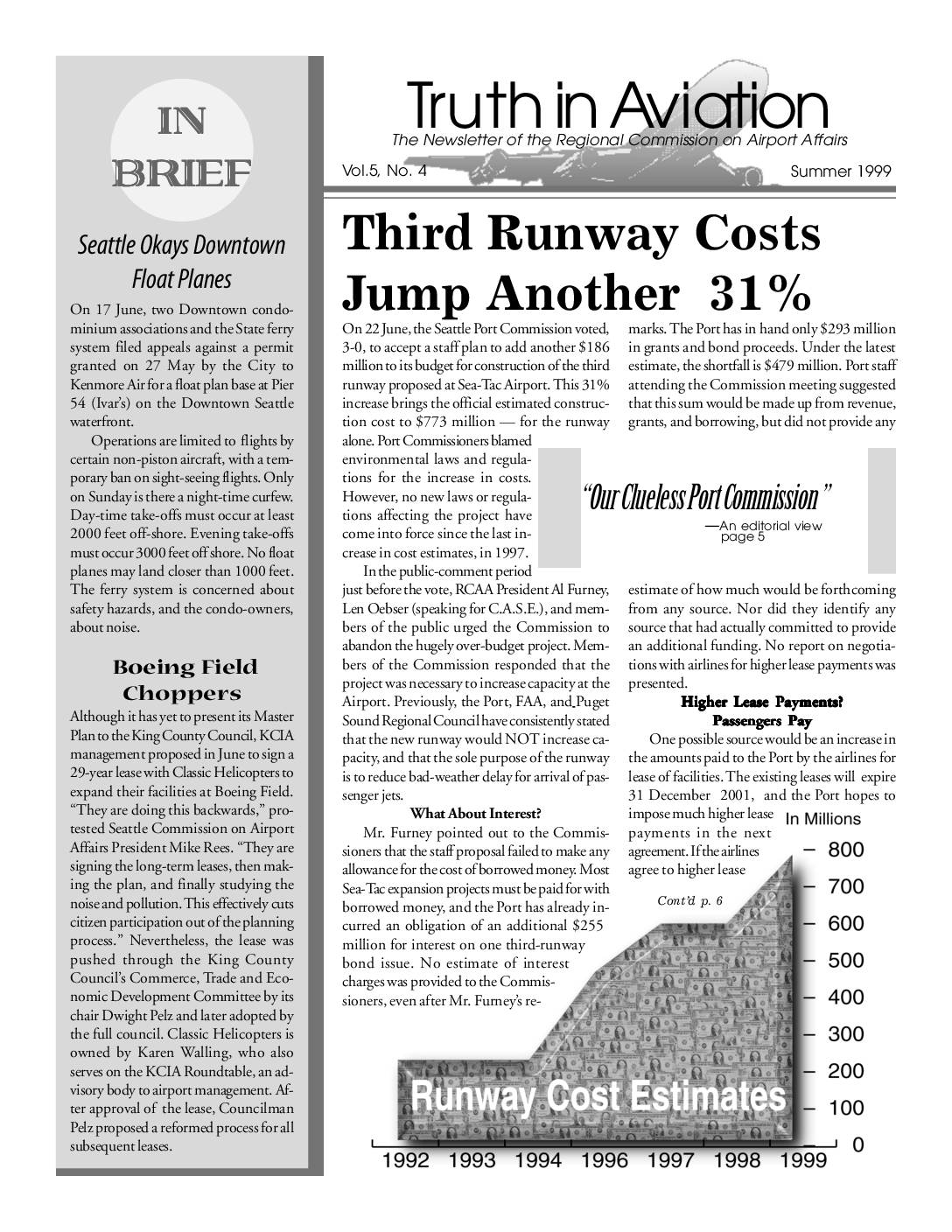
Truth in Aviation: Newsletter of the Regional Commission on Airport Affairs, Vol. 5, No. 4, Summer 1999
This 1999 newsletter from the Regional Commission on Airport Affairs covers major controversies surrounding Sea-Tac Airport's proposed third runway, including a 31% cost jump bringing construction estimates to $773 million, unresolved wetlands permits requiring the filling of 18+ acres of wetlands and 3,000 linear feet of streams, and disputes over water rights and environmental impacts on local creeks. The newsletter also reports on related issues including a rejected conveyor-belt proposal to transport runway fill, a $500,000 state-funded aquifer study, and separate local disputes over float planes on Seattle's waterfront and helicopter leases at Boeing Field. -
 1998-03-01
Truth in Aviation: The newsletter of the Regional Commission on Airport Affairs, Vol. 5, No. 1, Spring 1998
This 1998 newsletter from the Regional Commission on Airport Affairs covers several controversies surrounding Sea-Tac Airport's expansion, including a 24% cost overrun on the new parking garage, Port staff admitting they lack the capacity to manage over 100 simultaneous expansion projects, and the Highline School District launching an independent study of airport noise impacts on classrooms after failed negotiations with the Port. Additional issues covered include a proposed wetlands destruction permit for the third runway site, plans to extend King County International Airport's runway closer to Georgetown neighborhoods, and legal battles over city comprehensive plans that opposed airport expansion. -
 1997-02-01
Sea-Tac International Airport Impact Mitigation Study: Initial Assessment and Recommendations — Section 9, Potential Socio-Economic Impacts and Mitigation
A 1997 study commissioned by cities and institutions near Seattle-Tacoma International Airport found that airport operations depress nearby property values compared to similar homes elsewhere in King County, and that properties directly under flight paths suffer additional losses from noise, visual pollution, and reduced quality of life. Researchers compared single-family homes around Sea-Tac with comparable homes in Northwest King County (Shoreline area), using strict criteria to ensure fair comparisons. The study notes that while overall regional growth means nearby home values may still rise over time, they appreciate more slowly than they would without the airport's presence. -
 1997-02-01
Sea-Tac International Airport impact mitigation study: Initial assessment and recommendations
A 1997 impact mitigation study found that the expansion of Sea-Tac International Airport, including a proposed Third Runway, would impose significant costs on surrounding communities — with Burien and Des Moines alone accounting for nearly 80% of an estimated $2.95 billion in mitigation needs. The study examined 26 specific environmental impacts across areas such as noise, air quality, and water quality, and recommended establishing a permanent noise monitoring program to ensure projected noise contours are not exceeded. It also called for a comprehensive South King County planning effort to balance the needs of communities, schools, hospitals, and the airport. -
 1996-10-01
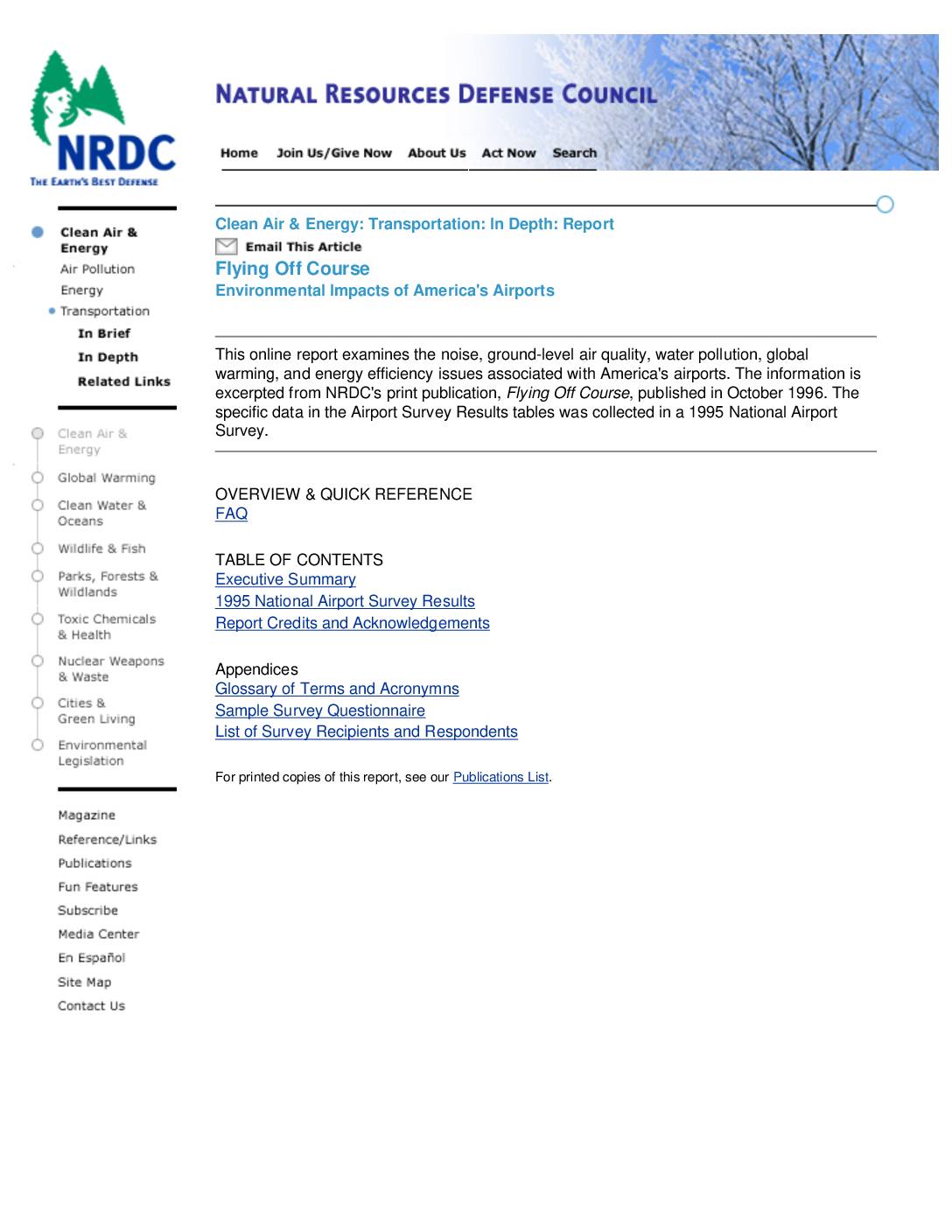
Flying off course: Environmental impacts of America’s airports
A 1996 Natural Resources Defense Council report examines the environmental impacts of America's airports, including aircraft noise, air pollution, water quality, and climate change, based on a 1995 survey of 125 of the nation's busiest airports. The report finds that the FAA's current noise threshold of 65 dB DNL inadequately measures the true impact of aircraft noise on nearby communities, and that noise problems are likely to worsen as air travel grows. NRDC recommends updating noise measurement standards and improving land-use planning around airports to better protect residents from aviation-related environmental harms. -
 1993-03-03
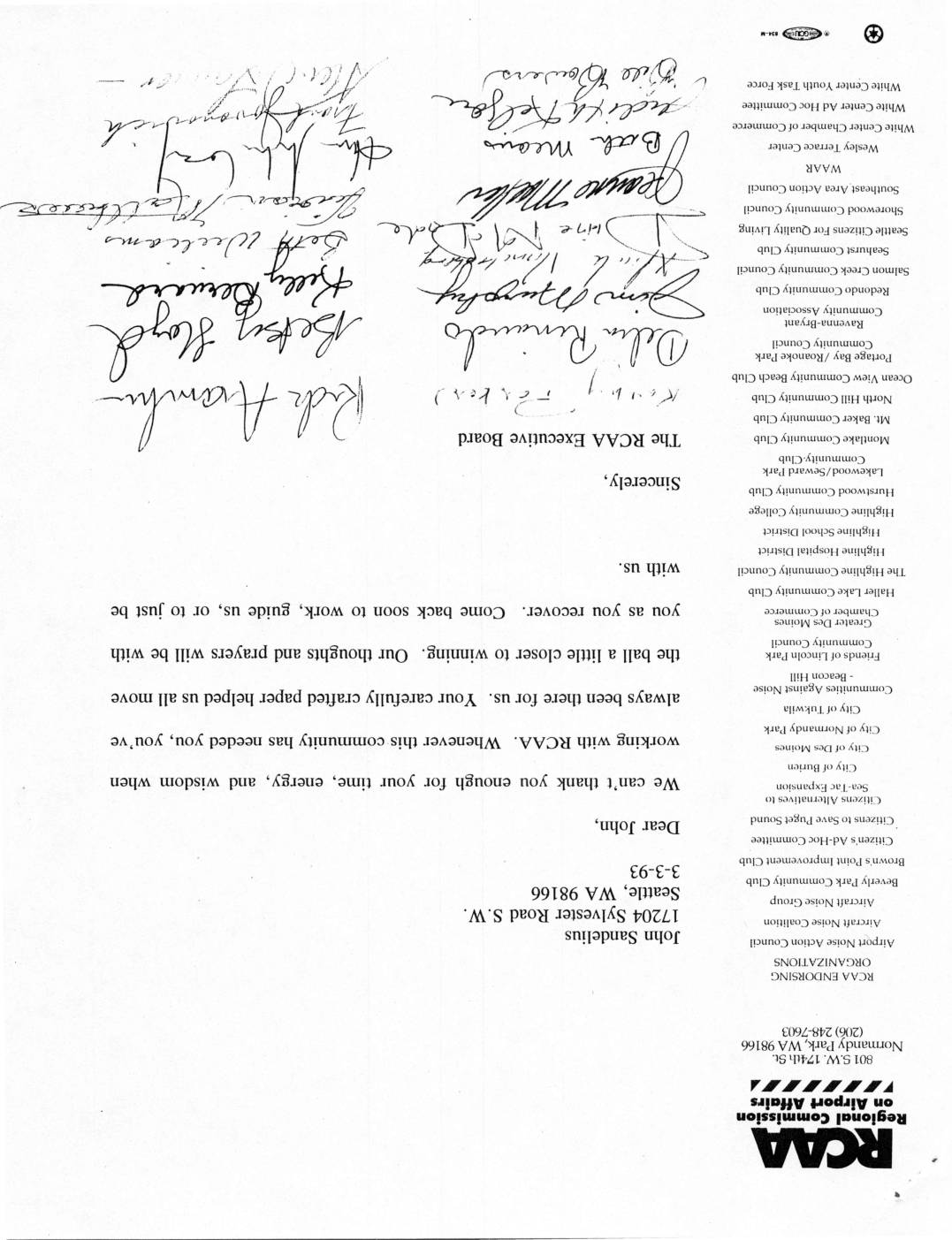
RCAA letter to John Sandelius
A March 1993 letter from the RCAA (Regional Commission on Airport Affairs) Executive Board addressed to John Sandelius of Seattle, thanking him for his time, energy, and wisdom contributed to the organization's efforts regarding Sea-Tac Airport noise issues. The letter expresses well-wishes for his recovery and notes that his work was valued whenever the community needed him. The document is endorsed by a wide coalition of over 50 community organizations, city governments, and civic groups from the greater Seattle and South King County area opposing airport noise expansion. -
 1993-01-28
RCAA letter to Transportation Policy and Executive Board
A January 28, 1993 letter from James T. Murphy of the Regional Commission on Airport Affairs (RCAA) to the Transportation Policy and Executive Board, presenting independent consultant research on air capacity options for the Puget Sound region. The letter notes that RCAA had delivered three volumes of material over three weeks, with a final compilation to follow, aimed at helping the Board make informed decisions about managing airport capacity. The RCAA, backed by dozens of community organizations and cities including Burien, Des Moines, Normandy Park, and Tukwila, framed its work as an alternative voice on Sea-Tac Airport expansion and noise policy. -
 1993-01-26
RCAA Regional Commission on Airport Affairs information packet
The Regional Commission on Airport Affairs (RCAA) was a coalition of cities and citizen groups in the Puget Sound region that opposed the proposed third dependent runway at Seattle-Tacoma International Airport in the early 1990s. The organization compiled expert research and white papers covering noise impacts, public health effects, environmental and social consequences, and economic costs associated with airport expansion. Their goal was to identify financially feasible and environmentally responsible alternatives to meet the region's air capacity needs without further expanding Sea-Tac. -
 1993-01-21
RCAA presentation materials on demand management, airport planning, and system alternatives
This January 1993 document from the Regional Commission on Airport Affairs (RCAA) presents materials to the Puget Sound Regional Council's Transportation Policy and Executive Board covering demand management, airport planning, and regional air capacity alternatives. The packet includes analysis of flight delays, airspace and runway capacity issues, and landside capacity concerns prepared by consultants J. Richard Aramburu and Gerald Bogan, along with alternative airport development ideas from locations such as Grays Harbor County, Toledo-Winlock, and Moses Lake. The RCAA, backed by dozens of community groups and several cities in the Sea-Tac area, sought to offer expert-driven solutions to address long-term aviation capacity needs while addressing aircraft noise concerns affecting surrounding neighborhoods.