TagRCW(53)
-
 2024-05-13
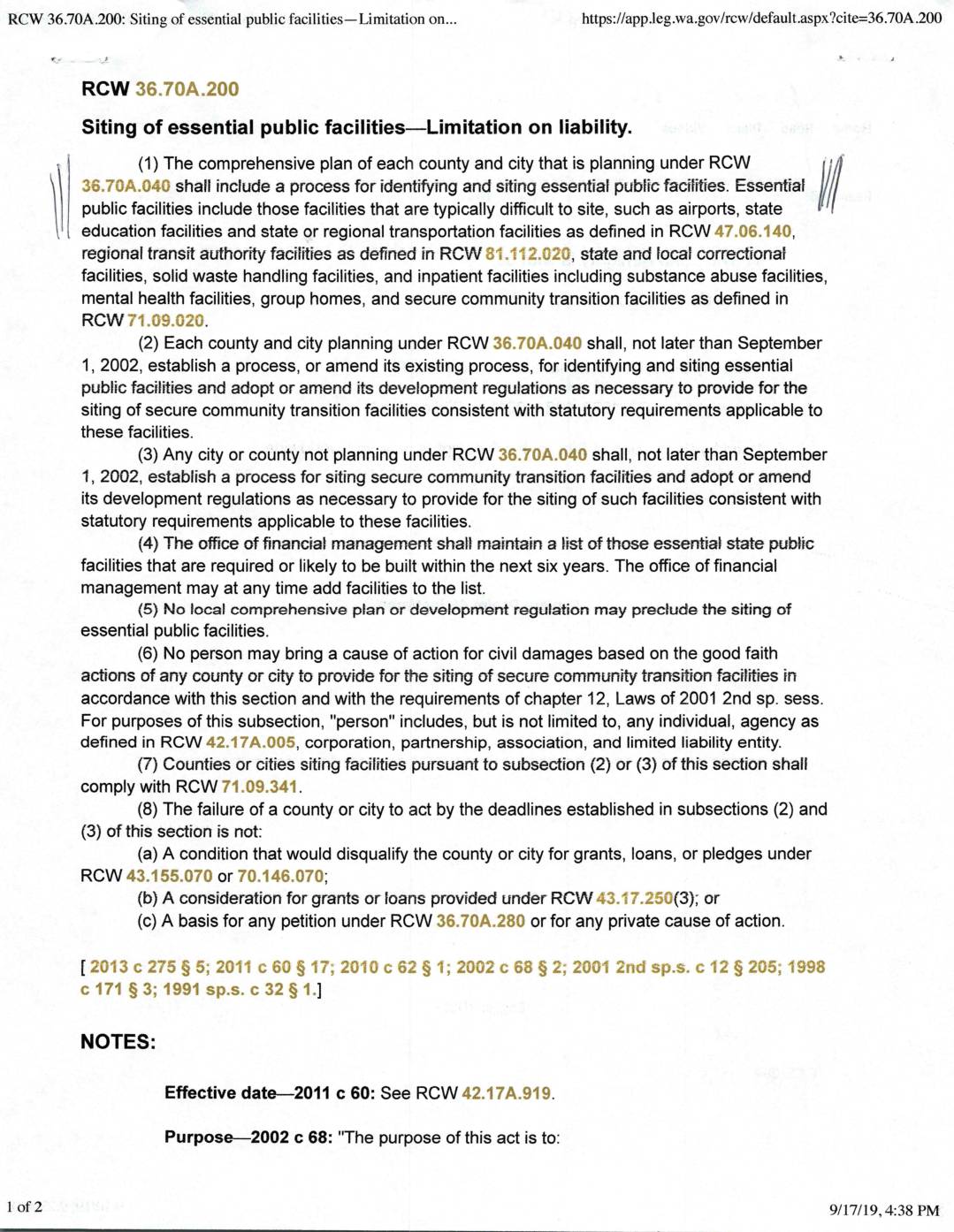
RCW 36.70A.200: Siting of essential public facilities—Limitation on liability
RCW 36.70A.200 requires counties and cities planning under Washington's Growth Management Act to include a process for identifying and siting essential public facilities — defined as those typically difficult to site, such as airports, state education facilities, regional transportation facilities, correctional facilities, solid waste handling facilities, and inpatient mental health or substance abuse facilities. The law explicitly prohibits any local comprehensive plan or development regulation from completely blocking the siting of such facilities. It also establishes liability protections for jurisdictions acting in good faith to site secure community transition facilities. -
 2024-05-13
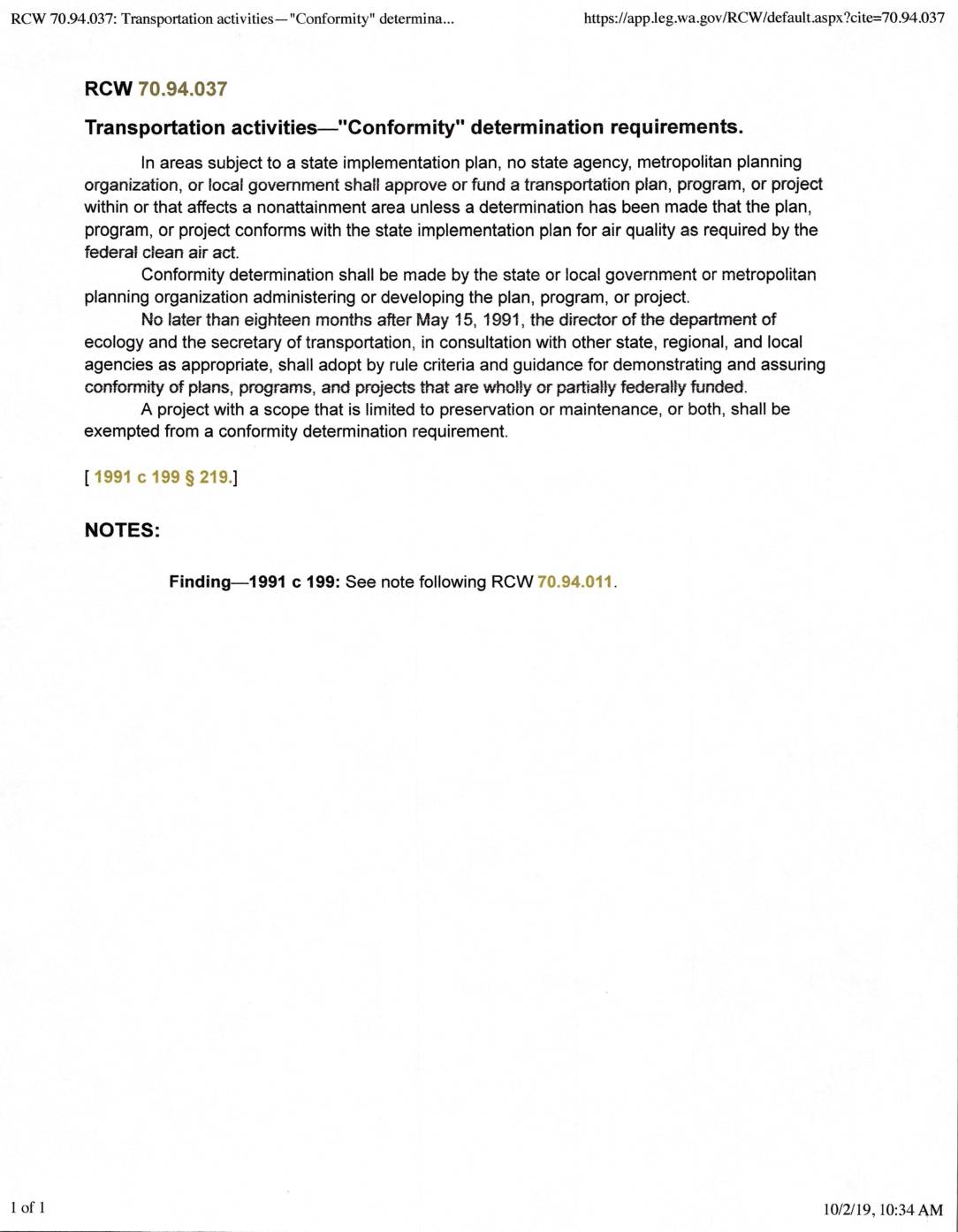
RCW 70.94.037: Transportation activities—”Conformity” determination requirements
Washington State law RCW 70.94.037 requires that any transportation plan, program, or project in areas that don't meet federal air quality standards must be shown to conform with the state's air quality implementation plan before it can be approved or funded. The conformity determination must be made by the responsible state agency, local government, or metropolitan planning organization overseeing the project. Projects limited strictly to preservation or maintenance work are exempt from this requirement. -
 2024-05-06
State governance of special purpose districts (ports) and FAA preeminence
This presentation, prepared for the City of Burien Airport Committee, examines the governance structure of Washington State's special purpose port districts and the FAA's preeminent authority over airport operations. It explains that port districts, enabled by state law since 1911 and governed by directly elected commissioners, hold broad powers including management of airports, while federal FAA regulations take precedence over local planning decisions. The document also touches on noise control considerations relevant to communities near Sea-Tac Airport, referencing state and federal regulatory frameworks. -
 2024-01-08
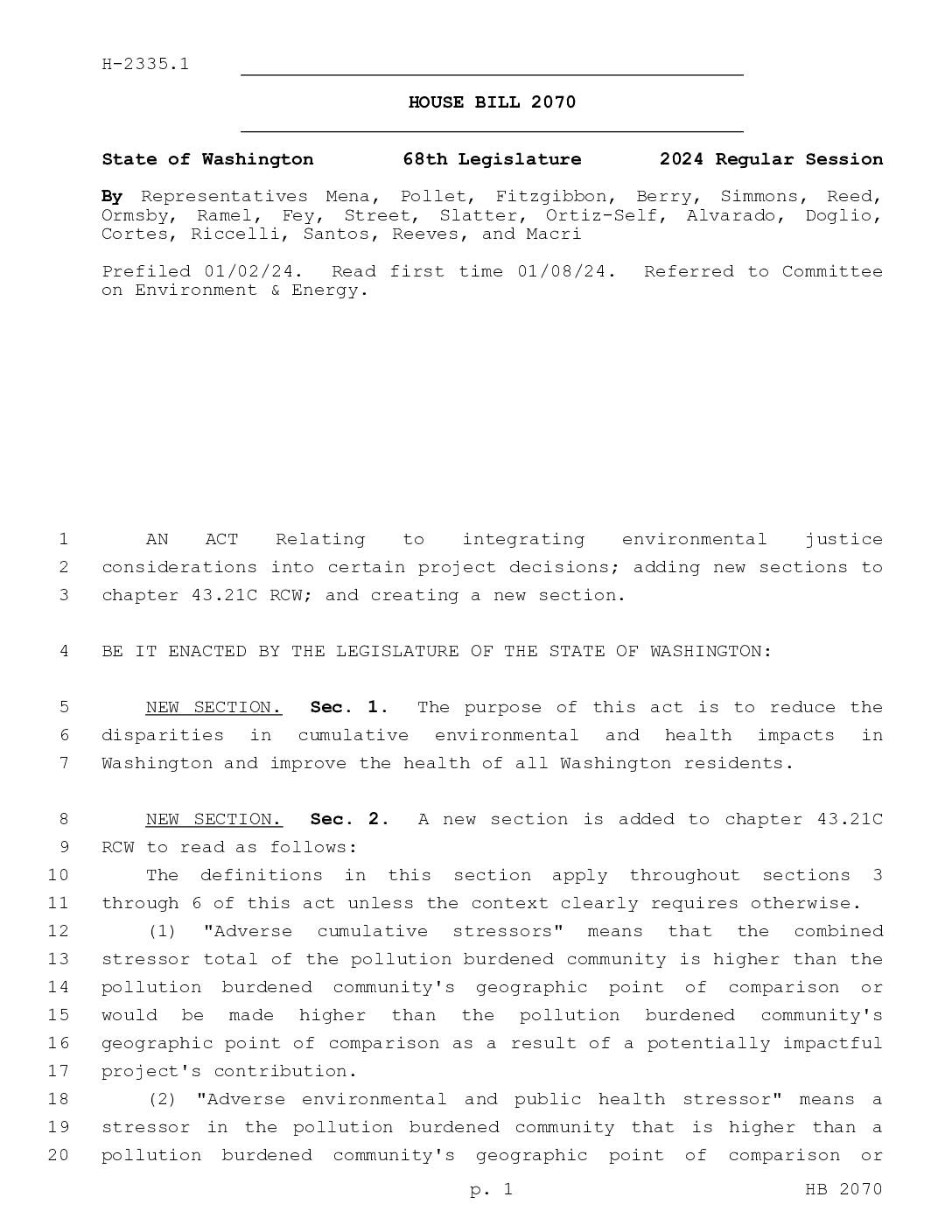
HB 2070: Integrating Environmental Justice Considerations into Certain Project Decisions
Washington House Bill 2070 (2024) aims to reduce environmental health disparities by requiring environmental justice impact assessments for projects that may add pollution burdens to already overburdened communities. The bill defines key terms such as 'disproportionate impact' and 'adverse cumulative stressors' to evaluate whether a proposed project would worsen air, water, or other environmental conditions in vulnerable neighborhoods. Note: this bill addresses broad environmental justice considerations statewide and does not specifically concern Sea-Tac Airport noise policy. -
 2024-01-08
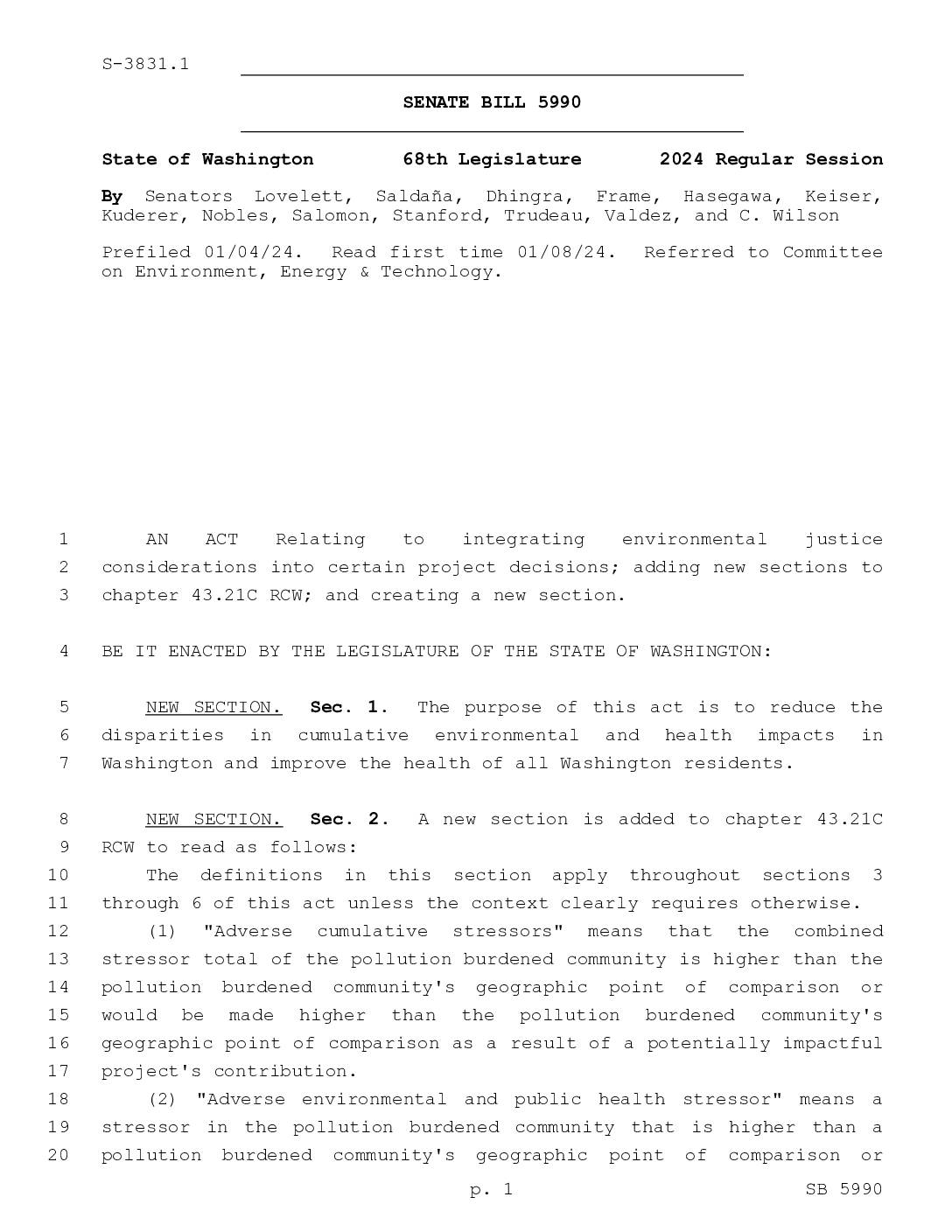
Senate Bill 5990: Integrating Environmental Justice Considerations into Certain Project Decisions
Washington Senate Bill 5990, introduced in January 2024, aims to reduce environmental health disparities by requiring assessment of cumulative pollution burdens on overburdened communities before approving new projects. The bill defines key terms such as 'disproportionate impact' and 'environmental justice impact statement,' and establishes a framework to evaluate stressors like air pollution, water quality, and public health risks. Note: this bill addresses broad environmental justice concerns statewide and does not specifically address Sea-Tac Airport noise policy. -
 2024-01-01
Areas 26, 29, 61, 62, 88: Residential Revalue for 2024 Assessment Roll
King County Department of Assessments 2024 annual residential revalue report covering Area 26 (Steel Lake/Star Lake), Area 29 (Kentridge), Area 61 (Kent Meridian), Area 62 (Lea Hill), and Area 88 (Des Moines/SeaTac/Kent). Authored by King County Assessor John Wilson. Explains mass appraisal methodology, property inspection cycles under RCW 84.40.025, time-adjusted sales analysis using three years -
 2024-01-01
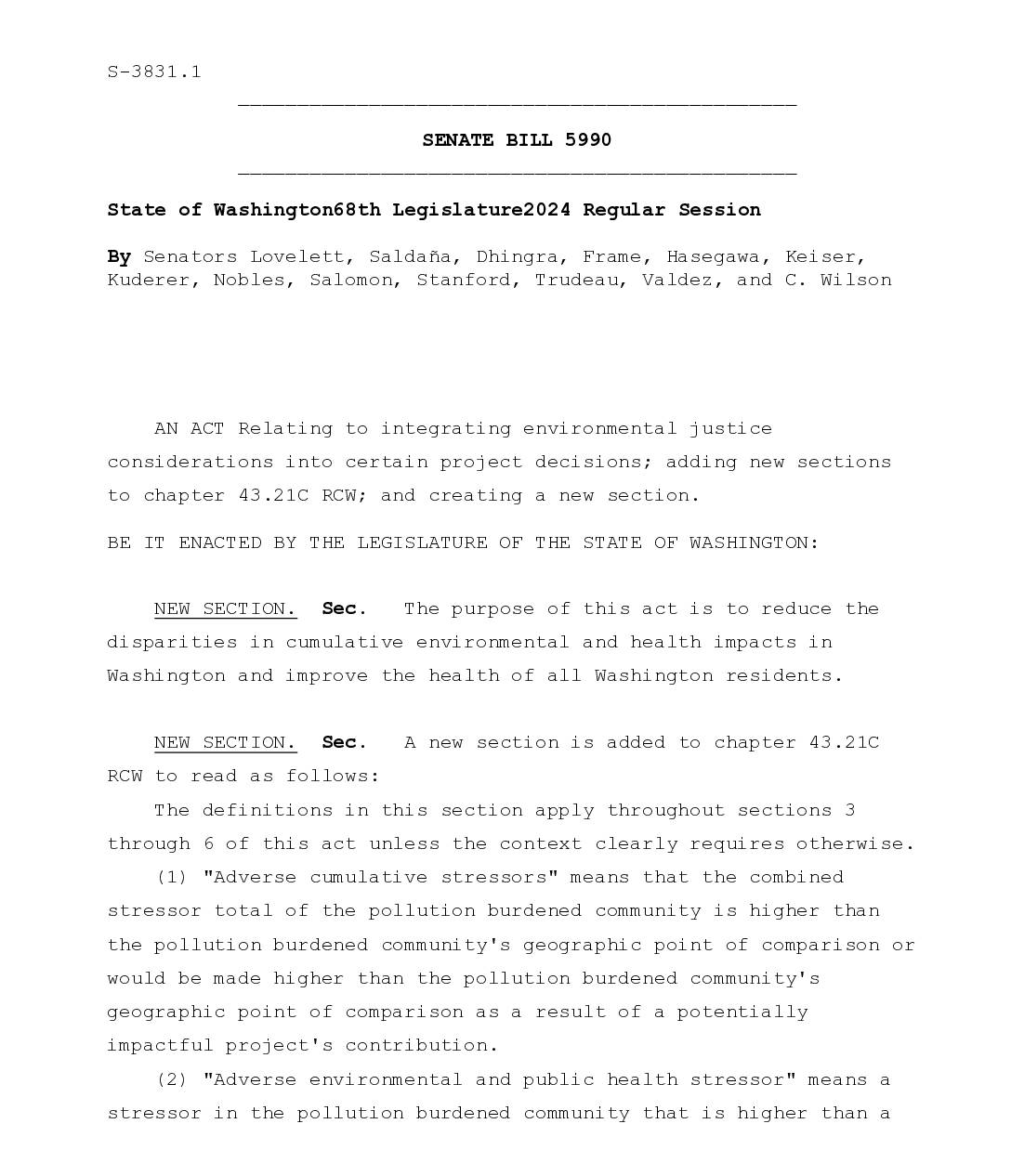
Senate Bill 5990: Integrating Environmental Justice Considerations into Certain Project Decisions
Washington Senate Bill 5990, introduced in the 2024 legislative session, aims to reduce environmental health disparities by requiring detailed impact assessments before approving projects in communities already burdened by pollution. The bill defines key terms such as 'disproportionate impact' and 'environmental justice impact statement,' and establishes a framework for evaluating whether new or expanded projects would worsen cumulative health and environmental stressors in overburdened communities. Note: this bill addresses broad environmental justice policy statewide and does not specifically address Sea-Tac Airport noise or aviation-related impacts. -
 2023-09-28
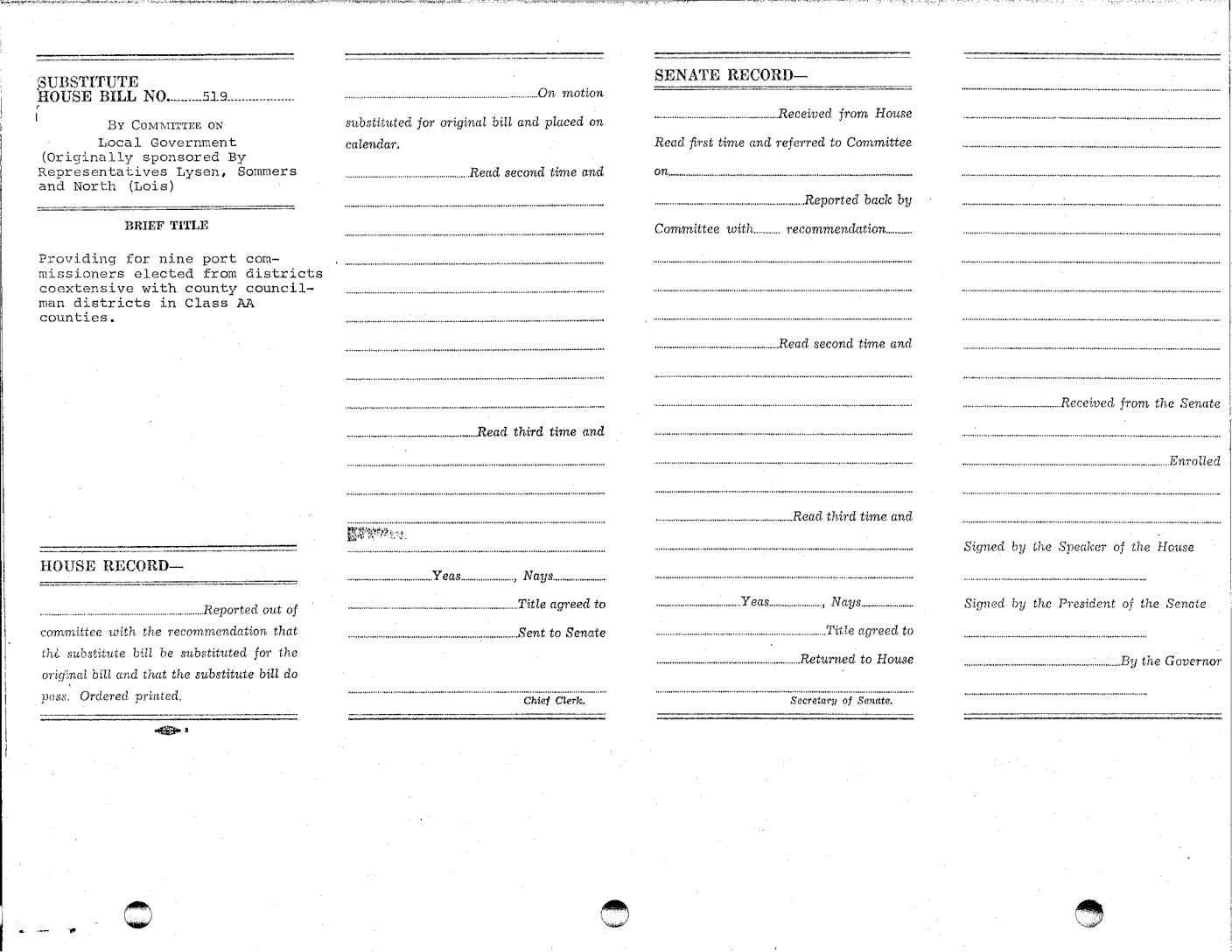
Substitute House Bill No. 519: Providing for nine port commissioners elected from districts coextensive with county councilman districts in Class AA counties
Washington State Substitute House Bill No. 519 proposes expanding port district commissions in Class AA counties from three to nine commissioners, each elected from districts that align with county councilman districts. The bill outlines election procedures, term lengths, and district boundaries for the new commissioner positions. Though focused on port governance structure, this legislation directly affects the Port of Seattle, which oversees Sea-Tac Airport and its surrounding communities. -
 2023-09-27
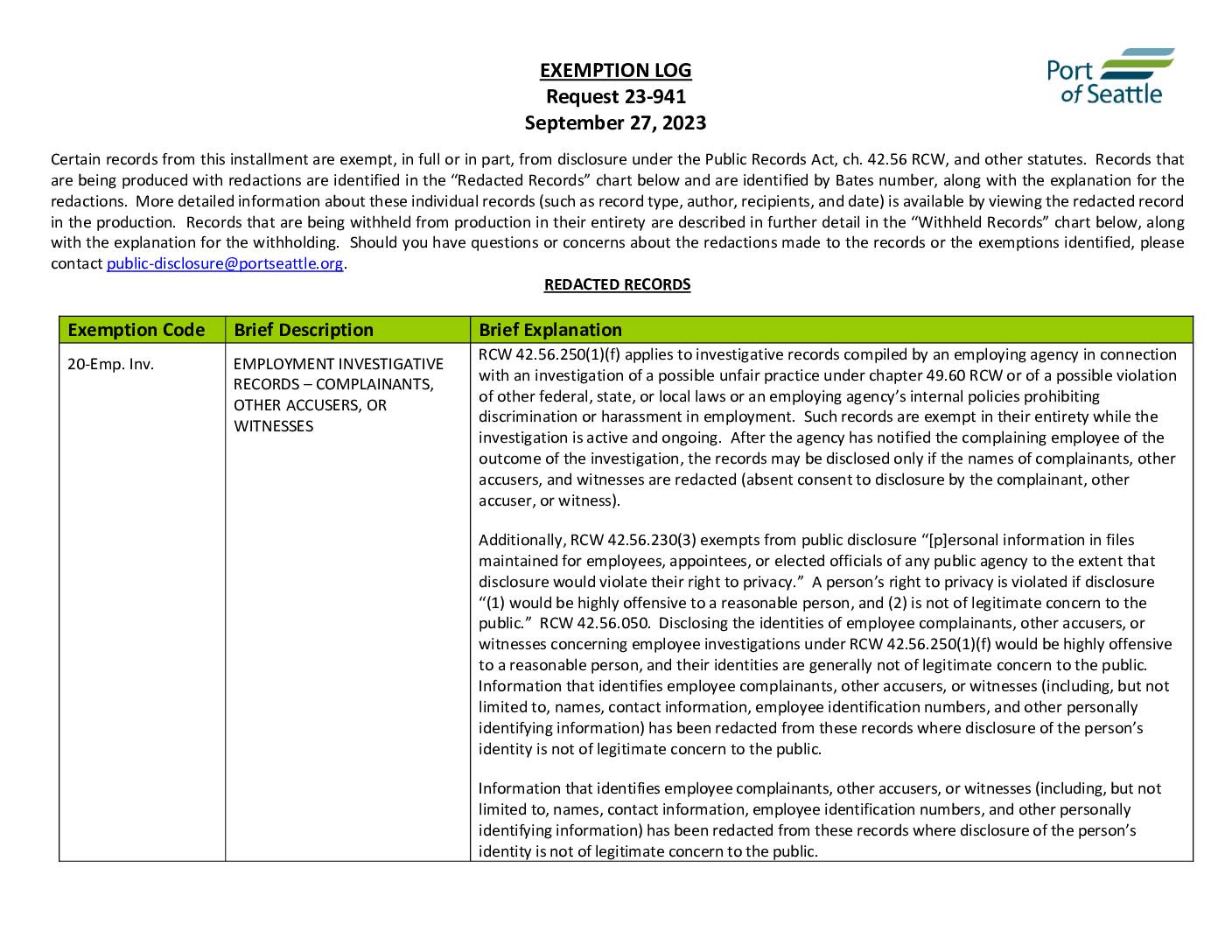
Exemption Log: Request 23-941
This is an Exemption Log from the Port of Seattle, dated September 27, 2023, related to Public Records Act request 23-941. It explains that certain employment investigation records are being partially redacted before release, with names and identifying information of complainants, accusers, and witnesses removed to protect their privacy under Washington State law (RCW 42.56.250 and 42.56.230). The redactions apply to records involving workplace discrimination or harassment investigations, where disclosing individual identities is deemed highly offensive and not of legitimate public concern. -
 2023-06-07
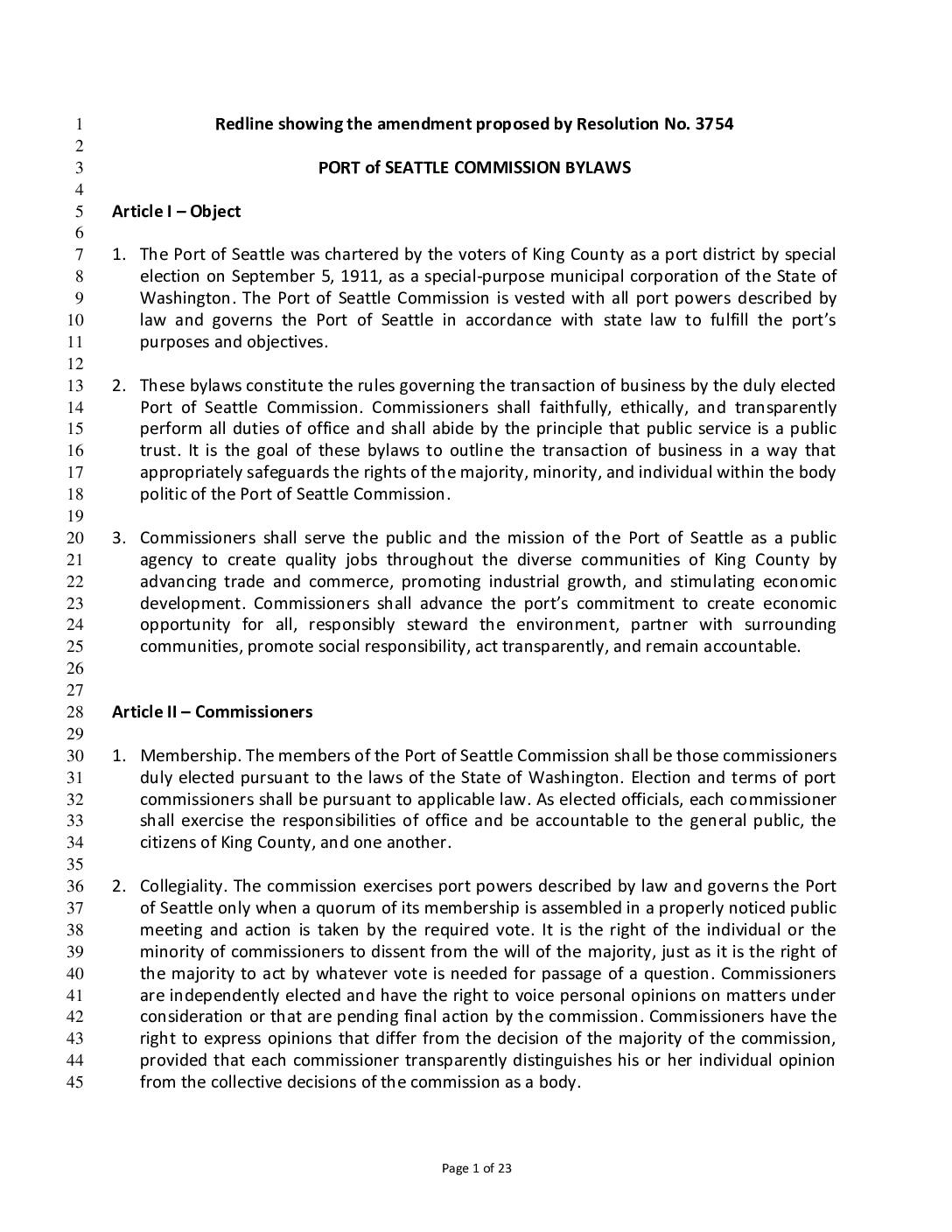
Port Of Seattle Commission bylaws
The Port of Seattle Commission Bylaws establish the rules governing how the five elected commissioners conduct official business, including requirements for ethical conduct, transparency pledges, conflict-of-interest recusals, and filling vacancies in office. Commissioners are bound to serve the public mission of creating jobs and economic development in King County while adhering to open-government standards under Washington State's Open Public Meetings Act and Public Records Act. These bylaws are proposed for amendment under Resolution No. 3754.