TagPSRC(154)
-
 2022-09-01
Destination 2030: Air quality conformity
This document outlines the air quality conformity analysis for Destination 2030, the long-range transportation plan for the central Puget Sound region, ensuring that planned transportation projects meet federal and state clean air standards. The region, previously designated as a nonattainment area for carbon monoxide, ozone, and particulate matter, was redesignated as a maintenance area after meeting federal air quality standards, with EPA approvals granted between 1996 and 2001. The conformity process involved consultation with agencies including the EPA, FHWA, and Washington State Department of Ecology to ensure new transportation projects do not cause or worsen air quality violations. -
 2022-09-01
Destination 2030: Environmental justice appendix
This appendix from the Destination 2030 Metropolitan Transportation Plan examines environmental justice in the central Puget Sound region, analyzing how transportation costs and benefits are distributed among minority and low-income populations across King, Kitsap, Pierce, and Snohomish counties. Using 1990 Census data and 1997–1998 estimates, it finds that low-income populations are concentrated in Seattle, Tacoma, and Everett, while the region's minority population stands at roughly 15 percent, with the highest concentrations in northern Pierce County and southwestern King County. The analysis was conducted to ensure that burdens and benefits of the regional transportation plan are equitably shared across groups defined by race, income, age, or disability. -
 2022-09-01
Destination 2030: Resources and references
This document is a resources and references section from the Puget Sound Regional Council's 'Destination 2030' metropolitan transportation plan, listing planning publications, environmental impact statements, and transportation policy reports relevant to the Central Puget Sound region. It includes references to the SeaTac Airport Master Plan Update and its Final Supplemental Environmental Impact Statement, alongside broader regional transportation and growth management studies. The document also credits the full Regional Council project team and policy board members involved in developing the plan. -
 2022-09-01
Destination 2030 glossary of terms
This document is a glossary of transportation planning terms from the Puget Sound Regional Council's long-range transportation plan, Destination 2030. It defines key concepts such as accessibility, congestion management, transit services, and land use strategies used to guide regional transportation policy in the greater Seattle metropolitan area. While not focused specifically on airport noise policy, it does include definitions related to airport ground access and commercial aviation as part of its broader multi-modal transportation framework. -
 2022-09-01
Destination 2030: Plan monitoring and assessment
Chapter 7 of the Destination 2030 regional transportation plan outlines how the Puget Sound Regional Council will monitor and assess progress toward its transportation goals through performance benchmarks, growth tracking, congestion management, and financial reporting. The plan establishes systems to measure land use patterns, travel behavior, and funding capacity across city streets, county roads, public transit, state highways, and ferries. Regular monitoring reports will help policymakers evaluate whether regional investments are achieving desired outcomes and allow for adjustments to planning and programming decisions over time. -
 2022-09-01
Destination 2030: Chapter 6 – Finance
Destination 2030 is a regional transportation financial plan for the Puget Sound area that outlines funding principles and strategies for meeting local, state, and regional transportation needs through 2030. The plan acknowledges that rising infrastructure costs, insufficient public revenues, and a growing maintenance backlog require new and enhanced funding sources beyond traditional tax bases such as motor fuel and vehicle sales. It recommends use-based financing, multi-modal investment support, and the creation of a regionally managed transportation fund to better coordinate planning, prioritization, and implementation of transportation improvements. -
 2022-09-01
Destination 2030: Implementation guidance and actions
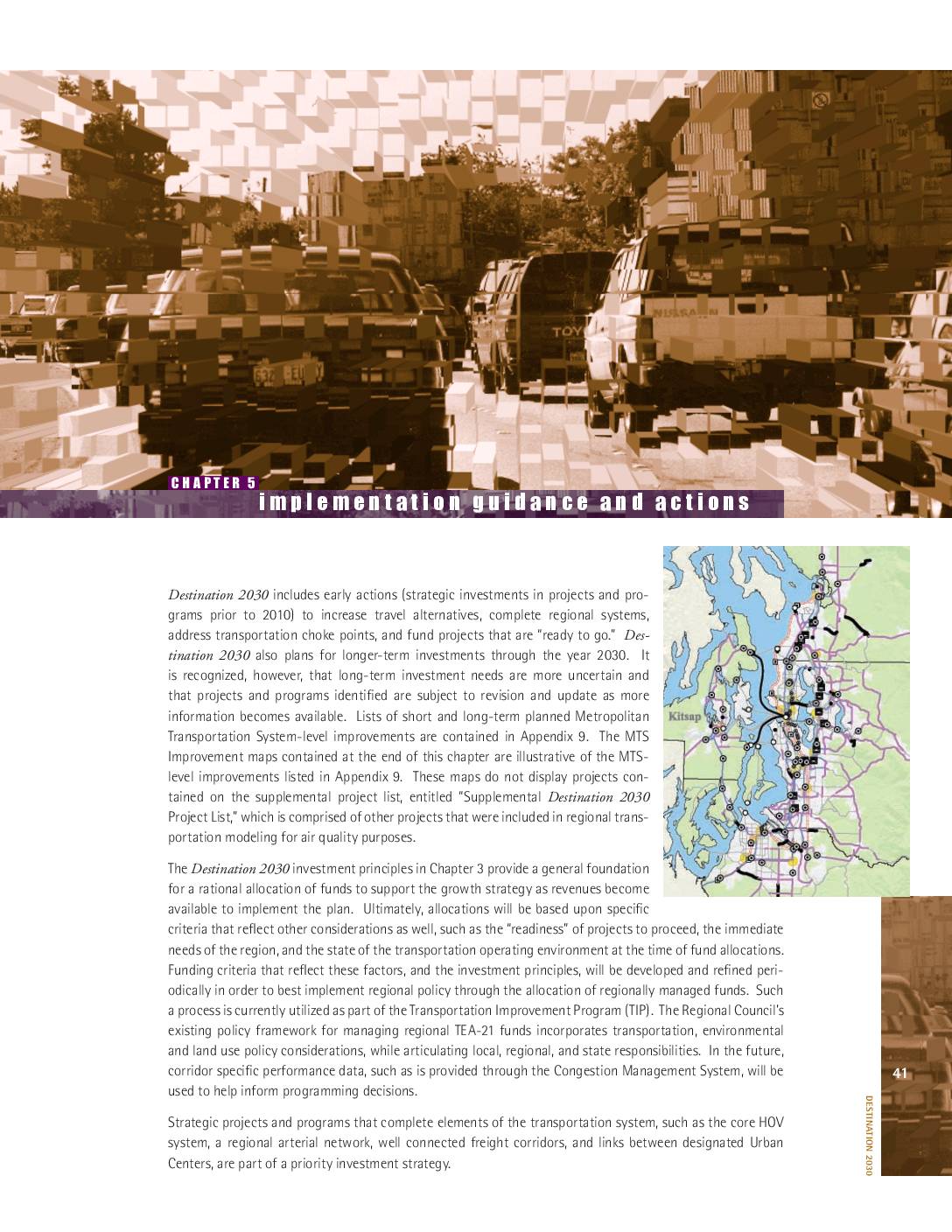
Destination 2030 is a long-term regional transportation plan for the greater Seattle area that outlines both short-term investments (prior to 2010) and longer-term improvements through 2030, focusing on roadway expansions, HOV lane completions, freight network connections, and reduced traffic congestion. The plan prioritizes safety, maintenance, and optimization of existing roads before pursuing new capacity projects, while also emphasizing travel alternatives and pedestrian and bicycle improvements. Fund allocations are guided by project readiness, regional need, and consistency with local growth management policies. -
 2022-09-01
Destination 2030: Linking land use and transportation
Destination 2030 is a regional growth and transportation plan for the Seattle metropolitan area that focuses on linking land use decisions with transportation investments. It outlines strategies for directing housing and employment growth into compact urban centers where walking, biking, and transit use are more practical, while also providing physical design guidelines and development tools to support that vision. The plan emphasizes coordinating infrastructure spending with growth management goals to build more connected, pedestrian-friendly communities across the region. -
 2022-09-01
Destination 2030: Investment strategy
The Destination 2030 plan outlines a long-range transportation investment strategy for the central Puget Sound region, prioritizing maintenance and preservation of existing infrastructure while expanding multimodal travel options. Key investment principles include completing gaps in regional transportation systems, linking spending to measurable outcomes, and supporting compact urban development connected by efficient transit. -
 2022-09-01
Destination 2030: Metropolitan Transportation Plan background
Destination 2030 is the long-range Metropolitan Transportation Plan for the central Puget Sound region, developed by the Puget Sound Regional Council to address transportation needs over a 30-year horizon as the region's population is expected to grow by over 1.5 million people. The plan covers all modes of transportation—including transit, roads, ferries, rail, bicycle, and pedestrian facilities—and links land use planning with transportation investment strategies. It builds upon the 1995 Metropolitan Transportation Plan by providing improved guidance on funding, system management, and multimodal improvements across King, Kitsap, Pierce, and Snohomish counties.