TagProperty Tax Levy(83)
-
Draft Finance Plan 201-2023-2018_11_13_SM_7c_supp_Page_11
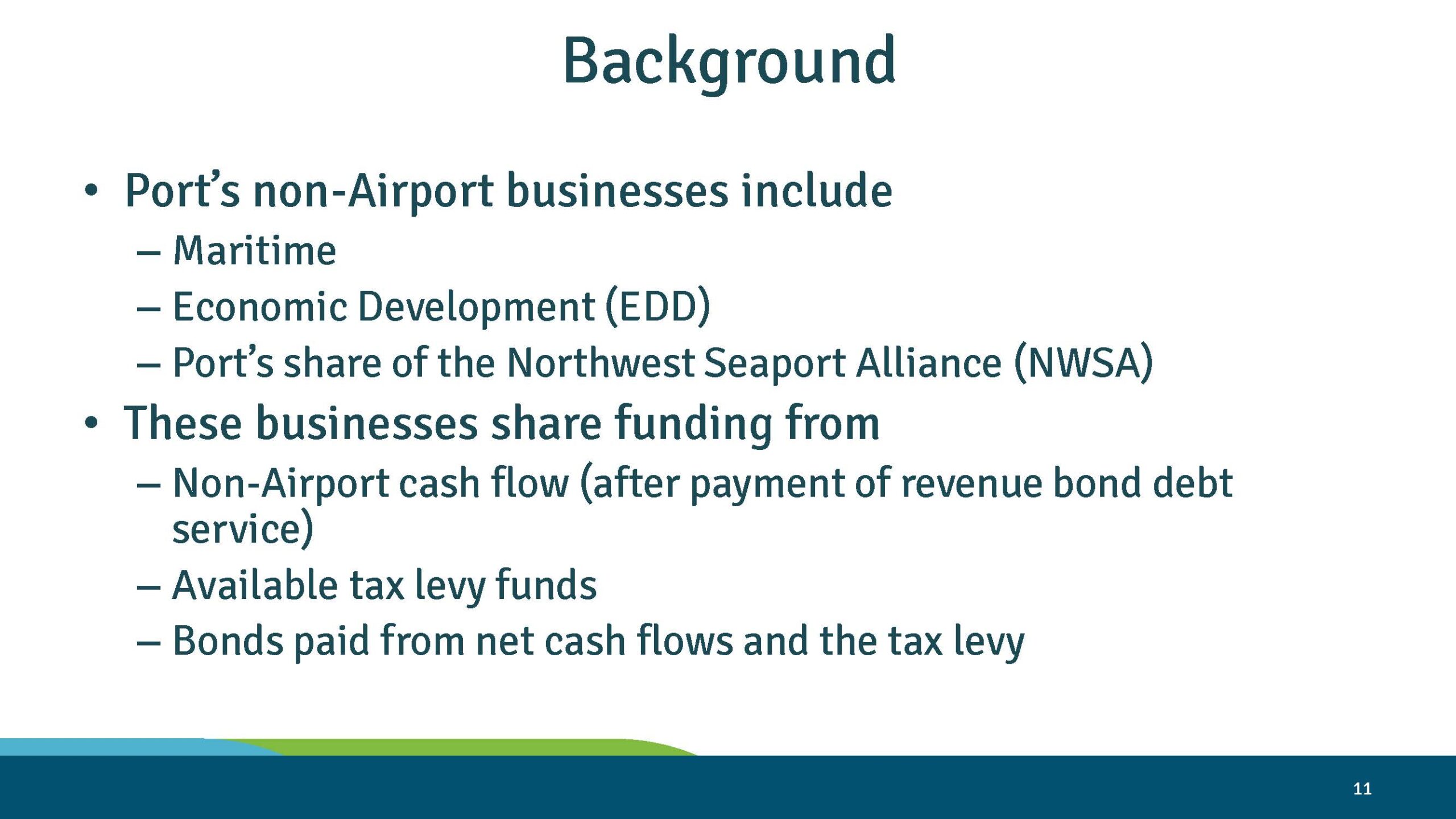
Slide 11 from a Port of Seattle presentation describes the Port's non-Airport businesses: Maritime, Economic Development (EDD), and its share of the Northwest Seaport Alliance (NWSA). It outlines shared funding sources including non-Airport cash flow after revenue bond debt service, available tax levy funds, and bonds paid from net cash flows and the tax levy. -
Draft Finance Plan 201-2023-2018_11_13_SM_7c_supp_Page_10
This is slide 10 from a Port of Seattle presentation titled 'Capital Planning and Funding – Non-Airport.' The slide features the Port of Seattle logo and uses the organization's branded color scheme of teal, green, and dark navy. -
Draft Finance Plan 201-2023-2018_11_13_SM_7c_supp_Page_09
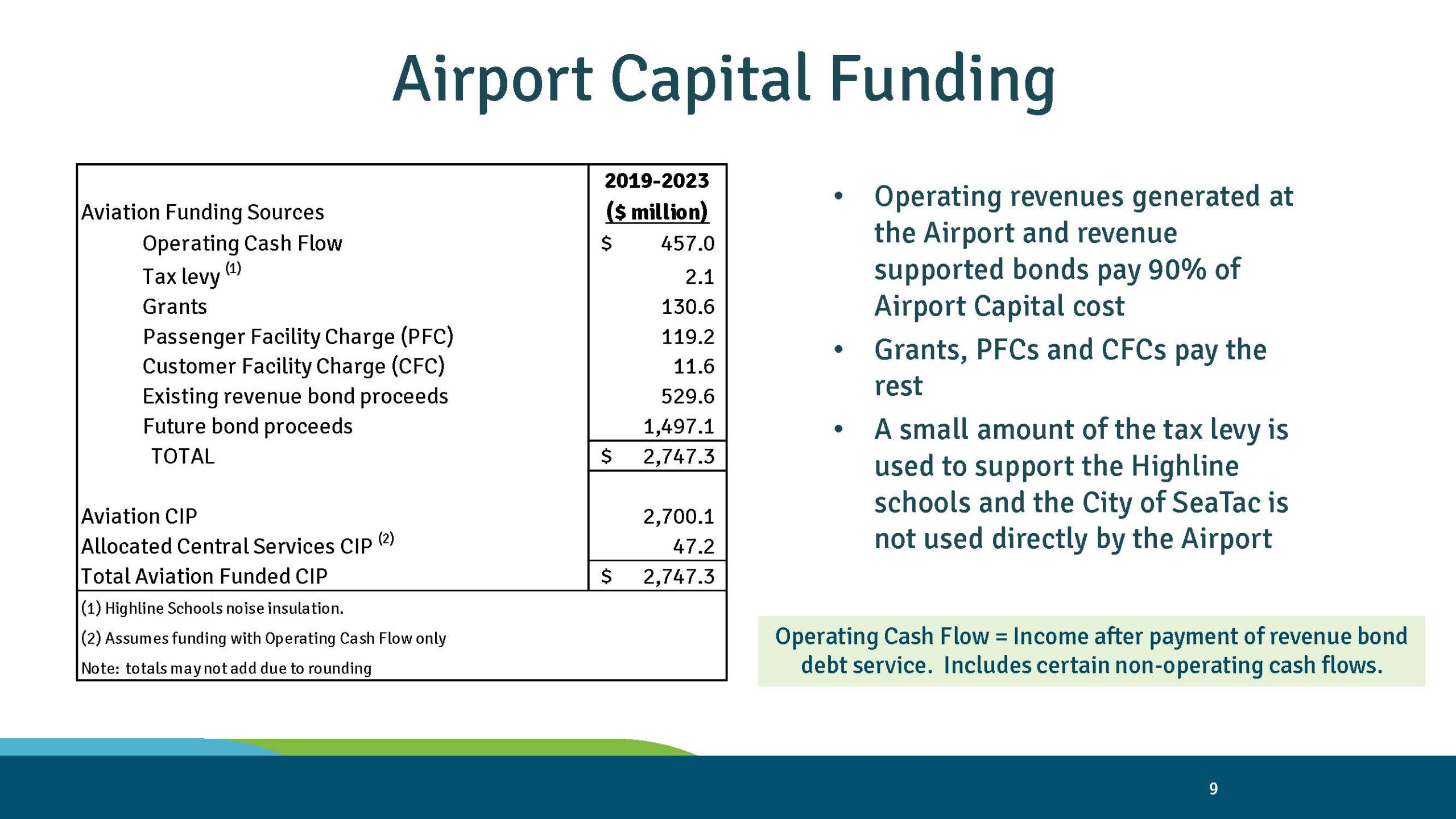
A Port of Seattle presentation slide titled 'Airport Capital Funding' details Sea-Tac Airport's 2019–2023 Capital Improvement Program (CIP) totaling $2,747.3 million, funded primarily through operating cash flow ($457M), future bond proceeds ($1,497.1M), and existing revenue bond proceeds ($529.6M). The slide notes that operating revenues and revenue-supported bonds cover 90% of airport capital costs, with grants, PFCs, and CFCs covering the remainder, and that a small tax levy supports Highline Schools noise insulation rather than direct airport use. -
Draft Finance Plan 201-2023-2018_11_13_SM_7c_supp_Page_18
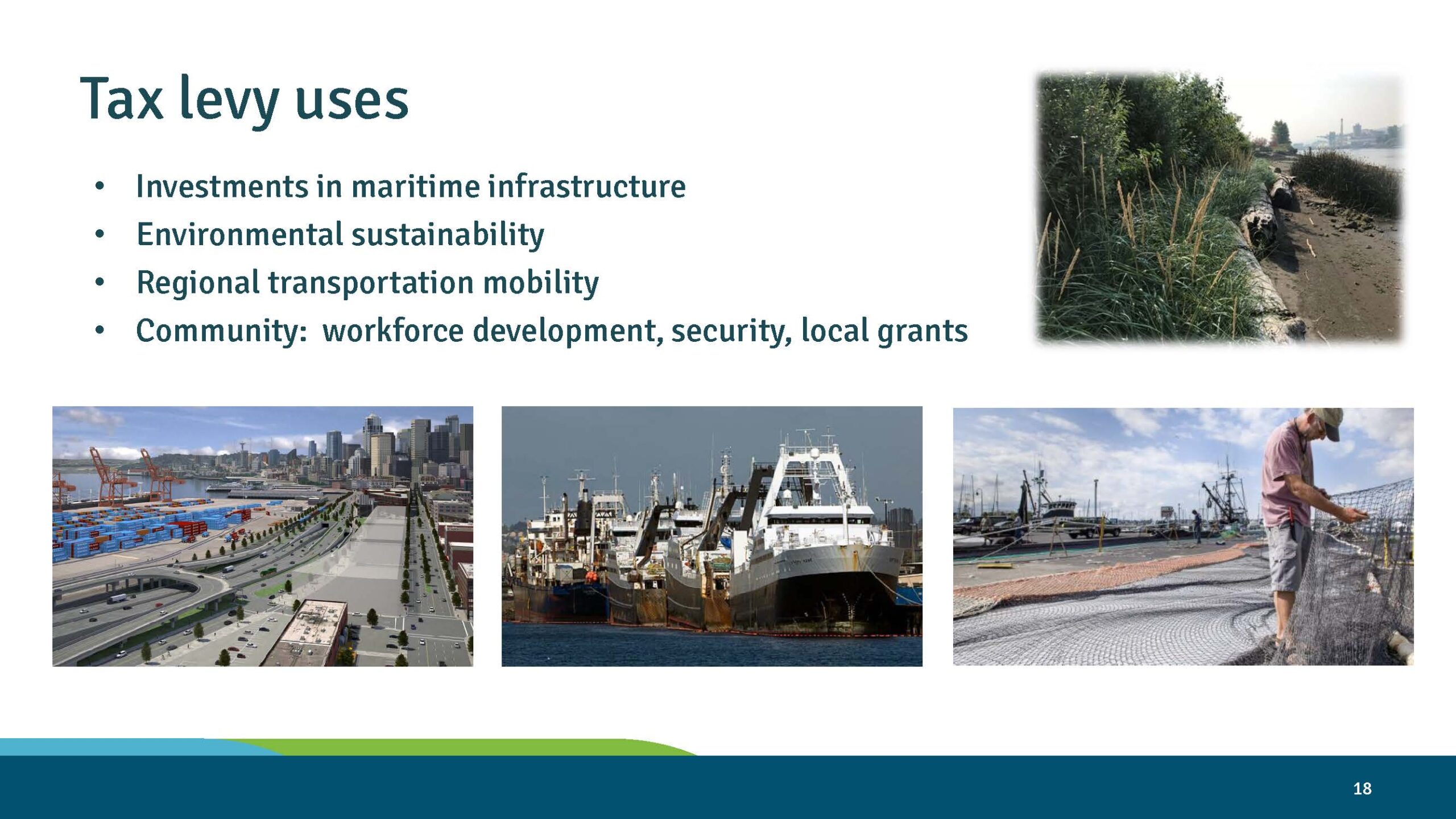
A presentation slide titled 'Tax levy uses' lists four funding categories: investments in maritime infrastructure, environmental sustainability, regional transportation mobility, and community workforce development/security/local grants. Three photos illustrate maritime port facilities, large fishing/commercial vessels at dock, and a fisherman working with nets; a fourth photo shows a shoreline restoration or environmental site. -
Draft Finance Plan 201-2023-2018_11_13_SM_7c_supp_Page_17
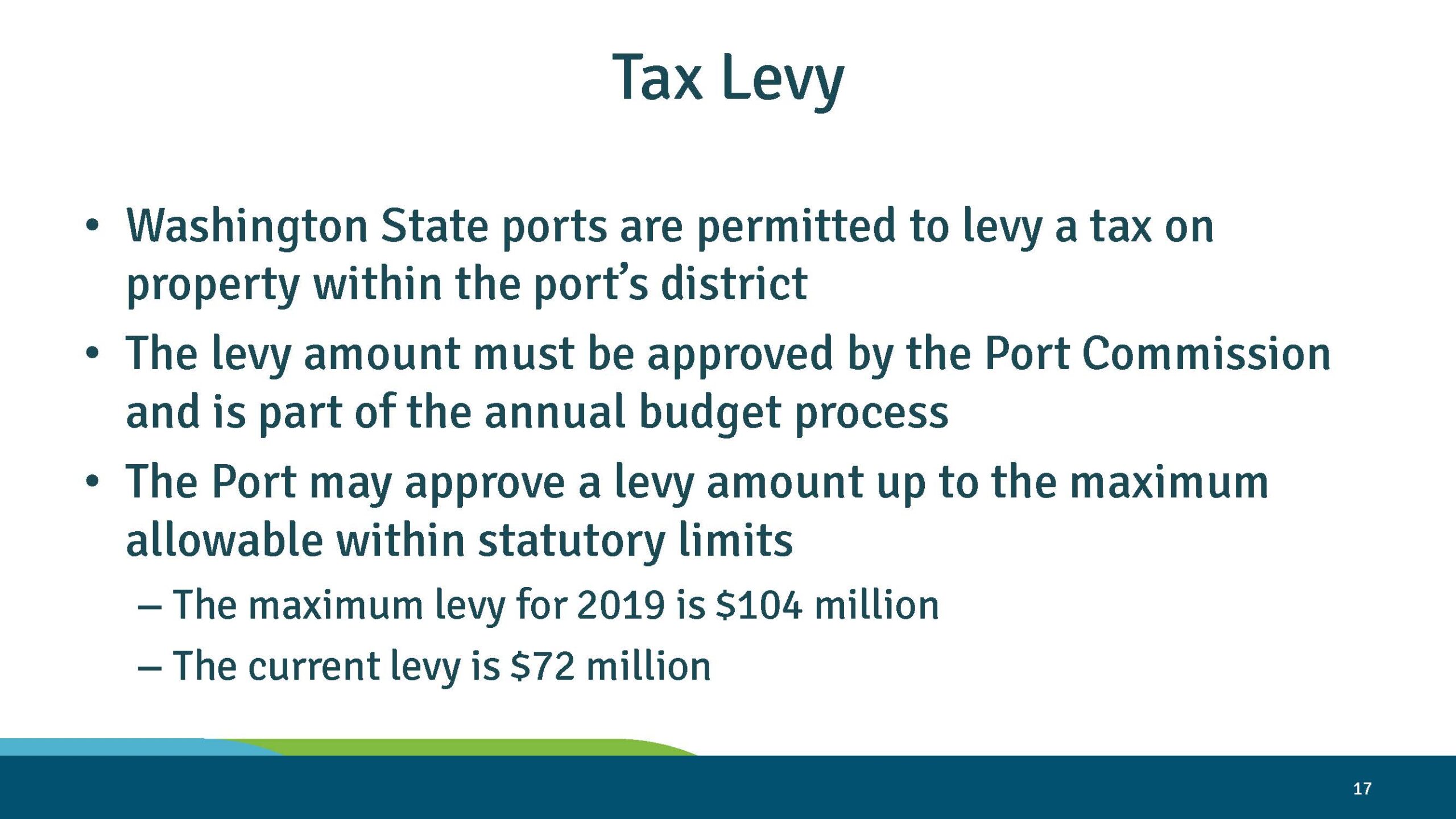
A presentation slide titled 'Tax Levy' explains that Washington State ports may levy a property tax within their district, subject to Port Commission approval as part of the annual budget process. For 2019, the maximum allowable levy is $104 million, while the current levy stands at $72 million. -
 2022-08-24
Attention King County taxpayers: Third Runway at Sea-Tac Airport
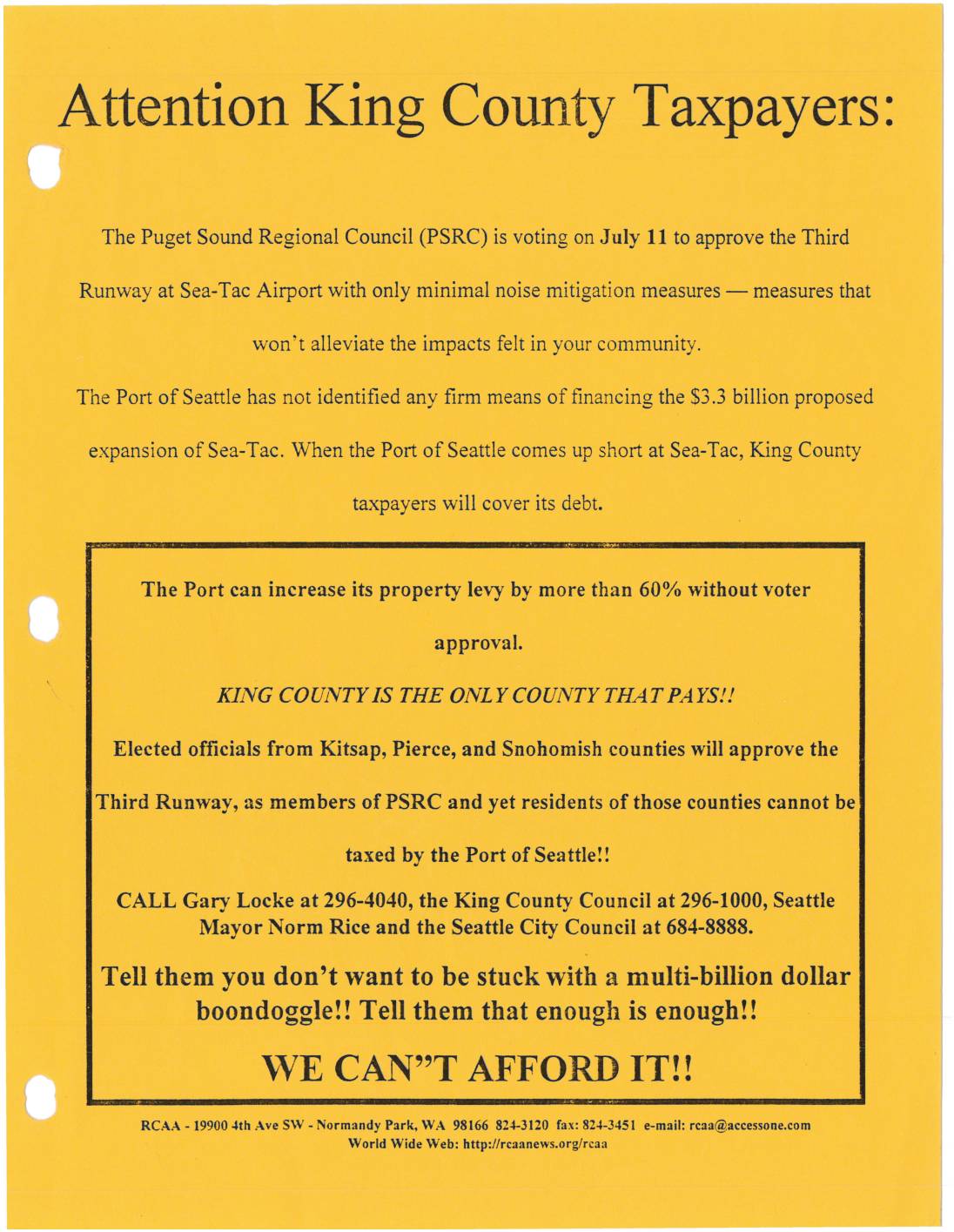
A community advocacy flyer from RCAA (Residential Communities Against Airport expansion) urges King County taxpayers to oppose the planned Third Runway at Sea-Tac Airport, warning that the Port of Seattle's $3.3 billion expansion lacks firm financing and could result in significant tax increases for King County residents. The flyer highlights that the Port can raise property levies by over 60% without voter approval, and that elected officials from neighboring counties — whose residents face no such tax burden — will have a vote in approving the project through the Puget Sound Regional Council. Residents are urged to contact local officials including King County Executive Gary Locke, Seattle Mayor Norm Rice, and their respective councils to oppose the expansion. -
Port Dracula
Using your tax dollars to drain the life from your community The Port of Seattle is much more than an airport or a seaport. It works diligently to be the economic engine of King County. By virtue of its status as a Port District under RCW 53, and as owner and operator of a Class -
 2022-01-10
King County Assessor eReal Property Record – Port Of Seattle Parcel 092204-9164, 2361 S 211th St
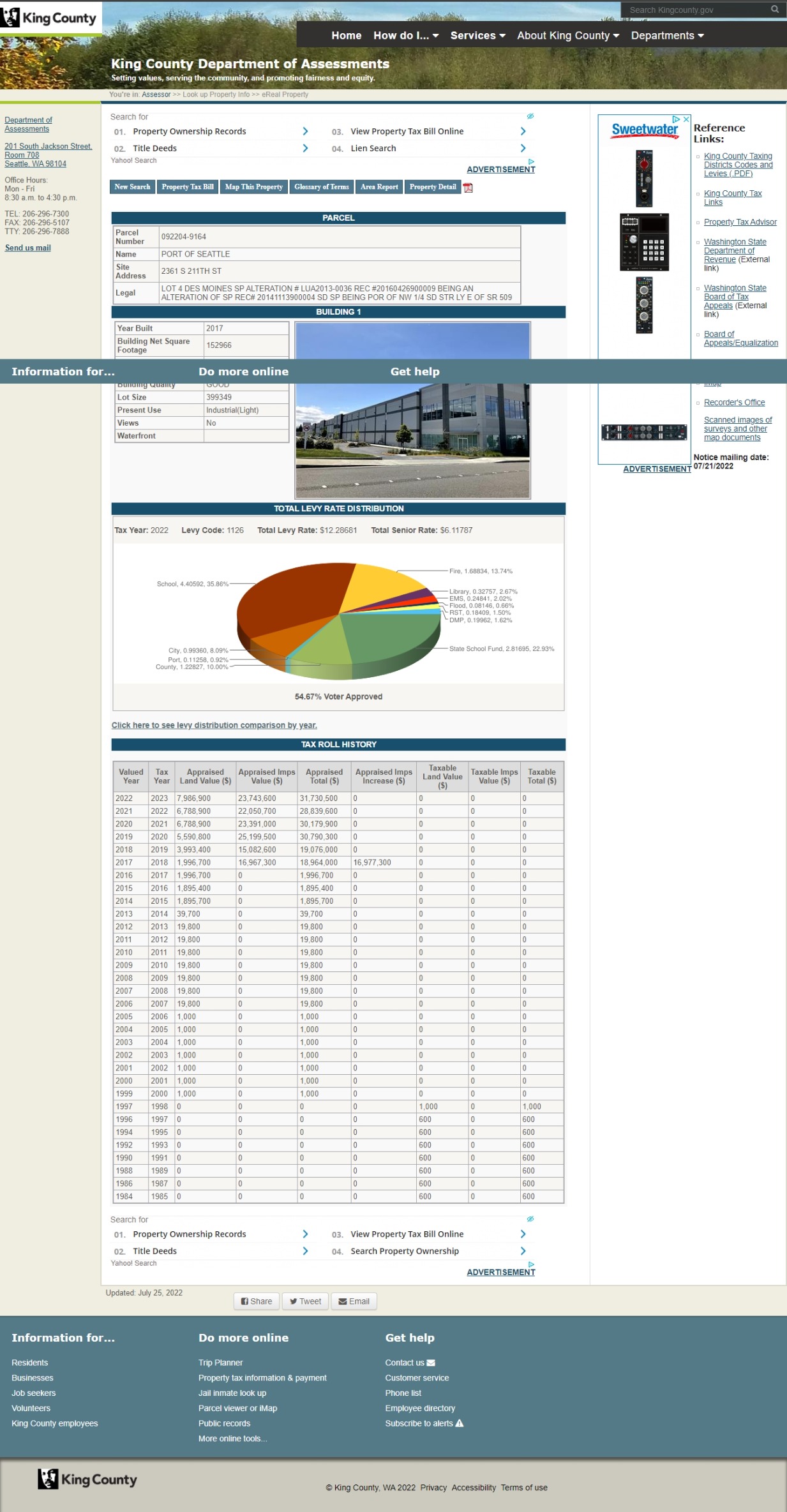
This is a King County Department of Assessments eReal Property page for Parcel 092204-9164, owned by the Port of Seattle, located at 2361 S 211th St, Des Moines, WA. The record shows a Building 1 constructed in 2017 with 152,966 square feet, zoned Industrial (Light), and includes tax roll history dating back to 1984 and a 2022 Total Levy Rate of $12.28681 under Levy Code 1126. -
 2020-02-26
Port Commission approves acceleration of noise insulation efforts for airport communities – The Waterland Blog
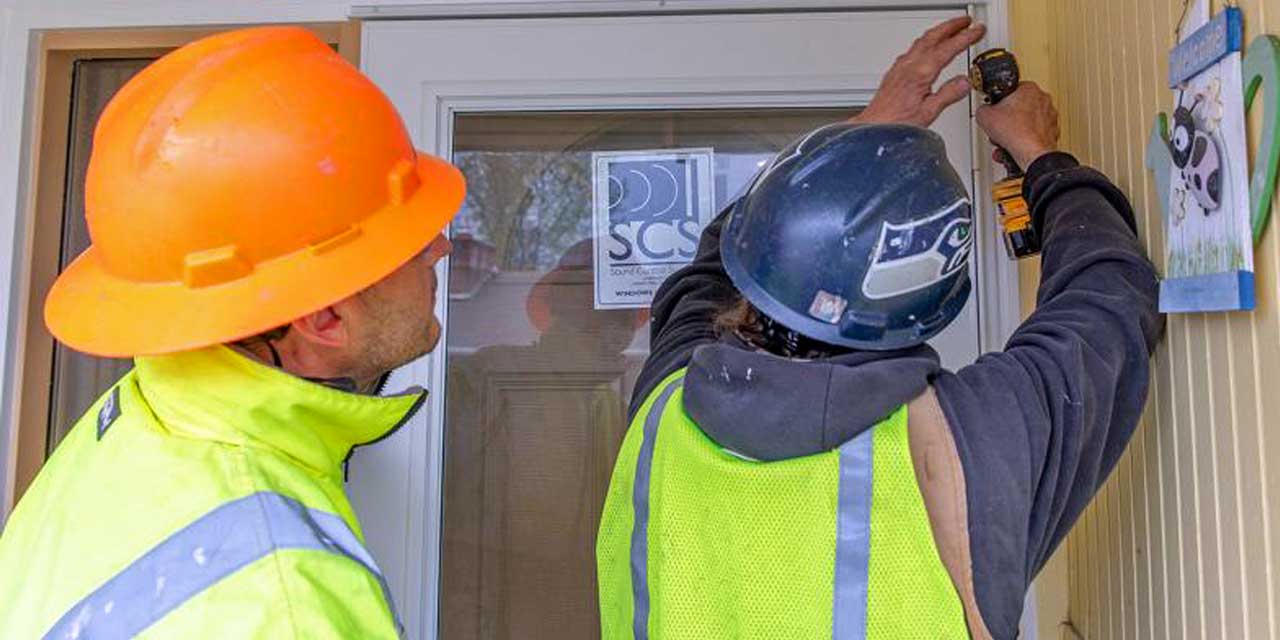
The Port of Seattle Commission this week approved the acceleration of sound insulation projects for homes, apartments, condominiums and places of worship in airport communities to be completed in less than half its current schedule. The faster noise reduction benefits near Seattle-Tacoma International Airport will cover projects originally not expected to be complete for another -
 2018-12-14
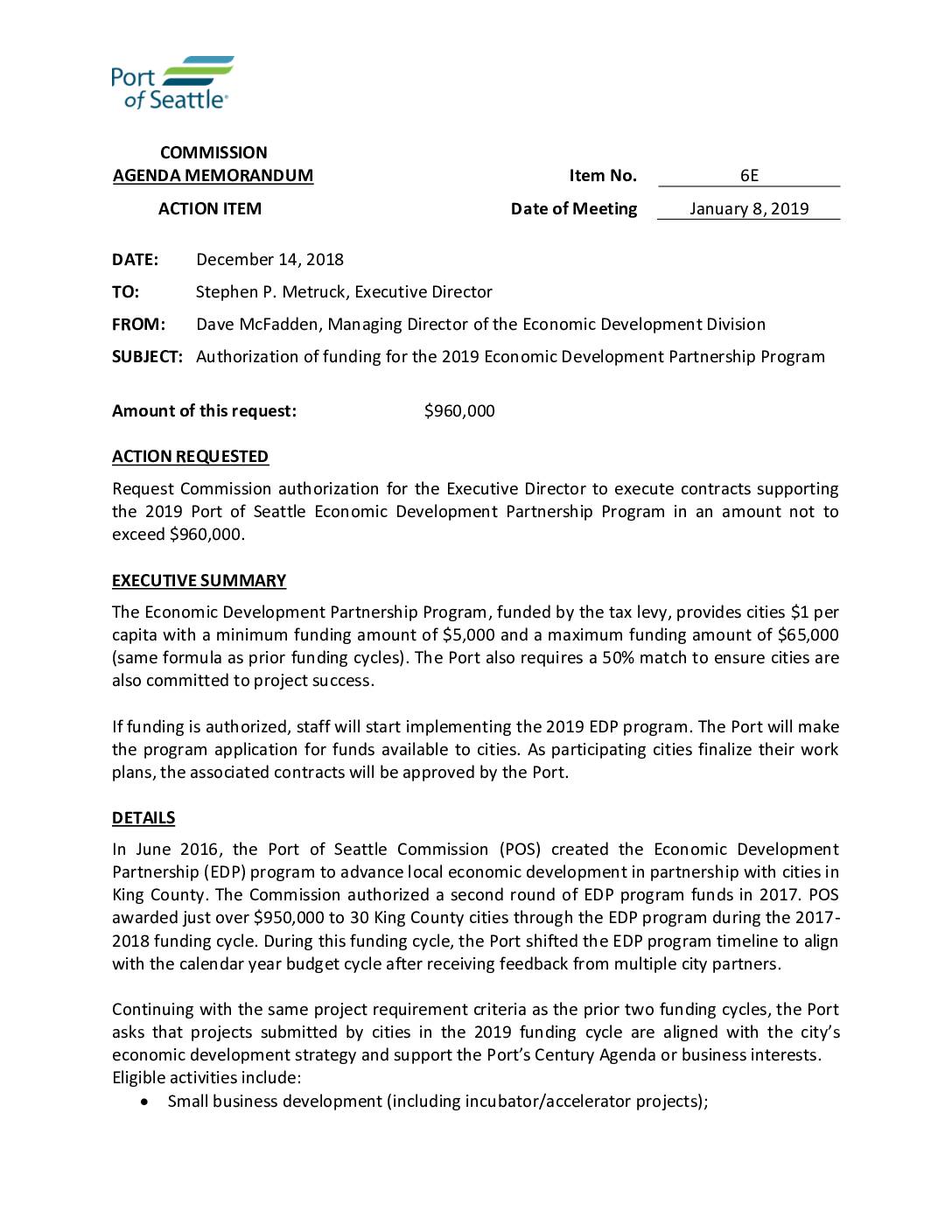
Authorization of funding for the 2019 Economic Development Partnership Program
The Port of Seattle Commission considered authorizing up to $960,000 for its 2019 Economic Development Partnership Program, which provides grant funding to King County cities based on a $1-per-capita formula (minimum $5,000, maximum $65,000) to support local economic development projects. Eligible activities include small business development, business recruitment, workforce development, tourism, and downtown revitalization, with cities required to provide a 50% funding match. The program, funded through the Port's property tax levy, has been running since 2016 and previously awarded about $950,000 to 30 King County cities during the 2017–2018 cycle.