Tagpollution
-
2020-01-17 15:27
Lora Lake Apartments
15001 Des Moines Memorial Dr Burien, King County Lora Lake Apartments Cleanup Update – February 2022 Facility Site ID: 1880040 Cleanup Site ID: 2008 Cleanup completed in January 2020. Ecology finalized the Lora Lake Apartments Site Construction As-Built Report in January 2021. The cleanup work was conducted over two construction seasons: April to December 2017, -
2020-01-17 10:11
Lawmakers want tougher carbon-reduction goals, even as WA falls short of current targets
Citing the latest scientific research, Gov. Jay Inslee is urging legislators to adopt a more aggressive course for curbing emissions. by Shauna Sowersby / January 17, 2020 Piles of wood chips sit near the RockTenn paper mill in Tacoma, June 1, 2016. State measures to limit greenhouse gas emissions from large polluters, including the mill, aren’t -
 2020-01-13 13:03
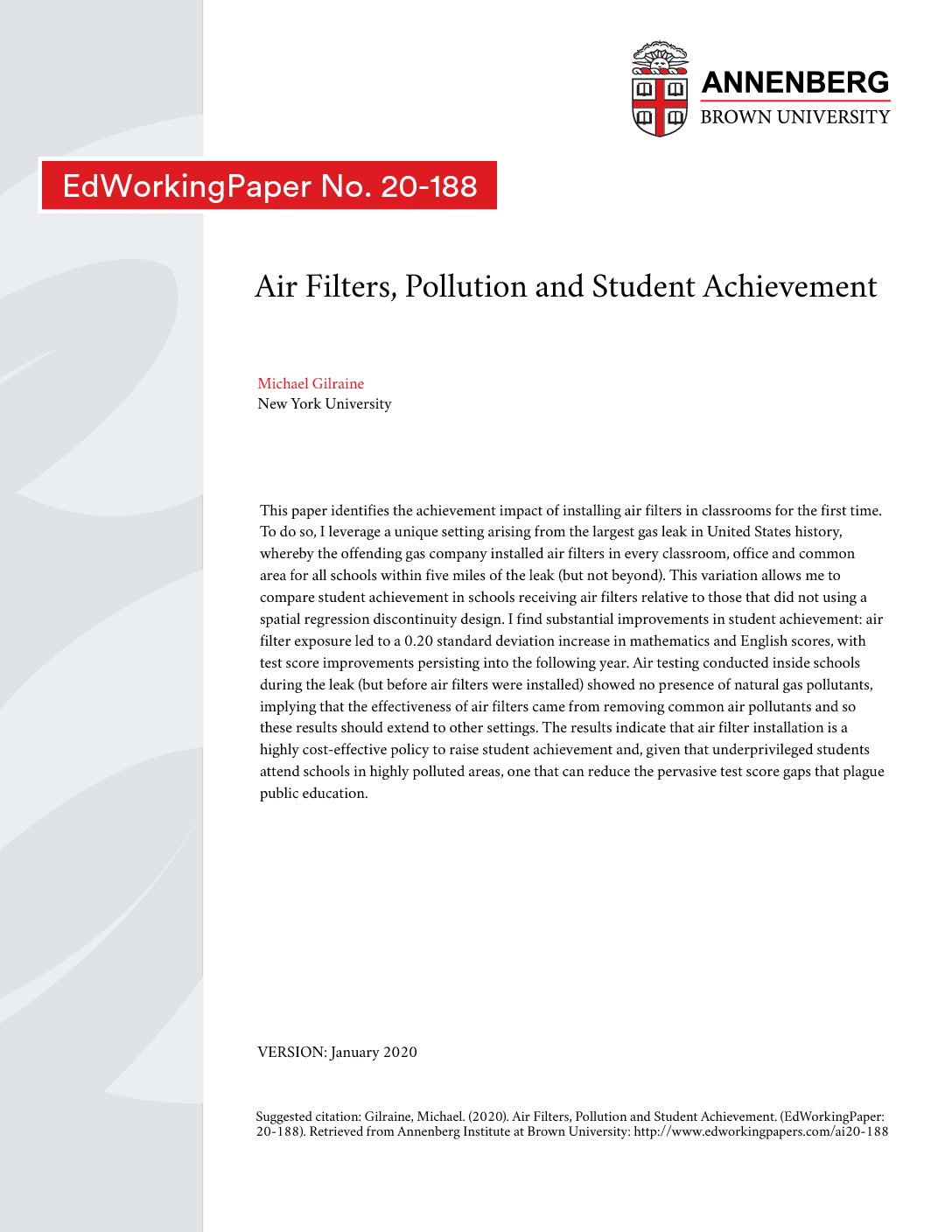
Air filters, Pollution and Student Achievement
This paper identifies the achievement impact of installing air filters in classrooms for the first time. To do so, I leverage a unique setting arising from the largest gas leak in United States history, whereby the offending gas company installed air filters in every classroom, office and common area for all schools within five miles of the leak (but not beyond). This variation allows me to compare student achievement in schools receiving air filters relative to those that did not using a spatial regression discontinuity design. I find substantial improvements in student achievement: air filter exposure led to a 0.20 standard deviation increase in mathematics and English scores, with test score improvements persisting into the following year. Air testing conducted inside schools during the leak (but before air filters were installed) showed no presence of natural gas pollutants, implying that the effectiveness of air filters came from removing common air pollutants and so these results should extend to other settings. The results indicate that air filter installation is a highly cost-effective policy to raise student achievement and, given that underprivileged students attend schools in highly polluted areas, one that can reduce the pervasive test score gaps that plague public education. Suggested citation: Gilraine, Michael. (2020). Air Filters, Pollution and Student Achievement. (EdWorkingPaper: 20-188). Retrieved from Annenberg Institute at Brown University: http://www.edworkingpapers.com/ai20-188 Michael Gilraine New York University VERSION: January 2020 EdWorkingPaper No. 20-188 Air Filters, Pollution and Student Achievement Michael Gilraine∗ Department of Economics New York University December 20, 2019 ABSTRACT… -
2020-01-08 11:45
Installing air filters in classrooms has surprisingly large educational benefits
$1,000 can raise a class’s test scores by as much as cutting class size by a third. By Matthew Yglesias@mattyglesiasmatt@vox.com An emergency situation that turned out to be mostly a false alarm led a lot of schools in Los Angeles to install air filters, and something strange happened: Test scores went up. By a -
 2019-12-13 00:00
Mobile ObserVations of Ultrafine Particles: The MOV-UP study report
The Mobile ObserVations of Ultrafine Particles (MOV-UP) study was a two-year project funded by the State of Washington to study air quality impacts of air traffic for communities located near and below the flight paths of Seattle-Tacoma International Airport. The University of Washington research team that led the study coordinated with local governments and solicited -
2019-11-15 17:10
The toxic killers in our air too small to see
Current pollution meters don’t count the very smallest pollutants – nanoparticles. Recent research suggests these tiny toxic substances could be a major cause of illness and death. By Tim Smedley 15th November 2019 A After years of headlines about air pollution, we’ve been misled on a few things about the world’s biggest environmental health problem. -
2019-07-19 13:29
The Guardian, Carbon calculator: how taking one flight emits as much as many people do in a year
Even short-haul flights produce huge amounts of CO2, figures show Niko Kommenda Fri 19 Jul 2019 09.05 GMT Taking a long-haul flight generates more carbon emissions than the average person in dozens of countries around the world produces in a whole year, a new Guardian analysis has found. The figures highlight the disproportionate carbon footprint of -
2019-05-21 21:19
Novel cardiovascular risk factors: air pollution, air temperature, pain, and sleep duration
For the podcast associated with this article, please visit https://academic.oup.com/eurheartj/pages/Podcasts. Traditionally, we have used age, gender, body mass index, blood pressure, lipids, smoking, and diabetes to assess cardiovascular (CV) risk. However, up until recently, the CV risk provided by environemental hazards such as pollution,1–3 noise,4–6 temperature,7 sleep duration8, and air quality,9,10 among others, have been -
2019-05-12 10:16
Emissions from planes and ships: facts and figures (infographic)
Greenhouse gas emissions from international aviation have more than doubled over the past two decades, while those from shipping have also increased. Check out our infographics. Although international aviation and shipping each account for less than 3.5% of the EU’s total greenhouse gas emissions, they have been the fastest growing sources of emissions that contribute -
 2019-04-17 20:35
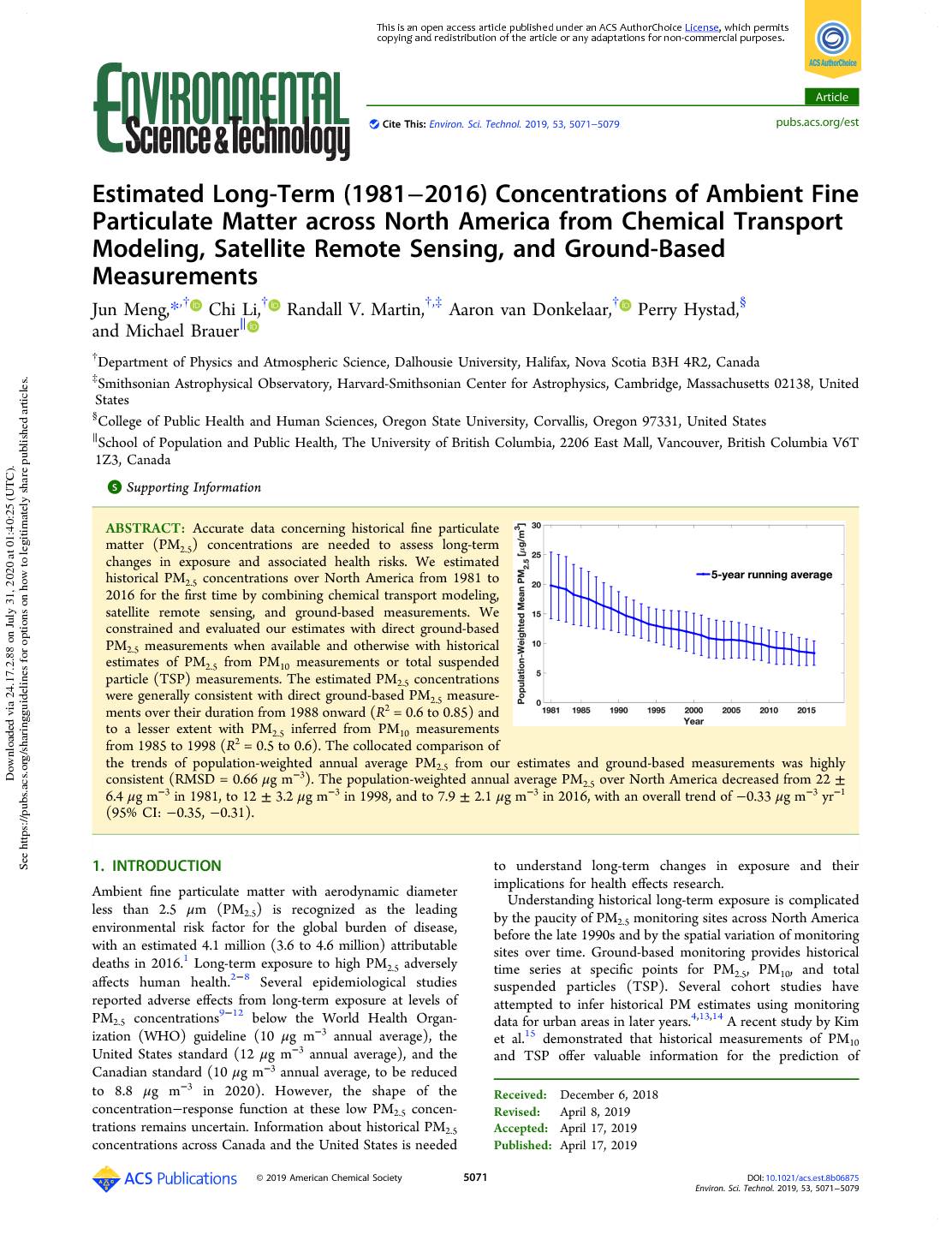
Estimated Long-Term (1981−2016) Concentrations of Ambient Fine Particulate Matter across North America from Chemical Transport Modeling, Satellite Remote Sensing, and Ground-Based Measurements
Estimated Long-Term (1981−2016) Concentrations of Ambient Fine Particulate Matter across North America from Chemical Transport Modeling, Satellite Remote Sensing, and Ground-Based Measurements Jun Meng,*,† Chi Li,† Randall V. Martin,†,‡ Aaron van Donkelaar,† Perry Hystad,§ and Michael Brauer∥ †Department of Physics and Atmospheric Science, Dalhousie University, Halifax, Nova Scotia B3H 4R2, Canada ‡Smithsonian Astrophysical Observatory, Harvard-Smithsonian Center for Astrophysics, Cambridge, Massachusetts 02138, United States §College of Public Health and Human Sciences, Oregon State University, Corvallis, Oregon 97331, United States ∥School of Population and Public Health, The University of British Columbia, 2206 East Mall, Vancouver, British Columbia V6T 1Z3, Canada *S Supporting Information ABSTRACT: Accurate data concerning historical fine particulate matter (PM2.5) concentrations are needed to assess long-term changes in exposure and associated health risks. We estimated historical PM2.5 concentrations over North America from 1981 to 2016 for the first time by combining chemical transport modeling, satellite remote sensing, and ground-based measurements. We constrained and evaluated our estimates with direct ground-based PM2.5 measurements when available and otherwise with historical estimates of PM2.5 from PM10 measurements or total suspended particle (TSP) measurements. The estimated PM2.5 concentrations were generally consistent with direct ground-based PM2.5 measure- ments over their duration from 1988 onward (R2 = 0.6 to 0.85) and to a lesser extent with PM2.5 inferred from PM10 measurements from 1985 to 1998 (R2 = 0.5 to 0.6). The collocated comparison of the trends of population-weighted annual average PM2.5 from our estimates and ground-based measurements was highly consistent (RMSD = 0.66 μg m−3). The population-weighted…