Tagindoor air quality(33)
-
 2020-10-19
Funding of Phase I of a University of Washington study in partnership with the cities of Des Moines, Federal Way, Normandy Park, and SeaTac — School resilience to air pollution
In October 2020, the City of Burien considered joining Des Moines, Federal Way, Normandy Park, and SeaTac in funding a $62,500 University of Washington study examining how ultrafine particles from aircraft emissions penetrate school buildings near Sea-Tac Airport. The first phase of the study would assess the air filtration efficiency of five schools located north and south of the airport, while a proposed second phase ($250,000) would test interventions to improve indoor air quality and measure their impact on student health and academic performance. Each participating city was asked to contribute $12,500, with the City Manager recommending approval of an Interlocal Agreement to move the project forward. -
Sea-Tac Airport improves air quality in new North Satellite Terminal amid COVID-19 concerns
Engineers at Sea-Tac Airport are working to boost safety around the coronavirus inside the new North Satellite Terminal with an improved HVAC system. Author: Glenn Farley Published: 8:30 PM PDT August 26, 2020 SEATAC, Wash. — Some passengers may be nervous about flying in airplanes right now over the fear of contracting coronavirus, but what -
Coronavirus is in the air. Here’s how to get it out.
How to make indoor air safer (but not necessarily safe) during the pandemic. By Brian Resnick@B_resnickbrian@vox.com Part of The Vox guide to navigating the coronavirus crisis SARS-CoV-2, the virus that causes Covid-19, can float in the air. In particular, it can linger in poorly ventilated indoor spaces, spreading farther than 6 feet from -
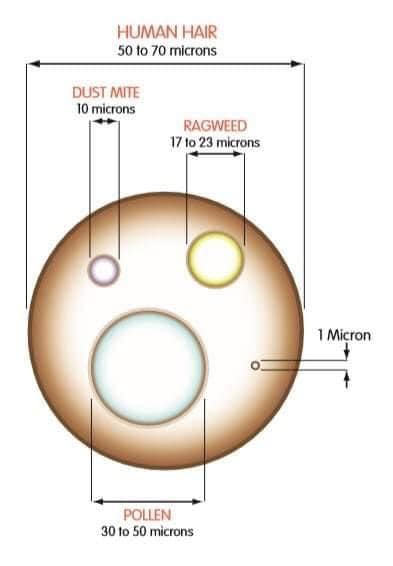
Relative sizes of various allergens
Diagram comparing the sizes of common airborne particles including human hair (50–70 microns), pollen (30–50 microns), ragweed (17–23 microns), dust mite (10 microns), and a 1-micron reference marker. The illustration uses scaled circles to visually represent relative particle sizes, relevant to air quality and filtration contexts. -
An Open Letter To Joel Wachtel re. HB2315
Mr. Wachtel is a member of the SeaTac City Council and chairs their Aviation Advisory Committee. The following letter was e-mailed to key Councilmembers in Des Moines, SeaTac, Normandy Park, Tukwila and Federal Way. Hi Joel, As I mentioned at yesterday’s Highline Forum, HB2315 is moving ahead very fast. There have been two hearings so -
Installing air filters in classrooms has surprisingly large educational benefits
$1,000 can raise a class’s test scores by as much as cutting class size by a third. By Matthew Yglesias@mattyglesiasmatt@vox.com An emergency situation that turned out to be mostly a false alarm led a lot of schools in Los Angeles to install air filters, and something strange happened: Test scores went up. By a -
 2019-09-01
Research, policies, and program options for improving indoor environmental quality
This EPA report, prepared by David Mudarri PhD in 2018, reviews the state of science on indoor environmental quality and outlines research, policy, and program options for improving it. The synthesis paper was developed to help the EPA establish research goals, objectives, and priorities across a wide range of indoor environmental topics and time frames. It is intended solely for internal EPA use due to the inclusion of copyrighted material from broad-based review articles. -
 2019-02-20
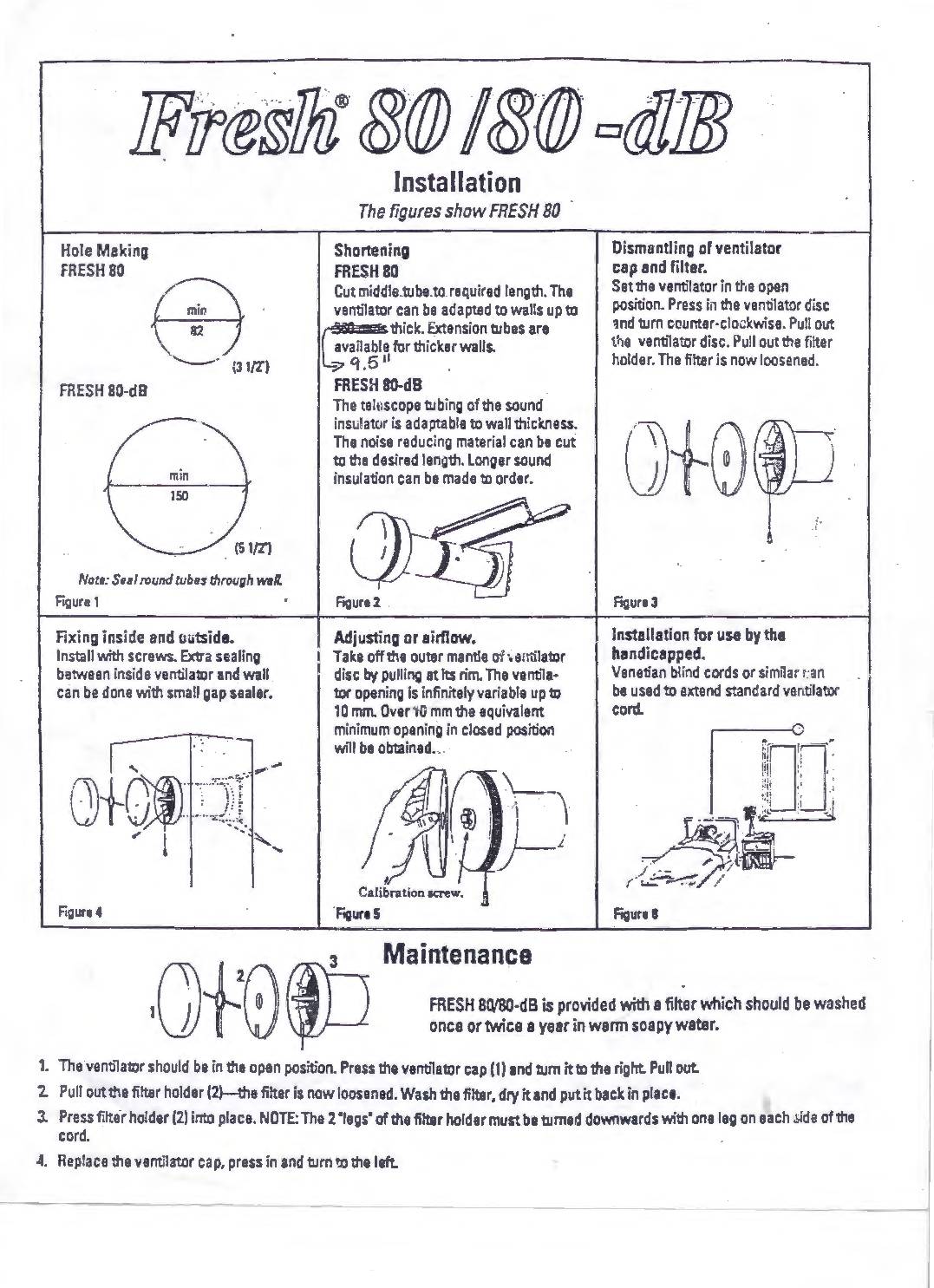
Fresh 80 / 80-dB Fresh Air Ventilator Installation and Maintenance Manual
The Fresh 80 and Fresh 80-dB are Swedish-made wall ventilators designed for quick installation through an exterior wall, offering fully adjustable and closeable airflow with 360-degree draft-free diffusion. The 80-dB model includes telescoping sound-insulating tubing adaptable to various wall thicknesses, making it suitable for noise-sensitive environments. Maintenance involves washing the built-in filter once or twice a year and can be adapted for use by handicapped individuals using extended cords. -
 2018-07-01
Residential air cleaners: A technical summary
This EPA technical guide explains how residential air cleaners and HVAC filters work to reduce indoor air pollutants, covering different device types, their effectiveness, and health impacts. It reviews technologies such as fibrous media filters, HEPA filters, electrostatic precipitators, and ionizers, while noting important cautions about byproduct emissions like ozone. Though focused on home air quality rather than airport noise policy, it offers useful background on indoor environmental controls for residential settings near noise-impacted areas. -
 2018-02-07
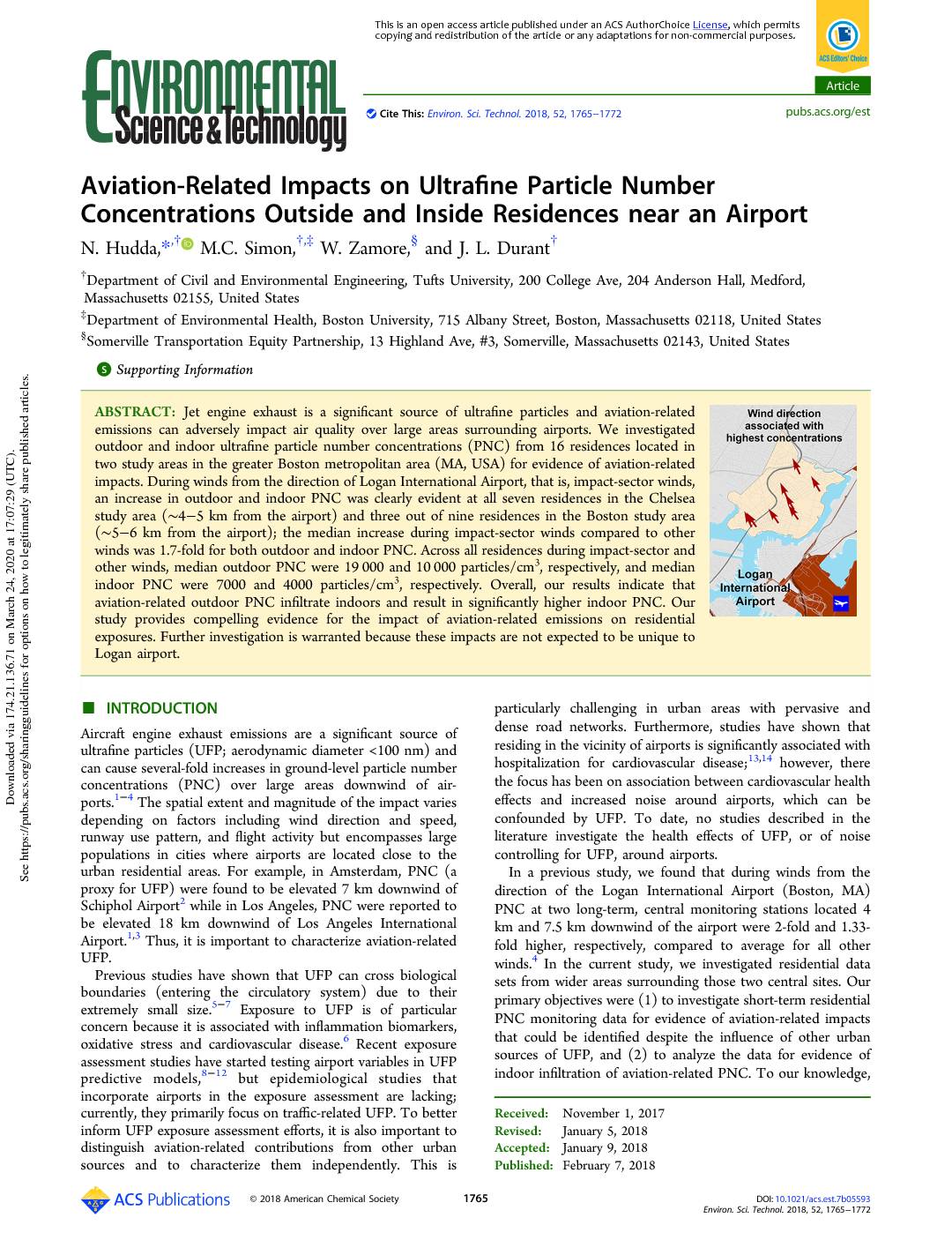
Aviation-related impacts on ultrafine particle number concentrations outside and inside residences near an airport
A study of residences near Boston's Logan International Airport found that jet engine exhaust significantly raises ultrafine particle concentrations both outdoors and indoors, with levels roughly 1.7 times higher when winds blow from the airport's direction. Researchers monitored 16 homes located 4–6 km from the airport and confirmed that aviation-related particles penetrate inside residences, posing potential health risks to nearby communities. While focused on Logan Airport, the authors note these findings are likely applicable to other major airports, including those in dense urban areas.