TagEPA(36)
-
 2022-06-30 00:00
West Virginia v. EPA – Supreme Court Decision, 20-1530
NOTE: Where it is feasible, a syllabus (headnote) will be released, as is being done in connection with this case, at the time the opinion is issued. The syllabus constitutes no part of the opinion of the Court but has been prepared by the Reporter of Decisions for the convenience of the reader. See United States v. Detroit Timber & Lumber Co., 200 U. S. 321, 337. SUPREME COURT OF THE UNITED STATES Syllabus WEST VIRGINIA ET AL. v. ENVIRONMENTAL PROTECTION AGENCY ET AL. CERTIORARI TO THE UNITED STATES COURT OF APPEALS FOR THE DISTRICT OF COLUMBIA CIRCUIT No. 20–1530. Argued February 28, 2022—Decided June 30, 2022* In 2015, the Environmental Protection Agency (EPA) promulgated the Clean Power Plan rule, which addressed carbon dioxide emissions from existing coal- and natural-gas-fired power plants. For authority, the Agency cited Section 111 of the Clean Air Act, which, although known as the New Source Performance Standards program, also au- thorizes regulation of certain pollutants from existing sources under Section 111(d). 42 U. S. C. §7411(d). Prior to the Clean Power Plan, EPA had used Section 111(d) only a handful of times since its enact- ment in 1970. Under that provision, although the States set the actual enforceable rules governing existing sources (such as power plants), EPA determines the emissions limit with which they will have to com- ply. The Agency derives that limit by determining the “best system of emission reduction . . . that has been adequately demonstrated,” or the BSER, for… -
2020-12-28 17:32
U.S. Implementing 1st-Ever Airplane Emission Rules; Critics Say They’re Ineffective
A Southwest Airlines flight takes off as United Airlines planes sit parked on a runway at Denver International Airport in April. Michael Ciaglo/Getty Images The U.S. is regulating greenhouse gas emissions from commercial aircraft for the first time. But critics are saying the rules will be ineffective. The Environmental Protection Agency said Monday the rules -
2020-07-22 23:17
What Airports Need to Know About Potential PFAS Liabilities
Learn more about the latest in PFAS regulations and how Jacobs can help in this article. Over the past several years, there has been a surge in regulatory interest to address the public health and environmental risks from releases of per- and polyfluoroalkyl substances (PFAS), including use of aqueous film-forming foams (AFFF) for firefighting or -
2019-06-21 19:12
The Supreme Court’s Covert Plan to Gut the EPA’s Powers
Ian Millhiser/June 21, 2019 The conservative justices signaled they want to limit agencies’ ability to regulate. That could have disastrous consequences for the planet. Nearly four decades ago, Anne Gorsuch Burford resigned as the head of the Environmental Protection Agency. Though at the helm for less than two years, she left behind a notorious anti-environment -
 2018-12-21 00:00
Beacon Hill Noise Project 2018 Rpt
Members/Beacon Hill residents: Ariana Casey, Bridget Ferriss, Deirdre Curle, Joe Albert, Lynda Wong, Monique Cherrier, Ray Nicoli, Roseanne Lorenzana Advisor: Dr. Edmund Seto, Univ of Wash Dept of Occupational & Environmental Science, School of Public Health Summer interns/UW Class of 2019: Eileen Tran, Phan Su Contact: Dr. Roseanne Lorenzana, contact@chacusa.org or rlorenza@uw.edu Acknowledgements The Beacon Hill Noise Team would like to thank Alicia Diefenbach and the Verity Credit Union microgrant program for providing funds to purchase the noise measurement equipment and the Beacon Hill Merchants Association for being the fiscal sponsor for the Verity CU funds. We would also like to thank Estela Ortega, El Centro de la Raza and U.S.EPA Region 10 for providing the funds to support our summer interns (USEPA Problem Solving Collaboration 01J27101 Community Empowerment Grant). And, a big thanks to all the Beacon Hill residents who volunteered to host a noise measurement device at their home. This project was possible because of the work of the Beacon Hill volunteer community. Introduction The overarching goal of the project was to conduct Citizen Science measurements with University of Washington undergraduate student summer interns paid by El Centro de la Raza to help residents collect noise measurements. The project aimed to empower residents to collect new noise measurement data, which may benefit future follow-up activities, including collecting additional measurements, improving community awareness of noise levels, and follow-up research by others to quantify relationships to potential noise sources and health impacts. This is the first project to collect quality… -
 2018-07-15 00:00
EPA: Residential Air Cleaners – a technical summary 3rd edition
EPA 402-F-09-002 | July 2018 | EPA Indoor Environments Division | www.epa.gov/iaq R E S I D E N T I A L A I R C L E A N E R S A T e c h n i c a l S u m m a r y www.epa.gov/iaq RESIDENTIAL AIR CLEANERS FOREWORD This document was developed by the U.S. Environmental Protection Agency (EPA), Office of Radiation and Indoor Air, Indoor Environments Division. It focuses on air cleaners for residential use; it does not address air cleaners used in large or commercial structures such as office buildings, schools, large apartment buildings, or public buildings. It should be particularly useful to residential housing design professionals, public health officials, and indoor air quality professionals. It may serve as a reference for anyone who designs, builds, operates, inspects, maintains, or otherwise works with buildings, heating, ventilating and air conditioning (HVAC) equipment, and/or portable air cleaners/sanitizers. This includes home services professionals, builders, remodelers, contractors, and architects. In addition to providing general information about the types of pollutants affected by air cleaners, this document discusses the types of air-cleaning devices and technologies available, metrics that can be used to compare air-cleaning devices, the effectiveness of air-cleaning devices in removing indoor air pollutants, and information from intervention studies on the effects that air cleaners can have on health and on health markers. A briefer companion publication, designed for the general public, Guide to Air Cleaners in the Home, is also available on the… -
 2016-07-01 21:01
Environmental Justice, before and after Executive Order 12898: What are agencies doing, how well are they doing it, and what else can be done?
This paper examines environmental justice requirements, best practices, and challenges facing federal agencies since Executive Order 12898. It explores the gap in EJ implementation after the order’s issuance, analyzes case studies from Porter Ranch and Flint, and proposes stopgap measures for consistent federal EJ compliance. -
 2007-04-02 00:00
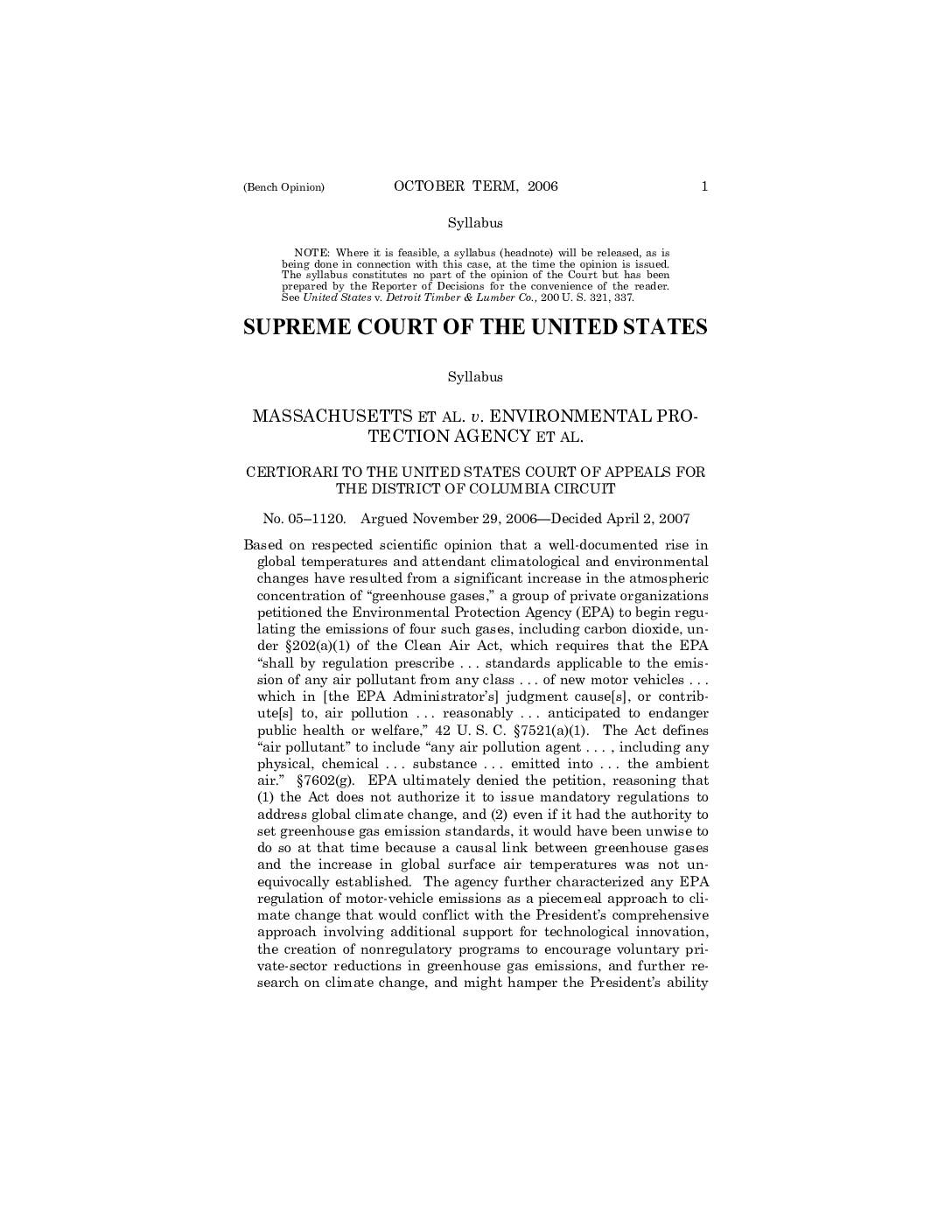
Massachusetts v. Environmental Protection Agency Supreme Court Decision
Supreme Court syllabus for Massachusetts v. EPA case regarding EPA’s denial of petition to regulate greenhouse gas emissions from motor vehicles under the Clean Air Act. The Court ruled that petitioners have standing to challenge EPA’s denial and that the agency must consider regulating greenhouse gases.