TagEdmund Seto(16)
-
What are they getting exposed to out there?
April 29, 2019 | Lynn Schnaiberg Research led by UW DEOHS measures air traffic pollution around Sea-Tac Airport to understand potential health effects on nearby communities UW DEOHS leads the first study to systematically track aircraft-related air pollution in the communities around Seattle-Tacaoma International Airport. Photo: Don Wilson, Port of Seattle. JC Harris lives on -
 2019-04-01
Ambient Ultrafine Particles Near Sea-Tac Airport: Presentation to the Federal Way Transportation & Planning Commission
Researchers from the University of Washington studied ultrafine particles (UFPs) — tiny airborne pollutants less than 100 nanometers in diameter — near Seattle-Tacoma International Airport. Their findings highlight that jet aircraft engines produce exceptionally small particles (under 30 nanometers), while diesel vehicles also contribute elevated UFP levels within about 200 meters of major roads. Although UFPs are currently unregulated, a growing body of scientific evidence suggests they pose significant health risks to nearby communities. -
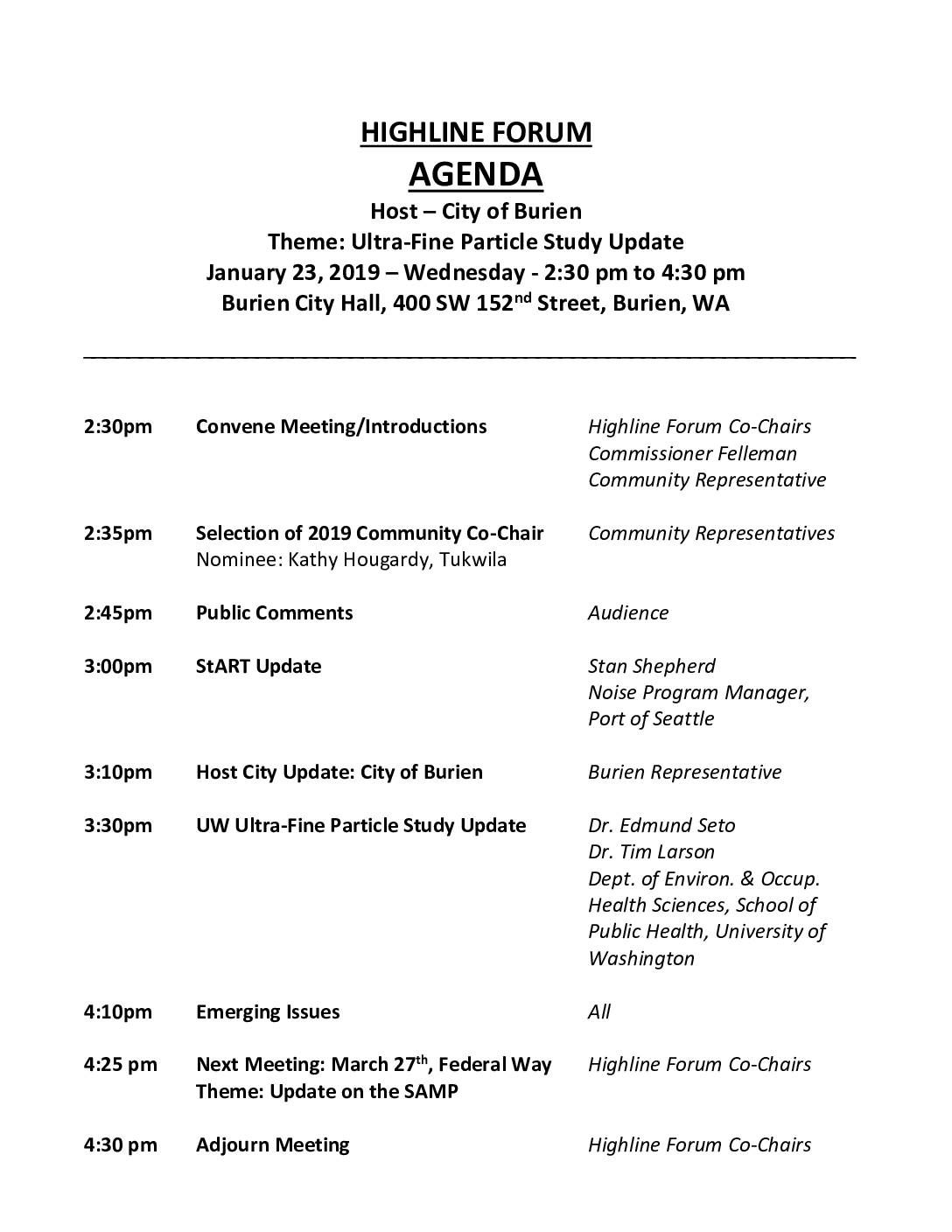 2019-01-23
Highline Forum agenda: Ultra-Fine Particle Study Update, January 23, 2019
The Highline Forum held its January 23, 2019 meeting at Burien City Hall, focusing on an update of the University of Washington's Ultra-Fine Particle Study presented by researchers from the UW School of Public Health. The agenda also included a StART program update from the Port of Seattle's Noise Program Manager, selection of a 2019 Community Co-Chair, and a City of Burien host update. The forum scheduled six bimonthly meetings throughout 2019, rotating among cities near Seattle-Tacoma International Airport including Federal Way, SeaTac, Tukwila, and Des Moines. -
 2018-12-21
Beacon Hill noise measurement project summer 2018
In summer 2018, Beacon Hill residents partnered with University of Washington researchers to measure noise levels at 52 locations across Seattle's Beacon Hill neighborhood over several months, collecting 136 separate 24-hour measurement periods. The study found that the neighborhood is heavily affected by aircraft noise from three nearby airports — Seattle-Tacoma International, King County International, and Renton Municipal — with Sea-Tac arrival flight paths directly overlying the area and King County International Airport runways located as close as a quarter mile away. The project represents the first quality-assured, community-led noise dataset of its kind for Beacon Hill, and was designed to inform future research into the health impacts of airport noise on residents. -
 2018-12-02
Beacon Hill Seattle Community Noise Team presentation
The Beacon Hill Seattle Community Noise Team, a group of neighborhood residents working with the University of Washington, has been documenting the disproportionate impact of Sea-Tac Airport aircraft noise on their community. Building on decades of prior advocacy—including a landmark April 2000 report by Citizens for Aircraft Noise Equity—the team highlights that official noise impact assessments still rely on mathematical models rather than actual measured data. Beginning in October 2017, they launched a citizen science effort to conduct systematic, long-term noise measurements throughout the Beacon Hill neighborhood, with a focus on health effects and impacts on children's learning. -
2017 Washington State Senate Bill 6032 Sec. 602 (19) MOV-UP Study
“$125,000 of the general fund—state appropriation for fiscal year 2018 and $125,000 of the general fund—state appropriation for fiscal year 2019 are provided solely for the University of Washington school of public health to study the air quality implications of air traffic at the international airport in the state that has the highest total annual