TagPSRC(154)
-
 1996-06-27
Puget Sound Regional Council Executive Board Meeting Agenda — June 27, 1996
The Puget Sound Regional Council held an Executive Board meeting on June 27, 1996, at the Seattle Center Flag Pavilion, featuring a public hearing and board deliberations on regional transportation matters. A key item on the agenda was a recommendation to the General Assembly on amending the Metropolitan Transportation Plan (MTP) to incorporate plans for Sea-Tac Airport expansion accompanied by additional noise reduction measures. The meeting also addressed transportation plan certifications, transit authority system plan consistency, and routine amendments to regional transportation improvement programs. -
1996-06-27
Puget Sound Regional Council Executive Board Meeting Agenda — June 27, 1996
Agenda for the Puget Sound Regional Council (PSRC) Executive Board Meeting held June 27, 1996, at the Seattle Center Flag Pavilion, Seattle, WA. Presided over by Executive Doug Sutherland, President. Public hearing from 9:00 a.m. to 12:00 noon, followed by Executive Board deliberation. Consent agenda items include approval of minutes from April 25, 1996; vouchers -
 1996-05-30
Puget Sound Regional Council Executive Board Workshop Agenda — May 30, 1996
The Puget Sound Regional Council held an Executive Board Workshop on May 30, 1996, at the Bellevue Conference Center to discuss and respond to Expert Panel recommendations on noise reduction measures. The day-long session included board dialogue aimed at directing staff to prepare a Draft Metropolitan Transportation Plan Amendment—including a refined list of noise reduction measures—for public review before a June 27, 1996 vote. The workshop was part of an ongoing regional planning process addressing transportation-related noise impacts in the greater Seattle–Puget Sound area. -
1996-05-30
Puget Sound Regional Council Executive Board Workshop Agenda — May 30, 1996
Agenda for the Puget Sound Regional Council (PSRC) Executive Board Workshop held May 30, 1996 at the Bellevue Conference Center, 121 107th Avenue NE, Bellevue, WA, beginning at 9:00 a.m. Presided over by Executive Doug Sutherland, President. Items include: Regional Council Response to Expert Panel Recommendations, Summary of Responses to Expert Panel Recommendations (Attachment 2), -
 1996-04-25
Puget Sound Regional Council Executive Board Meeting Agenda – April 25, 1996
The Puget Sound Regional Council (PSRC) held an Executive Board Meeting on April 25, 1996, at the Olympic Room, Seattle Center, beginning at 9:00 A.M. A key agenda item was a communications packet regarding an Expert Arbitration Panel's decision on airport noise and demand/system management issues, with follow-up action on noise also listed under New Business. The meeting covered additional regional transportation matters, including certification of local comprehensive plan transportation elements and amendments to the 1996–98 Transportation Improvement Program (TIP). -
1996-04-25
Puget Sound Regional Council Executive Board Meeting Agenda – April 25, 1996
Agenda for the Puget Sound Regional Council (PSRC) Executive Board meeting held April 25, 1996, at 9:00 A.M. in the Olympic Room, Seattle Center, Seattle, WA. Presided over by Executive Doug Sutherland, President. Agenda includes citizen comments, communications regarding Expert Arbitration Panel decision on noise and demand/system management, consent agenda items including approval of minutes -
 1996-03-27
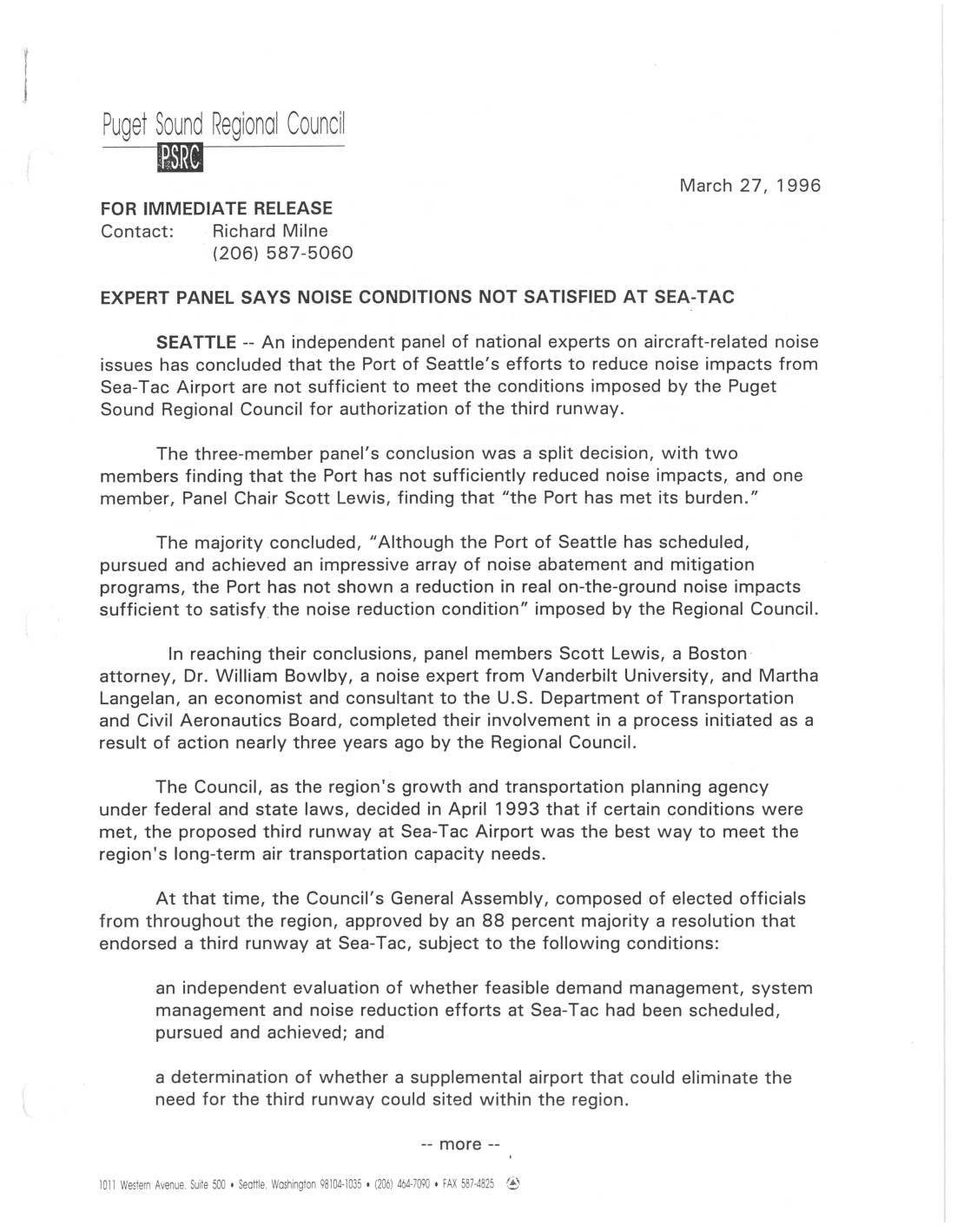
Expert panel says noise conditions not satisfied at Sea-Tac
In March 1996, an independent expert panel concluded by a 2-1 vote that the Port of Seattle had not done enough to reduce real-world noise impacts from Sea-Tac Airport to meet the conditions set by the Puget Sound Regional Council for approving a third runway. While the panel acknowledged the Port's extensive noise abatement programs, the majority found they fell short of the meaningful reductions required under Resolution A-93-03. The panel also determined that neither demand management improvements nor alternative transportation options, such as rail, would sufficiently reduce air travel demand to eliminate the need for the additional runway. -
 1996-03-27
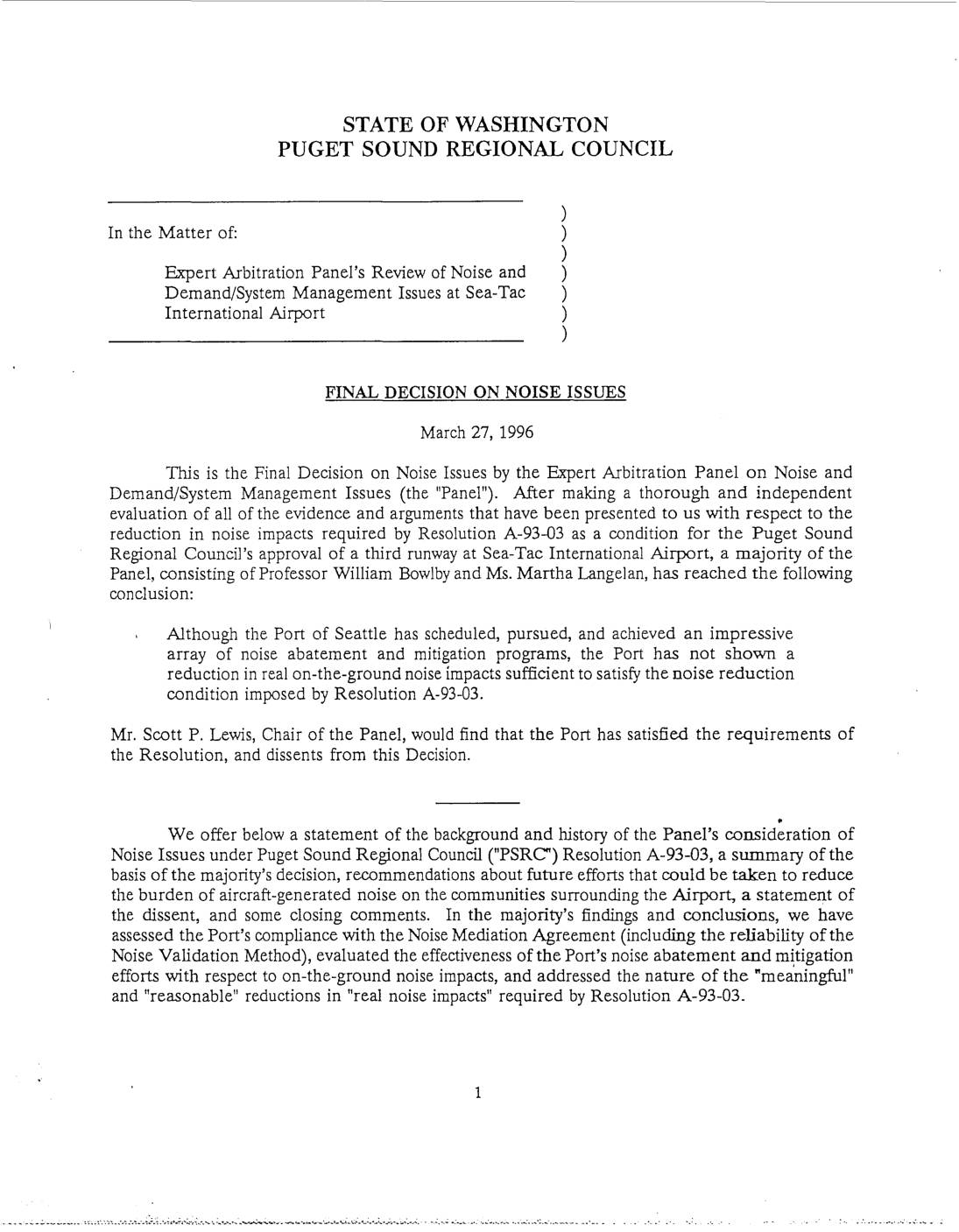
PSRC Expert Arbitration Panel Final decision on noise issues
The Expert Arbitration Panel on Noise and Demand/System Management Issues issued its final decision on noise issues related to Resolution A-93-03, which set noise reduction conditions for PSRC authorization of a third runway at Sea-Tac International Airport. A majority of the Panel found that the Port of Seattle had not demonstrated a sufficient reduction in -
 1996-03-27
Final decision on noise issues: Expert Arbitration Panel’s review of noise and demand/system management issues at Sea-Tac International Airport
In March 1996, an Expert Arbitration Panel appointed by Washington State concluded that Seattle's Port had not sufficiently reduced real on-the-ground noise impacts around Sea-Tac International Airport to meet the conditions required by Puget Sound Regional Council Resolution A-93-03 for approving a third runway. The Panel majority found that, despite an extensive array of noise abatement and mitigation programs, measurable noise reductions for surrounding communities were inadequate. One panel member dissented, arguing the Port had met the Resolution's requirements. -
 1996-03-27
Final Decision on Noise Issues – Expert Arbitration Panel’s Review of Sea-Tac International Airport
★In March 1996, an Expert Arbitration Panel reviewed whether the Port of Seattle had met noise reduction requirements set by the Puget Sound Regional Council as a condition for approving a third runway at Sea-Tac International Airport. A majority of the Panel concluded that, despite the Port's extensive noise abatement programs, it had not demonstrated a sufficient reduction in real, on-the-ground noise impacts to satisfy Resolution A-93-03. This decision left the noise condition as the sole remaining hurdle for authorizing the third runway's construction.