TagMTCA(83)
-
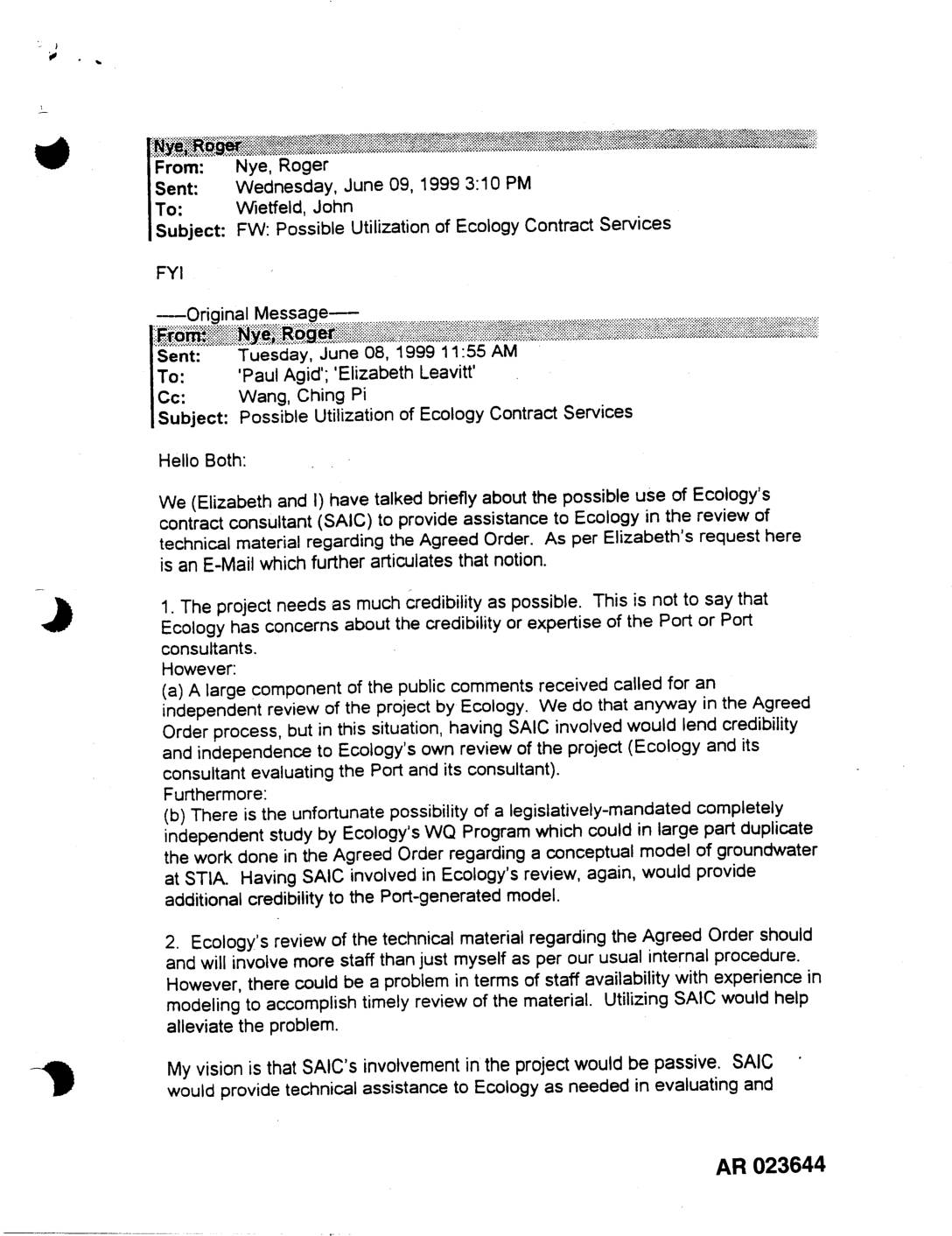 1999-06-09
EXH AR023644: Email Chain – Possible Utilization Ecology Contract Services (SAIC) Agreed Order Review STIA
In a June 1999 email chain, Washington State Department of Ecology staff member Roger Nye proposed bringing in an outside consulting firm (SAIC) to help review technical groundwater studies related to an environmental cleanup agreement (Agreed Order) at Seattle-Tacoma International Airport (STIA). The goal was to add credibility and independence to Ecology's review process, particularly in response to public demands for an independent assessment. Nye also requested that the Port of Seattle agree to cover SAIC's costs as part of the overall project expenses under state cleanup regulations (MTCA). -
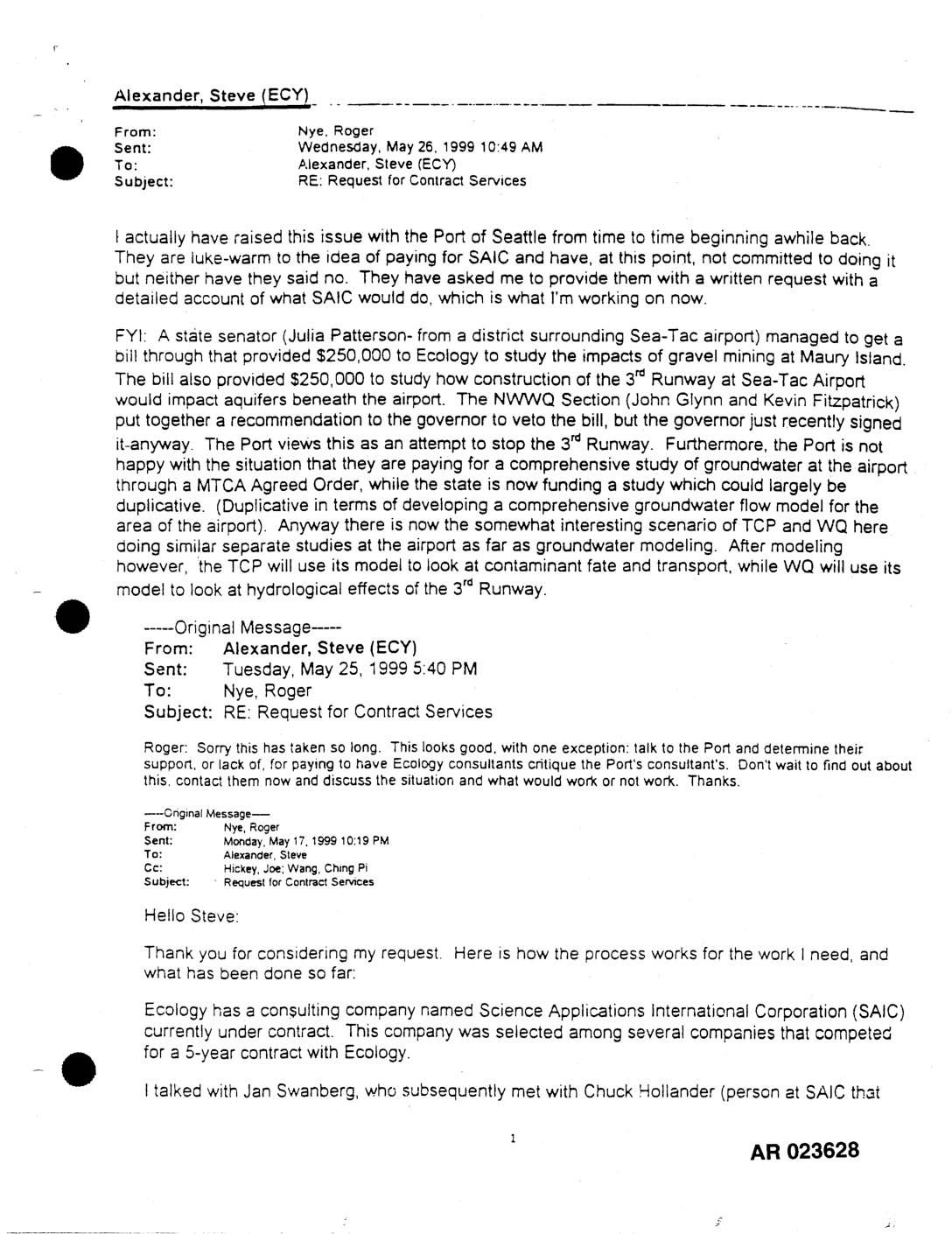 1999-05-26
EXH AR023628: Email Chain — Ecology SAIC Contract Request, Third Runway Groundwater Study Funding
In May 1999, Washington State Department of Ecology staff exchanged emails discussing plans to hire consulting firm SAIC to review groundwater studies at Sea-Tac Airport, with the question of whether the Port of Seattle would fund the work remaining unresolved. The emails also note that state legislation signed by the governor allocated $250,000 to study how construction of Sea-Tac's proposed Third Runway would impact aquifers beneath the airport, a move the Port viewed as an attempt to block the runway project. This created an unusual situation where two separate Ecology divisions were conducting potentially duplicative groundwater modeling studies at the airport for different purposes. -
 1999-05-01
EXH AR023630: STIA Ground Water Study — Public Participation Plan
This 1999 plan, prepared jointly by the Washington State Department of Ecology and the Port of Seattle, outlines how the public will be involved in a ground water study at Seattle-Tacoma International Airport. The study was prompted by decades of jet fuel and petroleum product releases from underground storage tanks and fuel systems in the Airport's Aircraft Operations and Maintenance Area, which contaminated soil and ground water across 13 known sites. The plan describes required and additional public participation activities, community outreach roles, and the two-phase study approach, which included computer modeling of ground water flow to assess contamination risks to public water supplies and surface water. -
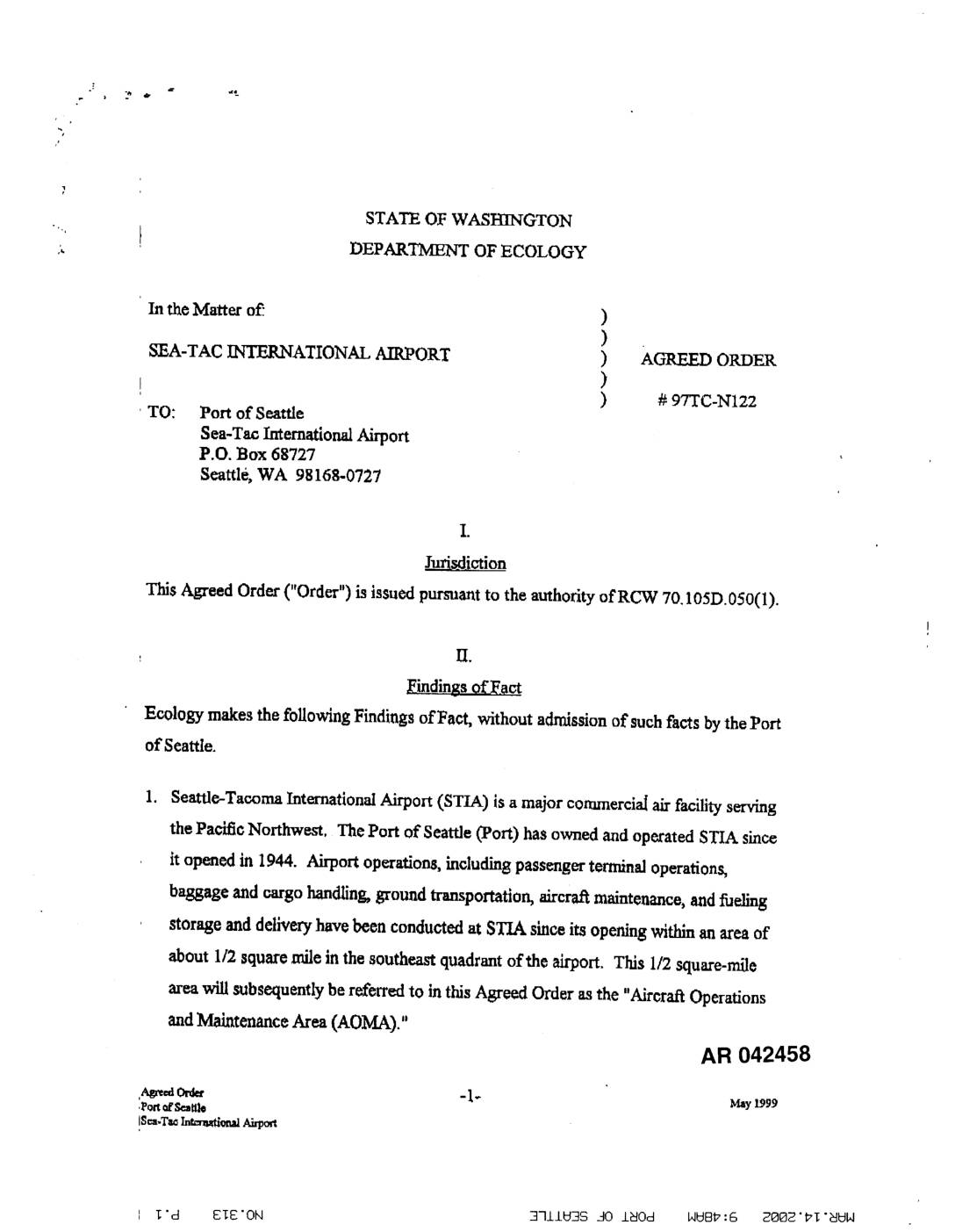 1999-05-01
EXH AR042458: Agreed Order #97TC-N122 — State of Washington Ecology vs. Port Of Seattle, Sea-Tac Airport
Agreed Order #97TC-N122 issued by Washington State Department of Ecology under RCW 70.105D.050(1) directed to Port Of Seattle regarding hazardous substance contamination at Seattle-Tacoma International Airport (STIA). Documents thirteen contaminated sites within the Aircraft Operations and Maintenance Area (AOMA), a 1/2 square-mile area in the southeast quadrant of the airport, contaminated with jet fuel, gasoline, -
 1999-05-01
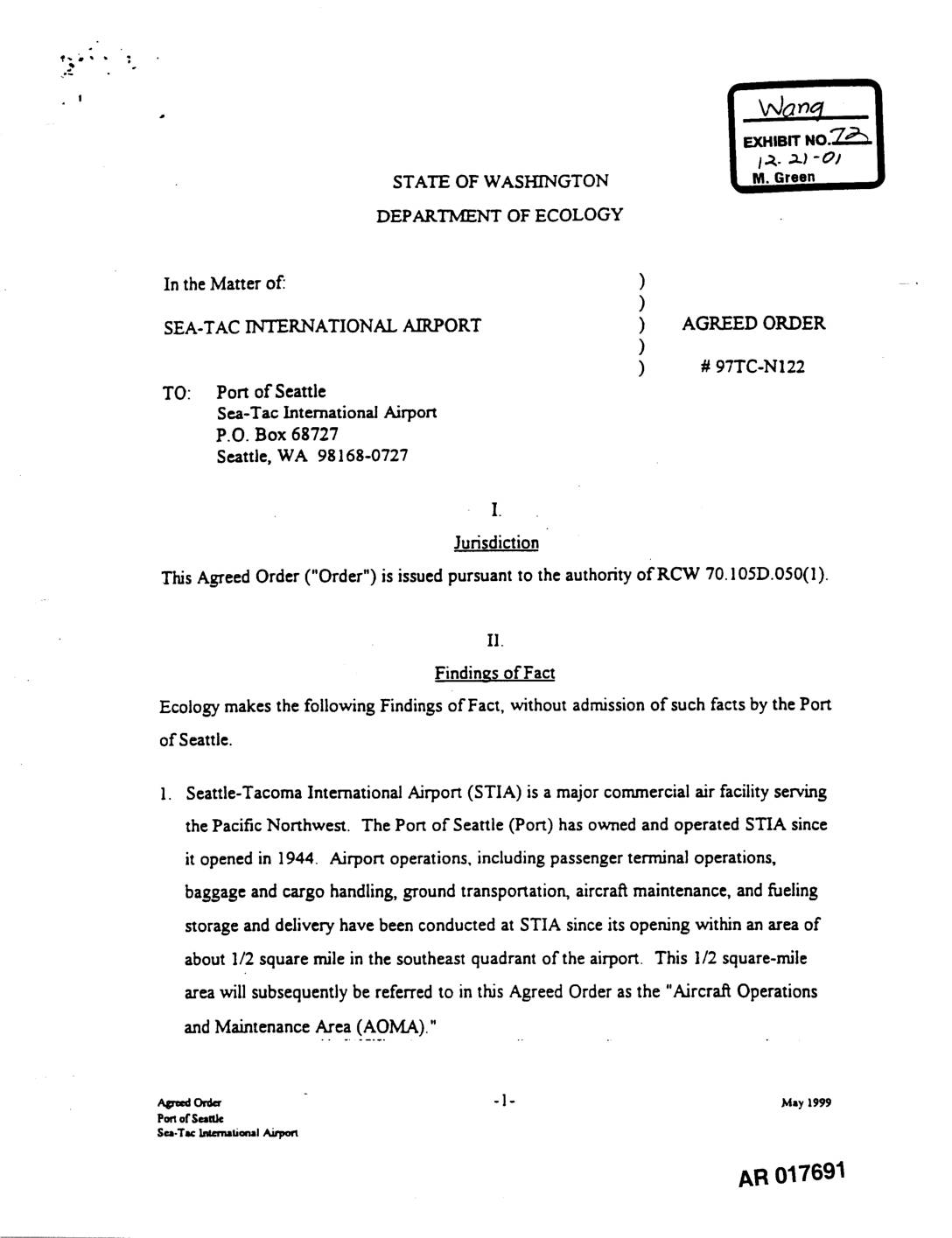
EXH AR017691: Agreed Order #97TC-N122 — State of Washington Ecology vs. Port Of Seattle, Sea-Tac Airport
Washington State Department of Ecology Agreed Order #97TC-N122 issued to Port Of Seattle for Seattle-Tacoma International Airport (STIA), pursuant to RCW 70.105D.050(1). Documents hazardous substance releases within the Aircraft Operations and Maintenance Area (AOMA), a half-square-mile southeast quadrant of STIA operational since 1944. Contaminants identified include jet fuel (most abundant by bulk volume), gasoline, industrial -
 1999-03-24
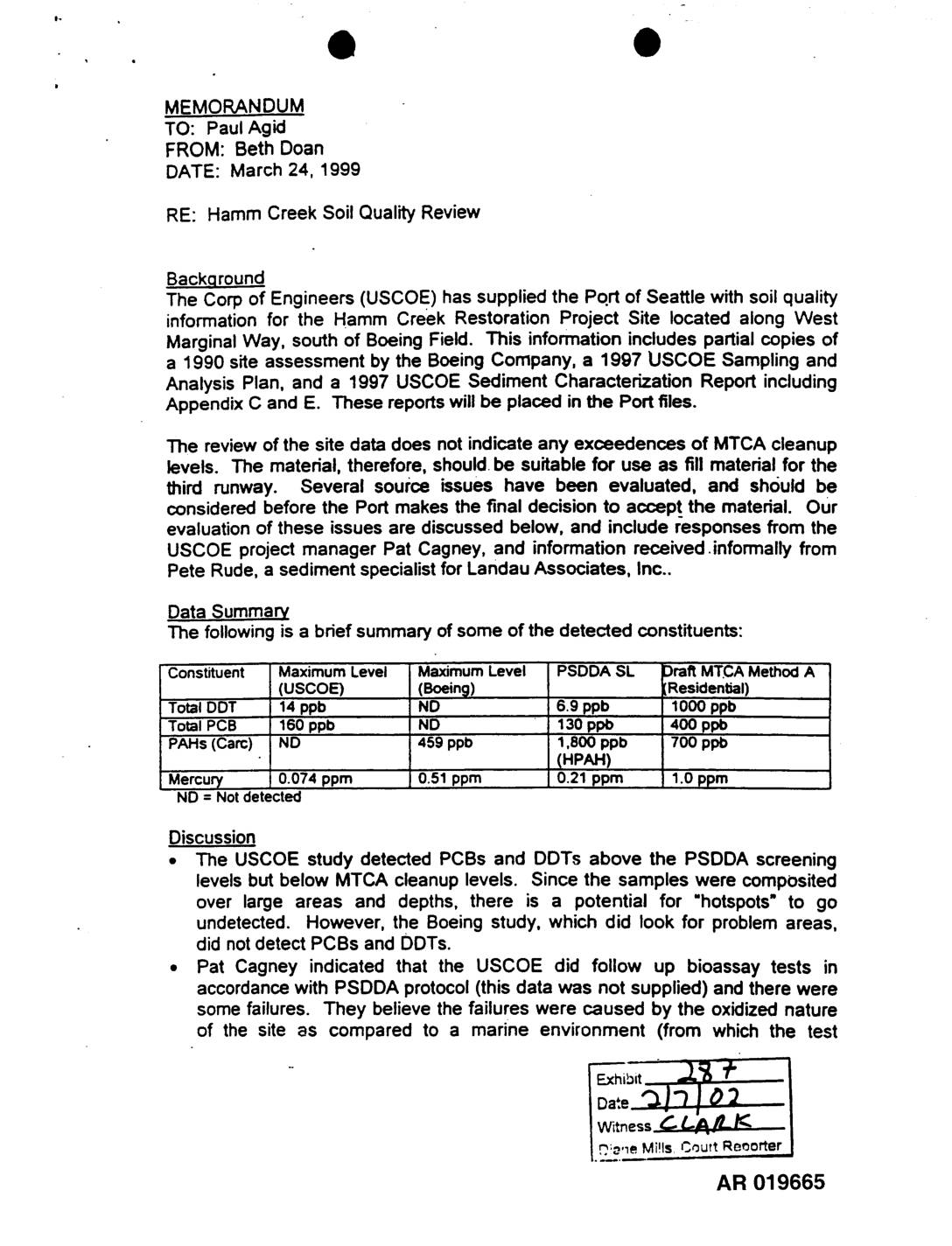
EXH AR019665: Hamm Creek Soil Quality Review — Memo Doan to Agid
A 1999 internal Port of Seattle memorandum reviews soil quality data for the Hamm Creek Restoration Project site near Boeing Field, evaluating whether the material is safe to use as fill for a proposed third runway. The review found that detected contaminants — including PCBs, DDTs, mercury, and PAHs — fell below MTCA cleanup levels, leading to the conclusion that the material is suitable for upland fill use. While the soil did not meet PSDDA standards for open-water disposal, the memo notes that this distinction is not technically relevant given its intended use as runway fill. -
 1999-01-01
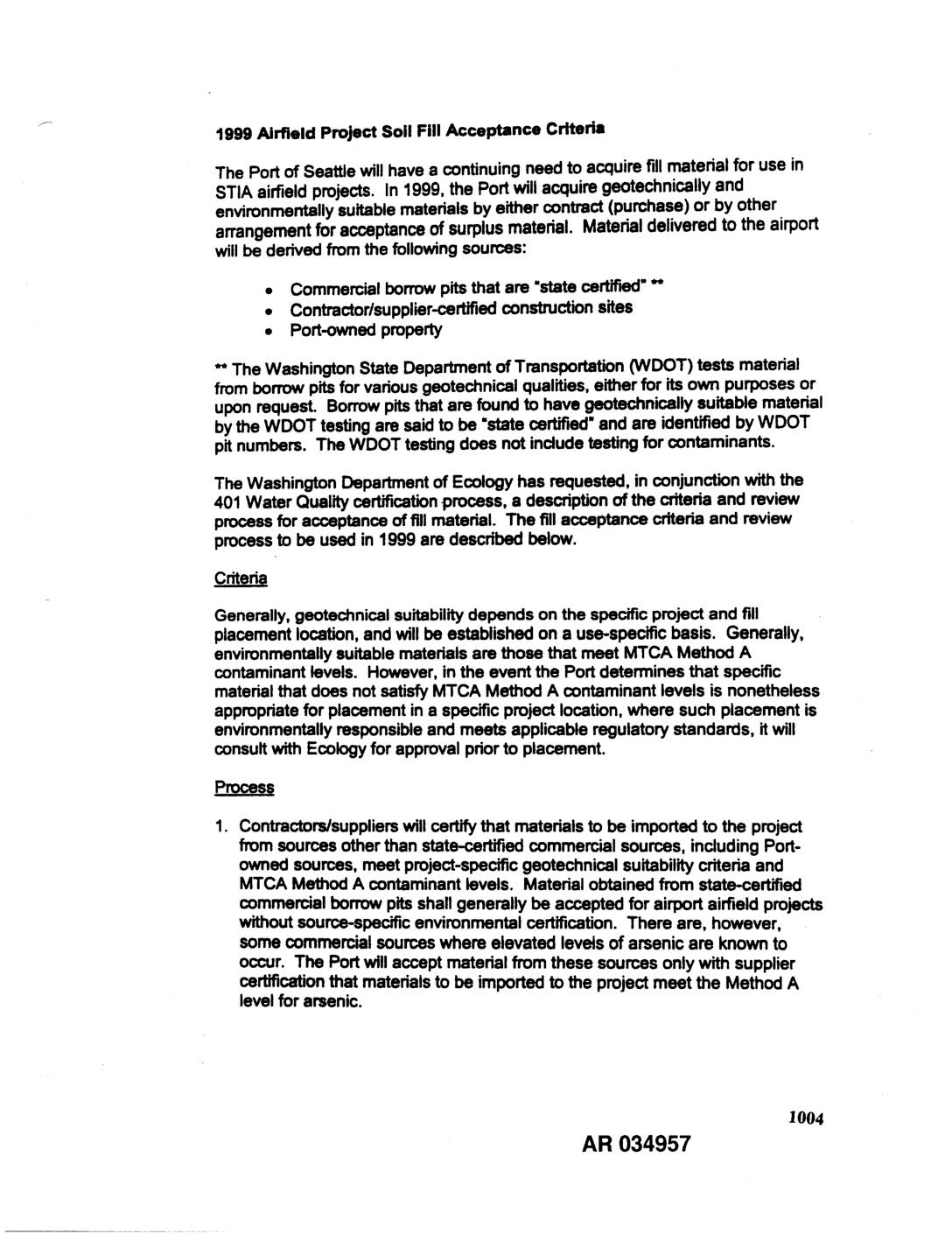
EXH AR034957: 1999 Airfield Project Soil Fill Acceptance Criteria
Port Of Seattle 1999 Airfield Project Soil Fill Acceptance Criteria for STIA airfield projects, describing criteria and review process for acceptance of fill material requested by Washington Department of Ecology in conjunction with 401 Water Quality certification. Covers geotechnical and environmental suitability standards including MTCA Method A contaminant levels, arsenic, TPH and metals analyses. Details -
 1999-01-01
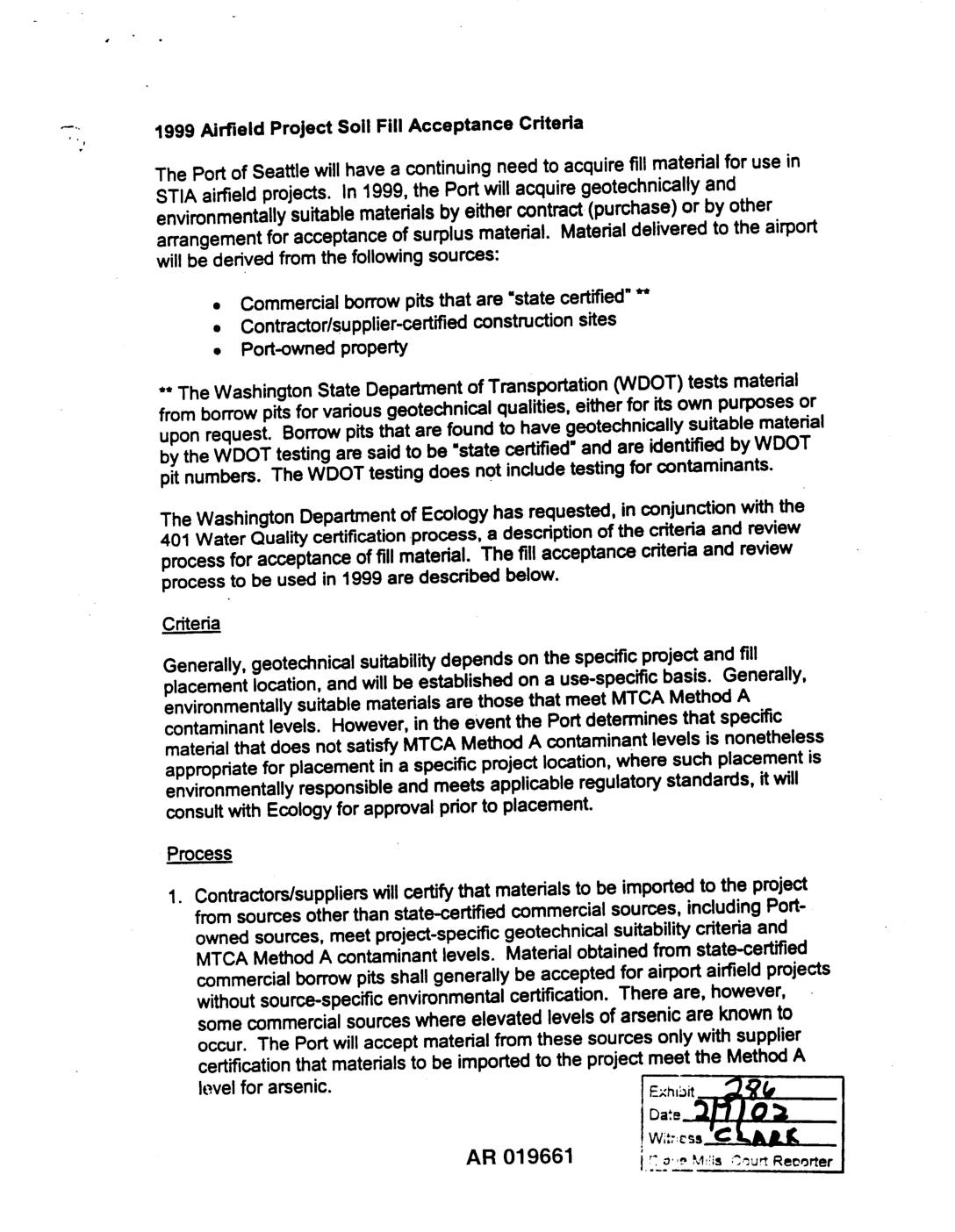
EXH 286: 1999 Airfield Project Soil Fill Acceptance Criteria
This 1999 Port of Seattle document outlines the criteria and review process for accepting soil fill material used in Sea-Tac International Airport (STIA) airfield construction projects. Fill material must come from approved sources—such as state-certified commercial borrow pits, contractor-certified construction sites, or Port-owned property—and generally must meet Washington State MTCA Method A environmental contamination standards. Contractors and suppliers are required to certify the quality of their materials, and independent soil technicians monitor all deliveries to ensure only safe, suitable fill is placed on airport grounds. -
 1997-01-01
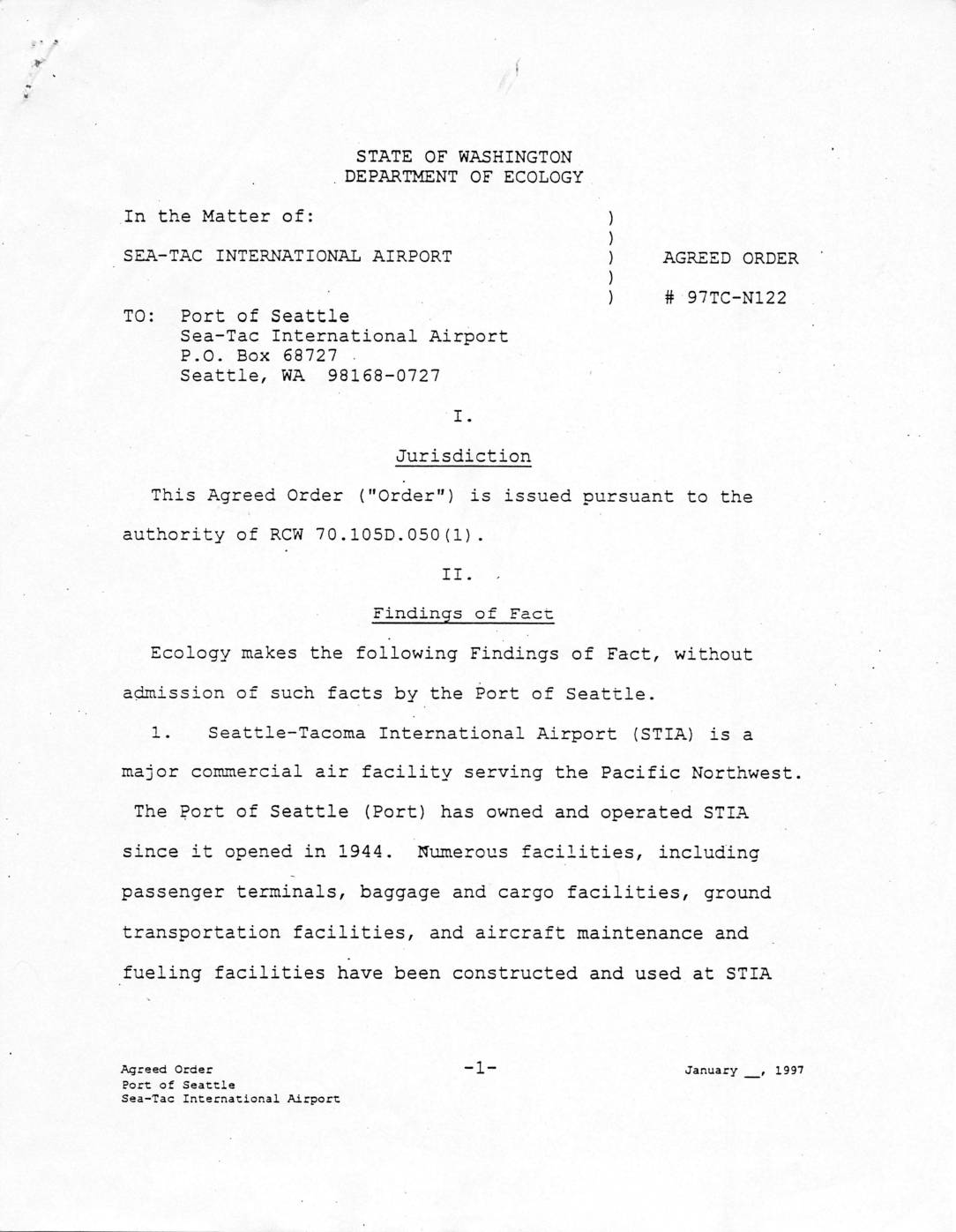
Agreed Order #97TC-N122: Ecology and Port Of Seattle — Sea-Tac International Airport Hazardous Substance Contamination
A 1997 Agreed Order issued by the Washington State Department of Ecology directed the Port of Seattle to address hazardous substance contamination at Seattle-Tacoma International Airport. Jet fuel, gasoline, industrial solvents, and other chemicals had been released across twelve separate sites within a half-square-mile Aircraft Operations and Maintenance Area, impacting both soil and groundwater. The order established a framework for ongoing environmental investigation and cleanup while acknowledging the operational challenges of working in an active airport environment. -
 1996-02-01
Exhibit 2124: Model Toxics Control Act Cleanup Levels and Risk Calculations (CLARC II) Update, February 1996
Washington State Department of Ecology publication #94-145 (updated 1/96) presenting the February 1996 annual update to the MTCA (Model Toxics Control Act) Cleanup Standards under CLARC II. Covers Method B and Method C cleanup levels for soil and groundwater, reference doses (RfD), cancer potency factors, hazard quotients, WAC 173-340-740 and WAC 173-340-745 calculations, inhalation correction