TagEconomic Impacts(25)
-
 2022-09-12
Economy, traffic fuel commercial-service talk
This article from the Snohomish County Business Journal discusses growing interest in establishing scheduled commercial air service at Paine Field in Everett, Washington, as an alternative to the congested Sea-Tac Airport. Supporters argue that commercial flights would boost the local economy and attract new businesses, while noting that modern, quieter aircraft have significantly reduced noise concerns. The county's 20-year airport master plan, approved in December, projected commuter service flights from Paine Field within five years. -
 2019-06-01
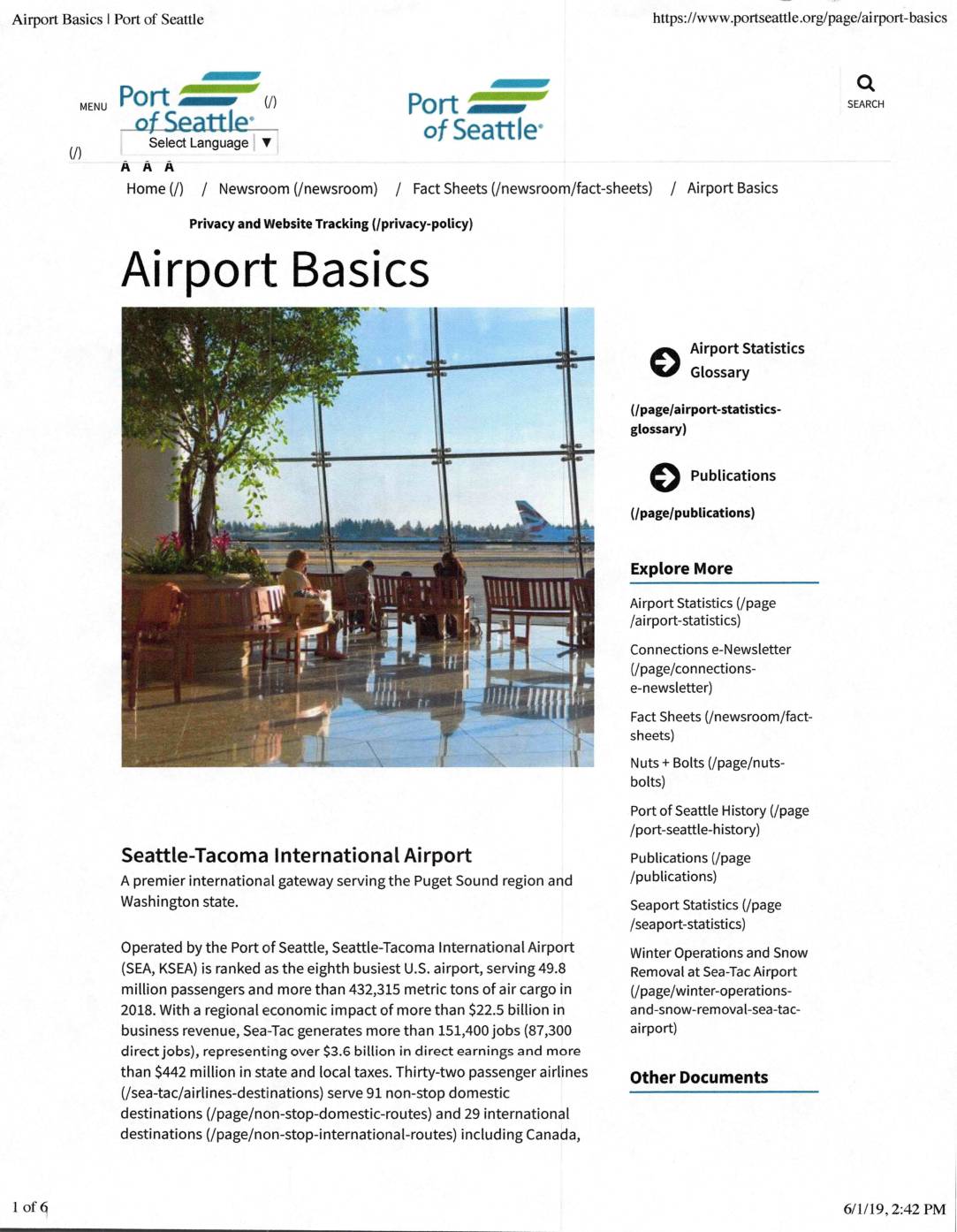
Airport basics
Seattle-Tacoma International Airport (Sea-Tac), operated by the Port of Seattle, is the eighth busiest U.S. airport, serving 49.8 million passengers and handling over 432,315 metric tons of air cargo in 2018, with 32 airlines offering 91 domestic and 29 international non-stop destinations. The document also profiles Jason Schwartz, an aviation professional with over 25 years of experience specializing in airport noise management, UAS operations, and airside planning, currently serving in dual roles at the Port of Portland and his own consulting firm, Aviation Compatibility Consulting. Schwartz's background includes noise program management, community engagement, and relevant certifications in airport environmental management and business operations. -
 2018-08-01
Sea-Tac International Airport economic impacts
This 2018 Port of Seattle report examines the economic impact of Seattle-Tacoma International Airport, which ranked as the 9th busiest U.S. airport with 46.8 million passengers in 2017. The airport directly supported 19,100 on-site jobs and $5.6 billion in economic activity, while generating a total of $22.5 billion in economic activity and 151,400 jobs across Washington state when multiplier effects are included. The report also highlights the airport's role as a key trade gateway, including the export of Washington-grown cherries and other goods to global markets. -
 2018-08-01
Sea-Tac International Airport Economic Impacts
This report, produced by Community Attributes Inc. for the Port of Seattle and revised in August 2018, analyzes the economic impacts of Seattle-Tacoma International Airport (Sea-Tac). It is included as Appendix K in a broader study covering socioeconomics and children's health topics related to airport operations. The findings are intended to inform decision makers about the airport's role in the regional economy and its effects on surrounding communities. -
 2018-08-01
Sea-Tac International Airport economic impacts
This 2018 Port of Seattle report analyzes the economic impact of Seattle-Tacoma International Airport, finding that Sea-Tac — the 9th busiest U.S. airport — hosted 46.8 million passengers in 2017 and directly supported 19,100 jobs and $5.6 billion in economic activity. When multiplier effects are included, the airport contributed nearly $22.5 billion to Washington's economy and supported over 151,400 jobs statewide. The report also highlights Sea-Tac's role in connecting Washington export industries, such as the cherry-growing regions of Yakima Valley and Wenatchee, to global markets. -
 2018-01-30
Sea-Tac International Airport economic impacts
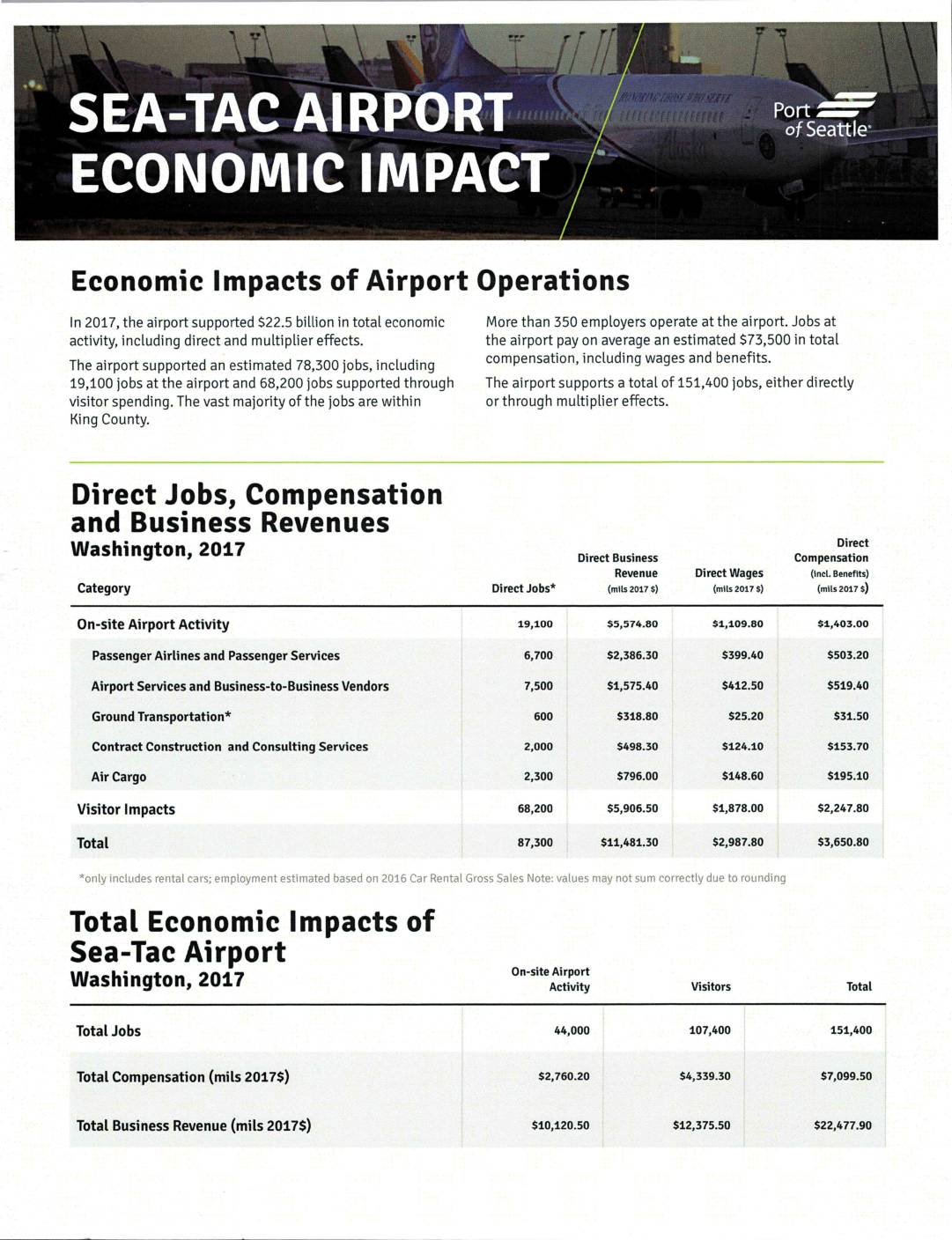
A January 2018 Port of Seattle report presented to the Port Commission details the economic impacts of Seattle-Tacoma International Airport, showing that Sea-Tac supported approximately 87,300 jobs and generated over $11.4 billion in business revenue in 2017. The impacts span on-site airport activities—including airlines, cargo, and ground transportation—as well as visitor spending, which alone accounted for 68,200 jobs and nearly $5.9 billion in revenue. The report provides a comprehensive breakdown of wages, compensation, and business revenue across all airport-related sectors. -
 2018-01-12
2017 Airport Economic Impacts Study briefing
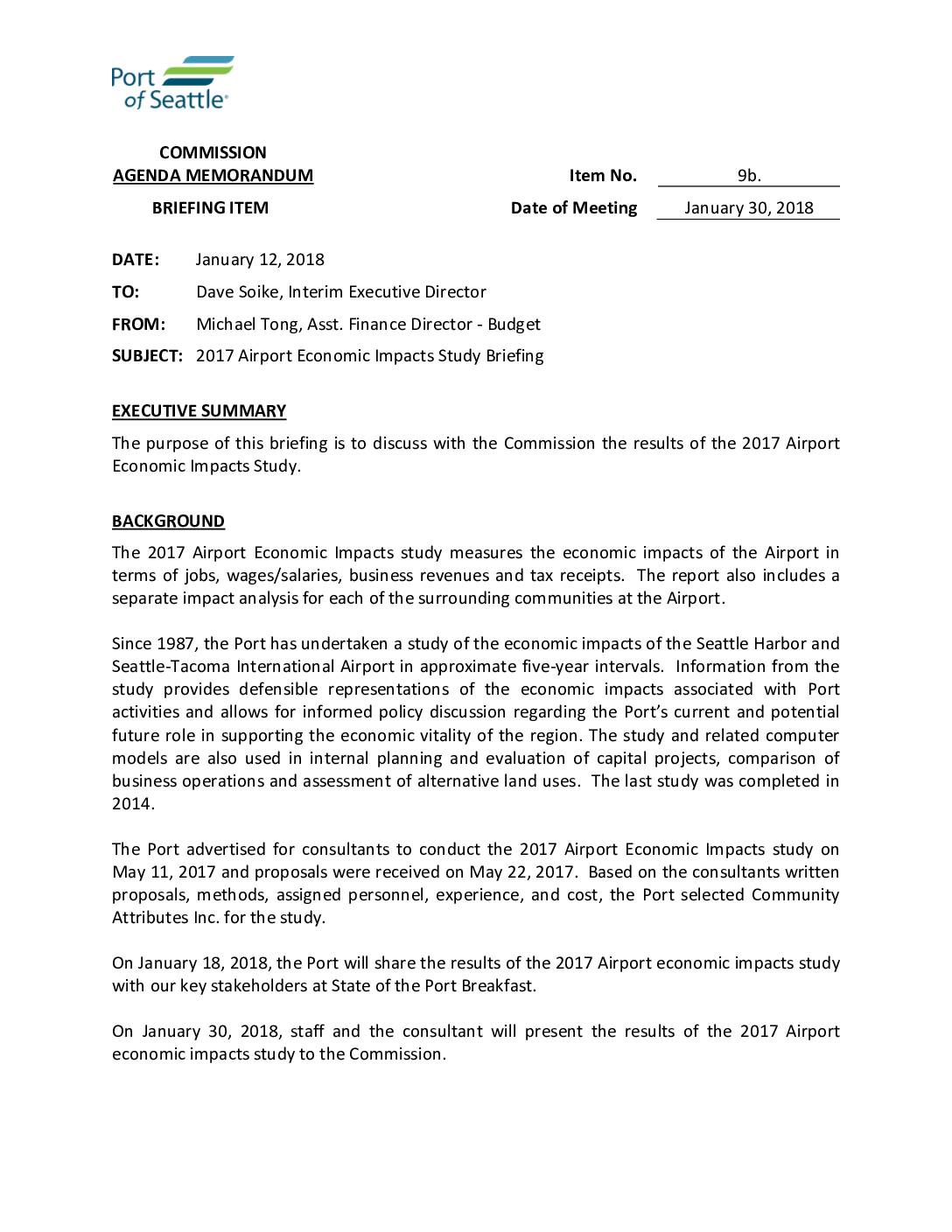
A January 2018 Port of Seattle memo prepared for the Commission outlines a briefing on the 2017 Airport Economic Impacts Study, which measures Seattle-Tacoma International Airport's effects on jobs, wages, business revenues, and tax receipts. The study, conducted by Community Attributes Inc., follows a series of similar assessments the Port has conducted roughly every five years since 1987. Results were shared with key stakeholders at a State of the Port Breakfast on January 18, 2018, ahead of a formal Commission presentation on January 30, 2018. -
 2018-01-01
Sea-Tac International Airport economic impacts
★ 32This January 2018 report from the Port of Seattle examines the economic impact of Seattle-Tacoma International Airport, which handled an estimated 46.8 million passengers and roughly 425,860 metric tons of air cargo in 2017. The airport directly supported 19,100 on-site jobs and $5.6 billion in economic activity, while generating nearly $22.5 billion in total economic output and 151,400 jobs across Washington state when multiplier effects are included. The report also highlights the airport's role as a critical trade gateway, including the export of Washington-grown cherries to international markets. -
 2018-01-01
Sea-Tac International Airport economic impacts
This January 2018 report by the Port of Seattle examines the economic impact of Seattle-Tacoma International Airport, which handled an estimated 46.8 million passengers and roughly 425,860 metric tons of air cargo in 2017. The airport directly supported 19,100 on-site jobs and $5.6 billion in economic activity, while generating a total of $22.5 billion in economic activity and 151,400 jobs across Washington state when multiplier effects are included. The report also highlights the airport's role as a critical trade gateway, including the export of Washington-grown cherries to international markets. -
 2018-01-01
Sea-Tac Airport economic impact
A 2017 economic impact report from the Port of Seattle shows that Seattle-Tacoma International Airport supported $22.5 billion in total economic activity and approximately 151,400 jobs across the region, including direct employment and multiplier effects. More than 350 employers operate at the airport, with on-site jobs averaging $73,500 in total compensation, and the surrounding communities of King and Pierce counties benefiting significantly from visitor spending and airport-related business revenues.