TagEconomic Impacts(25)
-
 2015-05-27
Port Of Seattle: An Economic Engine for Washington State
This presentation by Port of Seattle CEO Ted J. Fick outlines the Port's role as an economic engine for Washington State, highlighting its mission to create jobs through travel, trade, and commerce. The Port's Century Agenda, a 25-year strategic plan launched in 2011, aims to add 100,000 jobs through economic growth, position the region as a premier international logistics hub, and become the greenest port in North America. Success is measured by job creation, social responsibility, and environmental impact. -
 2014-12-31
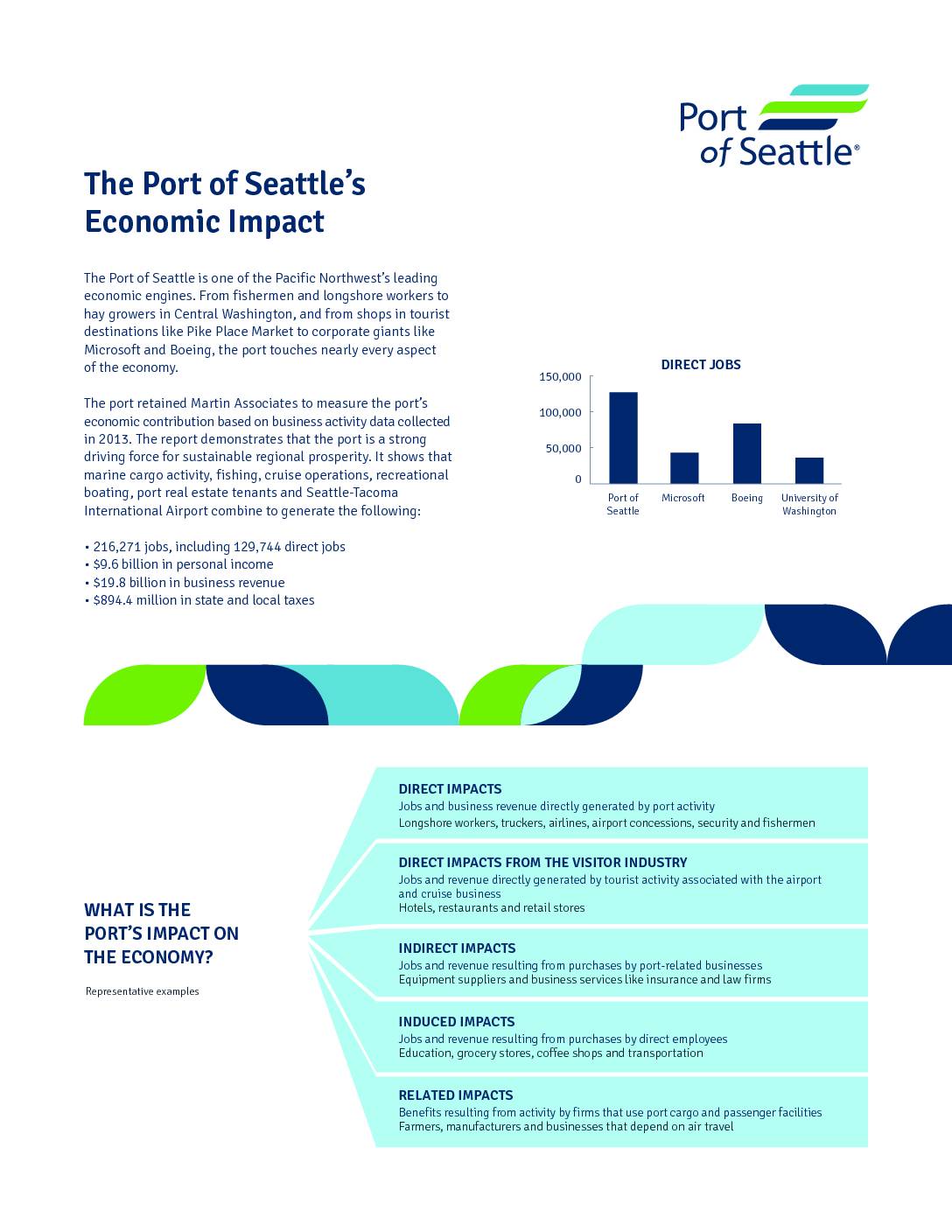
The Port Of Seattle’s economic impact
The Port of Seattle's 2013 economic impact report highlights the broad regional contributions of its operations, including Seattle-Tacoma International Airport, which alone supported over 171,000 jobs and $6.1 billion in personal income. Sea-Tac serves as the Pacific Northwest's primary gateway for domestic and international air travel, air cargo, and tourism, with approximately 3,000 Microsoft employees passing through weekly. Combined with marine cargo, fishing, cruise, and real estate operations, the port generated 216,271 total jobs and $19.8 billion in business revenue across the region. -
 1996-12-04
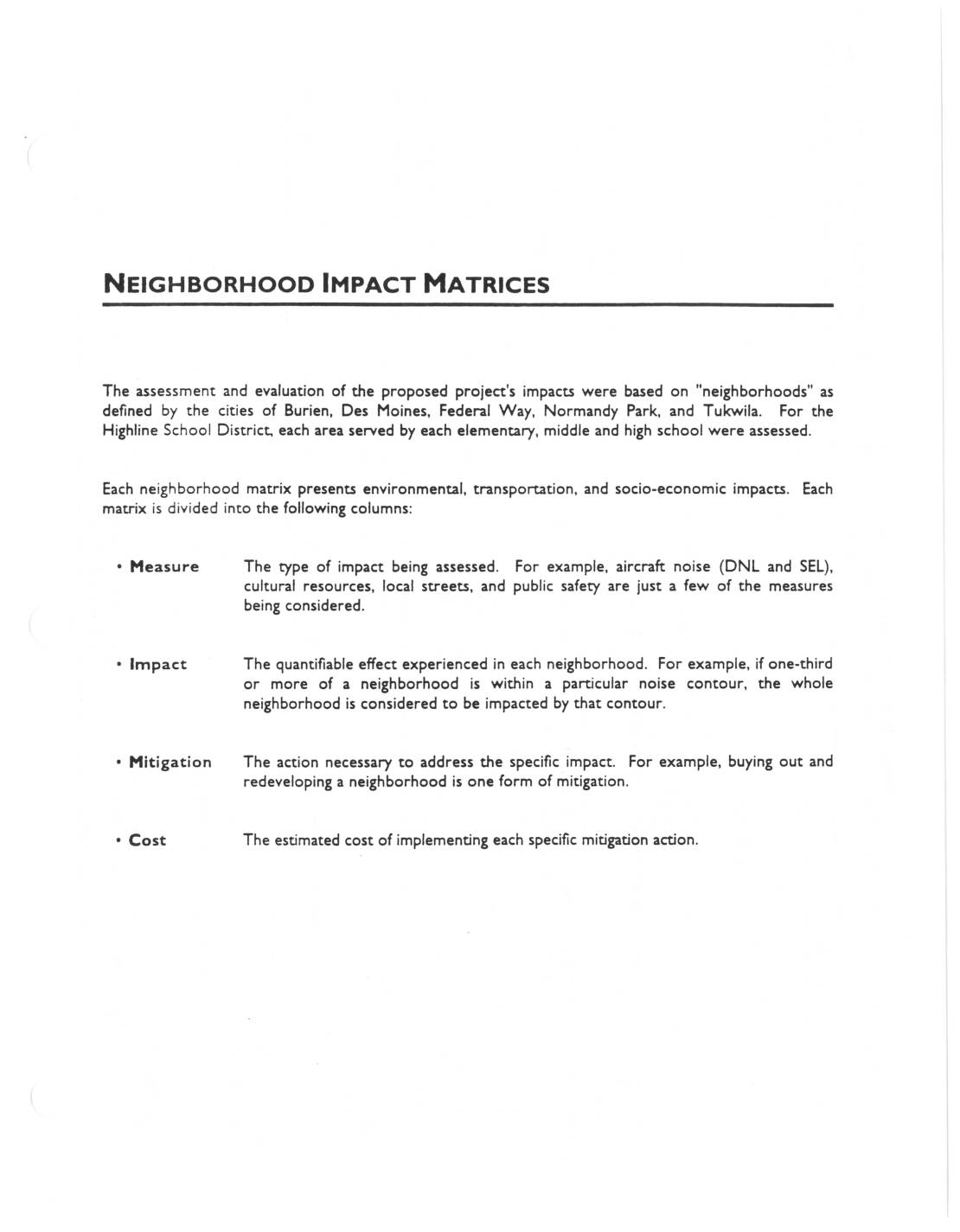
Neighborhood impact matrices
This document outlines a Neighborhood Impact Matrices framework used to assess environmental, transportation, and socio-economic effects of a proposed airport-related project on communities surrounding Seattle-Tacoma International Airport, including cities such as Burien, Des Moines, Federal Way, Normandy Park, and Tukwila. Each matrix evaluates impacts across four columns — Measure, Impact, Mitigation, and Cost — covering issues such as aircraft noise (DNL and SEL contours), air quality, surface and groundwater quality, wetlands, and floodplains. Proposed mitigations range from neighborhood buyouts at $760,000 per acre for areas within the 65 DNL contour to easement and insulation programs, stormwater management plans, and flight track modifications. -
 1996-03-18
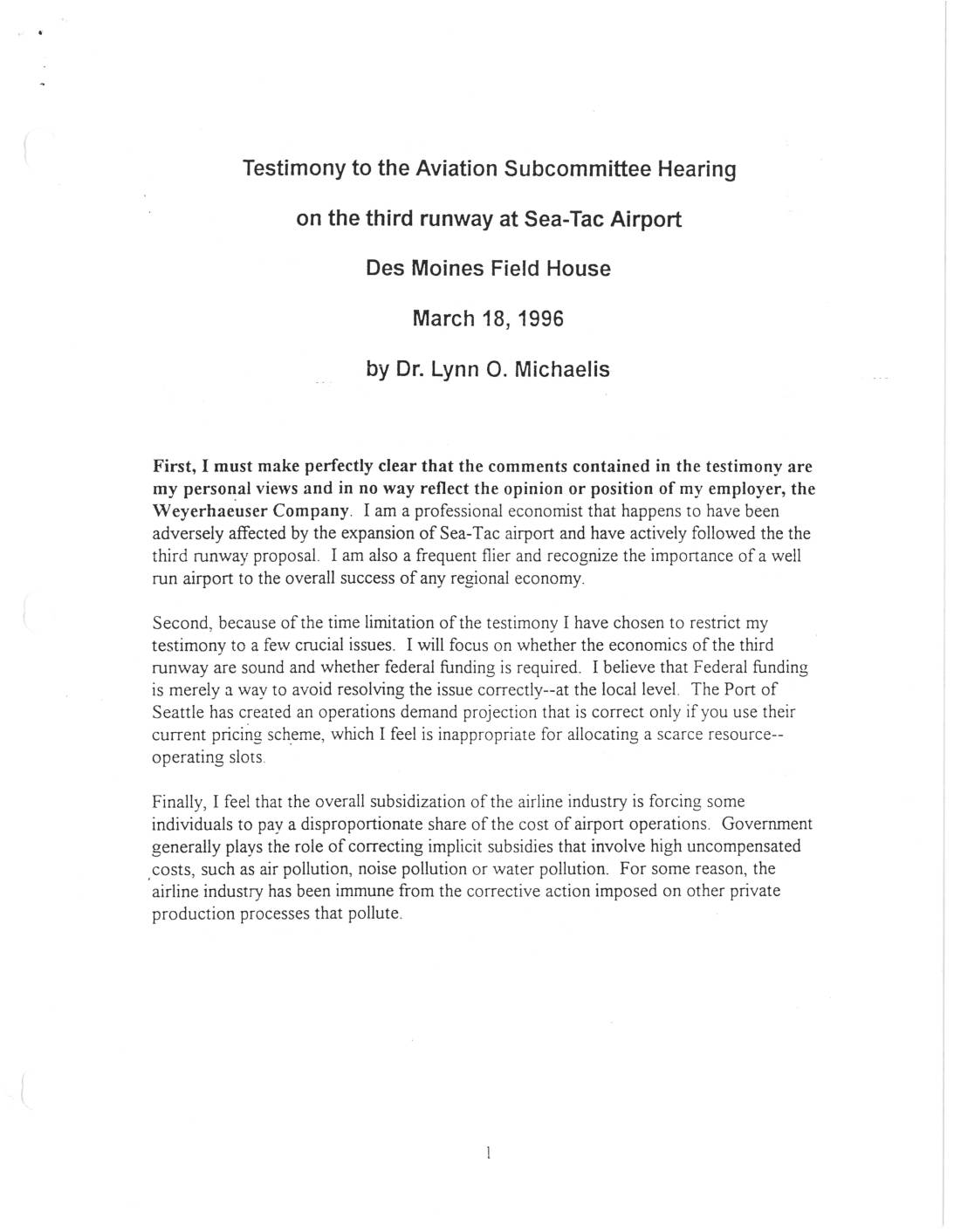
Testimony of Dr. Lynn O. Michaelis on the Third Runway at Sea-Tac Airport, Aviation Subcommittee Hearing, Des Moines Field House, March 18, 1996
In this 1996 testimony to the Aviation Subcommittee, economist Dr. Lynn O. Michaelis argues that the proposed third runway at Seattle-Tacoma International Airport is economically unjustified, citing flawed pricing schemes that fail to account for peak-hour demand and encourage inefficient small-plane operations. He contends that federal funding is being used to bypass local accountability, masking the project's poor return on investment — estimated at less than 1% on a $500 million expenditure. Michaelis also criticizes the airline industry's exemption from pollution-related cost corrections that apply to other industries, arguing that nearby residents bear a disproportionate share of the environmental costs. -
 1975-04-22
Development concept: the airport and the communities
This document outlines a development concept addressing the relationship between Sea-Tac International Airport and its surrounding communities. While the airport contributes significantly to the regional economy—supporting over 15,200 jobs and $390 million in annual business activity—local residents have long struggled with aircraft noise, uncertainty about airport expansion, and the impact on property values and neighborhood character. The concept seeks to find greater compatibility between the airport's growth and the needs of the communities it affects.