TagDes Moines Creek(162)
-
 2001-12-01
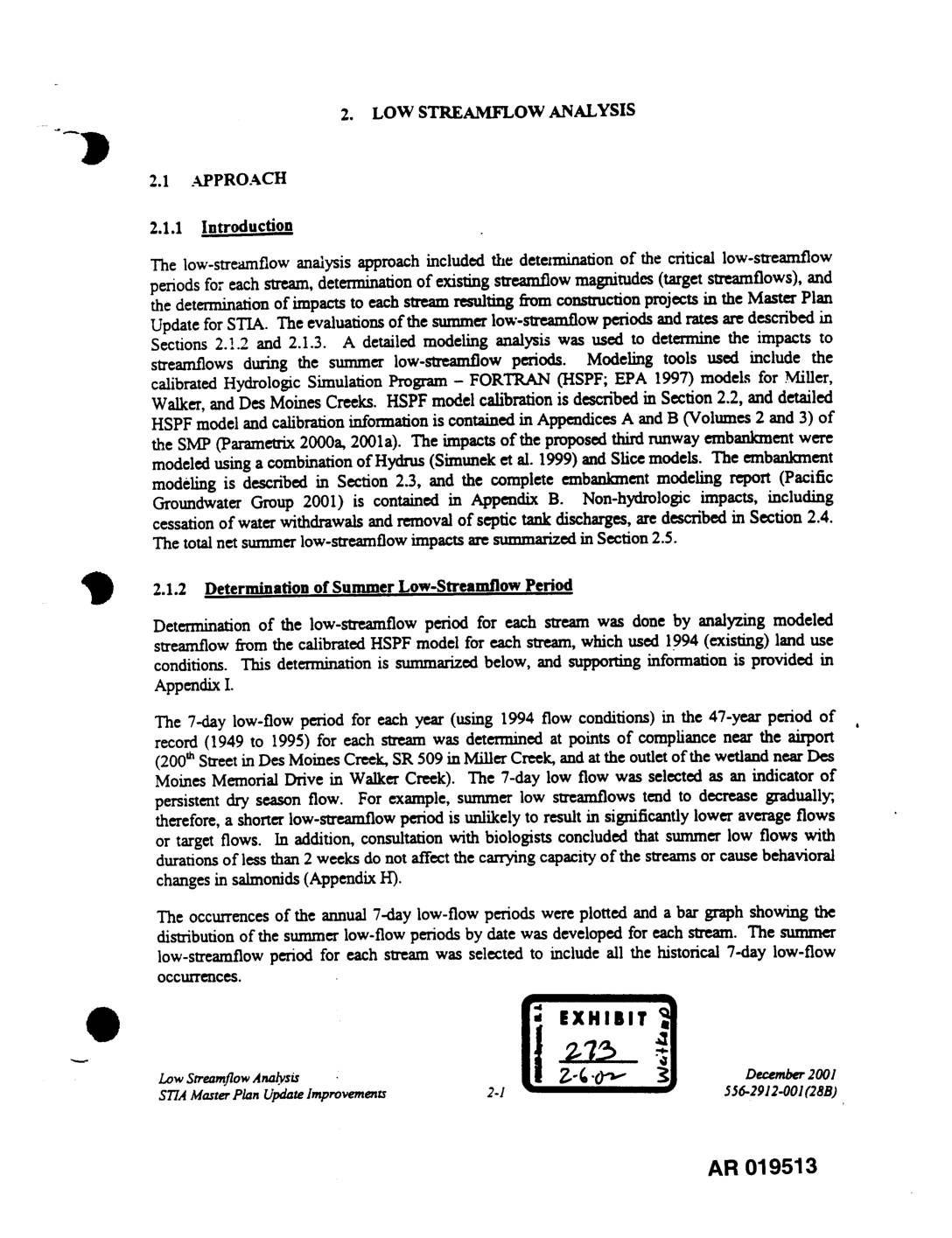
EXH 273: Low Streamflow Analysis — STIA Master Plan Update Improvements
This technical report analyzes low streamflow conditions in three creeks near Seattle-Tacoma International Airport (Miller, Walker, and Des Moines Creeks) to assess the potential impacts of airport construction projects on summer water flows. Using a 47-year record of streamflow data and computer modeling tools, analysts determined target streamflow levels for each creek and evaluated how proposed runway and infrastructure improvements might affect seasonal low-flow periods critical to salmon habitat. The study found existing summer low streamflow targets of 0.33 cfs for Des Moines Creek, 0.77 cfs for Walker Creek, and 0.73 cfs for Miller Creek, which were used to guide mitigation planning. -
 2001-12-01
EXH 464: Low Streamflow Analysis Summer Low Flow Impact Offset Facility Proposal STIA Master Plan Update
This December 2001 technical report analyzes low streamflow conditions in Miller, Walker, and Des Moines Creeks near Seattle-Tacoma International Airport, assessing the hydrologic impacts of the proposed third runway embankment as part of the airport's Master Plan Update. The study found that the runway construction would reduce summer stream flows, requiring mitigation of 0.11 cfs in Walker Creek and 0.08 cfs in Des Moines Creek during the annual low-flow period (late July through October). To offset these impacts, the Port of Seattle proposed collecting and storing excess winter stormwater in underground vaults—approximately 18.5 acre-feet for Walker Creek and 13.5 acre-feet for Des Moines Creek—for controlled release during dry-season low-flow periods. -
 2001-12-01
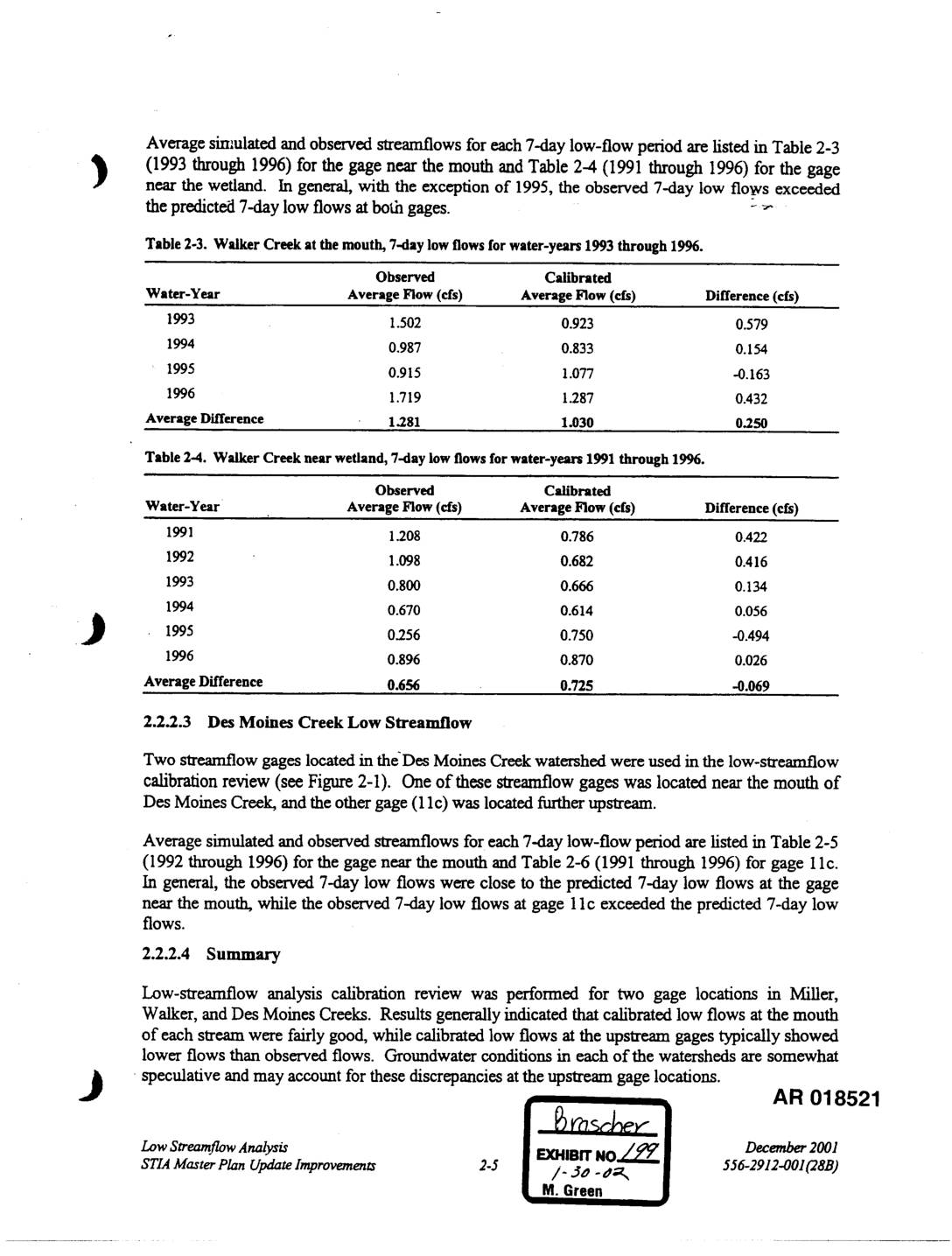
Exhibit 199: Walker Creek and Des Moines Creek 7-Day Low-Flow Calibration Analysis, STIA Master Plan Update
This technical document compares observed and model-predicted 7-day low streamflows for Walker Creek and Des Moines Creek near Seattle-Tacoma Airport for water years 1991–1996. Results show that calibrated (simulated) flows generally underestimated observed flows at most gage locations, with the exception of 1995, when the model overpredicted flows. Discrepancies at upstream gage locations are attributed to uncertain groundwater conditions within the watersheds. -
 2001-11-26
EXH AR017588: Northwest Hydraulic Consultants Letter to U.S. Army Corps of Engineers Regarding Port Of Seattle Low Flow Mitigation, Third Runway
Letter dated November 26, 2001, from Northwest Hydraulic Consultants (on behalf of ACC, Airport Communities Coalition) to Colonel Ralph H. Graves, Ms. Muffy Walker, and Ms. Gail Terzi of U.S. Army Corps of Engineers, Seattle District, Corps Ref. No. 1996-4-02325. Identifies serious flaws in Port Of Seattle’s low flow mitigation analysis for Miller Creek, Walker -
 2001-11-26
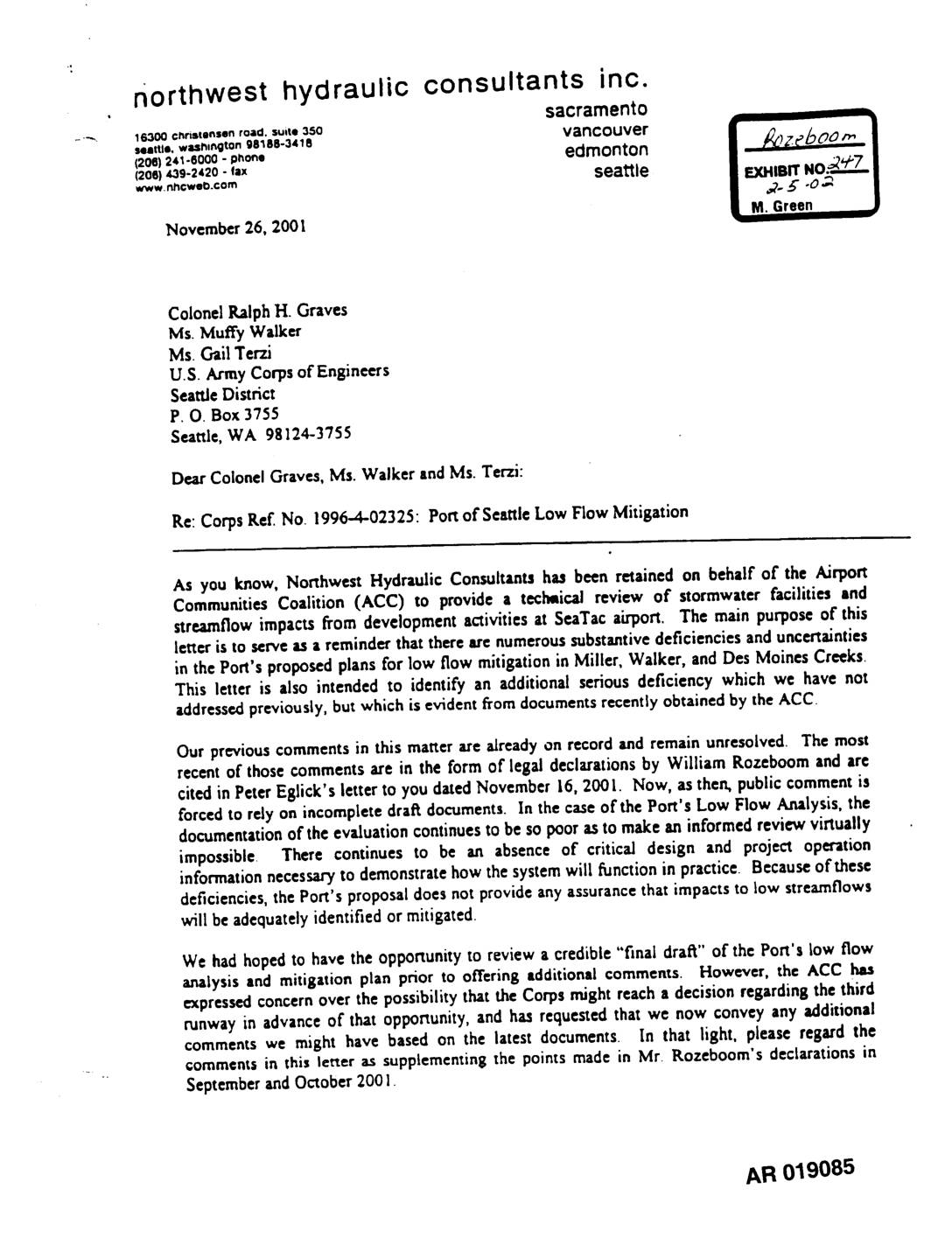
EXH 247: Northwest Hydraulic Consultants Letter to Army Corps — STIA Third Runway Low Flow Mitigation Deficiencies
A November 2001 letter from Northwest Hydraulic Consultants, written on behalf of the Airport Communities Coalition, raises serious technical objections to the Port of Seattle's proposed plan to manage low streamflow impacts from SeaTac Airport's third runway construction on Miller, Walker, and Des Moines Creeks. The letter argues that the Port's analysis contains critical flaws, including an incorrect assumption that virtually all runway runoff infiltrates into adjacent grassed filter strips, and that the use of hourly rather than shorter time intervals in hydrological modeling causes stream impacts to be underestimated and mitigation storage facilities to be undersized. The consultants also express concern that the Port was not adequately addressing outstanding public comments or certification requirements set by regulatory agencies such as the Washington Department of Ecology. -
 2001-11-07
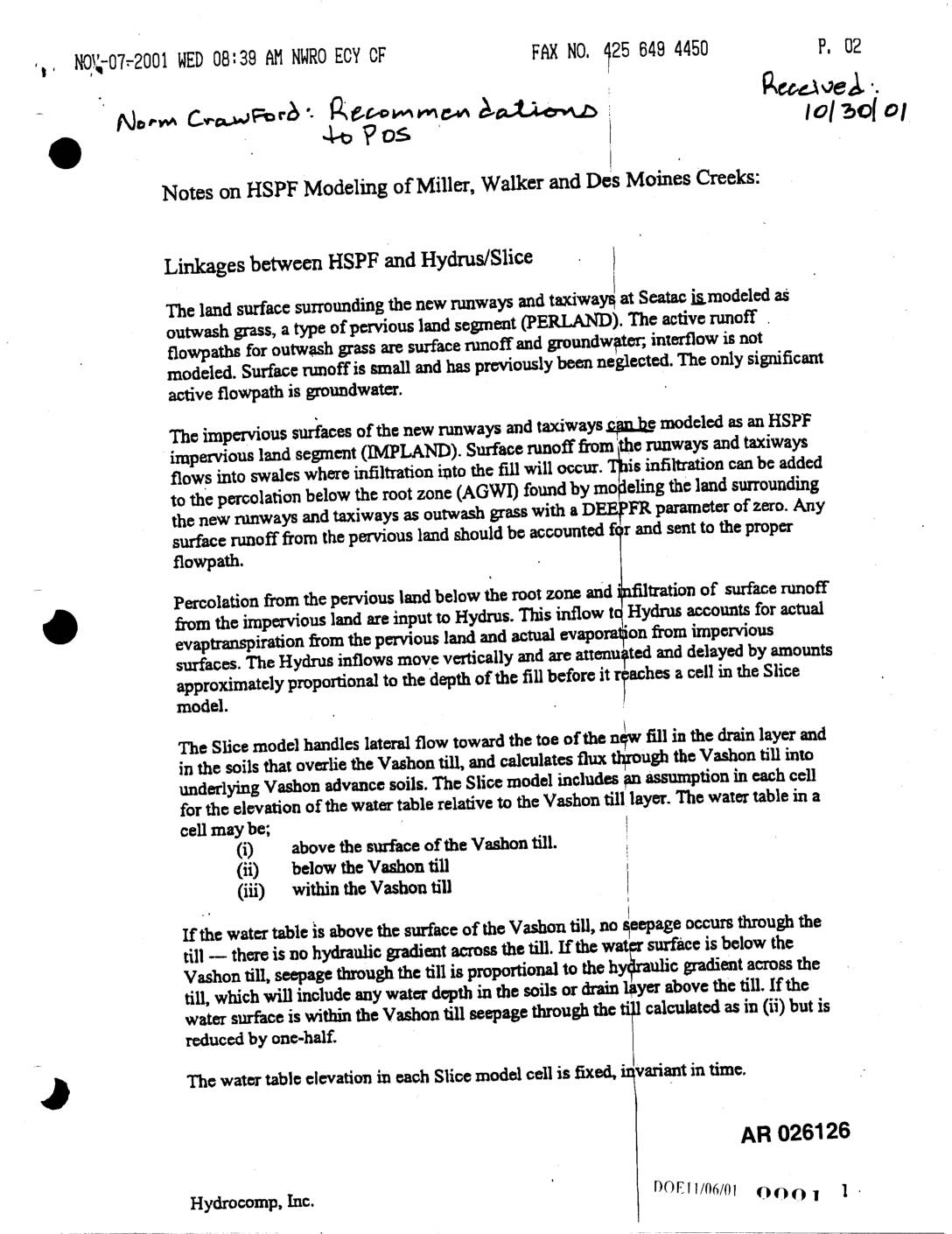
EXH AR026126: HSPF Modeling Notes — Miller, Walker & Des Moines Creeks; HSPF-Hydrus/Slice Linkages
A 2001 technical memo from Hydrocomp, Inc.'s Norm Crawford outlines recommendations for hydrological modeling of Miller, Walker, and Des Moines Creeks near Sea-Tac Airport's new runways and taxiways. The document describes how surface runoff and groundwater flow from both impervious runway surfaces and surrounding pervious grasslands should be calculated and linked across three modeling tools: HSPF, Hydrus, and the Slice model. Key recommendations include properly accounting for infiltration, reducing till seepage by 33% for inactive groundwater recharge, and reconciling discrepancies in land area calculations between the different models. -
 2001-11-02
EXH AR026273: Parametrix Transmittal & Responses to ACOE Questions Oct 26 2001 STIA MPU Natural Resource Mitigation
This November 2001 document from Parametrix, Inc. contains responses to U.S. Army Corps of Engineers questions regarding the Sea-Tac International Airport (STIA) Master Plan Update's natural resource mitigation project. It addresses technical questions about wetland mapping, watershed basin sizes, low-flow analysis, and cumulative wetland impacts across the Miller Creek, Walker Creek, and Des Moines Creek basins, showing projected wetland acreage reductions of approximately 3-4% with the project. The document also covers mitigation measures including wetland restoration sites and performance standards for invasive species control. -
 2001-10-30
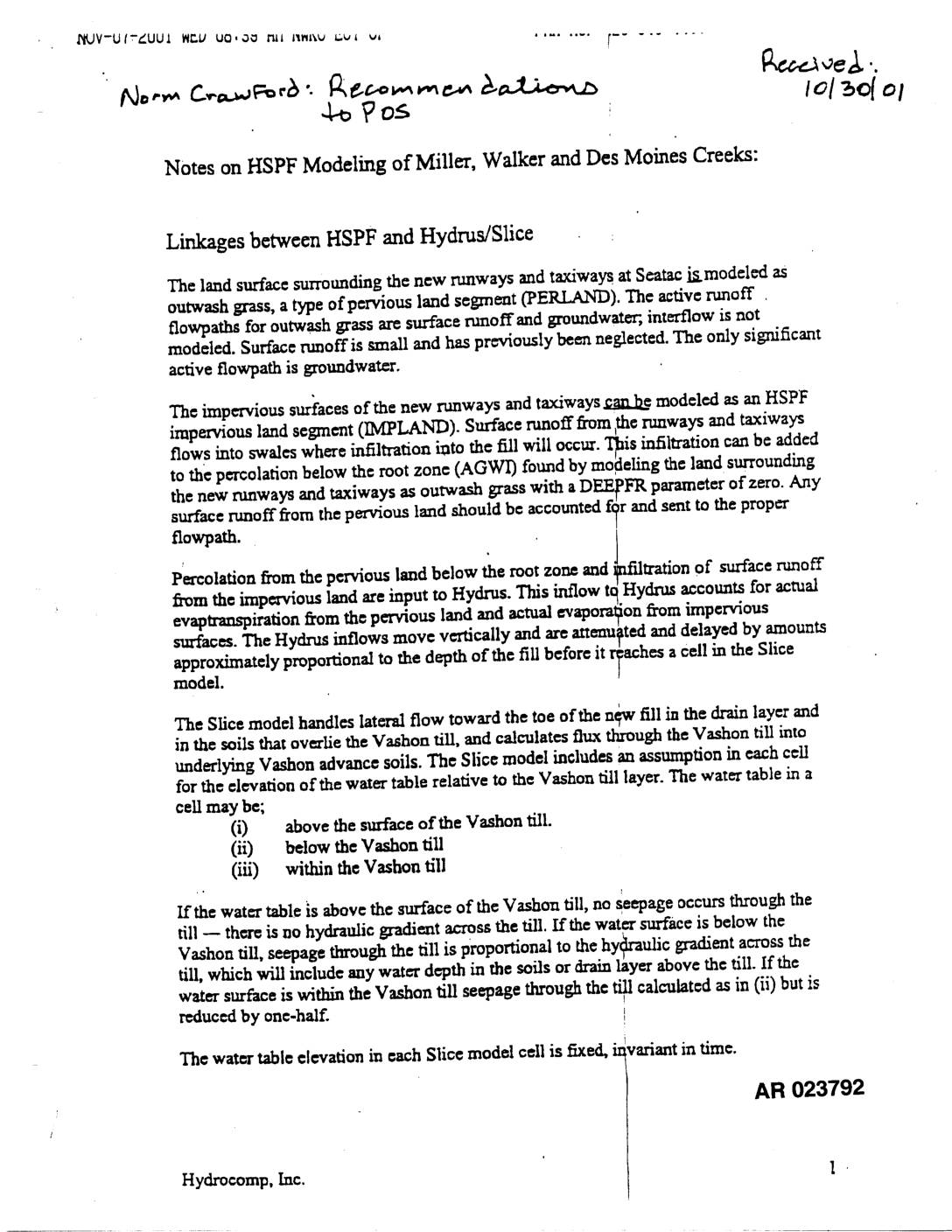
EXH AR023792: Notes HSPF Modeling Miller, Walker & Des Moines Creeks — HSPF/Hydrus/Slice Linkages
This technical memo from Hydrocomp, Inc. (authored by Norm Crawford) outlines recommendations for improving hydrological computer modeling of Miller, Walker, and Des Moines Creeks near Seattle-Tacoma International Airport's new runway construction. It describes how rainfall and runoff from the new impervious runway and taxiway surfaces and surrounding pervious grasslands are tracked through a linked series of models (HSPF, Hydrus, and Slice) to estimate groundwater movement and seepage through underlying soil layers. The document identifies several discrepancies in the existing model setup and recommends corrections to better account for water flow paths, drainage areas, and groundwater recharge in the fill areas created by airport expansion. -
 2001-08-06
EXH AR023128: Letter from Columbia Biological Assessments to Army Corps of Engineers and Ecology re Port Of Seattle Low Flow Analysis/Flow Impact Offset Facility Proposal
A biological scientist hired by the Airport Communities Coalition reviewed the Port of Seattle's plan to store airport stormwater in detention vaults and release it into Miller, Walker, and Des Moines Creeks during summer low-flow periods. The review found that the plan could worsen water quality in those creeks, because stored sediments may release toxic levels of copper and zinc, and potentially harbor human pathogens from airplane wastewater. The scientist concluded that regulators lacked sufficient information to approve the proposal without further testing, modeling, and independent scientific review. -
 2001-08-06
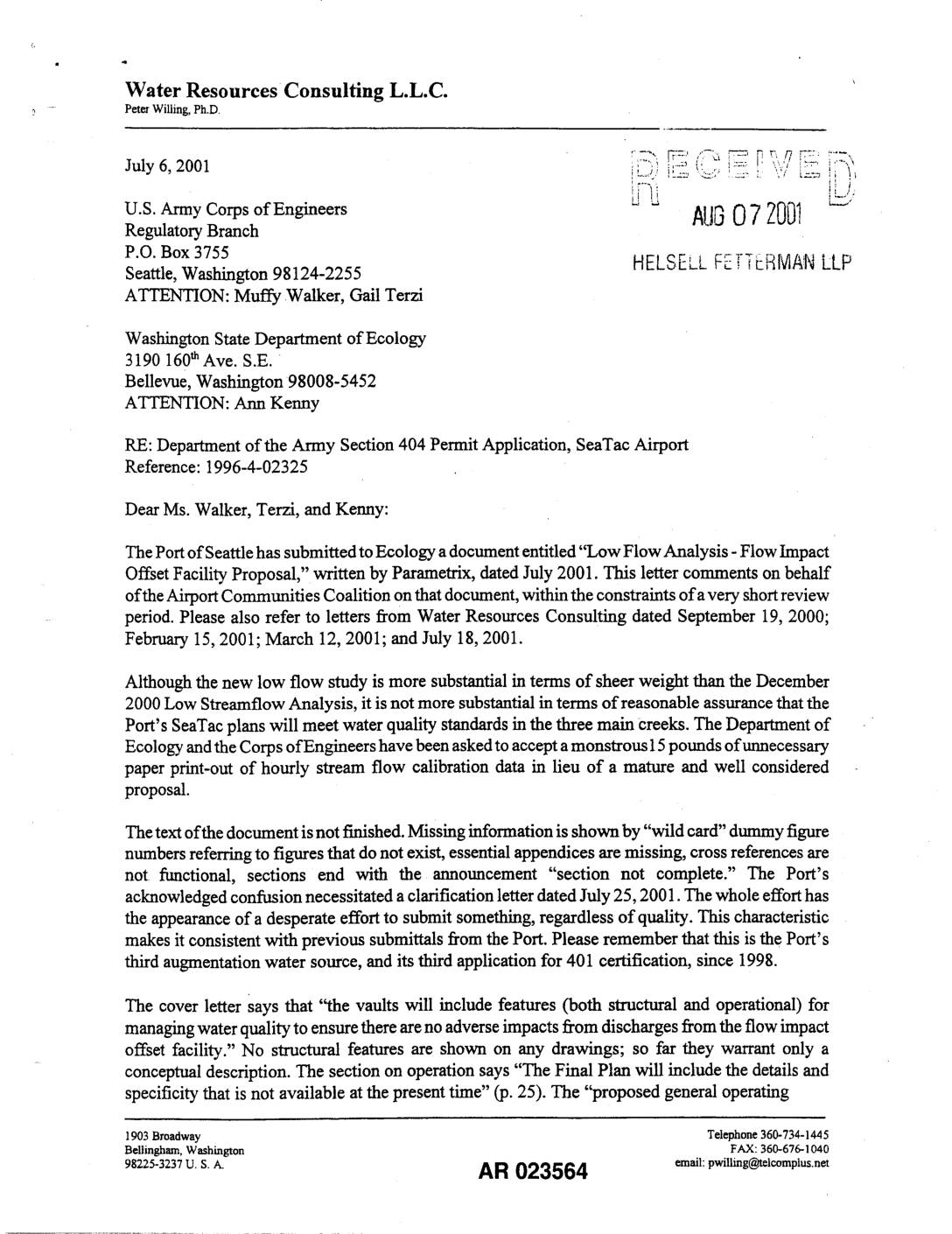
EXH AR023564: Letter Water Resources Consulting (Peter Willing) to Army Corps & Ecology — STIA Sec 404/401 Permit Low Flow Analysis & Flow Impact Offset Facility
A water resources consultant, writing on behalf of the Airport Communities Coalition, argues that the Port of Seattle's July 2001 Low Flow Analysis for Sea-Tac Airport expansion fails to provide reasonable assurance that the project will meet water quality standards in Miller, Walker, and Des Moines Creeks. The letter criticizes the submission as incomplete and rushed, noting missing figures, unfinished sections, and an unresolved plan to store the required 46 acre-feet of stormwater across the three watersheds. The consultant contends that the Port's proposed water quality protections—including filtration, aeration, and biofiltration swales—are unproven, inadequately designed, and fall short of the regulatory standard required for Section 401/404 permit approval.