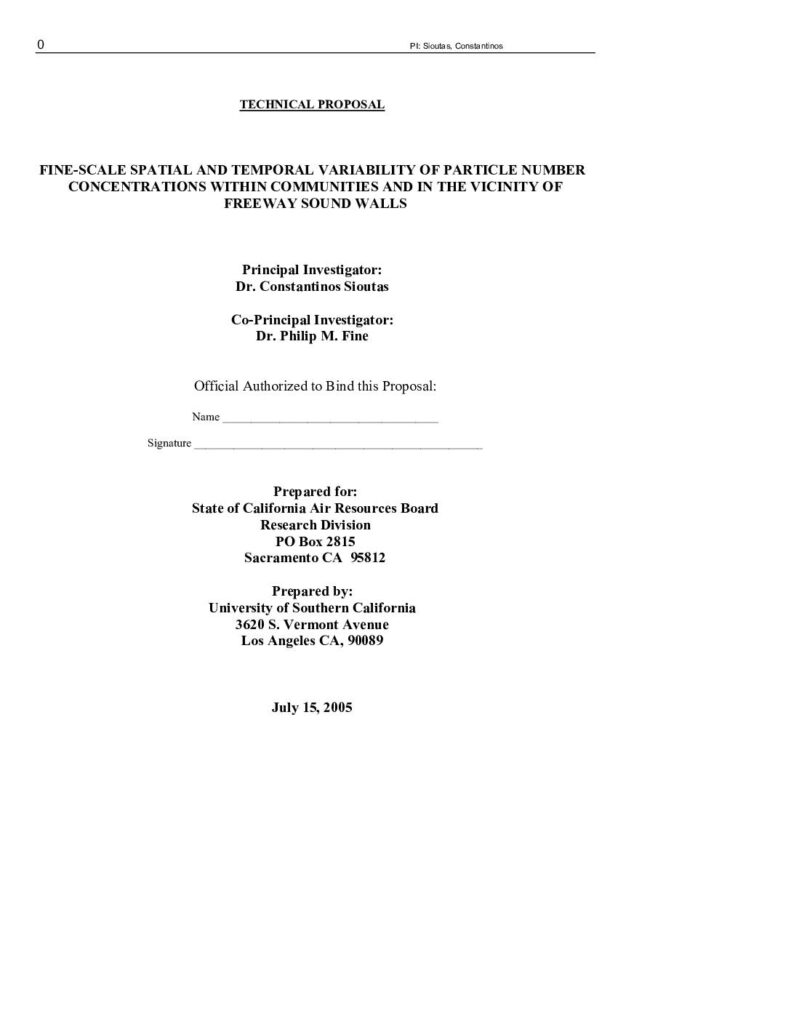
This 2005 technical proposal from the University of Southern California requests funding from the California Air Resources Board to study how ultrafine particle pollution varies at a fine scale within communities and near freeway sound walls. Researchers aim to determine whether single monitoring stations accurately represent residents' actual exposure to ultrafine particles, which are emitted primarily by vehicle traffic and are considered more toxic than the larger particles currently regulated by federal and state standards. The study focuses on spatial and temporal measurement of particle number concentrations rather than particle mass, as ultrafine particles may pose greater health risks despite making up only a small fraction of total airborne particulate matter.Open full document
Notes
A technical proposal submitted to the California Air Resources Board by University of Southern California researchers Dr. Constantinos Sioutas and Dr. Philip M. Fine. The proposal seeks to study fine-scale spatial and temporal variability of ultrafine particle number concentrations within communities and near freeway sound walls. Key objectives include determining the accuracy of single-site monitoring for human exposure estimation, locating ultrafine particle sources, and analyzing regional versus local contributions to particle concentrations.