TagSea-Tac Airport(285)
-
Ecology Focus STIA Environmental Update November 1997 0001
=i-e-Tacoma International Airport (Sea.-Tac) Expansion Project Environmental mp,ICt Statement-- The Port of Seattle completed and issued its Final Supplemental ,nvironmental Impact Statement for the proposed Master Plan Update at Sea-Tac. followed by the Federal Aviation Administration's release of its Record of Decision and Air Conformity determination. The FM determined that the project will not be considered regionally sigIdficant with regard to air pollution emissions, and that it is consistent with the State Implementation Plan ,r dir quality. The state reaffirmed its certification of the Sea-Tac Airport third runway project is certification is conditioned to assure that the third runway will be constructed and operated in compliance with applicable air and water quality standards. The conditions of the ,rtification uld the status of the environmental permits to be issued by the Department of ,c.ojogy (Ecology) are explained in more detail below. Ecology is one of several agencies that reviewed both the environmental impact statement (EIS) and the supplemental EIS for the proposed airport expansion project. and is involved in issuing environmental permits and ,ertifications for the project , Stockpile of fill material '-- The Port has begun to stockpile fill needed to build the third runway. CWTently, the fill is coming from a permitted spd and gravel mine located in Dupont. The fill is shipped by barge up the Duwamish River and then trucked up SR509 to the airport. , Enforcement – Ecology recently penalized the Port for improperly controlled soil erosion runoff from an employee parking lot under construction north… -
 1996-03-27 00:00
Final Decision on Noise Issues – Expert Arbitration Panel’s Review of Noise and Demand/System Management Issues at Sea-Tac International Airport
This is the final decision by the Expert Arbitration Panel on Noise and Demand/System Management Issues regarding Sea-Tac International Airport. The majority of the panel concluded that while the Port of Seattle has implemented noise abatement and mitigation programs, they have not shown sufficient reduction in real on-the-ground noise impacts to satisfy the requirements of -
1994-12-11 02:38
Sea-Tac’s Turbulent History
Stephen Clutter, Paul J. Lim The latest controversy at Sea-Tac, over a possible third runway, is one more chapter in a long, turbulent history of airport expansion. Planes started using the site in 1944 and in five decades, it has become the 16th-busiest airport in the nation. ———————————- If you’re upset about the possibility of -
-
 1992-12-01 00:00
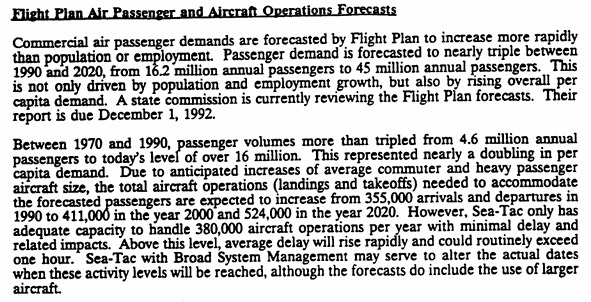
Flight Plan Air Passenger and Aircraft Operations Forecasts
Flight Plan forecasts show commercial air passenger demand increasing more rapidly than population or employment, from 4.6 million annual passengers in 1970 to 16 million in 1990. Between 1990 and 2020, passenger volumes are projected to nearly double with forecasted passengers expected to increase from 355,000 aircraft arrivals and departures in 1990 to 411,000 in -
 1992-10-01 00:00
The Flight Plan Project Final Environmental Impact Statement
Re: Flight Plan: Non-Project (Programmatic) Final Environmental Impact Statement (FEIS) Dear Reader:. The central Puget Sound region is faced with growing demand for commercial air the existing Seattle-Tacomatransportation services and a limited capacity at _ • " Sea Tac Without :_n_ionof " ort ca acity or other steps toInternaUon_..Airport.( .- ). exp ;- . _ .p ....... address the increase m m_d-to long-range travel neeos, me result wu/o.e oetays .mrmr travelers, which could ultimately affect the region's economy. The soluuon to this challenge must strike a balance between environmental impacts, quality of life faaors, and the travel needs of the region's populace. The Flight Plan Project has been a joint effort of the PugetSound RegionalCouncil and the Port of Seattle. The project was initiated bythe Puget bouno _oundl ox Governments (predecessor to the Puget Sound Regional Council) and the Port of Seattle to research airpon system alternatives to meet the region's long-term air transportation needs. (On October 1, 1991 the Puget Sound Council of Governments (r_L._u) was dissolved and replaced by the Puget Sound Regional Coundl.) The PSCOG ano me Port established the Puget Sound Air Transportation t_ommittee (PSATC), whi_ was composed of citizens, elected officials and private sector interests, to propose solutions to the region's air transportationneeds. The Flight Plan s Draft Report, prepared by the Re_ionaJ Council and the Port of Seattle and issued on January 7, 1992, included a.non- project, draftenvironmental impact statement (DEIS) re_gardingthe PSATC's ad_ ory recommendations. Section 1.1.3 of this FEIS describes me changes… -
1992-03-11 00:00
PORT OF SEATTLE ORDERS $75,000 AIR CARGO STUDY | Journal of Commerce
John Davies | Mar 11, 1992, 7:00 PM EST A $75,000 study of the needs of the air cargo industry at Seattle-Tacoma International Airport was ordered Tuesday. Port of Seattle commissioners authorized a review of existing facilities, growth forecasts and a projection of what the airport should do to be prepared for emerging demands.The action follows the -
1991-06-09 00:00
Destination Unknown — Airport! The Controversy
Destination Unknown — Airport! The Controversy Jun 9, 1991 Lance Dickie ONE word sums up the public’s reaction to expanding Sea-Tac airport or planning for more planes in the sky over Puget Sound: Don’t. Don’t expand the Seattle-Tacoma International Airport, don’t add runways to any existing regional airport and don’t replace Sea-Tac and start from -
Letter to United Airlines Captain Volz Regarding Sea-Tac Noise Abatement Procedures
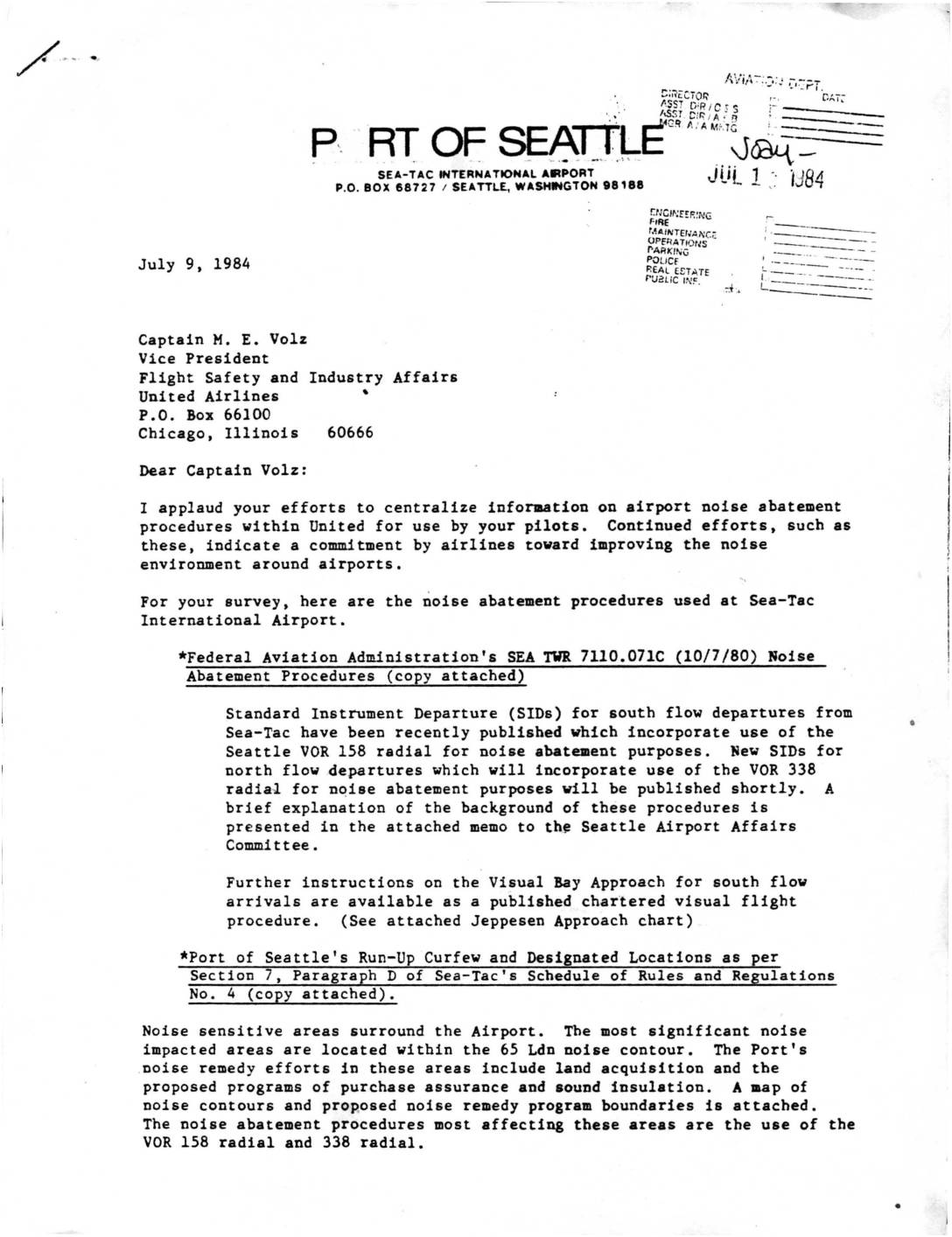
Letter from Port of Seattle to United Airlines Vice President Captain M.E. Volz providing Sea-Tac International Airport’s noise abatement procedures for United’s pilot information centralization effort. Includes information on FAA noise abatement procedures, Standard Instrument Departures, Visual Bay Approach, run-up curfews, and noise sensitive areas within the 65 Ldn noise contour. -
FAA Letter to Port of Seattle Regarding Noise Remedy Program
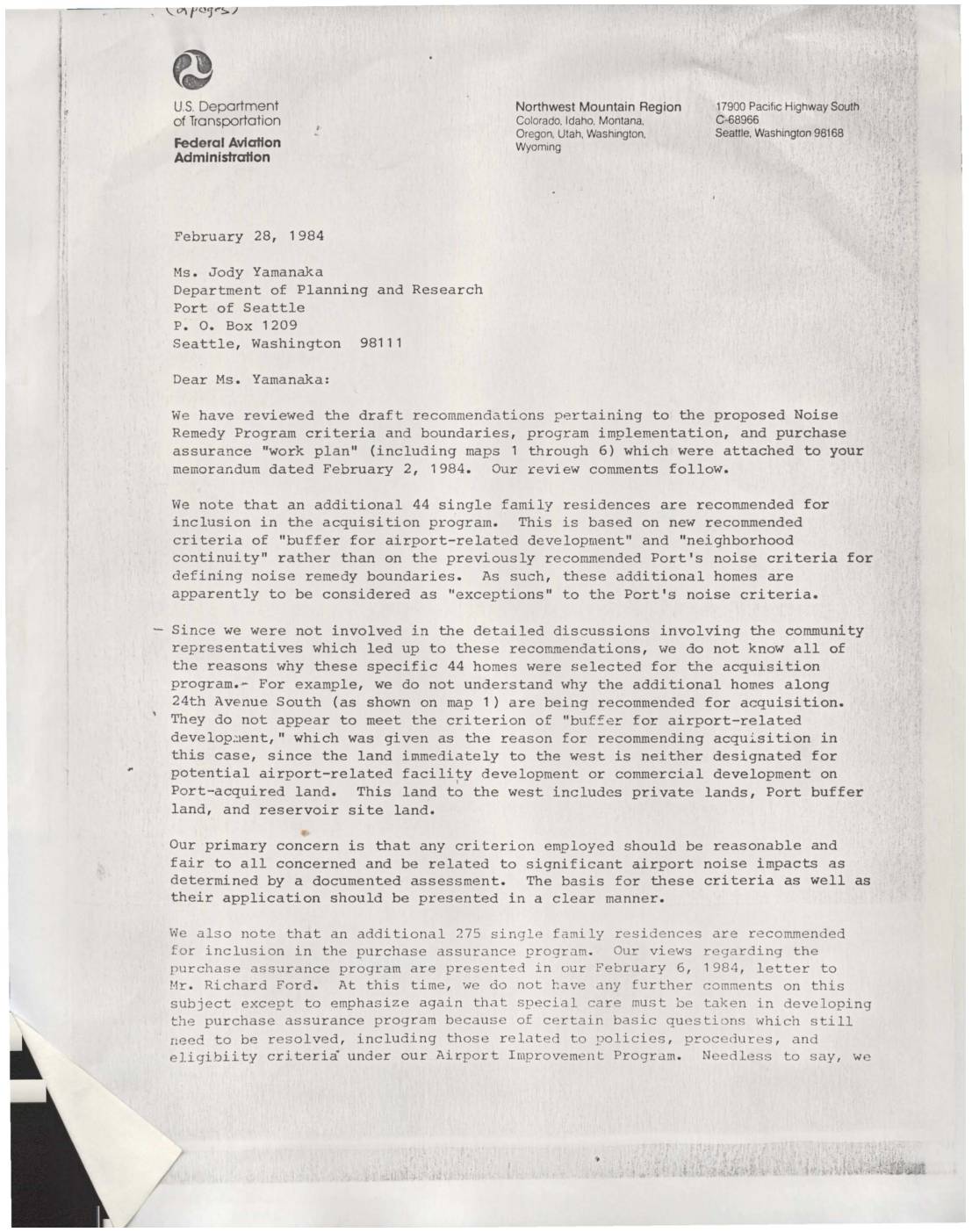
Letter from FAA Northwest Mountain Region to Port of Seattle reviewing draft recommendations for the Noise Remedy Program criteria and boundaries. The FAA expresses concerns about additional 44 single family residences recommended for acquisition based on ‘buffer’ and ‘neighborhood continuity’ criteria rather than noise criteria, and raises questions about the purchase assurance program for 275