Skip to content
  • STNI
  • Statistics
    • Ops and Passengers
      • King County International Airport (Boeing Field) Annual Operations
    • Financials
    • Aviation fuel uplift in the State of Washington 2018 – 2025
      • Aviation Fuel Uplift at Sea-Tac Airport
    • Air Quality Monitoring
    • Flight Tracking
      • Flow and Flight Tracks
      • Five Year Comparison
      • Busiest Hours and Days
    • SEL Noise Reports & Graphs
      • About The Permanent Noise Monitors
      • Minutes of Quiet by Noise Monitor
      • Noise Events mapped
      • Noise Events (SEL)
    • Runways
    • Employees
    • Real Estate
      • Port Properties and Trees mapped
    • Parking
  • Events
  • Protest
    • Regular Events
    • Legislation 2026
    • Complain about a particular flight
    • Advocacy Organizations
    • Media Outlets
    • People
    • The Port of Seattle
      • Commission Meetings
      • Public Records Requests
      • StART
      • Highline Forum
    • Contact Your Electeds
  • Resources
    • FAQs
      • FAA Occurrences/Accidents/Indents
    • The unSustainable Airport Master Plan
      • SAMP Public Comment Template
        • Two versions of Appendix K: NEPA/SEPA 2018 vs 2023
      • SAMP NTP: 31 projects by the numbers
      • SEPA Draft EIS (2026)
      • SAMP Record of Decision/FONSI (2025)
      • SAMP Draft EA (October 2024)
      • 2018 Scoping
    • Port Packages
      • Port Package Property Costs
      • Port Packages mapped
      • The Port Package Explainer
      • So you want a (first-time) Port Package? Start here
      • Port Package Looker Upper
      • How do I determine if I have a Port Package or Avigation Easement?
      • Progress on Port Package Update legislation
      • Having a Port Package Problem?
      • Port Package Site Visit Follow-Up
    • Document Library
    • Explainers
      • The Airport Law Cheat Sheet
      • The Grant Explainer
    • External Articles
    • History
      • Timeline
      • The Sea-Tac Communities Plan
        • Sea-Tac Communities Plan – Planning Maps
      • PSRC Third Runway Decision Process
    • Studies
    • Videos
  • Stories
  • Mission
  • Subscribe
  • Contact
Scroll down to content

Get InformedStay Informedx

I understand that you will never share my information with anyone, you will only use it to keep me updated on relevant events and that I may unsubscribe at any time.

STNI

STNISea-Tac Noise.Info

  • Solve for Sea-Tac. Solve for every airport.
  • Since 2016, working to obtain justice for everyone living under the flight path.
  • Less Noise. Cleaner Air. Better Public Health. Compensation.
  • Everything you think you know about the airport is wrong.

TagSafety(20)

Advanced Search Options

  • Dates
  • Media
    • External Articles
    • Images
    • PDFs
    • Video
    • Audio
  • Order By
  • 2020-02-21

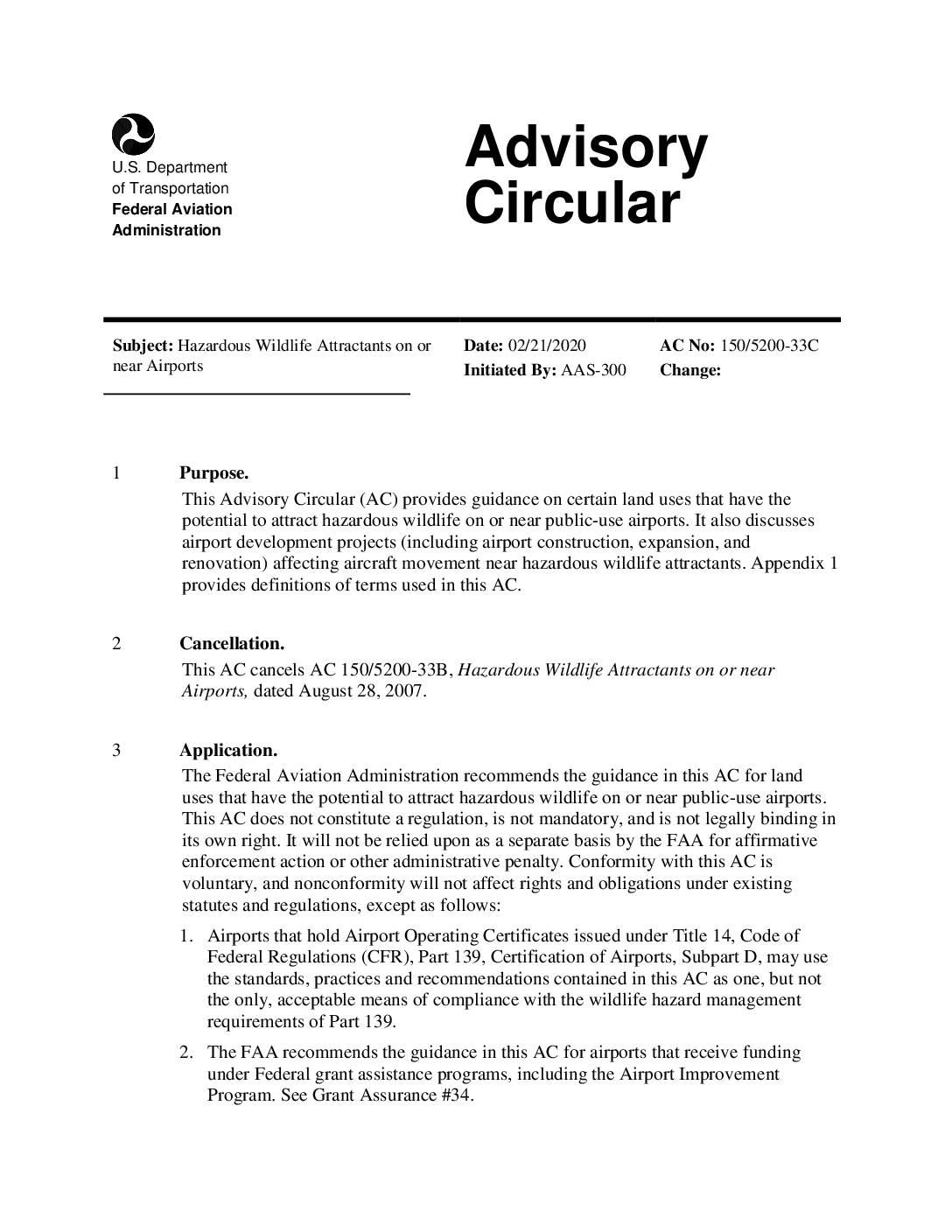
    Advisory circular: Hazardous wildlife attractants on or near airports

    This FAA Advisory Circular (AC 150/5200-33C), issued February 21, 2020, provides guidance on land uses and development projects near public-use airports that may attract hazardous wildlife such as birds, mammals, and reptiles, which pose serious safety and economic risks to aircraft. It outlines recommended practices for airport operators, land-use planners, and federally funded airport projects to assess and mitigate wildlife hazards, though compliance is voluntary except for airports holding operating certificates under 14 CFR Part 139 or receiving federal grant funding. The document updates and replaces the previous 2007 version of the same circular.
    TagsAirport, FAA, Part 139, Safety
  • 2020-02-21

    Advisory circular: Hazardous wildlife attractants on or near airports

    This FAA Advisory Circular (AC 150/5200-33C), issued February 21, 2020, provides guidance on land uses and development projects near public-use airports that may attract hazardous wildlife such as birds, mammals, and reptiles, which pose serious safety and economic risks to aircraft. It outlines recommended practices for airport operators, land-use planners, and federally funded airport projects to assess and mitigate wildlife hazards, though compliance is voluntary except for airports holding operating certificates under 14 CFR Part 139 or receiving federal grant funding. The document updates and replaces the previous 2007 version of the same circular.
    TagsAirport, FAA, Part 139, Safety
  • 2014-06-01

    Vegetation management for your home

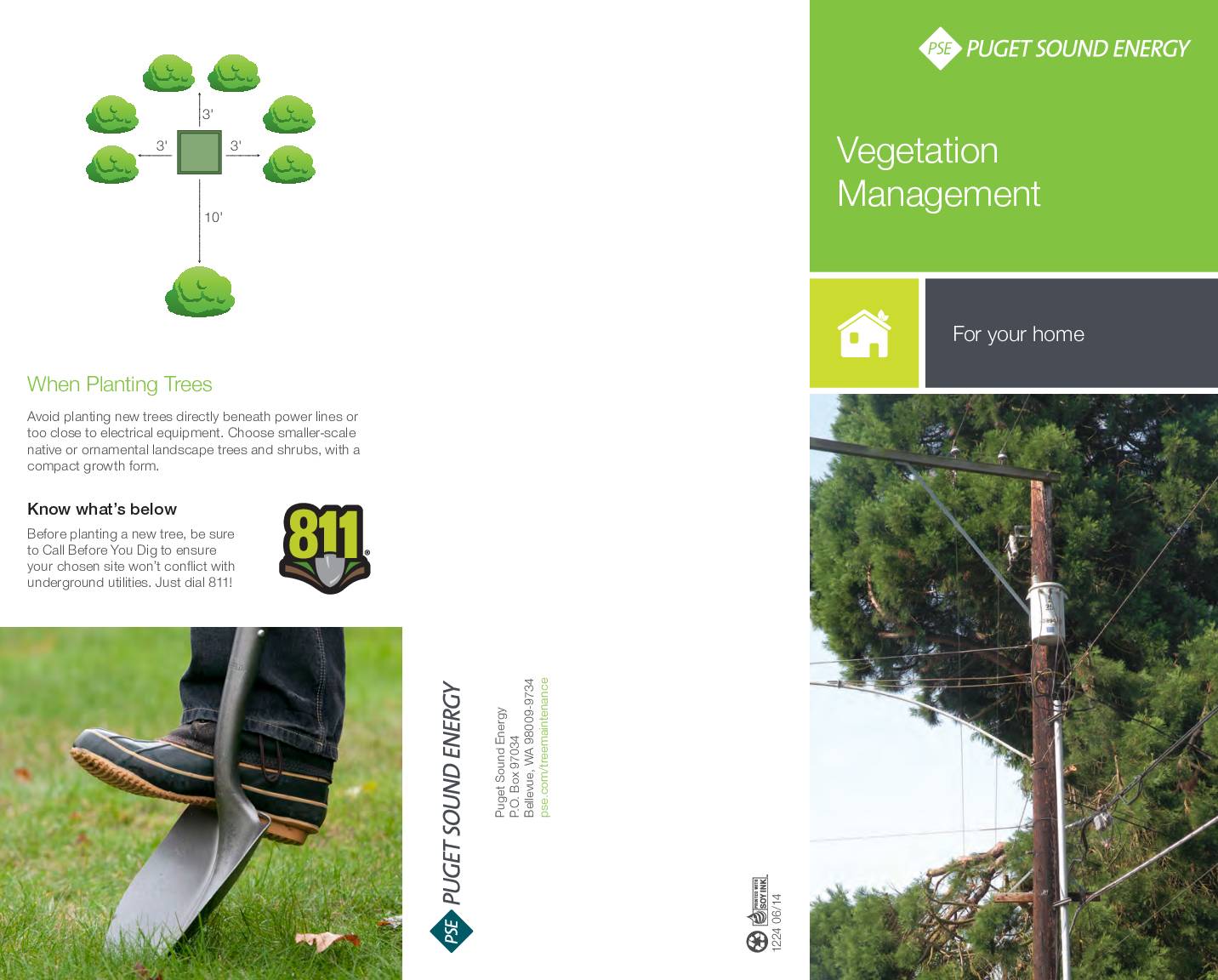
    This Puget Sound Energy brochure explains the company's vegetation management program, which focuses on trimming or removing trees near power lines to prevent outages and maintain reliable electrical service across Washington state. It outlines methods such as selective tree removal and directional pruning, and advises homeowners to avoid planting large trees beneath power lines or near electrical equipment. Residents are encouraged to call 811 before digging and to choose smaller native or ornamental trees suitable for planting near utility infrastructure.
    Tagscommunity engagement, Environment, Puget Sound, Safety, Trees
  • Safo12007 pdf
    2012-10-18

    Recategorization (recat) of federal aviation administration (FAA) wake turbulence separation categories at memphis international airport (mem)

    FAA Safety Alert for Operators announcing the implementation of new wake turbulence separation categories (RECAT Phase I) at Memphis International Airport, effective November 1, 2012. The document details changes from the current 6-category system to a new system based on weight, approach speeds, and wing characteristics, with specific separation standards and aircraft assignments.
    TagsAir Traffic Control, Airport, FAA, Safety
  • 2001-07-04

    Retired chief pilot warns against third runway

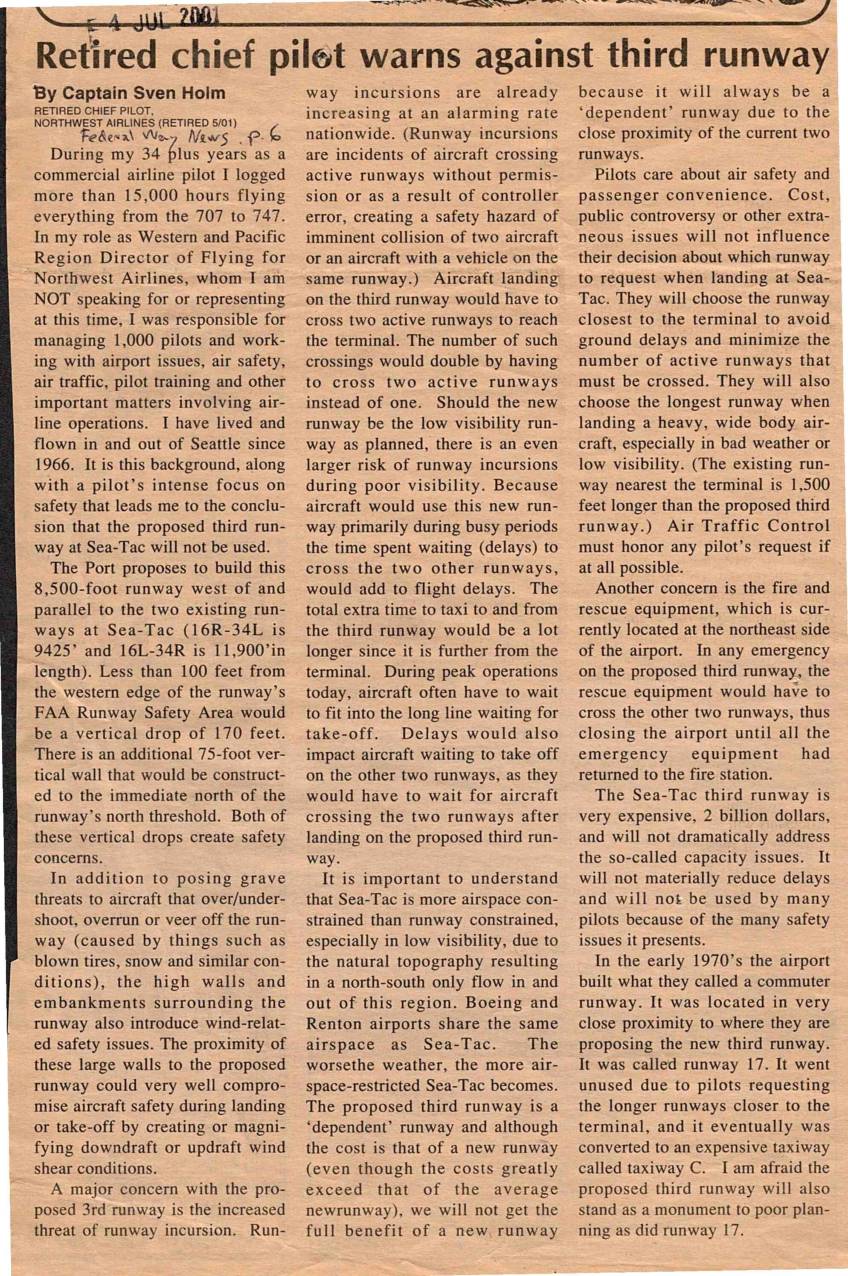
    A retired Northwest Airlines chief pilot with over 15,000 flight hours argues against the construction of a proposed third runway at Seattle-Tacoma International Airport, citing serious safety concerns including runway incursion risks, wind shear hazards from surrounding walls, and complications for fire and rescue operations. He contends that pilots will avoid the new runway because it is shorter and farther from the terminal than existing runways, meaning it will do little to reduce delays or increase capacity. Drawing a parallel to an unused commuter runway built at Sea-Tac in the 1970s, he warns that the $2 billion project will become a costly monument to poor planning.
    TagsAirport Expansion, Runways, Safety, Sea-Tac Airport, Third Runway
  • 2000-08-01

    EXH AR045494: Wildlife Hazard Management Plan — Sea-Tac Airport

    Wildlife Hazard Management Plan (WHMP) for Seattle-Tacoma International Airport (SEA), developed by Port Of Seattle in cooperation with USDA Animal and Plant Health Inspection Service (APHIS) Wildlife Services, Olympia, WA, August 2000, AR 045494. Covers habitat management (grass, wetlands, water, vegetation, structure), wildlife control procedures (bird and mammal control, wildlife patrol), laws and regulations (Washington
    TagsACC, Environment, FAA, Pollution Control Hearings Board, Port Of Seattle, Safety, Sea-Tac Airport
  • 1999-12-01

    EXH AR026410: Wildlife Hazard Management Airports — Manual Airport Personnel

    This 1999 manual, prepared jointly by the Federal Aviation Administration and the U.S. Department of Agriculture, provides airport personnel with guidance on managing the safety risks posed by wildlife at airports. It covers topics including the FAA National Wildlife Strike Database, the roles of various federal agencies, and strategies for reducing bird and animal strikes on aircraft. The manual draws on strike records from 1990–1998 to illustrate the frequency, types, and impacts of wildlife encounters with aircraft.
    TagsACC, Airport, FAA, Federal Aviation Administration, PCHB, Pollution Control Hearings Board, Safety, Third Runway
  • 1998-04-15

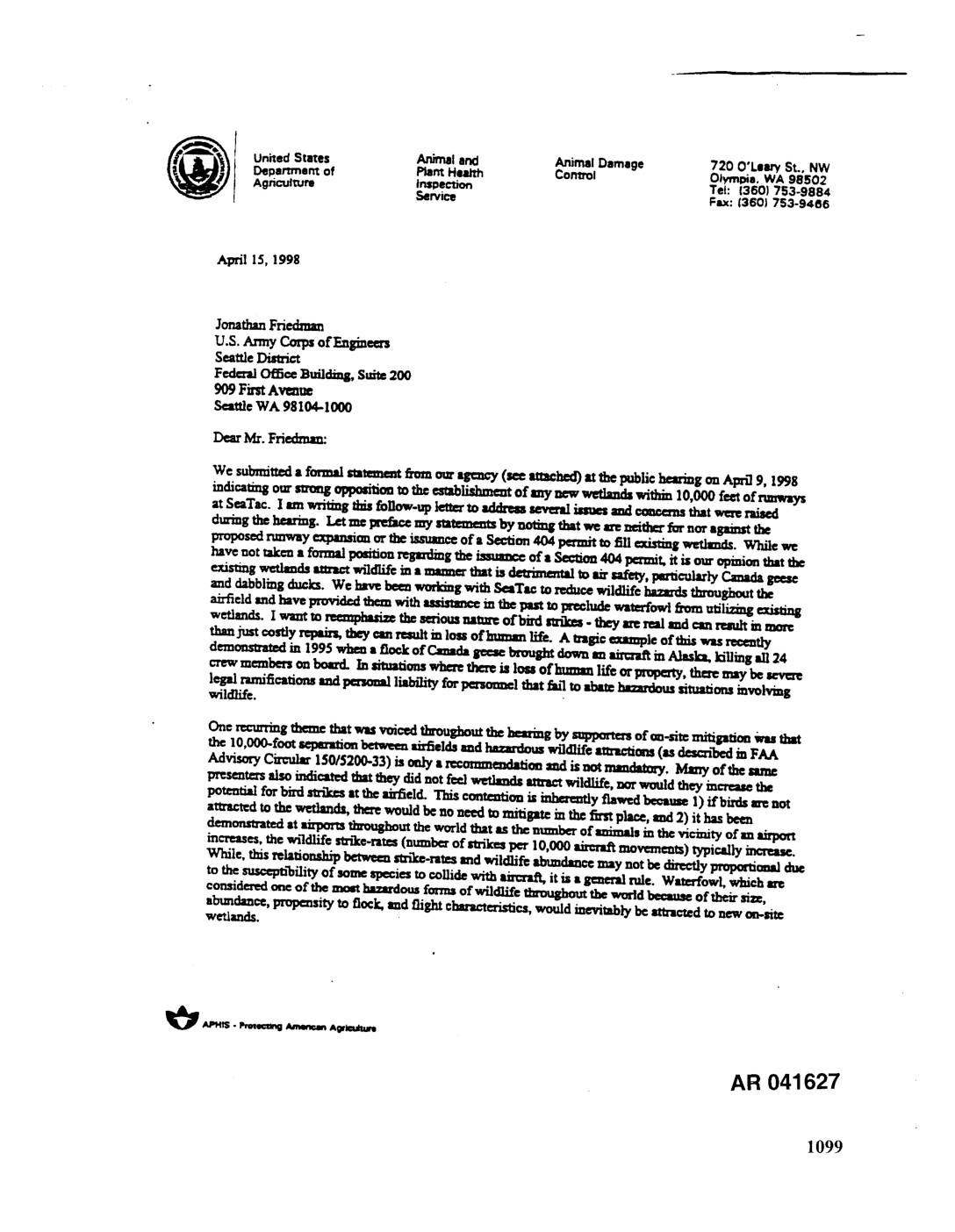
    EXH AR041627: USDA APHIS Animal Damage Control Letter to U.S. Army Corps of Engineers Opposing New Wetlands Within 10,000 Feet of Sea-Tac Airport Runways

    Letter dated April 15, 1998 from J. Gary Oldenburg, USDA Animal and Plant Health Inspection Service (APHIS) Animal Damage Control, State Director WA/AK/HI/Pacific Islands, to Jonathan Friedman, U.S. Army Corps of Engineers Seattle District, follow-up to public hearing of April 9, 1998. Strongly opposes establishment of any new wetlands within 10,000 feet of runways at
    TagsACC, Army Corp of Engineers, Environmental Impact Statement, FAA, Pollution Control Hearings Board, Safety, Sea-Tac Airport
  • 1997-05-01

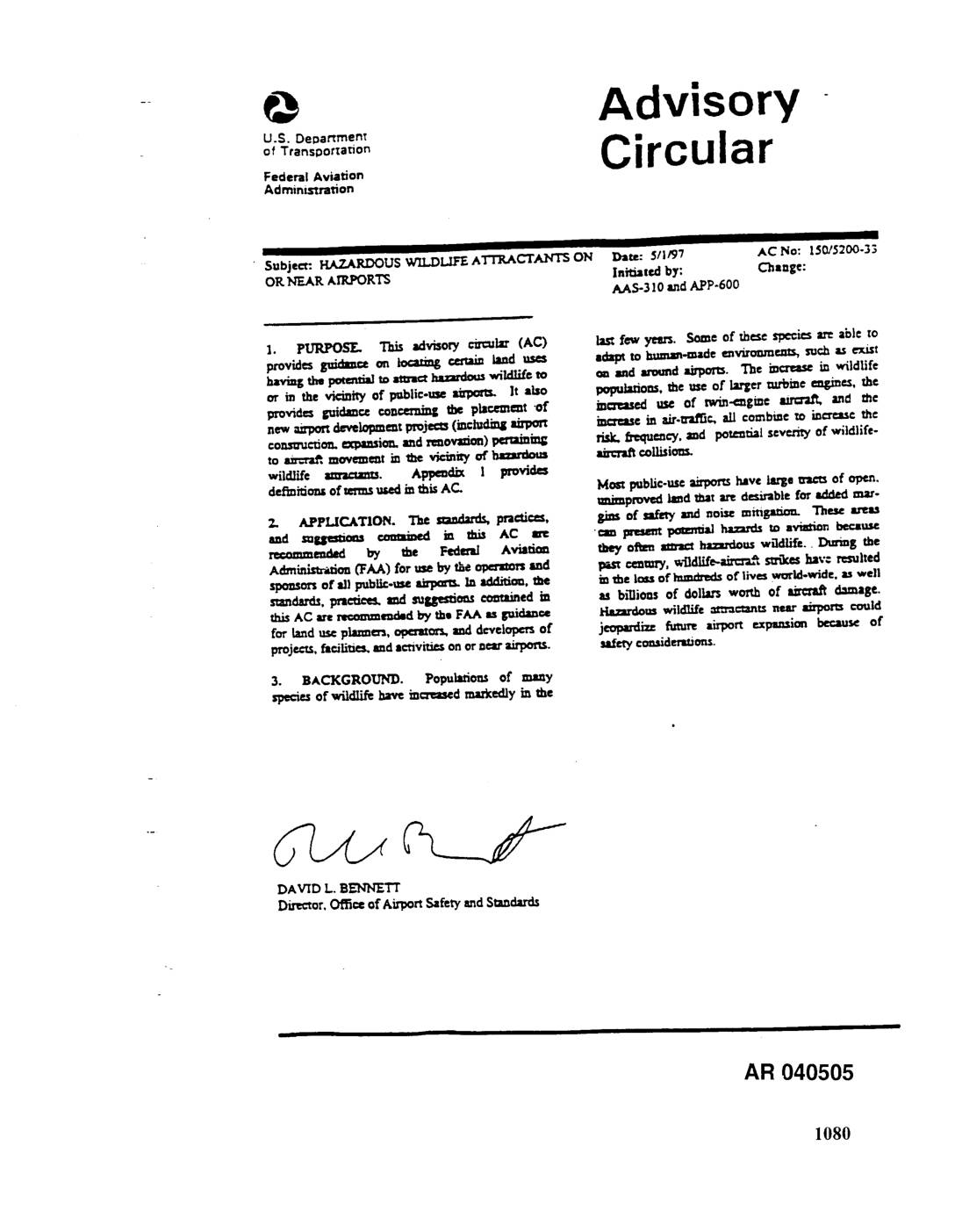
    EXH AR1080: Advisory Circular AC 150/5200-33 — Hazardous Wildlife Attractants On or Near Airports

    FAA Advisory Circular AC 150/5200-33, dated 5/1/97, initiated by AAS-310 and APP-600, signed by David L. Bennett, Director of Office of Airport Safety and Standards. Provides guidance on locating land uses that attract hazardous wildlife to or near public-use airports. Covers siting criteria: 5,000 feet separation for piston-powered aircraft airports, 10,000 feet for turbine-powered aircraft
    TagsACC, Airport, FAA, Land Use, Pollution Control Hearings Board, Safety
  • 1997-05-01

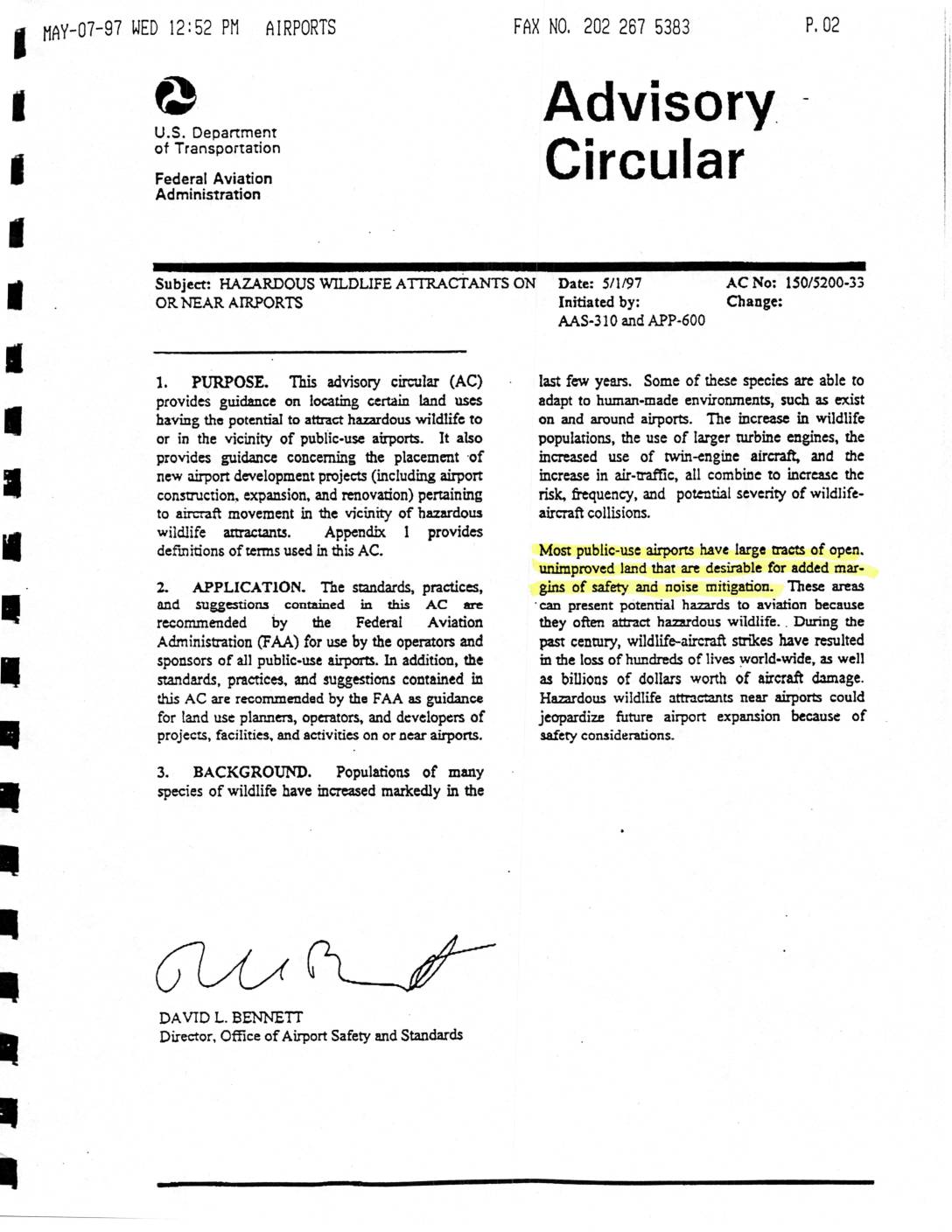
    Advisory circular: Hazardous wildlife attractants on or near airports

    This 1997 FAA Advisory Circular provides guidance on identifying and managing land uses near public airports that attract hazardous wildlife, such as waste disposal sites, wastewater treatment facilities, and wetlands. It recommends minimum separation distances — 5,000 feet for piston-powered aircraft airports and 10,000 feet for turbine-powered aircraft airports — between wildlife attractants and aircraft movement areas. The document notes that gulls, waterfowl, and raptors are among the most common wildlife involved in damaging aircraft strikes, and urges airport operators, land use planners, and developers to avoid practices that increase wildlife hazards near airports.
    TagsAirport, FAA, Land Use, Safety

Posts pagination

Page 1 Page 2
Sidebar On/Off

Upcoming Events

  • StART SEA Stakeholder Advisory Round Table
    Add to CalendarMWednesday Aug 26, 5:00pm - 7:00pm
    Zoom (Virtual Meeting)
    START meetingagenda 2026826 final 0 pdf

    Meeting Objectives Introduce the primary feedback themes identified by StART members regarding StART’s Operating Procedures and determine areas that may warrant future discussion. 5:00 PM – Welcome Meeting Management Welcome Lead: Andrés Mantilla, Facilitator, Uncommon Bridges; Wendy Reiter, Airport Managing Director, POS 5:15 PM – Dinner: All participants eat. 5:30 PM – StART Operating Procedures

    [...]
  • Commercial Aviation Work Group
    Add to CalendarMThursday Sep 3, 10:00am - 1:30pm
    Virtual Meeting (Zoom)
    Cawg agenda sep 3 26 virtual pdf

    Meeting Agenda 10:00 a.m. – 10:15 a.m. | Welcome – Evan Nordby, Chair a. Introductions and Agenda Reviewb. Status of appointments and non-voting member invitationsc. Other updates as necessary 10:15 a.m. – 11:00 a.m. | Is it practical and legal to operate the western Washington [Puget Sound] airports as a single airport system? – Consultant

    [...]

[See all...]


Help study childhood asthma. Get free HEPA filter!

read more...

Issues

Sea-Tac Airport is currently undergoing the largest and longest expansion in its history, collectively known as the Sustainable Airport Master Plan (SAMP). Some of it you can already hear, but you’re probably not aware of what it all means. Here’s what you need to know.
read more...

Read This!

As the source for federal transportation grants, the Puget Sound Regional Council was charged with developing a system to meet the growing need for commercial aviation. When the search for a second airport failed, they authorized the Port of Seattle to build the Third Runway, with a mandate to develop a noise abatement and mitigation program. In their effort to stop the Third Runway, the ACC argued over every detail of the Port's efforts--including property buyouts and sound insulation. The dispute was meant to be settled by a three member Expert Arbitration Panel. This is their final report. It finds 2-1, that the Port's program was insufficient in several respects. Despite that, funding for the Third Runway was approved by the PSRC, and the 'Port Package' program, proceeded largely unchanged. Expert Arbitration Panel's final decision finding that the Port of Seattle had not shown sufficient reduction in real on-the-ground noise impacts to satisfy noise reduction conditions required for approval of a third runway at Sea-Tac International Airport. The majority decision concluded the Port's noise abatement programs were insufficient despite being impressive in scope.
continue...

The Podcast!

Subscribe to the only podcast devoted to policies, politics, history, impacts for people living under the flight path everywhere. It’s definitely not just about noise!
  • Sea-Tac Noise.Info
  • Connect with STNI

    • Subscribe
    • Port Package Problem?
    • Donate
    • Podcast
    • Socials
      • Facebook
      • X (Twitter)
      • Bluesky
      • Instagram

    "EXH AR017782: RE: Third Runway 401 Permit Negotiations — Ann Kenny / Rachel McCrea Email Exchange" — , 2000

  • Learn

    • Frequently Asked Questions
    • Explainers
    • Youtube
    • Research Requests
    • Make a complaint
  • Goals

    Fulfill the promises of 1976:
    • Compensation
    • Reduced noise
    • Improved air quality
    • Environmental remediation
Login/Register
©2026•Data Privacy

Message

We use cookies to provide basic functionality. We also provide access to search engines in order to provide site analytics. We do not sell or share your data.
V V