TagRCAA(175)
-
2020-08-30 17:39
Regional Commission on Airport Affairs (RCAA)
The Regional Commission on Airport Affairs is a citizens’ group in the greater Seattle, Washington, metropolitan area. Our primary focus is to Protect our communities from the impacts of expansion at Sea-Tac Airport We pledge our best efforts to compel the Airport to obey the environmental rules that are supposed to govern the construction of -
2009-09-29 19:50
CASE/RCAA Community Forum 2009
Videos from CASE and RCAA September 29, 2009 community meeting moderated by former Des Moines City Councilmember Susan White, with opening comments from 33rd Rep. Tina Orwall, 33rd Senator Karen Keiser, King County Councilmember Dave Upthegrove and former 33rd Rep. Julia Patterson. Panel includes FAA Northwest Mountain Region Director Dave Soumi, Port of Seattle Noise -
2005-09-14 18:19
‘Historic’ agreement signed by Port, critics
Citizens Against Sea-Tac Expansion President Brett Fish, left, checks his paperwork as airport Deputy Director Michael Feldman and Regional Commission on Airport Affairs President Larry Corvari sign their copies of the agreement. Wed, 09/14/2005 by BOB DUFFNER Times/News The Port of Seattle recently signed an agreement on an airport environmental permit with two groups that -
 2005-09-12 15:32
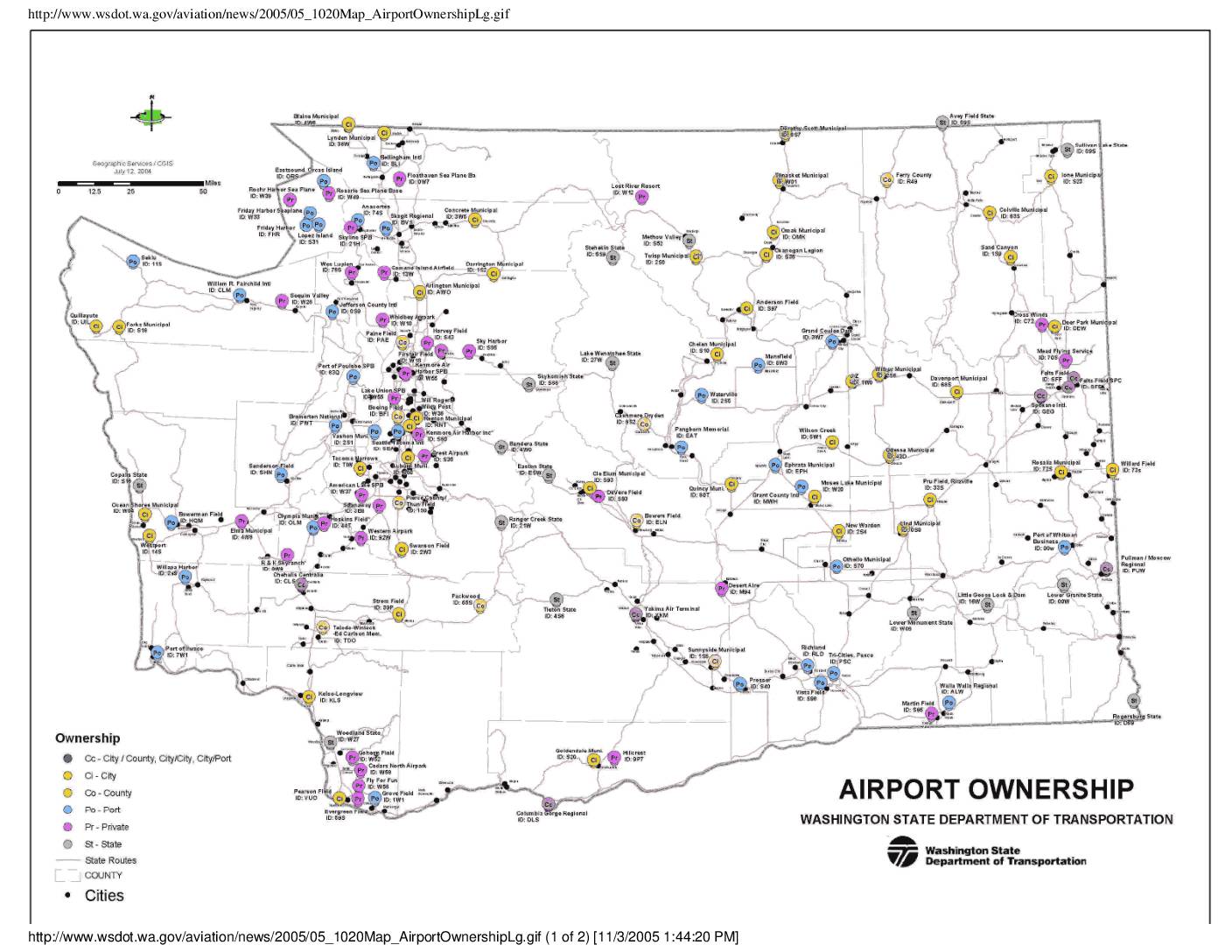
Airport Owners – MPA, 2005
http://www.wsdot.wa.gov/aviation/news/2005/05_1020Map_AirportOwnershipLg.gif (1 of 2) [11/3/2005 1:44:20 PM] http://www.wsdot.wa.gov/aviation/news/2005/05_1020Map_AirportOwnershipLg.gif http://www.wsdot.wa.gov/aviation/news/2005/05_1020Map_AirportOwnershipLg.gif (2 of 2) [11/3/2005 1:44:20 PM] wa.gov http://www.wsdot.wa.gov/aviation/news/2005/05_1020Map_AirportOwnershipLg.gif -
 2003-05-16 00:00
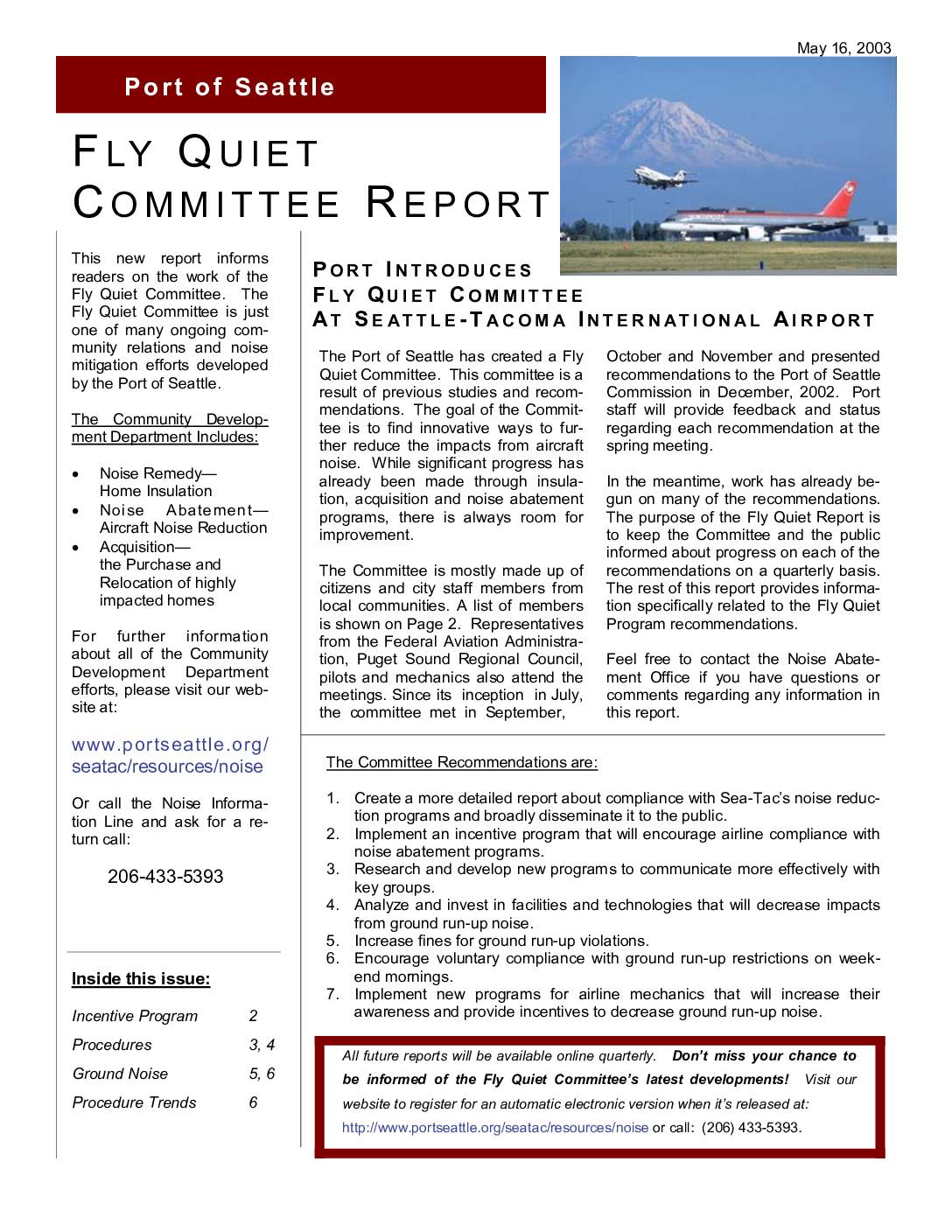
Fly Quiet Committee Report Port of Seattle (2003)
1. Create a more detailed report about compliance with Sea-Tac’s noise reduc- tion programs and broadly disseminate it to the public. 2. Implement an incentive program that will encourage airline compliance with noise abatement programs. 3. Research and develop new programs to communicate more effectively with key groups. 4. Analyze and invest in facilities and technologies that will decrease impacts from ground run-up noise. 5. Increase fines for ground run-up violations. 6. Encourage voluntary compliance with ground run-up restrictions on week- end mornings. 7. Implement new programs for airline mechanics that will increase their awareness and provide incentives to decrease ground run-up noise. The Port of Seattle has created a Fly Quiet Committee. This committee is a result of previous studies and recom- mendations. The goal of the Commit- tee is to find innovative ways to fur- ther reduce the impacts from aircraft noise. While significant progress has already been made through insula- tion, acquisition and noise abatement programs, there is always room for improvement. The Committee is mostly made up of citizens and city staff members from local communities. A list of members is shown on Page 2. Representatives from the Federal Aviation Administra- tion, Puget Sound Regional Council, pilots and mechanics also attend the meetings. Since its inception in July, the committee met in September, All future reports will be available online quarterly. Don’t miss your chance to be informed of the Fly Quiet Committee’s latest developments! Visit our website to register for an automatic electronic version when… -
 2002-07-18 15:24
Regional Airports Continue to Play Vital Role in Aviation and Development, July 2002
Regional Airports Continue to Play A Vital Role in Meeting Aviation and Development Needs Presentation to Washington State Senate Transportation Committee by Dr. Stephen Hockaday Pacific Aviation Consulting Inc. July 18, 2002 Regional Airports Continue to Play A Vital Role in Meeting Aviation and Development Needs 1. Many regions have multiple airport systems 2. Multiple airport systems have advantages 3. Regional airport need is well recognized 4. Airlines are developing regional airport service 5. Regional airports are developing airline service 6. Several airports are not fully utilized 7. Corps of Engineers identified several promising regional airport sites 8. Recent drop in demand gives time for studies 1. Many Regions Have Multiple Airport Systems As regions grow, multiple airport systems develop: Chicago – O’Hare, Midway Dallas – DFW, Love Field Los Angeles – LAX, Burbank, Long Beach, Orange County, Ontario San Francisco – SFO, Oakland, San Jose New York – Kennedy, La Guardia, Newark Washington DC – Dulles, National, Baltimore Low cost & regional airlines look for low cost and service advantages 2. Multiple Airport Systems Have Advantages • Reduce ground access time, cost, pollution • Provide competition in price and service • Provide a long-term solution that is not possible with a single airport • Spread economic benefits across the region • Improve regional aviation security - A single airport is vulnerable (can be closed by a single event or threat) - A regional airport provides redundancy and can be designed to meet new security requirements 3. Regional Airport Need… -
 2001-08-30 20:46
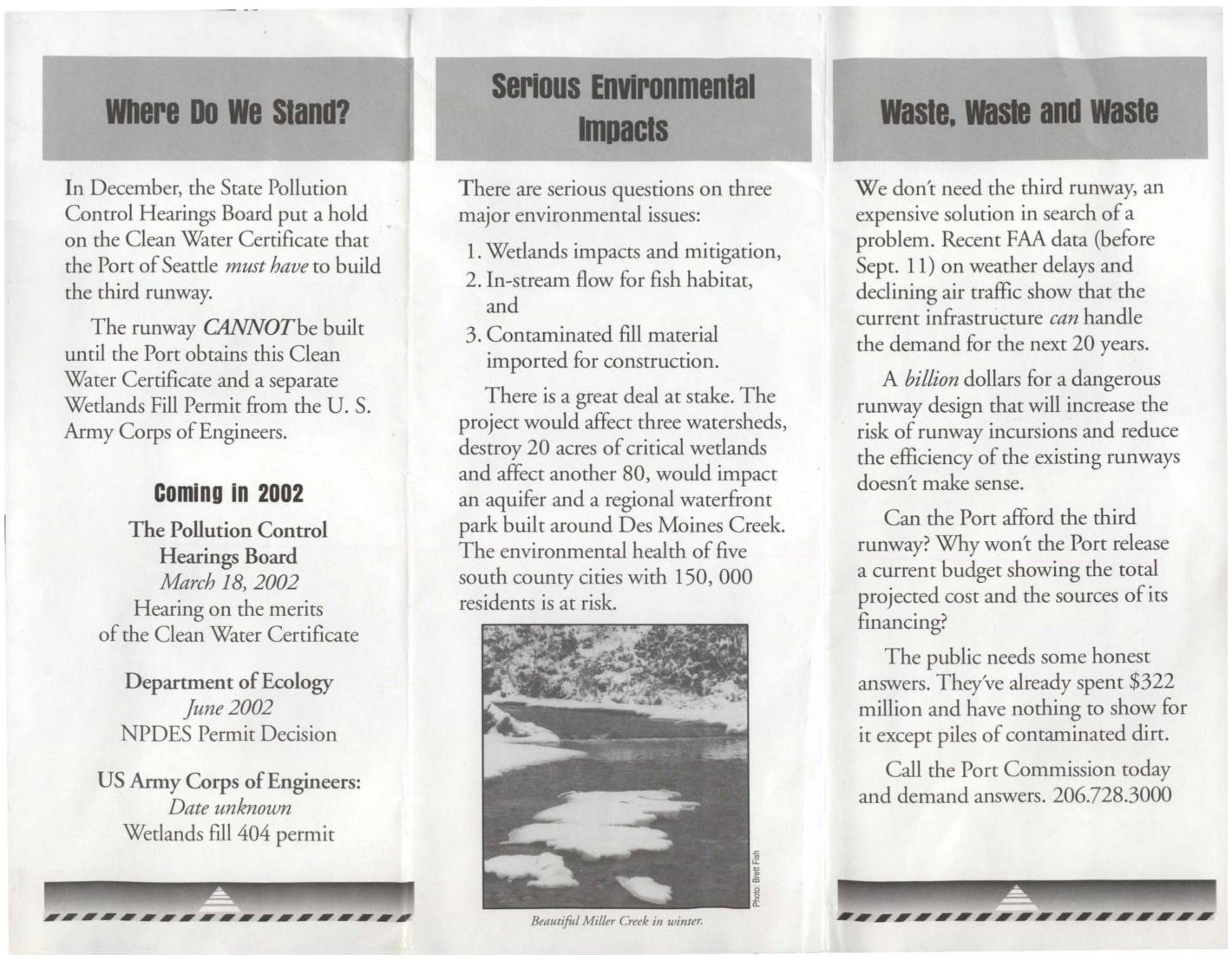
RCAA Flyer Conveyor 2001
the Port of Seattle must have to build the third runway. The runway CANNOTbe built until the Port obtains this Clean Water Certificate and a separate Wetlands Fill Permit from the U.S. Army Corps of Engineers. coming in 2002 The Pollution Control Hearings Board March 18, 2002 Hearing on the merits of the Clean Water Certificate Department of Ecology June2002 NPDES Permit Decision US Army Corps of Engineers: Date unknown Wetlands fill404 permit il : Serious Environmental -CIS There are serious questions on three major environmental issues: 1. Wetlands impacts and mitigation, 2. In-stream flow for fish habitat, and 3. Contaminated fill material imported for construction. There is a great deal at stake. The project would affect three watersheds, destroy 20 acres of critical wetlands and affect another 80, would impact an aquifer and a regional waterfront park built around Des Moines Creek The environmental health of five south county cities with 150, 000 residents is at risk Beautifi<L MilLer Creek in winter. wasta, ··-· We don't need the third runway, an expensive solution in search of a problem. Recent FAA data (before Sept. 11) on weather delays and declining air traffic show that the current infrastructure can handle the demand for the next 20 years. A billion dollars for a dangerous runway design that will increase the risk of runway incursions and reduce the efficiency of the existing runways doesn't make sense. Can the Port afford the third runway? Why won't the Port release a current budget showing the… -
 2001-05-01 00:00
RCAA – Conveyor Belt Through Des Moines Flyer, 2001
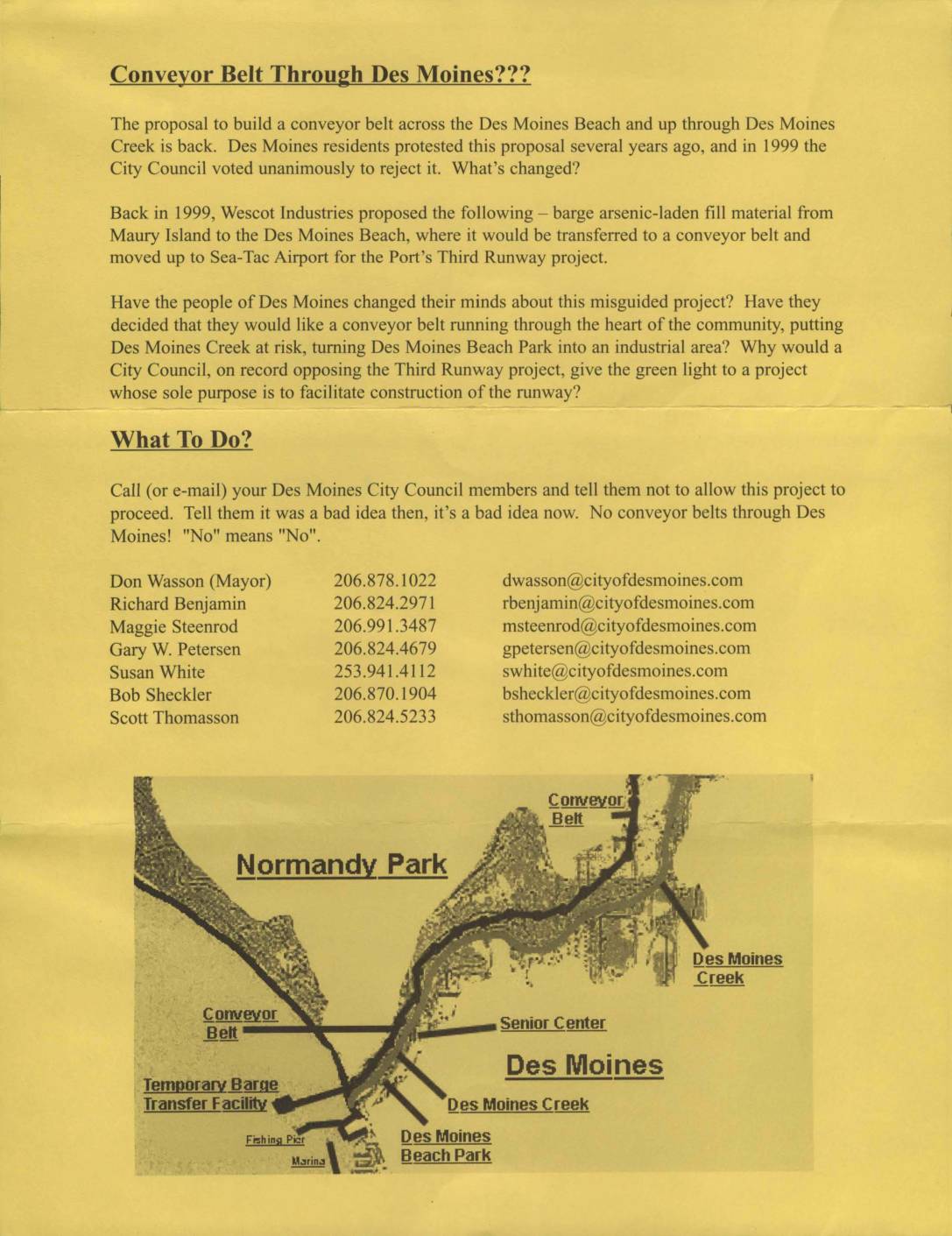
The proposal to build a conveyor belt across the Des Moines Beach and up through Des Moines Creek is back. Des Moines residents protested this proposal several years ago, and in 1999 the City Council voted unanimously to reject it. What's changed? Back in 1999, Wescot Industries proposed the following - barge arsenic-laden fill material from Maury Island to the Des Moines Beach, where it would be transferred to a conveyor belt and moved up to Sea-Tac Airport for the Port's Third Runway project. Have the people of Des Moines changed their minds about this misguided project? Have they decided that they would like a conveyor belt running through the heart of the community, putting Des Moines Creek at risk, turning Des Moines Beach Park into an industrial area? Why would a City Council, on record opposing the Third Runway project, give the green light to a project whose sole purpose is to facilitate construction of the runway? What To Do? Call (or e-mail) your Des Moines City Council members and tell them not to allow this project to proceed. Tell them it was a bad idea then, it's a bad idea now. No conveyor belts through Des Moines! "No" means "No". Don Wasson (Mayor) Richard Benjamin Maggie Steenrod Gary W. Petersen Susan White Bob Sheckler Scott Thomasson 206.878.1022 206.824.2971 206.991.3487 206.824.4679 253.941.4112 206.870.1904 206.824.5233 Normandy Park Temporary Barge Transfer F acilitv .-~-- dwasson@cityofdesmoines.com rben j amin@cityofdesmoines. com msteenrod@cityofdesmoines.com gpetersen@cityofdesmoines.com swhite@cityofdesmoines.com bsheckler@cityofdesmoines.com sthomasson@cityofdesmoines.com Des Moines -
 2001-04-01 00:00
RCAA Truth in Aviation – Vol. 6 No. 4, Spring 2001
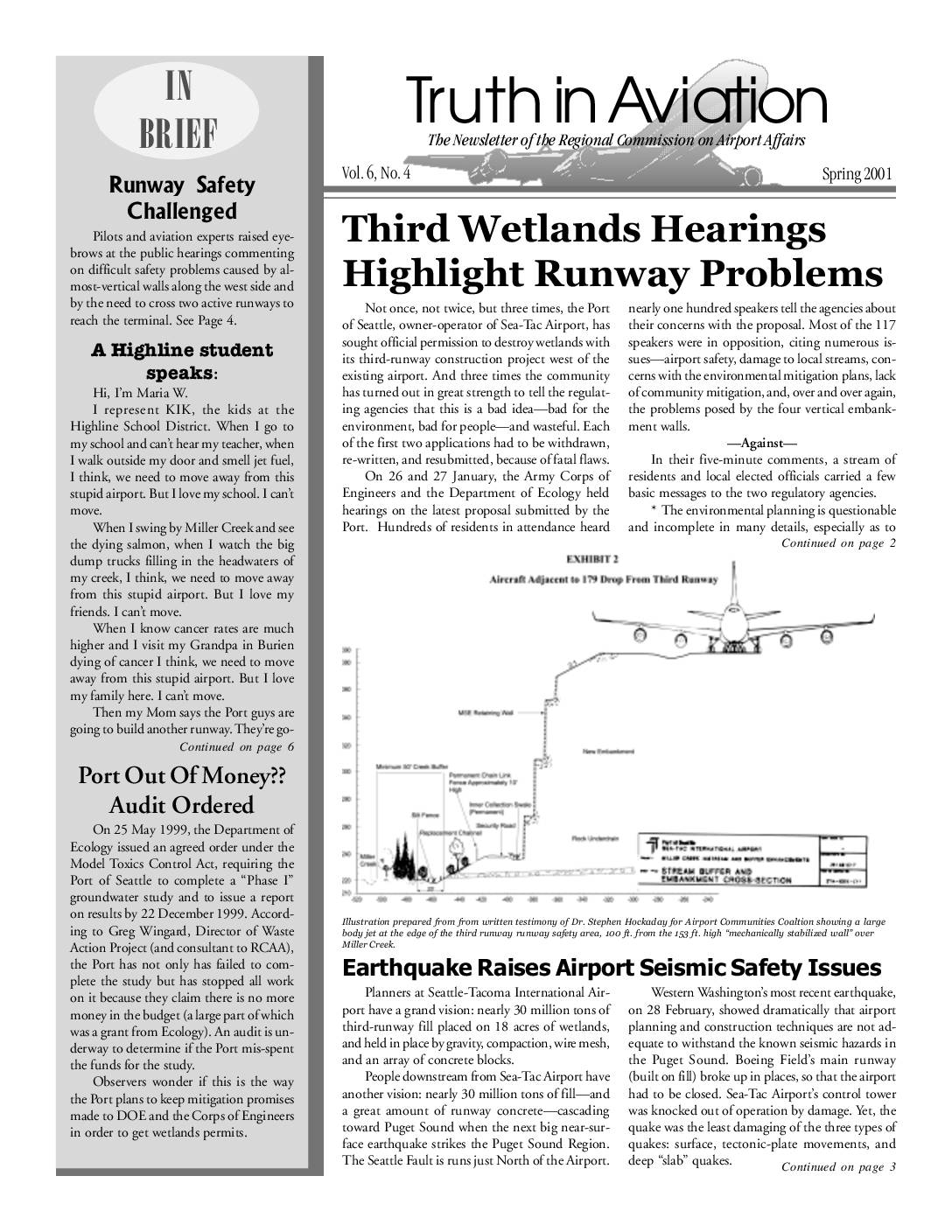
The Newsletter of the Regional Commission on Airport Affairs Vol. 6, No. 4 Spring 2001 IN BRIEF �������� ��� �������� ���� ��� ������������ �� Not once, not twice, but three times, the Port of Seattle, owner-operator of Sea-Tac Airport, has sought official permission to destroy wetlands with its third-runway construction project west of the existing airport. And three times the community has turned out in great strength to tell the regulat- ing agencies that this is a bad idea—bad for the environment, bad for people—and wasteful. Each of the first two applications had to be withdrawn, re-written, and resubmitted, because of fatal flaws. On 26 and 27 January, the Army Corps of Engineers and the Department of Ecology held hearings on the latest proposal submitted by the Port. Hundreds of residents in attendance heard nearly one hundred speakers tell the agencies about their concerns with the proposal. Most of the 117 speakers were in opposition, citing numerous is- sues—airport safety, damage to local streams, con- cerns with the environmental mitigation plans, lack of community mitigation, and, over and over again, the problems posed by the four vertical embank- ment walls. —Against— In their five-minute comments, a stream of residents and local elected officials carried a few basic messages to the two regulatory agencies. * The environmental planning is questionable and incomplete in many details, especially as to ���������� ��� ��� ���� ���� ������� �� ���� �� �������� �� �� �������� ������ ���� ��� ��� ��� ���� ��� �� �������� �… -
 2000-02-25 00:00
Letter to U.S. Senators Gorton and Murray Regarding Sea-Tac Airport Safety Issues
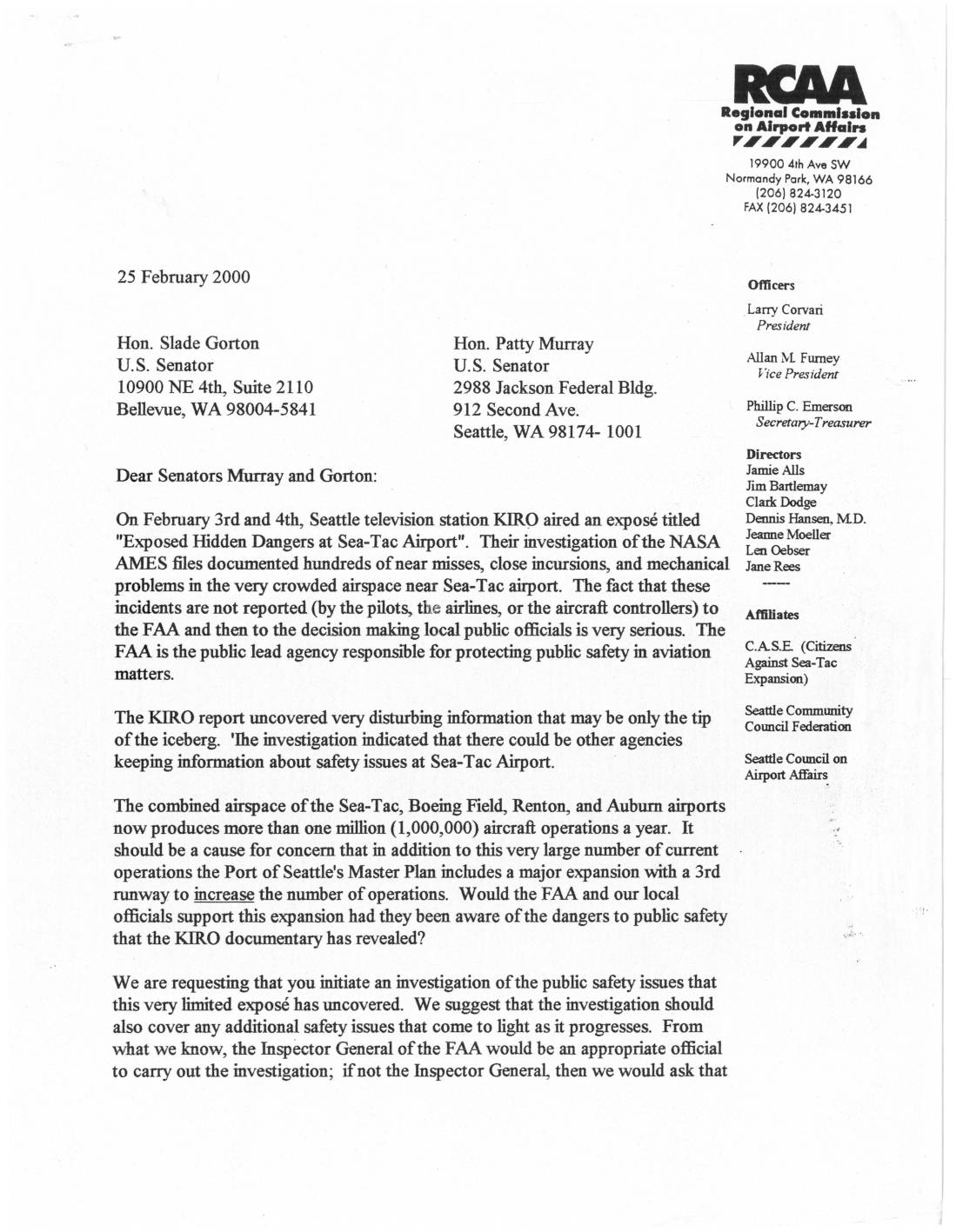
On February 3rd and 4th, Seattle television station KIRO aired an expose titled "Exposed Hidden Dangers at Sea-Tac Airport". Their investigation ofthe NASA AMES files documented hundreds of near misses, close incursions, and mechanical problems in the very crowded airspace near Sea-Tac airport. The fact that these incidents are not reported (by the pilots, the airlines, or the aircraft controllers) to the FAA and then to the decision making local public officials is very serious. The FAA is the public lead ~gency responsible for protecting public safety in aviation matters. The KIRO report uncovered very disturbing information that may be only the tip of the iceberg. 'Ihe investigation indicated that there could be other agencies keeping information about safety issues at Sea-Tac Airport. The combined airspace of the Sea-Tac, Boeing Field, Renton, and Auburn airports now produces more than one million (1,000,000) aircraft operations a year. It should be a cause for concern that in addition to this very large number of current operations the Port of Seattle's Master Plan includes a major expansion with a 3rd runway to increase the number of operations. Would the FAA and our local officials support this expansion had they been aware of the dangers to public safety that the KIRO documentary has revealed? We are requesting that you initiate an investigation of the public safety issues that this very limited expose has uncovered. We suggest that the investigation should also cover any additional safety issues that come to light as it progresses. From…