TagPuget Sound Regional Council(191)
-
 2018-05-01
The Regional Transportation Plan — 2018: Executive summary
The Puget Sound Regional Council's 2018 Regional Transportation Plan outlines how the central Puget Sound region, which has seen rapid population and job growth since 2010, intends to manage an additional one million residents by 2040. The plan details major investments across highway, transit, rail, ferry, bicycle, and pedestrian systems to reduce traffic congestion and better connect housing, employment centers, and freight hubs. It aims to provide equitable access to the region's natural, cultural, and recreational assets while keeping the transportation system sustainable through projected growth. -
 2018-05-01
Puget Sound Regional Council Annual Report 2018
The Puget Sound Regional Council's May 2018 Annual Report highlights the rapid growth and development occurring across the greater Seattle-Puget Sound region, including new housing, transportation, and infrastructure projects under construction. The report acknowledges challenges such as housing affordability, rising cost of living, and uneven economic growth across the region, while emphasizing the council's role in bringing local leaders together to find collaborative solutions. -
 2018-04-25
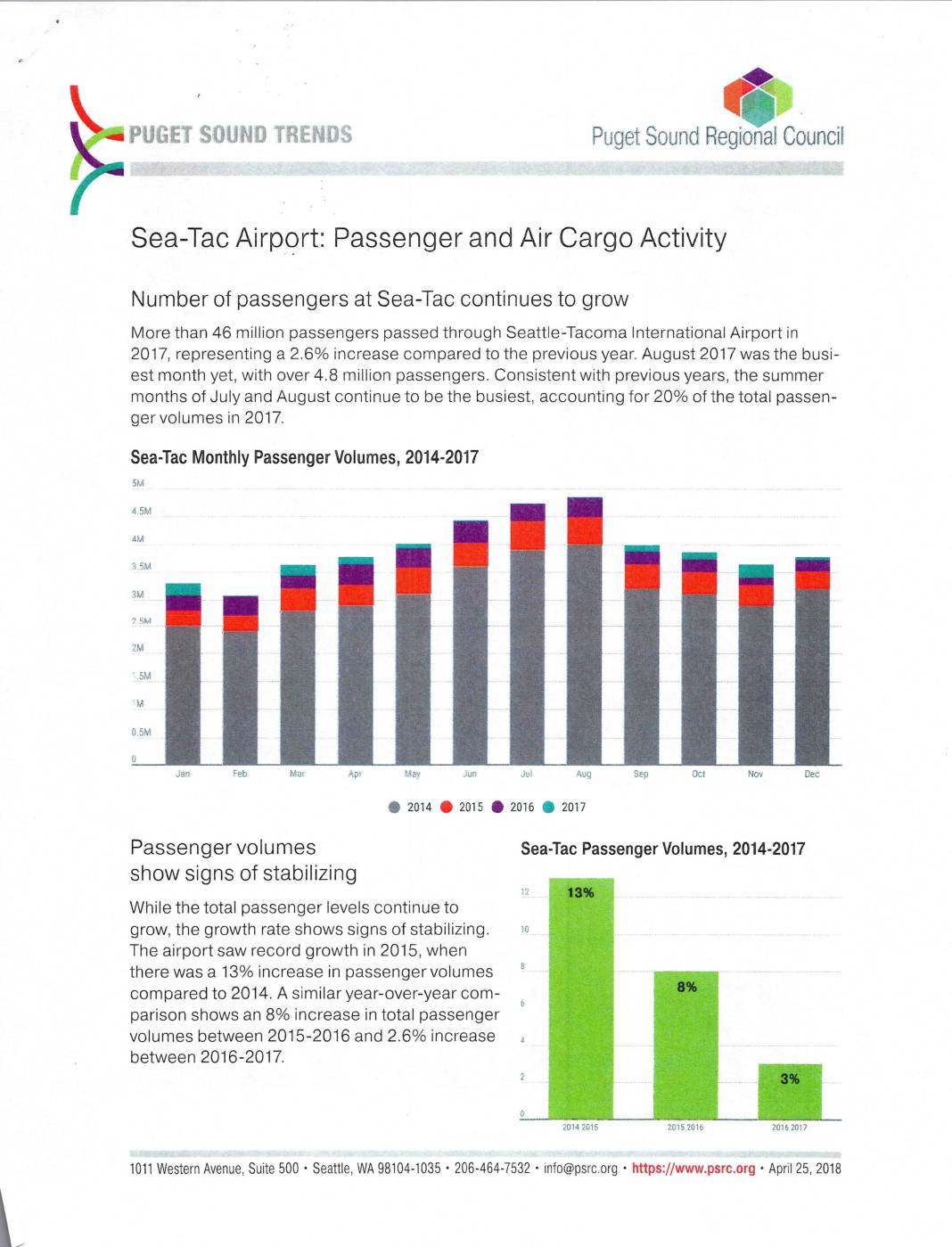
Sea-Tac Airport: passenger and air cargo activity
Sea-Tac Airport saw record activity between 2014 and 2017, with over 46 million passengers and 425,895 metric tons of cargo passing through in 2017 alone. Passenger growth is slowing — dropping from a 13% year-over-year increase in 2015 to just 2.6% in 2017 — while air cargo, driven largely by domestic freight, surged 16% compared to the prior year. Summer months remain the busiest for passengers, and air mail volumes have shown a steady annual increase throughout the period. -
 2018-03-20
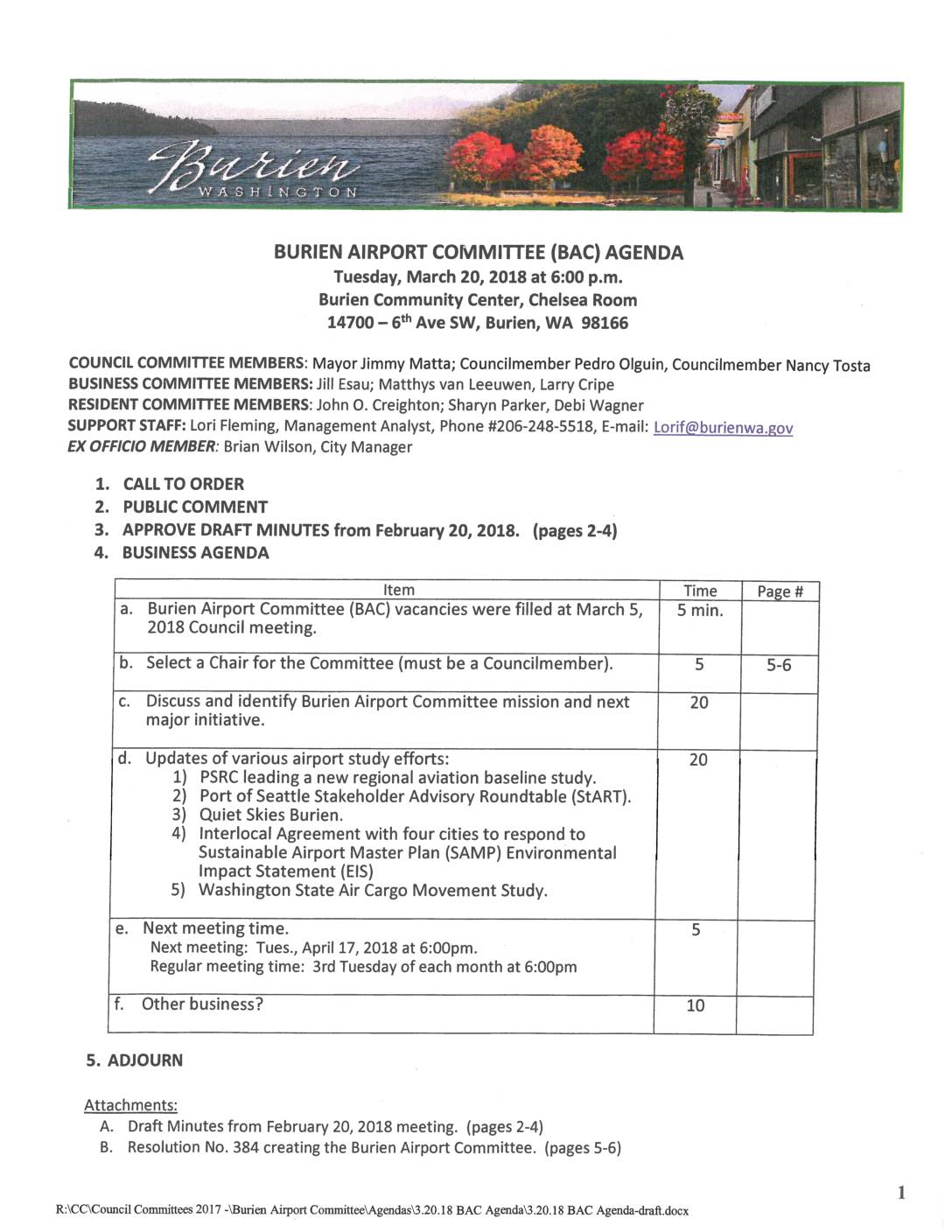
Burien Airport Committee (BAC) agenda and draft meeting minutes
The Burien Airport Committee (BAC) held meetings in early 2018 to address concerns about Seattle-Tacoma International Airport's growth and its impact on surrounding communities. Key topics included the Port of Seattle's Sustainable Airport Master Plan (SAMP) Environmental Impact Statement, an Interlocal Agreement among Burien, Des Moines, Normandy Park, and SeaTac to coordinate responses to airport expansion, and updates on noise-related efforts such as Quiet Skies Burien and the city's petition regarding turbo-prop flights overhead. The committee also discussed participation in regional aviation planning studies led by the Puget Sound Regional Council (PSRC) and the FAA. -
 2018-03-12
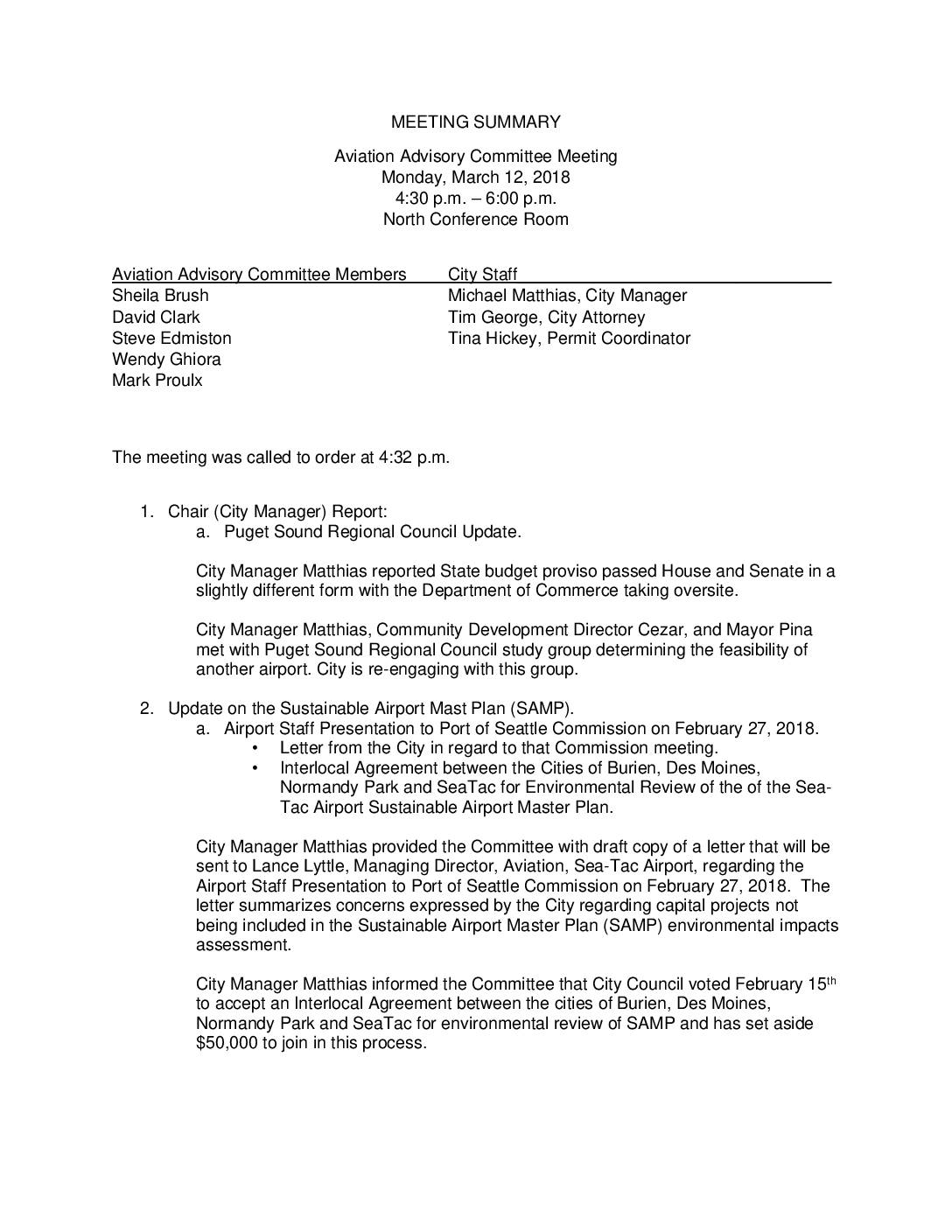
Aviation Advisory Committee Meeting Minutes – March 12, 2018
The Des Moines Aviation Advisory Committee met on March 12, 2018 to discuss concerns about Sea-Tac Airport's Sustainable Airport Master Plan (SAMP), including the city's decision to commit $50,000 to join an interlocal environmental review agreement with neighboring cities. The committee also reviewed the first meeting of the Sea-Tac Stakeholder Advisory Round Table (StART), with representatives expressing cautious optimism about its future value, and began preparing materials on noise and health issues for an upcoming City Council study session. A Federal Way resident also addressed the committee, urging Des Moines to encourage Federal Way to take a more active role in addressing airport noise impacts. -
 2018-02-12
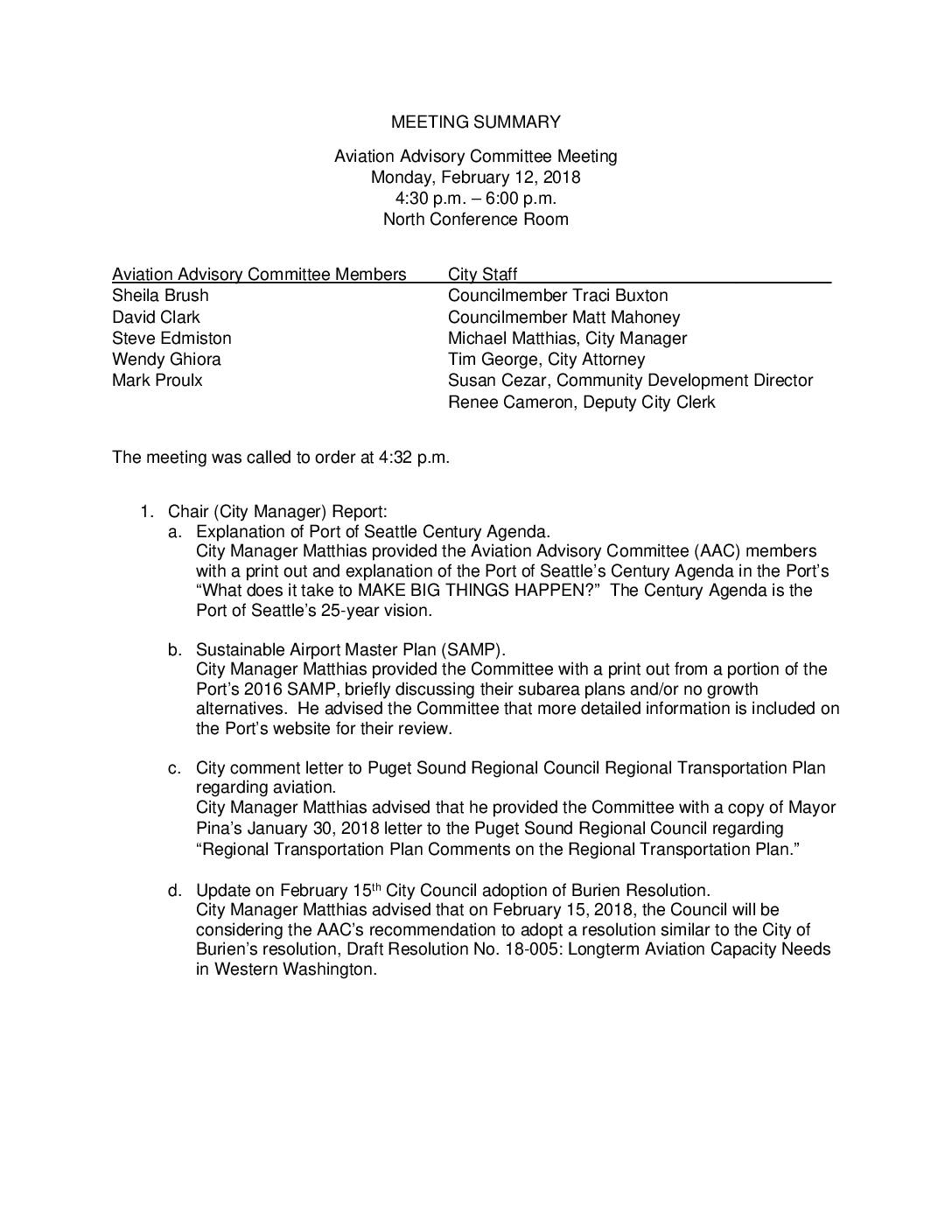
Aviation Advisory Committee Meeting Summary — February 12, 2018
The Des Moines Aviation Advisory Committee met on February 12, 2018 to discuss Sea-Tac Airport's 25-year growth plan (the Sustainable Airport Master Plan) and a proposed agreement between neighboring cities to jointly fund an independent environmental review of that plan. The committee also reviewed a resolution on long-term aviation capacity needs in Western Washington and planned to participate in a March 1 City Council study session covering topics such as the siting of a second airport, the roles of various regulatory bodies, and strategies for influencing the FAA and Port of Seattle. Additional items included updates on a state-funded airport impact study, the formation of a new Sea-Tac Airport Stakeholders Advisory Round Table, and community concerns about aircraft noise and its effects on property values. -
 2018-02-05
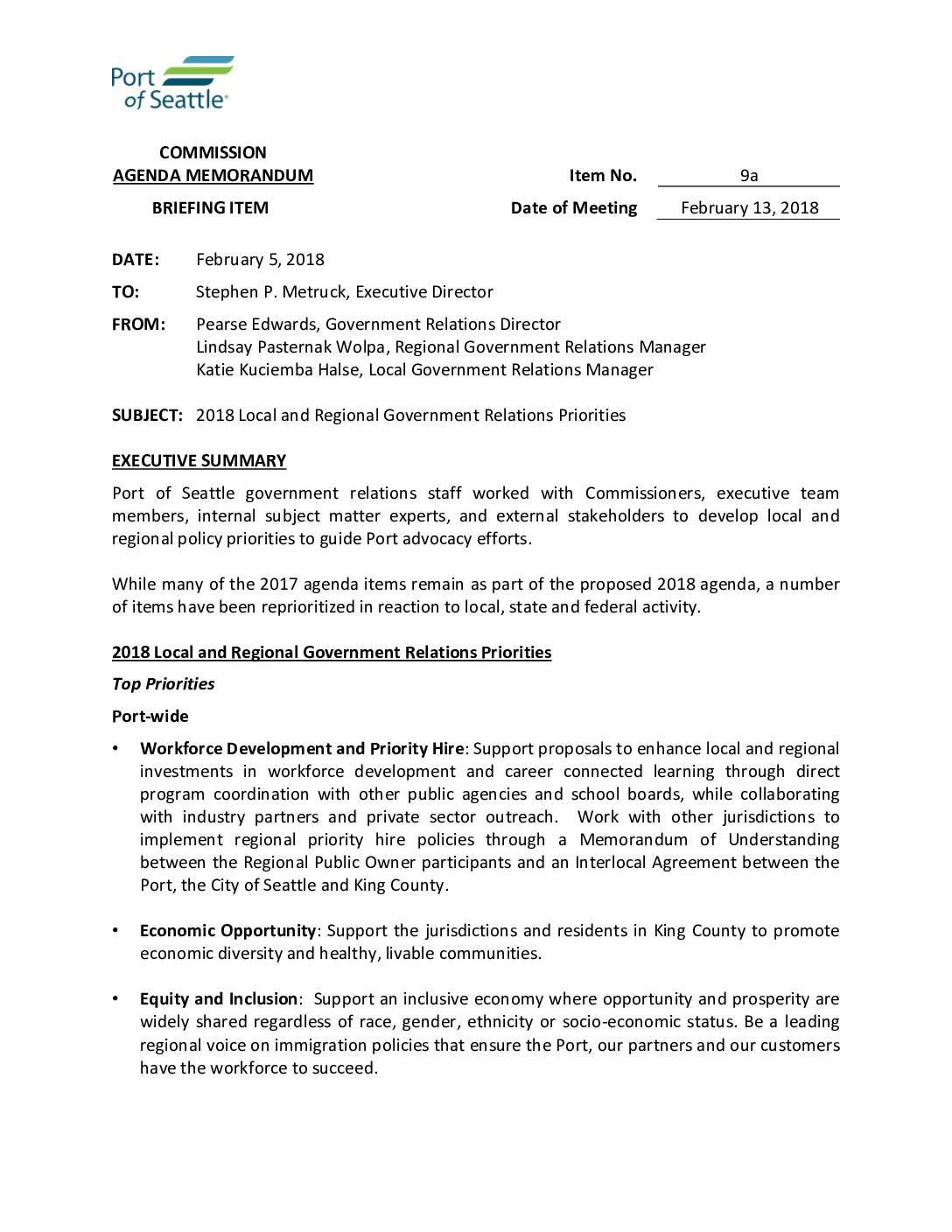
2018 local and regional government relations priorities
This February 2018 Port of Seattle Commission memo outlines the agency's local and regional government relations priorities for the year, covering areas such as workforce development, regional mobility, and environmental sustainability. Among the aviation-related priorities, the Port committed to advancing the Sustainable Airport Master Plan (SAMP), strengthening community engagement with airport-area neighborhoods through forums like the Sea-Tac Stakeholder Advisory Round Table (StART), and pursuing noise insulation grant funding for public schools near the airport. The document also highlights the Port's interest in studying the relationship between aviation activity and ultrafine particulate emissions as part of its broader state and federal legislative agenda. -
 2018-01-30
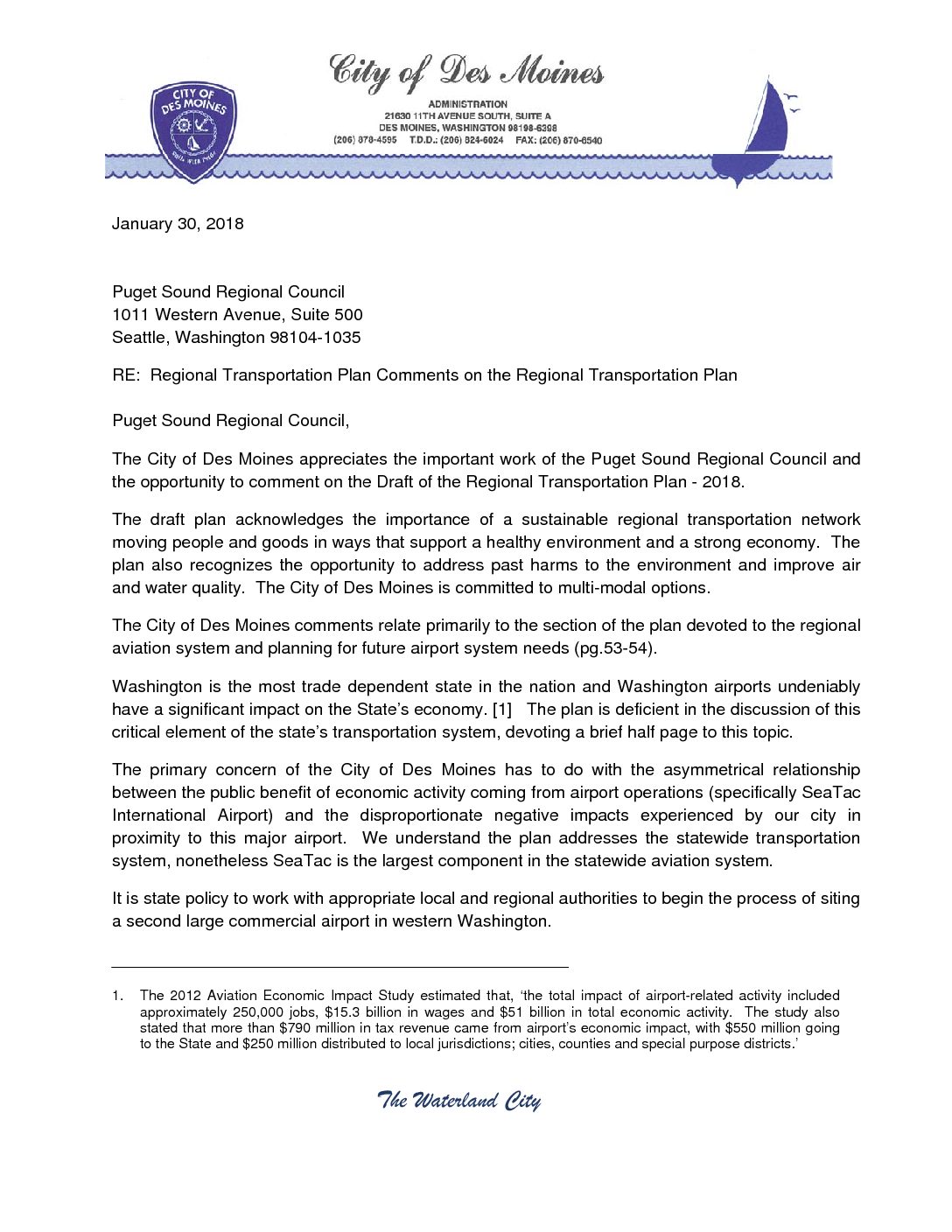
Regional Transportation Plan comments on the Regional Transportation Plan
In a January 2018 letter to the Puget Sound Regional Council, Des Moines Mayor Matt Pina raised concerns about the disproportionate noise, air quality, and environmental burdens placed on Des Moines residents by Seattle-Tacoma International Airport's rapid growth, arguing these impacts are inadequately addressed in the Draft Regional Transportation Plan. The city called for sustainability, human health, and community impacts to be central factors in any decision to expand SeaTac's capacity or site a new regional airport. The letter also requested that the plan include discussion of a potential passenger ferry terminal in Des Moines as a multi-modal transportation alternative. -
 2017-09-19
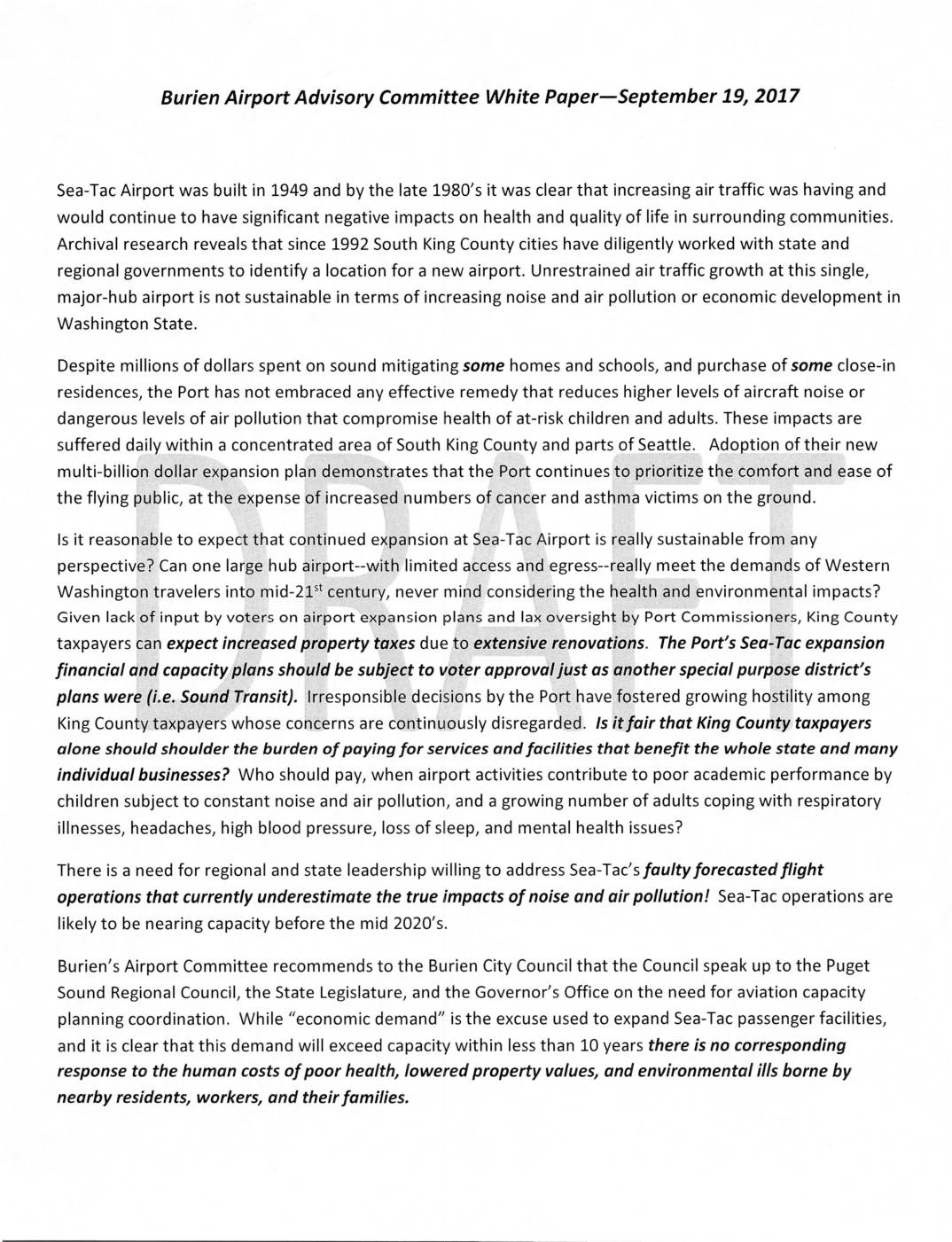
Burien Airport Advisory Committee white paper
A 2017 white paper from Burien's Airport Advisory Committee argues that unchecked expansion at Sea-Tac Airport is causing serious health and environmental harm—including noise pollution, air pollution, and related illnesses—for residents of South King County and parts of Seattle. The committee contends that the Port of Seattle has prioritized the convenience of air travelers over the well-being of nearby communities, while King County taxpayers bear the financial burden of an airport that benefits the entire state. The paper calls on the Burien City Council to urge regional and state leaders to coordinate aviation capacity planning and meaningfully address the human costs of continued airport growth. -
 2017-01-01
Puget Sound Regional Council Annual Report 2017
The Puget Sound Regional Council's 2017 Annual Report outlines the region's response to rapid population and job growth, focusing on transportation investments, long-term planning, and equitable development. Key highlights include over $11 billion in secured state and local transportation funding, an update to the Transportation 2040 plan, and nearly $700 million in federally funded regional projects covering transit, roads, and bike and pedestrian infrastructure. The report emphasizes guiding growth sustainably through 2040 while preserving the region's natural environment and quality of life.